
Інформація призначена тільки для фахівців сфери охорони здоров'я, осіб,
які мають вищу або середню спеціальну медичну освіту.

Підтвердіть, що Ви є фахівцем у сфері охорони здоров'я.

Журнал "Гастроэнтерология" Том 57, №3, 2023

Вернуться к номеру

Структура печінки та маркери фіброзу при моделюванні алкогольного ураження печінки й корекції виявлених порушень
Авторы: V.I. Didenko, I.A. Klenina, O.I. Hrabovska, Yu.A. Gaidar, O.O. Halinskyi, V.A. Karachynova, D.F. Mylostуva
State Institution “Institute of Gastroenterology of the National Academy of Medical Sciences of Ukraine”, Dnipro, Ukraine

Рубрики: Гастроэнтерология

Разделы: Клинические исследования

Версия для печати


Резюме

Актуальність. Хронічне вживання алкоголю призводить до алкогольного фіброзу печінки. На сьогодні багато наукових досліджень спрямовано на вивчення патометаболічних механізмів розвитку та формування фіброзу печінки у тваринних моделях. Мета дослідження: вивчення структурних змін та жорсткості печінки, біохімічних маркерів фіброзу при моделюванні хронічного алкогольного ураження печінки (ХАУП) у щурів та оцінка змін цих параметрів при різних типах корекції. Матеріали та методи. Вісімдесят дев’ять щурів були поділені на експериментальні групи залежно від терміну впливу алкоголю (4 й 12 тижнів) і виду корекції (метадоксин та пребіотик). У роботі використовували морфологічні методи, зсувнохвильову еластографію, біохімічні та статистичні методи. Результати. При моделюванні ХАУП на 4 тижні морфологічні дослідження виявили помірний крупнокрапельний жировий гепатоз та легкий фіброз у ділянці центральної венули печінкових часток. Після 12 тижнів примусової алкоголізації, коли загальна інтоксикація є більш вираженою, гепатоцити мають дистрофічні зміни, що виражаються появою в паренхімі поодиноких або зібраних в групи дистрофічних клітин. Частіше спостерігалося поєднання білкової та жирової дистрофії. Еластографія дозволила виявити структурні зміни в печінці на ранніх стадіях формування фіброзу при моделюванні ХАУП упродовж 12 тижнів. Також змінювалися рівні біохімічних показників: вільного й білковозв’язаного гідроксипроліну, глікозаміногліканів. Після корекції ХАУП, як коротко-, так і довгострокового, уміст маркерів фіброзу в гомогенаті печінки щурів нормалізувався після введення метадоксину й пребіотика. Після корекції пребіотиком на 12 тижні алкоголізації спостерігалося зниження жорсткості паренхіми печінки на 12 % у групі моделювання ХАУП, на 19 % (p < 0,05) у групі плацебо-контролю. Після корекції метадоксином виявлено збільшення рівня вільного гідроксипроліну в гомогенаті печінки щурів в 1,5 раза на 12 тижні та збільшення глікозаміногліканів в 1,2 раза (p < 0,05) на 4 тижні порівняно з групою моделювання ХАУП. Висновки. Довгострокова алкоголізація тварин призвела до розвитку дистрофічних змін у гепатоцитах, білкової та жирової дистрофії, збільшення кількості капілярів. На цьому фоні змінювалися жорсткість печінки та біохімічні параметри. Після корекції метадоксином і пребіотиком зміни у показниках жорсткості печінки та рівнях маркерів фіброзу спостерігалися на 12 тижні моделювання ХАУП.

Background. Chronic alcohol use leads to alcoholic liver fibrosis. Today, a sufficient number of scientific studies are focused on the pathometabolic mechanisms of liver fibrosis development and formation in animal models. The purpose of our study was to investigate structural changes and liver stiffness, biochemical markers of fibrosis in rats with chronic alcoholic liver injury (CALI) modeling and to evaluate the changes of these parame­ters with different types of treatment. Materials and methods. Eighty-nine rats were divided into experimental groups depending on the duration of alcohol exposure (4 and 12 weeks) and the corresponding type of correction (metadoxine and prebiotic). Results. When modeling CALI at week 4, morphological studies revealed moderate large-droplet fatty hepatosis and mild fibrosis in the central venule of the liver lobes. After 12 weeks of forced alcoholization, with more pronounced general intoxication, hepatocytes have dystrophic changes such as appearance of single or grouped dystrophic cells in the parenchyma. A combination of protein and fatty dystrophy was more common. Elastography allowed to detect structural changes in the liver at the early stages of fibrosis formation when modeling CALI for 12 weeks. There were also changes in the levels of biochemical parameters: free and protein-bound hydroxyproline, glycosaminoglycans. According to the results of elastography, liver stiffness in rats increased maximally after prebiotic correction in all approaches compared to the controls. After correction of CALI, both early- and long-term, fibrosis markers normalized in rat liver homogenate after administration of metadoxine and prebiotic. After prebiotic correction at week 12 of alcoholization, we observed a 12% decrease in liver parenchymal stiffness in the CALI modeling group and a 19% decrease (p < 0.05) in the placebo group. After correction with metadoxine, there was a 1.5-fold increase in free hydroxyproline levels in rat liver homogenate at week 12 and a 1.2-fold increase in glycosaminoglycans (p < 0.05) at week 4 compared to the CALI modeling group. Conclusions. Long-term alcoholization of animals led to the development of dystrophic changes in hepatocytes, protein and fatty degeneration, and an increase in the number of capillaries. Against this background, liver stiffness and biochemical parameters changed. After correction with metadoxine and prebiotic, changes in the liver stiffness and fibrosis markers were observed at week 12 of CALI modeling.


Ключевые слова

фіброз; хронічне ураження печінки; гідроксипролін; глікозаміноглікани; жорсткість печінки; морфологічні дослідження

fibrosis; chronic liver damage; hydroxyproline; glycosaminoglycans; liver stiffness; morphological studies

Introduction

Nowadays in the world, there are hundreds of millions of patients with liver fibrosis due to excessive alcohol consumption [18]. Alcoholic liver disease (ALD) covers a wide range of illnesses initiated by simple steatosis, which can progress to more severe pathologies such as alcoholic hepatitis, fibrosis, cirrhosis and, in extreme cases, hepatocellular carcinoma, because the liver is the main site of ethanol metabolism. Chronic use of ethanol can cause disease by interfering with the nutritional status of the body through changes in nutrient absorption and/or metabolism and may contribute to the progression of liver damage. Liver fibrosis is an important health problem due to high morbidity and mortality. Better understanding of the factors that facilitate the transition from acute to chronic progressive ALD is needed to identify people at risk and refine diagnostic and therapeutic approaches [1, 6].
Elastography is a modern non-invasive diagnostic me–thod for determining liver stiffness, signs of steatosis and fibrosis stage. The difficulty of diagnosis and differential diagnosis of liver damage caused by the almost complete absence of specific signs, especially in the early stages of the disease, defines the importance of studying the main liver stiffness coefficients and their relationship with biochemical markers of liver damage as modern methods of detecting the development and progression of fibrosis [3, 5].
As a result of the influence of different factors or inflammatory processes, an excessive accumulation of extracellular matrix proteins, in particular collagen, leads to fibrosis of parenchymal organs. Hydroxyproline (HP) is a non-proteinogenic amino acid that is synthesized by posttranslational hydroxylation of proline during collagen biosynthesis. Its level in liver tissue, blood serum and urine is an excellent limiting factor that can correctly reflect the progression of liver fibrogenesis [21, 23].
Glycosaminoglycans (GAG) as biomarkers for cancer and other chronic diseases including hepatocellular carcinoma, liver fibrosis, ovarian cancer, prostate cancer, gastric carcinoma and carcinoma of the pancreas were the focus of many recent studies [4, 9, 19]. In addition, GAG-based diagnostic methods usually focus on the analysis of GAG structure and concentration [12]. Elevated serum GAG levels positively correlate with disease progression in liver fibrosis and cirrhosis [14].
Modeling of human diseases in animals plays an important role in the study of pathogenic processes due to easy management and elimination of clinical trials and financial or ethical problems [7]. However, it is difficult to unify the results of these studies due to many methods of modeling and its different qualities [22]. In recent decades, a wide variety of animal models for ALD has been developed with different results. Finding the “ideal” experimental model for ALD would help study the pathogenesis and, consequently, develop new therapeutic strategies for the treatment of ALD [20].
The purpose of our study was to investigate structural changes and liver stiffness, biochemical markers of fibrosis in rats with chronic alcoholic liver injury (CALI) modeling and to evaluate the changes of these parameters with different types of treatment.

Materials and methods

The study was conducted following the standards of the European Convention of Bioethics (1997), the provisions of EU Directive 2010/63 of September 22, 2010, the European Convention for the Protection of Vertebrate Animals used for Experimental and Other Scientific Purposes, general ethical principles experiments on animals, approved by the law of Ukraine (No. 3447-IV dated August 4, 2017) “On protection of animals from cruel treatment” by the decisions of the First National Congress of Ukraine on Bioethics (“General ethical principles of animal experiments”, 2001). Local bioethics committee approved the study (protocol No. 2 dated March 21, 2023).
Eighty-nine laboratory rats (weight 180–230 g) were used to solve the set tasks. The animals were kept in standard conditions and received a standard diet that quantitatively and qualitatively provided their physiological needs.
Animals were divided into the following groups:
1) intact group (controls) consisted of 15 healthy animals that throughout the study period were in the same conditions and on the same diet as the experimental groups;
2) I group (n = 38) — 4 weeks of CALI modeling:
— Ia group (n = 15) — modeling of CALI by two-phase alcoholization with ethanol aqueous solution, with chroni–city of the pathological process of 4 weeks;
— Ib group (n = 8) — CALI 4 weeks + metadoxine, 30 days of the standard diet with the addition of metadoxine (Liveria IC) at a dose of 320 mg/kg for a day;
— Ic group (n = 8) — CALI 4 weeks + prebiotic, 30 days of the standard diet with prebiotic (Hylak forte) added in food at a dose of 2.8 ml/kg for a day;
— Id group (n = 7) — CALI 4 weeks + placebo, 30 days of the standard diet with placebo (drinking water) added in food at a dose of 1 ml for a day;
3) II group (n = 36) — 12 weeks of CALI modeling:
— IIa group (n = 16) — modeling of CALI by two-phase alcoholization with ethanol aqueous solution, with chroni–city of the pathological process of 12 weeks;
— IIb group (n = 7) — CALI 12 weeks + metadoxine, 30 days of the standard diet with the addition of metadoxine (Liveria IC) in food at a dose of 320 mg/kg for a day;
— IIc group (n = 6) — CALI 12 weeks + prebiotic, 30 days of the standard diet with the addition of prebiotic (Hylak forte) in food at a dose of 2.8 ml/kg for a day;
— IId group (n = 7) — CALI 12 weeks + placebo, 30 days of the standard diet with the addition of placebo (drinking water) in food at a dose of 1 ml for a day.
CALI was simulated after 48 hours of food deprivation by performing forced intermittent alcoholization for 5 days with repetition in 2 days, by intraperitoneal administration of 16.5% ethanol solution in 5% aqueous glucose solution at the rate of 4 ml ethanol per 1 kg animal weight. After 14 days of forced alcoholization, rats were transferred to semi-forced alcoholization, that is, animals used 15% aqueous ethanol solution as their sole source of drinking. The animals were euthanized by administering a lethal dose of ketamine at a dose of 200 mg/kg.
For histological studies, the biopsies were fixed in a 10.0% solution of neutral formalin, dehydrated in alcohols of increasing concentration, and embedded in paraffin. Histological sections of 3–5 μm thick were stained with hematoxylin and eosin, according to Mallory’s modification of Slinchenko, and mounted on slides. The microscopic structure of the organ, the presence and nature of dystrophic changes, infiltration of inflammatory cells, and the state of portal tracts were evaluated [1].
The structure of the liver was studied by evaluating the stiffness of the tissue (kPa) using shear wave elastography (SWE) on the Ultima PA ultrasound machine (Ukraine). To exclude the influence of anatomical, physical, and physio–logical factors that could alter measurements, 3 measurement approaches were used: lifetime (in vivo), decapitated, and phantom (in vitro). Stiffness measurements were carried out with a linear sensor, 5 measurements in each approach, with the calculation of average data. For ultrasound examination in 2D mode, the area of liver parenchyma without vessels and artifacts was selected. Control volume — 5 mm wide in the area of interest 10 mm. The quantitative value of liver stiffness was determined automatically (in kPa).
The phantom is a device for studying the stiffness of isolated rat liver in vitro, which looks like a cuvette (5 × 5 × 15 cm) filled with saline at 36–37 °C. The bottom of the cuvette was covered with a layer of material that does not create echoes. At a depth of 5 cm from the surface of the immersion liquid, a rat liver sample was placed on a special acoustically transparent mesh area, which did not generate acoustic noise but allowed the test sample to be held at a certain distance from the ultrasonic transducer, which prevented its deformation [3].
10% liver homogenate was prepared on 0.1 g phosphate buffer (pH 7.4) using a Dounce homogenizer with a Teflon pestle, centrifuged for 15 minutes at 5000 g. The supernatant was used for further research. The presence of fibrosis was assessed by the content of biochemical markers in the liver homogenate — HP free (HPf), HP protein-bound (HPp/b) and GAG. The content of GAG was evaluated by Rimington’s method, HPp/b and HPf — by Osadchuk’s method [2, 13].
Descriptive statistics was used for statistical analysis of the obtained material: comparisons of average values of variab–les were carried out using Student’s t-test on the normal distribution of data features expressed on the interval scale. The differences obtained by the method of paired comparisons were considered valid at p < 0.05.

Results and discussion

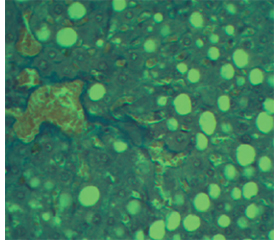
After 4 weeks of alcoholization (Ia group), the liver cells were swollen and showed signs of vacuolar and fatty degene–ration. There were necrotically altered hepatocytes. Against the background of severe focal diffuse fatty and hydropic dystrophy, the beam-radial structure of the liver lobes in animals was fuzzy, blurred (Fig. 1).
There was significant vascular dilation and perivascular edema, loosening of the walls, plasmorrhages, tortuosity of the vessels and uneven blood filling, as well as a significant expansion of the hepatic sinusoids. The stasis of red blood cells and lymphocytes was determined.
Therefore, in the simulation of CALI, moderate granular fatty hepatosis and mild fibrosis in the venule area of the hepatic lobes were registered.
After 12 weeks of forced alcoholization (IIa group), hepatocytes had dystrophic changes such as the appearance of single or clustered dystrophic cells in the parenchyma. A more common phenomenon was a combination of protein and fatty dystrophy (Fig. 2).
A significant number of “balloon” cells (the final form of hydropic dystrophy) was observed, which look like fluid-filled balloons with a nucleus in the center altered in shape. These cells were found both singly and in clusters, which is ultimately a manifestation of focal collisional necrosis. Moreover, an increase in the number of capillaries was observed in animals at week 12 of the experiment, indicating increased vascularization under the influence of alcohol.
SWE in the control rats found that the median of liver stiffness (Eavg, kPa) was more than 1.5 times higher with the decapitation approach — 8.33 kPa; when animals were exsanguinated, liver stiffness was 51 % (p < 0.01) higher than that in vivo (Fig. 3). This may indicate the revealed dependence of liver parenchyma stiffness on the influence of the functional state of the circulatory system (the bloodless state) and the local pressure of neighboring organs of the abdominal and thoracic cavities (acoustic phantom).
In rats of Ia group, liver stiffness increased only in vivo by 26 % (p < 0.01) compared to the controls. It was an early stage of 4 weeks. The maximum liver stiffness was found in rats of IIa group: by 30 % in vivo (p < 0.01), by 26 % in decapitated (p < 0.01), by 15 % in vitro (p < 0.05) compared to the controls (Fig. 4). The stiffness of the liver parenchyma increased with increasing duration of simulation from 4 to 12 weeks: by 18 % in decapitated and by 7 % in vitro (p < 0.05) compared to Іa group.
The results of SWE in rats of Ic group showed that liver stiffness increased maximally after the prebiotic correction in all approaches compared to the controls: by 48 % in vivo, by 33 % with a decapitated approach and by 21 % in phantom (p < 0.05) (Fig. 5). Compared with the placebo group (Id), the indicators of the liver parenchyma stiffness were 16 % higher (p < 0.05) in vivo and in vitro and 15 % higher in the decapitated animals (p < 0.05).
After correction with metadoxine (Ib group), the stiffness of the liver remained increased compared to the control group in vivo and decapitated state by 14 and 25 %, respectively (p < 0.05), but had not significant differences in acoustic phantom.
When comparing liver stiffness in rats of IIa group with the controls, an increase by 30 % was found in vivo and by 26 % in the decapitated approach (p < 0.05) (Fig. 6).
It was found that the stiffness of the liver parenchyma was higher in all subgroups of II group compared to the controls (Fig. 6), with the exception of the values measured under the conditions of the acoustic phantom (in vitro) in IIb group, where they did not have significant differences in comparison with the controls.
It should be noted that the analysis of numerical results characterizing the liver elasticity in rats after medicinal correction in the context of simulating chronic alcohol-induced liver damage demonstrated that liver stiffness in vivo in animals receiving probiotics was 12 % (p < 0.05) lower than before correction (IIa group) and 19 % (p < 0.01) lower than in the placebo group (IId). This is the most favorable outcome of correction, although this indicator still remained 15 % (p < 0.05) higher than the value of the control group. This may be associated with the insufficient duration of correction for the complete restoration of liver tissue elasticity after prolonged alcohol-induced damage.
It was found that when the modeling CALI, fibrosis markers changed at weeks 4 and 12 (Table 1). It is known that HPf is formed after the breakdown of collagen. The level of HPf significantly decreased in Ia and IIa groups by 1.5 times (p < 0.001). GAG level significantly decreased in all groups: in Ia group by 1.8 times (p < 0.001), in IIa — by 1.7 times (p < 0.01) compared to the controls.
When modeling CALI (4 weeks) after the introduction of metadoxine and prebiotic to animals in the early terms, HPf level significantly decreased in Ic group, by 1.6 times (p < 0.01) compared to Ia group. The content of GAG significantly increased in group Ib, by 1.3 times (p < 0.01) compared to Ia group.
A decrease in HPf by 1.8 times was observed in IIc group (p < 0.01) compared to IIa group after introduction of pre–biotic and metadoxine in animals when modeling CALI for 12 weeks. The level of GAG decreased in all groups, but changes were significant in IIc group, by 1.7 times compared to IIa group (p < 0.01).
Over the past decades, researchers have been actively working to create an “ideal” experimental model of alcoholic liver injury, which would allow to study pathogenetic mechanisms and to develop new therapeutic strategies for the treatment of CALI [16, 22].
Analysis of the histological studies data made it possible to conclude that chronic alcohol intoxication leads to significant morphological and functional disorders of the liver at the cellular level. This is characterized by dystrophic changes, destruction of some liver cells, as well as changes in vascularization rate, and a decrease in the energy-forming and protein-synthesizing functions of hepatocytes. This phenomenon can be considered as an activation of the compensatory properties of the liver [20, 23, 25].
Our previous work has shown that early alcoholization of animals led to the development of fatty degeneration, but it did not affect the stiffness of the liver parenchyma [3]. The SWE data of current study demonstrated that liver stiffness changed by week 12 of CALI modeling.
In model of alcoholic hepatitis, it was shown that colchicine treatment, for example, significantly restored the level of hepatic HP compared to the control group (p < 0.05). Cilostazol treatment (5 mg/kg/day) did not significantly change the level of hepatic HP, but significantly decreased it compared to the controls (p < 0.05) when administered at doses of 10 and 20 mg/kg/day. Cilostazol treatment (10 mg/kg/day) without alcohol did not significantly change the level of hepatic HP compared to the control group [9]. In modeling of CALI for 4 and 12 weeks, an imbalance was found in HPf and HPp/b content that indicates fibrotic changes in the liver of rats. Apparently, the synthesis and degradation of collagen are more active in the early stages of modeling steatosis and hepatic fibrosis, but later, collagen metabolism in the liver decreases. The observed decrease in GAG level in rat liver homogenate may indicate low intercellular catabolism of connective tissue.
According to our research, after correction of CALI, fibrosis markers normalized in liver homogenate, especially after administration of metadoxine to rats. Metadoxine makes liver restoration faster due to reduced level of glutathione in the liver, as well as enhanced oxidation of ethanol and acetaldehyde based on preclinical results. The half-life of ethanol in the blood also significantly reduces with single intravenous injection of metadoxine at a dose of 900 mg (from 6.7 to 5.4 hours) [7]. Metadoxine is a chemical compound that is synthesized in vitro by crystallization of two molecules and consists of L-2-pyrrolidone-5-carboxylate (pyroglutamic acid) and pyridoxine (vitamin B6). This drug also has antioxidant properties, reduces alcohol consumption and activity of liver enzymes according to research [24]. In a clinical trial, there was a decrease in the development of encephalopathy and hepatorenal syndrome after treatment of patients receiving combined therapy with metadoxine [16].
In our research, prebiotic correction has led to a significant decrease of HPf in liver homogenate compared to the groups of both early- and long-term CALI. After prebiotic correction, changes in levels of fibrosis markers were observed at week 12 of CALI modeling.
Given the characteristics of the results obtained, it may be promising to combine all three factors during the correction (rehabilitation) of experimental alcoholic liver fibrosis, further research is required to clarify this hypothesis.

Conclusions

1. After 4 weeks, the initial signs of dystrophic changes were detected in the liver parenchyma of rats with modeled CALI, with a deterioration of the morphological picture at week 12, when an increase in the number of capillaries was observed, and protein and fatty degeneration was detected.
2. CALI modeling for 4 weeks caused an increase in liver parenchymal stiffness by 26 % (p < 0.05) and its increase by 30 % (p < 0.05) at week 12 compared to the control group. Significant changes in the levels of fibrosis markers in the rat liver homogenate at weeks 4 and 12 of CALI modeling were revealed: the level of HPf significantly decreased by 1.5 times (p < 0.001) at week 4, the content of GAG — by 1.8 (p < 0.001) and 1.7 times (p < 0.01), respectively, compared to the control group.
3. After 30 days of prebiotic correction, a decrease in liver parenchymal stiffness by 12 % (p < 0.05) was found in IIa group and by 19 % (p < 0.05) in the placebo group (IId) at week 12 of alcoholization. After correction with metadoxine (IIb), we observed a 1.5-fold increase in HPf in rat liver homogenate at week 12, and a 1.2-fold increase in GAG (p < 0.05) at week 4 compared with the CALI-modeled group.
 
Received 01.08.2023
Revised 13.08.2023
Accepted 22.08.2023

Список литературы

  1. Жорсткість паренхіми печінки щурів при моделюванні стеатозу аліментарного генезу та його корекції / В.І. Діденко та ін. Проблеми екології та медицини. 2019. № 5–6. С. 36-41. doi: 10.31718/mep.2019.23.5-6.06.
  2. Методи визначення глікопротеїнів та їх компонентів з діагностичною метою у змішаній слині у дітей з гастродуоденальної патологією: методичні рекомендації. Київ, 2015. 19 с.
  3. Взаємозв’язок між морфологічними змінами печінки та жорсткістю її паренхіми при моделюванні алкогольного та токсичного гепатиту / Ю.М. Степанов та ін. Журнал Національної Академії Медичних Наук України. 2017. № 23(3–4). С. 196-204.
  4. Glycosaminoglycans: Carriers and Targets for Tailored Anti-Cancer Therapy / A. Berdiaki et al. Biomolecules. 2021. Vol. 11(3). P. 395. doi: 10.3390/biom11030395.
  5. Bertola A. Rodent models of fatty liver diseases. Liver Research. 2018. Vol. 2(1). P. 3-13. doi: 10.1016/j.livres.2018.03.001.
  6. Identification of key metabolic changes during liver fibrosis progression in rats using urine and serum metabolomics approach / H. Chang et al. Springer Science and Business Media LLC. 2017. Vol. 7 (1). P. 11433. doi: 10.1038/s41598-017-11759-z.
  7. Di Miceli M., Gronier B. Pharmacology, Systematic Review and Recent Clinical Trials of Metadoxine. Rev Recent Clin Trials. 2018. Vol. 13(2). P. 114-125. doi: 10.2174/1574887113666180227100217.
  8. Gabr S.A., Alghadir A.H., Sherif Y.E., Ghfar A.A. Hydroxyproline as a Biomarker in Liver Disease. Biomarkers in Disease. Dordrecht; 2017. P. 471-491.
  9. Ghadie N.M., St-Pierre J.P., Labrosse M.R. The Contribution of Glycosaminoglycans/Proteoglycans to Aortic Mechanics in Health and Disease: A Critical Review. IEEE Trans Biomed Eng. 2021 Dec. Vol. 68(12). P. 3491-3500. doi: 10.1109/TBME.2021. 3074053.
  10. Rodent Models of Alcoholic Liver Disease: Role of Binge Etha–nol Administration / S. Ghosh Dastidar et al. Biomolecules. 2018. Vol. 8(1). Р. 3. doi: 10.3390/biom8010003.
  11. Habash N.W., Sehrawat T.S., Shah V.H., Cao S. Epigenetics of alcohol-related liver diseases. JHEP Rep. 2022. Vol. 4(5). P. 100466. doi: 10.1016/j.jhepr.2022.100466.
  12. Han K., Zhang Y., Yang Z. Cilostazol protects rats against alcohol-induced hepatic fibrosis via suppression of TGF-β1/CTGF activation and the cAMP/Epac1 pathway. Experimental and Therapeutic Medicine. 2019. Vol. 17. P. 2381-2388. doi: 10.3892/etm.2019.7207.
  13. Hofman K., Hall B., Cleaver H., Marshall S. High-throughput quantification of hydroxyproline for determination of collagen. Analit Biochem. 2011. Vol. 417(2). P. 289-91. doi: 10.1016/j.ab.2011.06.019.
  14. Kim J., Seki E. Hyaluronan in liver fibrosis: basic mechanisms, clinical implications, and therapeutic targets. Hepatol Commun. 2023 Mar. Vol. 7(4). P. e0083. doi: 10.1097/HC9.0000000000000083.
  15. Pathogenesis, Early Diagnosis, and Therapeutic Management of Alcoholic Liver Disease / L.Z. Kong et al. Int J Mol Sci. 2019. Vol. 20(11). P. 2712. doi: 10.3390/ijms20112712.
  16. Alcoholic liver disease: Utility of animal models / A. Lamas-Paz et al. World J Gastroenterol. 2018. Vol. 24(45). P. 5063-5075. doi: 10.3748/wjg.v24.i45.5063.
  17. Liu S.Y., Tsai I.T., Hsu Y.C. Alcohol-Related Liver Disease: Basic Mechanisms and Clinical Perspectives. Int J Mol Sci. 2021. Vol. 22(10). P. 5170. doi: 10.3390/ijms22105170.
  18. Alcohol Consumption and Risk of Liver Fibrosis in People Living With HIV: A Systematic Review and Meta-Analysis / H. Lyu et al. Front Immunol. 2022. Vol. 18(13). P. 841314. doi: 10.3389/fimmu.2022.841314.
  19. Compositional Analysis of Glycosaminoglycans in Different Lung Cancer Types — A Pilot Study / D. Pál et al. Int J Mol Sci. 2023. Vol. 24(8). P. 7050. doi: 10.3390/ijms24087050.
  20. Sehrawat T.S., Liu M., Shah V.H. The knowns and unknowns of treatment for alcoholic hepatitis. Lancet Gastroenterol Hepatol. 2020. Vol. 5(5). P. 494-506. doi: 10.1016/S2468-1253(19)30326-7.
  21. Shouman M.M., Abdelsalam R.M., Tawfick M.M., Kenawy S.A., El-Naa M.M. Antisense Tissue Factor Oligodeoxynucleotides Protected Diethyl Nitrosamine/Carbon Tetrachloride-Induced Liver Fibrosis Through Toll Like Receptor4-Tissue Factor-Protease Activated Receptor1 Pathway. Front Pharmacol. 2021. Vol. 12. P. 676608. doi: 10.3389/fphar.2021.676608.
  22. Natural Recovery by the Liver and Other Organs after Chronic Alcohol Use / P.G. Thomes et al. Alcohol Res. 2021. Vol. 41(1). P. 5. doi: 10.35946/arcr.v41.1.05.
  23. Wang Q., Chi L. The Alterations and Roles of Glycosaminoglycans in Human Diseases. Polymers (Basel). 2022. Vol. 4(22). P. 5014. doi: 10.3390/polym14225014.
  24. Yang Y.M., Cho Y.E., Hwang S. Crosstalk between Oxidative Stress and Inflammatory Liver Injury in the Pathogenesis of Alcoholic Liver Disease. Int J Mol Sci. 2022. Vol. 23(2). P. 774. doi: 10.3390/ijms23020774.
  25. Dynamic changes of key metabolites during liver fibrosis in rats / J. Yu et al. World J Gastroenterol. 2019. Vol. 25(8). P. 941-954. doi: 10.3748/wjg.v25.i8.941.

Вернуться к номеру