
Международный эндокринологический журнал Том 22, №2, 2026
Вернуться к номеру
Вплив хронічного стресу на показники особистісної і ситуативної тривожності у хворих на автоімунний тиреоїдит за умов воєнного часу
Авторы: Караченцев Ю.І., Гопкалова І.В., Дубовик В.М., Герасименко Л.В., Македонська В.O.
ДУ «Інститут проблем ендокринної патології імені В.Я. Данилевського НАМН України», м. Харків, Україна
Рубрики: Эндокринология
Разделы: Клинические исследования
Версия для печати
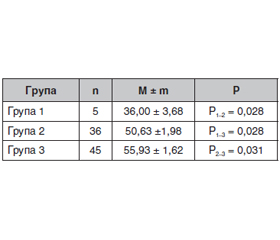
Актуальність. Війна в Україні зумовила надзвичайно високий рівень гострого та хронічного стресу у пацієнтів з автоімунними захворюваннями щитоподібної залози, що може впливати на перебіг цієї патології. Оцінку саме такого стресу у хворих на автоімунний тиреоїдит (АІТ) ще ніхто у світі не проводив. Мета: визначити вплив хронічного стресу на показники особистісної (ОТ) і ситуативної тривожності (СТ) у хворих на автоімунний тиреоїдит в умовах воєнного часу. Матеріали та методи. За період російської воєнної агресії в Україні обстежено 86 пацієнтів із АІТ. Їм проведено опитування за шкалою тривоги Спілбергера (STAI). Оцінили тривожність і як особистісну властивість, і як стан, пов’язаний з поточною ситуацією. Хворі на АІТ були поділені нами на три групи — з низьким (група 1), середнім (група 2) та високим (група 3) рівнем тривожності. В учасників усіх груп визначався рівень кортизолу у сироватці крові. Результати. Виявлено, що лише 37 % хворих мають ОТ середнього ступеня. СТ середнього ступеня становила 42 %. З високим рівнем ОТ і СТ було 54 та 52 % хворих, з низьким рівнем тривожності — 6 і 9 % відповідно. Параметри (бали) ОТ в даних групах мали значні відмінності (група 1 — 28,0 ± 1,2; група 2 — 38,4 ± 0,7; група 3 — 57,1 ± 1,3; Р < 0,05). СТ значуще не відрізнялася від значень ОТ (група 1 — 36,40 ± 2,64; група 2 — 38,78 ± 0,98; група 3 — 55,80 ± 1,55; Р > 0,05). Але виявлено значуще (Р < 0,05) підвищення рівня тривожності із зростанням віку хворих на АІТ. Кортизол не став показовим параметром для оцінки ступеня тривожності в умовах хронічного стресу (P1–2 = 0,48; P1–3 = 0,77; P2–3 = 0,42). Висновки. У більшості хворих на АІТ був виявлений високий рівень як особистісної, так і ситуативної тривожності. Майже 40 % опитаних мають середній рівень тривожності та можуть адекватно приймати рішення на тлі воєнних дій. Не виявлено значущої різниці між параметрами СТ та ОТ у хворих на АІТ на тлі російської воєнної агресії. Виявлено значуще підвищення рівня тривожності із зростанням віку хворих на АІТ. У пацієнтів рівень кортизолу не був показовим при оцінці ступеня тривожності на тлі трирічного хронічного стресу, викликаного воєнними діями.
Background. The war in Ukraine has caused extremely high levels of acute and chronic stress in patients with autoimmune thyroid diseases, which can affect this pathology. No one in the world has yet assessed this type of stress in patients with autoimmune thyroiditis (AIT). The purpose of the study was to investigate the effect of chronic stress on indicators of personal (PA) and situational anxiety (SA) in patients with autoimmune thyroiditis in wartime conditions. Materials and methods. During the period of military aggression in Ukraine, 86 patients with AIT were examined. They were surveyed using the State-Train Anxiety Inventory. Anxiety was assessed both as a personality trait and as a state related to the current situation. AIT patients were divided into three groups: with low (group 1), moderate (group 2), and high (group 3) anxiety levels. Serum cortisol levels were determined in all participants. Results. It was found that only 37 % of patients had moderate PA. SA of moderate severity was detected in 42 % of cases. High PA and SA levels were found in 54 and 52 % of patients, respectively, while low anxiety levels — in 6 and 9 %. PA values (scores) in these groups differed significantly (group 1 — 28.0 ± 1.2; group 2 — 38.4 ± 0.7; group 3 — 57.1 ± 1.3; P < 0.05). SA did not differ significantly from the values of PA (group 1 — 36.40 ± 2.64; group 2 — 38.78 ± 0.98; group 3 — 55.80 ± 1.55; P > 0.05). However, a significant (P < 0.05) increase in anxiety levels was found with increasing age of AIT patients. Cortisol was not a significant parameter for assessing the degree of anxiety under chronic stress (P1–2 = 0.48; P1–3 = 0.77; P2–3 = 0.42). Conclusions. Most patients with AIT showed high levels of both personal and situational anxiety. Almost 40 % of participants had moderate anxiety levels and were able to make adequate decisions in the context of military operations. No significant difference was found between the parameters of SA and PA in patients with AIT against the background of military aggression. A significant increase in anxiety levels was found with increasing age in patients with autoimmune thyroiditis. Cortisol levels were not indicative of anxiety levels against the background of three years of chronic stress caused by military aggression.
автоімунний тиреоїдит; хронічний стрес; війна в Україні; особистісна і ситуативна тривожність
autoimmune thyroiditis; chronic stress; war in Ukraine; personal and situational anxiety
Для ознакомления с полным содержанием статьи необходимо оформить подписку на журнал.
- Chen Y, Shen Q, Lichtenstein P, et al. Incidence Trajectories of Psychiatric Disorders After Assault, Injury, and Bereavement. JAMA Psychiatry. 2024 Apr 1;81(4):374-385. doi: 10.1001/jamapsychiatry.2023.5156.
- Song H, Sieurin J, Wirdefeldt K, et al. Association of Stress-Related Disorders with Subsequent Neurodegenerative Diseases. JAMA Neurol. 2020 Jun 1;77(6):700-709. doi: 10.1001/jamaneurol.2020.0117. PMID: 32150226.
- Song H, Fall K, Fang F, et al. UA. Stress related disorders and subsequent risk of life threatening infections: population based sibling controlled cohort study. BMJ. 2019 Oct 23;367:l5784. doi: 10.1136/bmj.l5784.
- Sulaieva O, Yerokhovych V, Zemskov S, et al. The impact of war on people with type 2 diabetes in Ukraine: a survey study. E Clinical Medicine. 2024 Dec 15;79:103008. doi: 10.1016/j.Eclinm.2024.103008.
- Averill LA, Fouda S, Murrough JW, Abdallah CG. Chro–nic stress pathology and ketamine-induced alterations in functional connectivity in major depressive disorder: An abridged review of the clinical evidence. Adv. Pharmacol. 2020;89:163-194. doi: 10.1016/bs.apha.2020.04.003.
- Song H, Fang F, Tomasson G, et al. Association of Stress-Related Disorders with Subsequent Autoimmune Disease. JAMA. 2018;319(23):2388-2400. doi: 10.1001/jama.2018/7028.
- Bookwalter DB, Kimberly AR, Cynthia A, et al. Posttraumatic stress disorder and risk of selected autoimmune diseases among US mili–tary personnel. BMC Psychiatry. 2020 Jan 15;20(1):23. doi: 10.1186/s12888-020-2432-9.
- O’Donovan A, Cohen BE, Seal KH, et al. Elevated risk for autoimmune disorders in Iraq and Afghanistan veterans with posttraumatic stress disorder. Biol. Psychiatry. 2015;77(4):365-374. doi: 10.1016/j. biolpsych.2014.06.015.
- Кravchenko V, Тоvkay О, Rakov О, Тronko М. Epidemiology of autoimmune thyroiditis. Int J Endocrin. (Ukraine). 2021;17(2):136-144. https://doi.org/10.22141/2224-0721.17.2.2021.230568.
- Pankiv V. Coexistence of accompanying autoimmune diseases in adolescents with autoimmune thyroiditis. Child’s Health. 2024;19(7):429-433. https://doi.org/10.22141/2224-0551.19.7.2024.1754.
- Markomanolaki ZS, Tigani X, Siamatras T, et al. Stress Management in Women with Hashimoto’s thyroiditis: A Randomized Controlled Trial. J Mol Biochem. 2019;8(1):3-12. PMID: 31404454. PMCID: PMC6688766.
- Agorastos A, Chrousos GP. The neuroendocrinology of stress: the stress-related continuum of chronic disease development. Mol. Psychiatry. 2022 Jan; 27(1):502-513. doi: 10.1038/s41380-021-01224-9.
- Chatzitomaris A, Hoermann R, Midgley JE, et al. Thyroid allostasis-adaptive responses of thyrotropic feedback control to conditions of strain, stress, and developmental programming. Front. Endocrinol. 2017 Jul;20(8):163. doi: 10.3389/fendo.2017.00163.
- Grill E, Strong M, Sonnad SS, et al. Altered thyroid function in severely injured patients. J. Surg. Res. 2013 Jan;179(1):132-137. doi: 10.1016/j.jss.2012.09.008.
- Vyunytska LV, Yuzvenko TYu, Dashuk TI, et al. Stress-induced urgent conditions in endocrinology. Int J Endocrin. (Ukraine). 2024;20(1):81-87. https://doi.org/10.22141/2224-0721.20.1.2024.1360.
- Madar AA, Meltzer HM, Heen E, Meyer HE. Iodine status among Somali immigrants in Norway. Nutrients. 2018 Mar 5;10(3):305. doi: 10.3390/nu10030305.
- Ducoulombier V, Chiquet R, Graf S, et al. Usefulness of a Visual Analog Scale for Measuring Anxiety in Hospitalized Patients Experiencing Pain: A Multicenter Cross-Sectional Study. Pain Manag Nurs. 2020 Dec;21(6):572-578. doi: 10.1016/j.pmn.2020.03.004.
- Agayev NA, Kokun OM, Pishko IO, et al. Collection of me–thods for diagnosing negative mental states of military personnel: Methodolo–gical manual. Research and Development Center of the Armed Forces of Ukraine. 2016:97-103. https://lib.iitta.gov.ua/id/eprint/107163.
- Lutsiv NZ, Akimova VM, Labinska OYe, Halkevich MP, Demyanchuk NR, et al. Non-specific adaptive reactions in patients with acute coronary syndrome with ST-segment elevation (STEMI) at different body weights. Clinical and experimental medicine. 2023;2(169):269-271. doi: 10.29254/2077-4214-2023-2-169-269-277
- Третя хвиля дослідження Gradus Research «Психічне здоров’я та ставлення українців до психологічної допомоги під час війни». 2024, березень. https://mms.gov.ua/news/tretia-khvylia-doslidzhennia-gradus-research-psykhichne-zdorovia-ta-stavlennia-ukraintsiv-do-psykholohichnoi-dopomohy-pid-chas-viiny.
- Результати соціологічного дослідження «Психічне здоров’я та ставлення українців до психологічної допомоги під час війни». 2025, січень. https://dozdniprooda.com.ua/site/uk/content/rezultaty-sociologichnogo-doslidzhennya-psyhichne-zdorovya-ta-stavlennya-ukrayinciv-do.