
Журнал "Гастроэнтерология" Том 60, №1, 2026
Вернуться к номеру
Ефективність смартфон-асистованої програми зі зниження ваги у жінок: ретроспективне дослідження
Авторы: Кравчук С.Л., Бичков М.А.
ДНП «Львівський національний медичний університет імені Данила Галицького», м. Львів, Україна
Рубрики: Гастроэнтерология
Разделы: Клинические исследования
Версия для печати
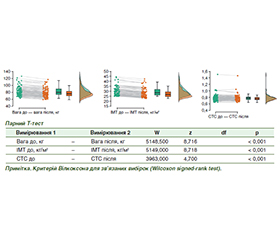
Актуальність. Цифрові втручання все частіше розглядають як ефективну стратегію зниження ваги в умовах епідемії ожиріння XXI століття. Водночас існує брак локальних даних щодо їх ефективності серед жінок в Україні. Мета роботи: оцінити ефективність тримісячної смартфон-асистованої програми зі зміни способу життя The Body School щодо зменшення маси тіла та поліпшення антропометричних показників у жінок із надмірною вагою та ожирінням. Матеріали та методи. Проведено ретроспективний аналіз даних 101 жінки, які повністю пройшли програму у 2023–2024 роках. Програма поєднувала нутриціологічний супровід через мобільний застосунок, освітні модулі, психологічну підтримку та рекомендації з фізичної активності. Первинними результатами були зміни у масі тіла, індексі маси тіла (ІМТ) та співвідношення окружності талії та стегон (СТС), що фіксувалися учасницями самостійно у додатку програми. Для статистичної оцінки застосовано тест Вілкоксона (p < 0,001). Результати. Програма сприяла статистично значущому зниженню всіх основних антропометричних показників: медіанна втрата маси тіла становила 4 кг (–5 %), ІМТ знизився на 1,83 кг/м2, СТС — на 0,016. Отримані результати є клінічно значущими, оскільки втрата 5 % маси тіла пов’язана зі зниженням ризику метаболічних порушень. Порівняно з іншими комерційними mHealth-програмами The Body School продемонструвала не меншу або навіть вищу ефективність. Високу ефективність можна пояснити мультикомпонентністю інтервенції та персоналізованим підходом. Обмеження дослідження: ретроспективний дизайн та відсутність контрольної групи. Подальші проспективні дослідження дозволять краще оцінити довготривалий вплив програми. Висновки. Смартфон-асистована програма The Body School є ефективним інструментом у зниженні маси тіла та поліпшенні антропометричних показників у жінок із надмірною вагою та ожирінням. Її результати мають як статистичну, так і клінічну значущість, що вказує на потенціал до впровадження в ширшу клінічну практику.
Background. Digital interventions are increasingly viewed as effective strategies for weight reduction amid the obesity epidemic of the 21st century. However, data on their effectiveness among women in Ukraine remain limited. The purpose of the study was to assess the effectiveness of a 3-month smartphone-assisted lifestyle modification program The Body School in reducing body weight and improving anthropometric parameters among overweight and obese women. Materials and methods. A retrospective analysis was conducted using data from 101 women who completed the program in 2023–2024. The program combined nutrition support through a mobile app, educational modules, psychological support, and physical activity recommendations. The primary outcomes were changes in body weight, body mass index, and waist-to-hip ratio, self-recorded by participants in the app. The Wilcoxon signed-rank test was used for statistical analysis (p < 0.001). Results. The program resulted in a statistically significant reduction in all primary anthropometric indicators: median weight loss was 4.0 kg (–5 %), body mass index decreased by 1.83 kg/m2, and waist-to-hip ratio by 0.016. These outcomes are clinically meaningful, as a 5 % weight reduction is associated with lower risk of metabolic disorders. Compared to other commercial mHealth programs, The Body School demonstrated equal or greater effectiveness, likely due to its multicomponent structure and personalized approach. Study limitations include its retrospective design and lack of a control group. Future prospective studies are warranted to assess the program’s long-term impact. Conclusions. The smartphone-assisted The Body School program is an effective tool for reducing body weight and improving anthropometric parameters in overweight and obese women. Its statistically and clinically significant results support the program’s potential for broader clinical implementation.
ожиріння; надмірна маса тіла; модифікація способу життя; цифрова медицина; mHealth
obesity; overweight; lifestyle modification; digital health; mHealth
Для ознакомления с полным содержанием статьи необходимо оформить подписку на журнал.
- World Health Organization. Obesity and overweight [Internet]. Geneva: WHO; 2024 Jun 9 [cited 2025 Jul 20]. Available from: https://www.who.int/news-room/fact-sheets/detail/obesity-and-overweight.
- Rains M. The origins of the obesity epidemic may be further back than we thought. Science. 2023 Sep 13. doi: 10.1126/science.adk8406.
- NCD Risk Factor Collaboration (NCD-RisC). Trends in adult body-mass index in 200 countries from 1975 to 2014: a pooled ana–lysis of 1698 population-based measurement studies with 19·2 million participants. Lancet. 2016 Apr 2;387(10026):1377-1396. doi: 10.1016/S0140-6736(16)30054-X. Erratum in: Lancet. 2016 May 14;387(10032):1998. doi: 10.1016/S0140-6736(16)30472-X. PMID: 27115820; PMCID: PMC7615134.
- Peters SA, Huxley RR, Woodward M. Diabetes as a risk factor for stroke in women compared with men: a systematic review and meta-analysis of 64 cohorts, including 775,385 individuals and 12,539 strokes. Lancet. 2014 Jun 7;383(9933):1973-80. doi: 10.1016/S0140-6736(14)60040-4. Epub 2014 Mar 7. PMID: 24613026.
- Ball K, Crawford D. Socioeconomic status and weight change in adults: a review. Soc Sci Med. 2005 May;60(9):1987-2010. doi: 10.1016/j.socscimed.2004.08.056. Epub 2004 Nov 11. PMID: 15743649.
- Washington TB, Johnson VR, Kendrick K, Ibrahim AA, Tu L, Sun K, Stanford FC. Disparities in Access and Quality of Obesity Care. Gastroenterol Clin North Am. 2023 Jun;52(2):429-441. doi: 10.1016/j.gtc.2023.02.003. Epub 2023 Apr 7. PMID: 37197884; PMCID: PMC10198472.
- Hinchliffe N, Capehorn MS, Bewick M, Feenie J. The Potential Role of Digital Health in Obesity Care. Adv Ther. 2022 Oct;39(10):4397-4412. doi: 10.1007/s12325-022-02265-4. Epub 2022 Aug 4. PMID: 35925469; PMCID: PMC9362065.
- Kupila SKE, Joki A, Suojanen LU, Pietiläinen KH. The Effectiveness of eHealth Interventions for Weight Loss and Weight Loss Maintenance in Adults with Overweight or Obesity: A Systematic Review of Systematic Reviews. Curr Obes Rep. 2023 Sep;12(3):371-394. doi: 10.1007/s13679-023-00515-2. Epub 2023 Jun 24. Erratum in: Curr Obes Rep. 2023 Dec;12(4):544-545. doi: 10.1007/s13679-023-00530-3. PMID: 37354334; PMCID: PMC10482795.
- Kahan S, Look M, Fitch A. The benefit of telemedicine in obesity care. Obesity (Silver Spring). 2022 Mar;30(3):577-586. doi: 10.1002/oby.23382. PMID: 35195367.
- Dhar D, Packer J, Michalopoulou S, Cruz J, Stansfield C, Viner RM, et al. Assessing the evidence for health benefits of low-level weight loss: a systematic review. Int J Obes (Lond). 2025 Feb;49(2):254-268. doi: 10.1038/s41366-024-01664-7. Epub 2024 Nov 1. PMID: 39487296; PMCID: PMC11805710.
- Cornier MA. A review of current guidelines for the treatment of obesity. Am J Manag Care. 2022 Dec;28(15 Suppl):S288-S296. doi: 10.37765/ajmc.2022.89292. PMID: 36525676.
- Williamson DA, Bray GA, Ryan DH. Is 5 % weight loss a satisfactory criterion to define clinically significant weight loss? Obesity (Silver Spring). 2015 Dec;23(12):2319-20. doi: 10.1002/oby.21358. Epub 2015 Nov 2. PMID: 26523739.
- Knowler WC, Barrett-Connor E, Fowler SE, Hamman RF, Lachin JM, Walker EA, Nathan DM; Diabetes Prevention Program Research Group. Reduction in the incidence of type 2 diabetes with lifestyle intervention or metformin. N Engl J Med. 2002 Feb 7;346(6):393-403. doi: 10.1056/NEJMoa012512. PMID: 11832527; PMCID: PMC1370926.
- Douketis JD, Macie C, Thabane L, Williamson DF. Systema–tic review of long-term weight loss studies in obese adults: clinical significance and applicability to clinical practice. Int J Obes (Lond). 2005 Oct;29(10):1153-67. doi: 10.1038/sj.ijo.0802982. PMID: 15997250.
- Hamman RF, Wing RR, Edelstein SL, Lachin JM, Bray GA, Delahanty L, et al. Effect of weight loss with lifestyle intervention on risk of diabetes. Diabetes Care. 2006 Sep;29(9):2102-7. doi: 10.2337/dc06-0560. PMID: 16936160; PMCID: PMC1762038.
- Antoun J, Itani H, Alarab N, Elsehmawy A. The Effectiveness of Combining Nonmobile Interventions with the Use of Smartphone Apps with Various Features for Weight Loss: Systematic Review and Meta-analysis. JMIR Mhealth Uhealth. 2022 Apr 8;10(4):e35479. doi: 10.2196/35479. PMID: 35394443; PMCID: PMC9034427.
- Gudzune KA, Doshi RS, Mehta AK, Chaudhry ZW, Jacobs DK, Vakil RM, et al. Efficacy of commercial weight-loss programs: an updated systematic review. Ann Intern Med. 2015 Apr 7;162(7):501-12. doi: 10.7326/M14-2238. Erratum in: Ann Intern Med. 2015 May 19;162(10):739-40. doi: 10.7326/L15-5097. PMID: 25844997; PMCID: PMC4446719.