
Международный эндокринологический журнал Том 22, №3, 2026
Вернуться к номеру
Прогностична цінність іризину та хемерину як інтегрованих біохімічних і гормональних біомаркерів прогресування пухлини молочної залози
Авторы: Lubna Khalid Farhan (1), Abdulhakeem Dahham Hussein (1), Shaymaa Hameed Fayyadh (1), Osama A. Mohsein (2)
(1) - College of Applied Science, University of Fallujah, Al-Anbar, Iraq
(2) - Thi-Qar Health Directorate, Al Habbobi Teaching Hospital, Thi-Qar, Iraq
Рубрики: Эндокринология
Разделы: Клинические исследования
Версия для печати
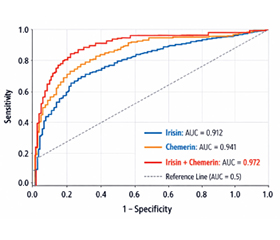
Актуальність. Розвиток пухлини молочної залози відбувається внаслідок багатогранного впливу метаболічних, гормональних і запальних механізмів, що робить іризин та хемерин вагомими біомаркерами тяжкості й динаміки раку в процесі складної біохімічної та гормональної взаємодії. Мета: встановити прогностичне і діагностичне значення рівнів іризину й хемерину в крові як інтегрованих біохімічних та гормональних біомаркерів при раку молочної залози, а також визначити їх зв’язок зі стадією пухлини, метаболічним статусом і гормональною дисрегуляцією прогресування пухлини. Матеріали та методи. Дослідження типу «випадок — контроль» проведено з березня до грудня 2025 року для оцінки прогностичної цінності іризину та хемерину в розвитку пухлини молочної залози. У ньому взяли участь 180 жінок (120 пацієнток із раком молочної залози та 60 здорових осіб контрольної групи). Діагноз і стадія захворювання були підтверджені клінічно, радіологічно й гістопатологічно. Зразки крові натще були зібрані, оброблені та зберігалися при температурі –20 °C. Рівні іризину та хемерину в сироватці крові вимірювали за допомогою імуноферментного аналізу поряд із рутинними біохімічними й гормональними дослідженнями. Результати. Поширеність раку молочної залози була вірогідно вищою залежно від показників індексу маси тіла та родинного анамнезу. Рівень іризину був нижчим, а показники хемерину, естрадіолу, інсуліну й індексу HOMA-IR збільшувалися, що свідчить про метаболічний та гормональний дисбаланс. Уміст іризину знижувався, а хемерину — зростав при прогресуванні пухлини. Обидва біомаркери можна розглядати як предиктори ризику раку молочної залози незалежно один від одного. Також продемонстровано їх високу діагностичну точність, особливо при спільному використанні. Установлено, що вони доповнюють один одного з точки зору ролі в прогресуванні пухлини молочної залози і метаболічних порушеннях. Висновки. Метаболічний та гормональний дисбаланс, знижений рівень іризину й підвищений — хемерину пов’язані з прогресуванням раку молочної залози. Порушений енергетичний обмін та запалення, що проявляються через протилежні біологічні функції, обґрунтовують їх використання в комбінації як прогностичних біомаркерів розвитку пухлини.
Background. The progressive development of breast tumor is considered a multifaceted effect of metabolic, hormonal, and inflammatory mechanisms, which makes irisin and chemerin predictive biomarkers of the severity and the dynamics of cancer growth as a complex biochemical-hormonal interaction. The purpose of this study was to establish the predictive and diagnostic usefulness of the circulating irisin and chemerin as integrated biochemical-hormonal biomarkers in breast cancer, and to identify their relationships with tumor stage, metabolic status and hormonal dysregulation of breast tumor progression. Materials and methods. A case-control study was conducted between March and December 2025 to assess the predictive value of irisin and chemerin in breast tumor progression. It included 180 women (120 breast cancer patients and 60 healthy controls). Diagnosis and staging were confirmed clinically, radiologically, and histopathologically. Fasting blood samples were collected, processed, and stored at –20 °C. Serum irisin and chemerin levels were measured using enzyme-linked immunosorbent assay, alongside routine biochemical and hormonal assessments. Results. The results indicated that the groups matched as there was a similar age and menopausal status. Prevalence of breast cancer was much higher in terms of body mass index and family history. The level of irisin was lower, and the content of chemerin, estradiol, insulin, and HOMA-IR increased, which testifies to metabolic-hormonal disbalance. Irisin reduced, and chemerin grew with the advance stage of tumor. Both biomarkers themselves were predictors of breast cancer risk independently and also showed high diagnostic accuracy, especially when used together, which shows that they are complementary in terms of their role in breast tumor progression and metabolic disturbances. Conclusions. Metabolic and hormonal imbalance such as reduced irisin and increased levels of chemerin are associated with the progression of breast cancer. The disrupted energy metabolism and inflammation, as seen through their opposing biological functions, justifies their use in combination as predictive biomarkers of tumor progression that are mechanistically intertwined to each other.
гормональні біомаркери; метаболічна дисрегуляція; рак молочної залози; іризин; хемерин; прогресування пухлини
hormonal biomarkers; metabolic dysregulation; breast cancer; irisin; chemerin; tumor progression
Для ознакомления с полным содержанием статьи необходимо оформить подписку на журнал.
- Kim J, Harper A, McCormack V, Sung H, Houssami N, et al. Global patterns and trends in breast cancer incidence and mortality across 185 countries. Nat Med. 2025 Apr;31(4):1154-1162. doi: 10.1038/s41591-025-03502-3.
- Lv L, Zhao B, Kang J, Li S, Wu H. Trend of disease burden and risk factors of breast cancer in developing countries and territories, from 1990 to 2019: Results from the Global Burden of Disease Study 2019. Front Public Health. 2023 Jan 16;10:1078191. doi: 10.3389/fpubh.2022.1078191.
- Nair PMK, Palanisamy A, Sivaranjani S, Sudarshan S, Shubhakarini S, et al. Decoding metabolic dysfunction in cancer: foundations for early detection and personalized therapeutics. Front Endocrinol (Lausanne). 2025 Nov 24;16:1693142. doi: 10.3389/fendo.2025.1693142.
- Inamura K, Hamada T, Bullman S, Ugai T, Yachida S, Ogino S. Cancer as microenvironmental, systemic and environmental diseases: opportunity for transdisciplinary microbiomics science. Gut. 2022 Jul 12:gutjnl-2022-327209. doi: 10.1136/gutjnl-2022-327209.
- Daudon M, Bigot Y, Dupont J, Price CA. Irisin and the fibronectin type III domain-containing family: structure, signaling and role in female reproduction. Reproduction. 2022 May 23;164(1):R1-R9. doi: 10.1530/REP-22-0037.
- Yardimci A, Ertugrul NU, Ozgen A, Ozbeg G, Ozdede MR, et al. Effects of chronic irisin treatment on brain monoamine levels in the hypothalamic and subcortical nuclei of adult male and female rats: An HPLC-ECD study. Neurosci Lett. 2023 May 29;806:137245. doi: 10.1016/j.neulet.2023.137245.
- Jang SY, Choi KM. Impact of Adipose Tissue and Lipids on Skeletal Muscle in Sarcopenia. J Cachexia Sarcopenia Muscle. 2025;16(4):e70000. doi: 10.1002/jcsm.70000.
- Gonçalves CCRA, Feitosa BM, Cavalcante BV, Lima ALGSB, de Souza CM, et al. Obesity and recurrent miscarriage: The interconnections between adipose tissue and the immune system. Am J Reprod Immunol. 2023 Sep;90(3):e13757. doi: 10.1111/aji.13757.
- Man AWC, Xia N, Li H. Vascular effects of perivascular adi–pose tissue-derived chemerin in obesity-associated cardiovascular disease. Cardiovasc Diabetol. 2025 Jun 13;24(1):249. doi: 10.1186/s12933-025-02814-5.
- Hemat Jouy S, Mohan S, Scichilone G, Mostafa A, Mahmoud AM. Adipokines in the Crosstalk between Adipose Tissues and Other Organs: Implications in Cardiometabolic Diseases. Biomedicines. 2024 Sep 19;12(9):2129. doi: 10.3390/biomedicines12092129.
- Pelczyńska M, Miller-Kasprzak E, Piątkowski M, Mazurek R, Klause M, et al. The Role of Adipokines and Myokines in the Pathoge–nesis of Different Obesity Phenotypes — New Perspectives. Antioxidants (Basel). 2023 Nov 26;12(12):2046. doi: 10.3390/antiox12122046.
- Fu X, Wang Y, Zhao F, Cui R, Xie W, et al. Shared biologi–cal mechanisms of depression and obesity: focus on adipokines and lipokines. Aging (Albany NY). 2023 Jun 29;15(12):5917-5950. doi: 10.18632/aging.204847.
- Skrzep-Poloczek B, Idzik M, Michalczyk K, Chełmecka E, Kukla M, et al. A 21-Day Individual Rehabilitation Exercise Training Program Changes Irisin, Chemerin, and BDNF Levels in Patients after Hip or Knee Replacement Surgery. J Clin Med. 2023 Jul 25;12(15):4881. doi: 10.3390/jcm12154881.
- Ndlovu H, Lawal IO, Mokoala KMG, Sathekge MM. Imaging Molecular Targets and Metabolic Pathways in Breast Cancer for Improved Clinical Management: Current Practice and Future Perspectives. Int J Mol Sci. 2024 Jan 26;25(3):1575. doi: 10.3390/ijms25031575.
- Carmona A, Mitri S, James TA, Ubellacker JM. Lipidomics and metabolomics as potential biomarkers for breast cancer progression. NPJ Metab Health Dis. 2024 Sep 2;2(1):24. doi: 10.1038/s44324-024-00027-0.
- Calcaterra V, Tiranini L, Magenes VC, Rossi V, Cucinella L, et al. Impact of Obesity on Pubertal Timing and Male Fertility. J Clin Med. 2025 Jan 25;14(3):783. doi: 10.3390/jcm14030783.
- Goh KK, Chen CY, Wu TH, Chen CH, Lu ML. Crosstalk between Schizophrenia and Metabolic Syndrome: The Role of Oxytocinergic Dysfunction. Int J Mol Sci. 2022 Jun 25;23(13):7092. doi: 10.3390/ijms23137092.
- Hu P, Guo D, Cao K, Xu T. The role of novel adipokines in hepatocellular carcinoma progression: a mini review. Am J Cancer Res. 2024 Nov 15;14(11):5471-5485. doi: 10.62347/PZDM1736.
- Aldharee H, Yousif RM, Hamdan ZH. The Association Between Chemerin Levels and Gestational Diabetes Mellitus: An Upda–ted Systematic Review and Meta-Analysis. International Journal of Molecular Sciences. 2025;26(14):6622. doi: 10.3390/ijms26146622.
- Spanoudaki M, Giaginis C, Karafyllaki D, Papadopoulos K, Solovos E, et al. Exercise as a Promising Agent against Cancer: Evaluating Its Anti-Cancer Molecular Mechanisms. Cancers (Basel). 2023 Oct 25;15(21):5135. doi: 10.3390/cancers15215135.
- Zhang Y, Jo Y, Wei S, Kim Y, Park W, et al. Myosteatosis: Epidemiological Insights, Functional Decline, and Diagnostic Advances. Curr Obes Rep. 2025 Dec 16;14(1):83. doi: 10.1007/s13679-025-00676-2.
- Engin A. Obesity-Associated Breast Cancer: Analysis of Risk Factors and Current Clinical Evaluation. Adv Exp Med Biol. 2024;1460:767-819. doi: 10.1007/978-3-031-63657-8_26.
- Wang Q, Wang H, Ding Y, Wan M, Xu M. The Role of Adipokines in Pancreatic Cancer. Front Oncol. 2022 Jul 8;12:926230. doi: 10.3389/fonc.2022.926230.
- Torres A, Cameselle C, Otero P, Simal-Gandara J. The Impact of Vitamin D and Its Dietary Supplementation in Breast Cancer Prevention: An Integrative Review. Nutrients. 2024 Feb 20;16(5):573. doi: 10.3390/nu16050573.
- Grigoraș A, Amalinei C. The Role of Perirenal Adipose Tissue in Carcinogenesis — From Molecular Mechanism to Therapeutic Perspectives. Cancers (Basel). 2025 Mar 23;17(7):1077. doi: 10.3390/cancers17071077.
- AlZaim I, Al-Saidi A, Hammoud SH, Darwiche N, Al-Dhaheri Y, et al. Thromboinflammatory Processes at the Nexus of Metabolic Dysfunction and Prostate Cancer: The Emerging Role of Periprostatic Adipose Tissue. Cancers (Basel). 2022 Mar 25;14(7):1679. doi: 10.3390/cancers14071679.
- Ebrahim NAA, Soliman SMA, Farghaly TA. Saliva-based molecular diagnostics in oral squamous cell carcinoma (OSCC): a non-invasive frontier in oncology. Eur Arch Otorhinolaryngol. 2025 Dec 29. doi: 10.1007/s00405-025-09934-4.
- Clemente-Suárez VJ, Redondo-Flórez L, Beltrán-Velasco AI, Martín-Rodríguez A, Martínez-Guardado I, et al. The Role of Adipokines in Health and Disease. Biomedicines. 2023 Apr 27;11(5):1290. doi: 10.3390/biomedicines11051290.
- Barbagallo F, Cannarella R, Garofalo V, Marino M, La Vigne–ra S, et al. The Role of Irisin throughout Women’s Life Span. Biomedi–cines. 2023 Dec 9;11(12):3260. doi: 10.3390/biomedicines11123260.
- Lis-Kuberka J, Berghausen-Mazur M, Orczyk-Pawiłowicz M. Evaluation of Selected Pro- and Anti-Inflammatory Adipokines in Colostrum from Mothers with Gestational Diabetes Mellitus. Int J Mol Sci. 2024 Dec 24;26(1):40. doi: 10.3390/ijms26010040.
- Wang W, Wang X, Jiang Y, Guo Y, Fu P, et al. Normal weight obesity, circulating biomarkers and risk of breast cancer: a prospective cohort study and meta-analysis. Br J Cancer. 2025 Feb;132(2):203-211. doi: 10.1038/s41416-024-02906-1.
- Feng J, Qi X, Chen C. et al. Multilayer analysis of ethnically diverse blood and urine biomarkers for breast cancer risk and prognosis. Sci Rep. 2025;15:6791 (2025). doi: 10.1038/s41598-025-90447-9.