
Журнал "Гастроэнтерология" Том 60, №2, 2026
Вернуться к номеру
Гастроінтестинальні прояви COVID-19 у жінок з ендометріозом: проспективне обсерваційне когортне дослідження
Авторы: Подольський Вoл.В. (1), Подольський Вас.В. (1), Медведовська Н.В. (2), Осауленко С.В. (3)
(1) - Державна установа «Всеукраїнський центр материнства та дитинства Національної академії медичних наук України», м. Київ, Україна
(2) - Президія Національної академії медичних наук України, м. Київ, Україна
(3) - Національний медичний університет імені О.О. Богомольця, м. Київ, Україна
Рубрики: Гастроэнтерология
Разделы: Клинические исследования
Версия для печати
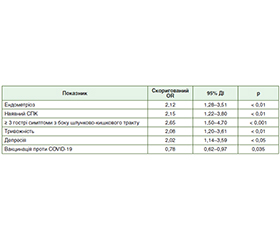
Актуальність. Жінки з ендометріозом можуть мати підвищений ризик тривалого COVID-19, однак клінічні дані щодо персистенції гастроінтестинальних симптомів після COVID-19 у цієї групи обмежені, що ускладнює післяінфекційне ведення та планування спостереження. Мета дослідження: оцінити гострі та тривалі шлунково-кишкові прояви COVID-19 у жінок з ендометріозом порівняно з контрольною групою, а також визначити фактори ризику розвитку тривалого COVID-19 зі стійкими гастроінтестинальними симптомами. Матеріали та методи. Проведено проспективне обсерваційне когортне дослідження за участю 100 жінок віком 18–45 років: 50 з хірургічно підтвердженим або клінічно верифікованим ендометріозом та 50 без ендометріозу, підібраних за віком. Усі учасниці перенесли лабораторно підтверджену інфекцію SARS-CoV-2 протягом останніх шести місяців. Оцінювали гострі й персистуючі шлунково-кишкові симптоми (GSRS), гінекологічні прояви, психічний стан (HADS). Повторні оцінки здійснювали через 3 та 6 місяців. Результати. Жінки з ендометріозом мали істотно вищу частоту гострих гастроінтестинальних симптомів під час COVID-19 (76,6 проти 62,4 %; p = 0,013), зокрема здуття живота (56,3 проти 36,0 %) та болю в животі (45,3 проти 25,6 %). Через три місяці після інфікування тривалий COVID-19 спостерігався у 42,2 % жінок з ендометріозом порівняно з 25,6 % у контрольній групі (RR = 1,65; p = 0,005), а персистуючі шлунково-кишкові симптоми — у 35,2 проти 17,6 % відповідно (p = 0,001). Також у групі ендометріозу частіше фіксували погіршення дисменореї (27,3 проти 9,6 %) та тазового болю (21,9 проти 6,4 %). У багатофакторній логістичній моделі ендометріоз залишався незалежним предиктором тривалого COVID-19 із гастроінтестинальними симптомами (OR = 2,12; p < 0,01) поряд з наявністю синдрому подразненого кишечника, ≥ 3 гострими шлунково-кишковими симптомами, тривогою та депресією, тоді як вакцинація мала захисний ефект (OR = 0,78; p = 0,035). Висновки. Отримані результати свідчать, що ендометріоз значно підвищує ризик як гострих, так і тривалих шлунково-кишкових ускладнень після COVID-19. Необхідні цілеспрямовані стратегії моніторингу та профілактики, включно з вакцинацією та раннім виявленням стійких симптомів.
Background. Women with endometriosis may be at increased risk of long COVID-19; however, clinical data on the persistence of gastrointestinal symptoms after COVID-19 in this group are limited, complicating post-infection management and follow-up planning. The purpose of the study was to assess acute and prolonged gastrointestinal manifestations of COVID-19 in women with endometriosis compared to the control group, as well as to determine risk factors for the development of long COVID-19 with persistent gastrointestinal symptoms. Materials and methods. A prospective observational cohort study was conducted with the participation of 100 women aged 18–45 years: 50 with surgically confirmed or clinically verified endometriosis and 50 without endometriosis, selected by age. All participants had a laboratory-confirmed SARS-CoV-2 infection within the past six months. Acute and persistent gastrointestinal symptoms (according to the Gastrointestinal Symptom Rating Scale), gynecological manifestations, mental status (according to the Hospital Anxiety and Depression Scale) were assessed. Repeated tests were carried out after 3 and 6 months. Results. Women with endometriosis had a significantly higher incidence of acute gastrointestinal symptoms during COVID-19 (76.6 vs. 62.4 %; p = 0.013), including bloating (56.3 vs. 36.0 %) and abdominal pain (45.3 vs. 25.6 %). Three months after infection, long COVID-19 was observed in 42.2 % of women with endometriosis compared to 25.6 % in the control group (RR = 1.65; p = 0.005), and persistent gastrointestinal symptoms were detected in 35.2 vs. 17.6 %, respectively (p = 0.001). Also, in the endometriosis group, worsening of dysmenorrhea (27.3 vs. 9.6 %) and pelvic pain (21.9 vs. 6.4 %) were more often recorded. In the multivariate logistic model, endometriosis remained an independent predictor of long COVID-19 with gastrointestinal symptoms (OR = 2.12; p < 0.01), along with the presence of irritable bowel syndrome, ≥ 3 acute gastrointestinal symptoms, anxiety, and depression, while vaccination had a protective effect (OR = 0.78; p = 0.035). Conclusions. The findings show that endometriosis significantly increases the risk of both acute and long-term gastrointestinal complications after COVID-19. Targeted monitoring and prevention strategies are needed, including vaccination and early detection of persistent symptoms.
ендометріоз; тривалий COVID-19; шлунково-кишкові симптоми; вегетативна дисфункція; запалення; тазовий біль; жіноче здоров’я
endometriosis; long COVID-19; gastrointestinal symptoms; autonomic dysfunction; inflammation; pelvic pain; women’s health
Для ознакомления с полным содержанием статьи необходимо оформить подписку на журнал.
- Cuffaro F, Russo E, Amedei A. Endometriosis, Pain, and Rela–ted Psychological Disorders: Unveiling the Interplay among the Microbiome, Inflammation, and Oxidative Stress as a Common Thread. Int J Mol Sci. 2024;25(12):6473. doi: 10.3390/ijms25126473.
- Ek M, Roth B, Ekström P, Valentin L, Bengtsson M, Ohlsson B. Gastrointestinal symptoms among endometriosis patients — A case-cohort study. BMC Womens Health. 2015;15:59. doi: 10.1186/s12905-015-0213-2.
- Martire FG, Costantini E, d’Abate C, Capria G, Piccione E, Andreoli A. Endometriosis and Nutrition: Therapeutic Perspectives. J Clin Med. 2025;14(11):3987. doi: 10.3390/jcm14113987.
- Yang F, Wu Y, Hockey R, Doust J, Mishra GD, Montgo–mery GW, et al. Evidence of shared genetic factors in the etiology of gastrointestinal disorders and endometriosis and clinical implications for disease management. Cell Rep Med. 2023;4(11):101250. doi: 101250.10.1016/j.xcrm.2023.101250.
- Marasco G, Cremon C, Barbaro MR, Salvi D, Cacciari G, Kagramanova A, et al. Prevalence of Gastrointestinal Symptoms in Severe Acute Respiratory Syndrome Coronavirus 2 Infection: Results of the Prospective Controlled Multinational GI-COVID-19 Study. Am J Gastroenterol. 2022;117(1):147-57. doi: 10.14309/ajg.0000000000001541.
- Perisetti A, Goyal H, Gajendran M, Boregowda U, Mann R, Sharma N. Prevalence, Mechanisms, and Implications of Gastrointestinal Symptoms in COVID-19. Front Med (Lausanne). 2020;7:588711. doi: 10.3389/fmed.2020.588711.
- Tariq R, Saha S, Furqan F, Hassett L, Pardi D, Khanna S. Prevalence and Mortality of COVID-19 Patients With Gastrointestinal Symptoms: A Systematic Review and Meta-analysis. Mayo Clin Proc. 2020;95(8):1632-48. doi: 10.1016/j.mayocp.2020.06.003.
- Venegas-Borsellino C, Sankararaman S, Roche K, Burns J, Landis RM. Impact of COVID-19 on the Intestinal Microbiome. Curr Nutr Rep. 2021;10(4):300-6. doi: 10.1007/s13668-021-00375-z.
- Cirkel A, Göbel H, Göbel C, Alkatout I, Khalil A, Baum S, et al. Endometriosis Patients Have an Increased Risk of Experiencing Long-Covid Symptoms: Results from a Cross-Sectional Multicenter Study. Womens Health Rep (New Rochelle). 2024;5(1):671-9. doi: 10.1089/whr.2024.0049.
- Riemma G, Etrusco A, Laganà AS, Torella M, Vastarella MG, Della Corte L, et al. Susceptibility to Infection and Impact of COVID-19 Vaccines on Symptoms of Women with Endometriosis: A Systematic Review and Meta-Analysis of Available Evidence. Reprod Sci. 2024;31(11):3247-56. doi: 10.1007/s43032-024-01707-4.
- Vallée A, Arutkin M, Ceccaldi PF, Feki A, Ayoubi JM. Long COVID and endometriosis: a systematic review and meta-analysis. BMC Womens Health. 2025;25(1):229. doi: 10.1186/s12905-025-03761-9.
- Wang S, Farland LV, Gaskins AJ, Mortazavi J, Wang YX, Tamimi RM, et al. Association of laparoscopically-confirmed endometriosis with long COVID-19: a prospective cohort study. Am J Obstet Gynecol. 2023;228(6):714.e1-.e13. doi: 10.1016/j.ajog.2023.03.030.
- Xholli A, Perugi I, Cremonini F, Londero AP, Cagnacci A. Evaluation of Long-COVID Syndrome in a Cohort of Patients with Endometriosis or Adenomyosis. J Clin Med. 2025;14(6):1835. doi: 10.3390/jcm14061835.
- 14. Svedlund J, Sjödin I, Dotevall G. GSRS — a clinical rating scale for gastrointestinal symptoms in patients with irritable bowel syndrome and peptic ulcer disease. Dig Dis Sci. 1988 Feb;33(2):129-34. doi: 10.1007/BF01535722.
- 15. Zigmond AS, Snaith RP. The hospital anxiety and depression scale. Acta Psychiatr Scand. 1983 Jun;67(6):361-70. doi: 10.1111/j.1600-0447.
- Chadchan SB, Popli P, Maurya VK, Kommagani R. The SARS-CoV-2 receptor, angiotensin-converting enzyme 2, is required for human endometrial stromal cell decidualization†. Biol Reprod. 2021;104(2):336-43. doi: 10.1093/biolre/ioaa211.
- Henarejos-Castillo I, Sebastian-Leon P, Devesa-Peiro A, Pellicer A, Diaz-Gimeno P. SARS-CoV-2 infection risk assessment in the endometrium: viral infection-related gene expression across the menstrual cycle. Fertil Steril. 2020;114(2):223-32. doi: 10.1016/j.fertnstert.2020.06.026.
- Lehmann M, Allers K, Heldt C, Meinhardt J, Schmidt F, Rodriguez-Sillke Y, et al. Human small intestinal infection by SARS-CoV-2 is characterized by a mucosal infiltration with activated CD8+ T cells. Mucosal Immunol. 2021;14(6):1381-92. doi: 10.1038/s41385-021-00437-z.
- Racilan AM, Assis WA, Casalechi M, Spagnolo-Souza A, Pascoal-Xavier MA, Simões ESAC, et al. Angiotensin-converting enzyme 2, the SARS-CoV-2 cellular receptor, is widely expressed in human myometrium and uterine leiomyoma. J Endometr Pelvic Pain Disord. 2021;13(1):20-4. doi: 10.1177/2284026520954068.
- Björk E, Vinnars MT, Nagaev I, Nagaeva O, Lundin E, Ottander U, et al. Enhanced local and systemic inflammatory cytokine mRNA expression in women with endometriosis evokes compensatory adaptive regulatory mRNA response that mediates immune suppression and impairs cytotoxicity. Am J Reprod Immunol. 2020;84(4):e13298. doi: 10.1111/aji.13298.
- Khalaj K, Ahn SH, Bidarimath M, Nasirzadeh Y, Singh SS, Fazleabas AT, et al. A balancing act: RNA binding protein HuR/TTP axis in endometriosis patients. Sci Rep. 2017;7(1):5883. doi: 10.1038/s41598-017-06081-7.
- Krygere L, Jukna P, Jariene K, Drejeriene E. Diagnostic Potential of Cytokine Biomarkers in Endometriosis: Challenges and Insights. Biomedicines. 2024;12(12):2867. doi: 10.3390/biomedicines12122867.
- Machairiotis N, Vasilakaki S, Thomakos N. Inflammatory Mediators and Pain in Endometriosis: A Systematic Review. Biomedicines. 2021;9(1):54. doi: 10.3390/biomedicines9010054.
- Elbeltagi R, Al-Beltagi M, Saeed NK, Bediwy AS. COVID-19-induced gastrointestinal autonomic dysfunction: A systematic review. World J Clin Cases. 2023;11(22):5252-72. doi: 10.12998/wjcc.v11.i22.5252.
- Liu X, Li D, Gao W, Liu H, Chen P, Zhao Y, et al. Shared genetic architecture between COVID-19 and irritable bowel syndrome: a large-scale genome-wide cross-trait analysis. Front Immunol. 2024;15:1442693. doi: 10.3389/fimmu.2024.1442693.
- Zhang D, Chen C, Xie Y, Zeng F, Chen S, Chen R, et al. Post-infection functional gastrointestinal disorders following coronavirus disease-19: a prospective follow-up cohort study. BMC Infect Dis. 2023;23(1):422. doi: 10.1186/s12879-023-08401-x.
- Buonsenso D, Piazza M, Boner AL, Bellanti JA. Long COVID: A proposed hypothesis-driven model of viral persistence for the pathophysiology of the syndrome. Allergy Asthma Proc. 2022;43(3):187-93. doi: 10.2500/aap.2022.43.220018.
- Jing H, Wu X, Xiang M, Liu L, Novakovic VA, Shi J. Pathophysiological mechanisms of thrombosis in acute and long COVID-19. Front Immunol. 2022;13:992384. doi: 10.3389/fimmu.2022.992384.
- Yong SJ. Long COVID or post-COVID-19 syndrome: putative pathophysiology, risk factors, and treatments. Infect Dis (Lond). 2021;53(10):737-54. doi: 10.1080/23744235.2021.1924397.
- Cacciola R, Gentilini Cacciola E, Vecchio V, Cacciola E. Cellular and molecular mechanisms in COVID-19 coagulopathy: role of inflammation and endotheliopathy. J Thromb Thrombolysis. 2022;53(2):282-90. doi: 10.1007/s11239-021-02583-4.
- Nicolai L, Kaiser R, Stark K. Thromboinflammation in long COVID-the elusive key to postinfection sequelae? J Thromb Haemost. 2023;21(8):2020-31. doi: 10.1016/j.jtha.2023.04.039.
- Vahdat S. A review of pathophysiological mechanism, diagnosis, and treatment of thrombosis risk associated with COVID-19 infection. Int J Cardiol Heart Vasc. 2022;41:101068. doi: 10.1016/j.ijcha.2022.101068.
- Dani M, Dirksen A, Taraborrelli P, Torocastro M, Panagopoulos D, Sutton R, et al. Autonomic dysfunction in ‘long COVID’: rationale, physiology and management strategies. Clin Med (Lond). 2021;21(1):e63-e7. doi: 10.7861/clinmed.2020-0896.
- Rangon CM, Krantic S, Moyse E, Fougère B. The Vagal Autonomic Pathway of COVID-19 at the Crossroad of Alzheimer’s Disease and Aging: A Review of Knowledge. J Alzheimers Dis Rep. 2020;4(1):537-51. doi: 10.3233/ADR-200273.
- Szirmai D, Györfi O, Kamondi A. TH-285. Autonomic nervous system dysfunction in long-COVID patients. Clinical Neurophysio–logy. 2022;141:S178. https://doi.org/10.1016/j.clinph.2022.07.471.
- Wilson DA, Nowak T, Gupta A, McKinnon M, Clements I, Everett T, et al. Application of Physiological Autonomic Activity Tracking GUI and Computational Algorithms for Measuring Persistent Vagal Nerve Dysfunction After Recovery from SARS-CoV-2 Infection. The FASEB Journal. 2022;36(S1). https://doi.org/10.1096/fasebj.2022.36.S1.R4244.
- Woo MS, Shafiq M, Fitzek A, Dottermusch M, Altmeppen H, Mohammadi B, et al. Vagus nerve inflammation contributes to dysautonomia in COVID-19. Acta Neuropathol. 2023;146(3):387-94. doi: 10.1007/s00401-023-02612-x.
- Costeira R, Lee KA, Murray B, Christiansen C, Castillo-Fernandez J, Ni Lochlainn M, et al. Estrogen and COVID-19 symptoms: Associations in women from the COVID Symptom Study. PLoS One. 2021;16(9):e0257051. doi: 10.1371/journal.pone.0257051.
- Ghare Naz MS, Banaei M, Dashti S, Tehrani FR. An overview of sex hormones in relation to SARS-CoV-2 infection. Future Virol. 2021 Jul 20:10.2217/fvl-2021-0058. doi: 10.2217/fvl-2021-0058.
- Tramontana F, Battisti S, Napoli N, Strollo R. Immuno-Endocrinology of COVID-19: The Key Role of Sex Hormones. Front Endocrinol (Lausanne). 2021;12:726696. doi: 10.3389/fendo.2021.726696.
- Xiao H, Wei J, Yuan L, Li J, Zhang C, Liu G, et al. Sex hormones in COVID-19 severity: The quest for evidence and influence mechanisms. J Cell Mol Med. 2024;28(12):e18490. doi: 10.1111/jcmm.18490.
- Kavanagh E. Long Covid brain fog: a neuroinflammation phenomenon? Oxf Open Immunol. 2022;3(1):iqac007. doi: 10.1093/oxfimm/iqac007.
- Kazama I. Brain Leukocytes as the Potential Therapeutic Target for Post-COVID-19 Brain Fog. Neurochem Res. 2023;48(8):2345-9. doi: 10.1007/s11064-023-03912-0.
- Loftis JM, Firsick E, Shirley K, Adkins JL, Le-Cook A, Sano E, et al. Inflammatory and mental health sequelae of COVID-19. Compr Psychoneuroendocrinol. 2023;15:100186. doi: 10.1016/j.cpnec.2023.100186.
- Ai Q, Yang B. Are inflammatory bowel diseases associated with an increased risk of COVID-19 susceptibility and severity? A two-sample Mendelian randomization study. Front Genet. 2023;14:1095050. doi: 10.3389/fgene.2023.1095050.
- Ghoshal UC, Ghoshal U, Rahman MM, Mathur A, Rai S, Akhter M, et al. Post-infection functional gastrointestinal disorders following coronavirus disease-19: A case-control study. J Gastroenterol Hepatol. 2022;37(3):489-98. doi: 10.1111/jgh.15717.
- Kostoff RN, Briggs MB, Kanduc D, Shores DR, Kovatsi L, Vardavas AI, et al. Common contributing factors to COVID-19 and inflammatory bowel disease. Toxicol Rep. 2021;8:1616-37. doi: 10.1016/j.toxrep.2021.08.007.
- Luckow Invitti A, Schor E, Martins Parreira R, Kopelman A, Kamergorodsky G, Gonçalves GA, et al. Inflammatory cytokine profile of co‑cultivated primary cells from the endometrium of women with and without endometriosis. Mol Med Rep. 2018;18(2):1287-96. doi: 10.3892/mmr.2018.9137.
- Prabhakaran D, Day GS, Munipalli B, Rush BK, Pudalov L, Niazi SK, et al. Neurophenotypes of COVID-19: risk factors and recovery outcomes. Res Sq. 2023 Feb 20:rs.3.rs-2363210. doi: 10.21203/rs.3.rs-2363210/v2.
- Butzin-Dozier Z, Ji Y, Wang LC, Anzalone AJ, Coyle J, Phillips RV, et al. COVID-19 Vaccination Timing, Relative to Acute COVID-19, and Subsequent Risk of Long COVID. medRxiv. 2025 Apr 23. doi: 10.1101/2025.04.22.25326224.
- Byambasuren O, Stehlik P, Clark J, Alcorn K, Glasziou P. Effect of covid-19 vaccination on long covid: systematic review. BMJ Med. 2023;2(1):e000385. doi: 10.1136/bmjmed-2022-000385.
- Gao P, Liu J, Liu M. Effect of COVID-19 Vaccines on Reducing the Risk of Long COVID in the Real World: A Systematic Review and Meta-Analysis. Int J Environ Res Public Health. 2022;19(19):12422. doi: 10.3390/ijerph191912422.
- Notarte KI, Catahay JA, Velasco JV, Pastrana A, Ver AT, Pangilinan FC, et al. Impact of COVID-19 vaccination on the risk of developing long-COVID and on existing long-COVID symptoms: A systematic review. EClinicalMedicine. 2022;53:101624. doi: 10.1016/j.eclinm.2022.101624.
- Tofarides AG, Christaki E, Milionis H, Nikolopoulos GK. Effect of Vaccination against SARS-CoV-2 on Long COVID-19: A Narrative Review. Life (Basel). 2022;12(12):2057. doi: 10.3390/life12122057.
- Watanabe A, Iwagami M, Yasuhara J, Takagi H, Kuno T. Protective effect of COVID-19 vaccination against long COVID syndrome: A systematic review and meta-analysis. Vaccine. 2023;41(11):1783-90. doi: 10.1016/j.vaccine.2023.02.008.