
Журнал «Здоровье ребенка» Том 21, №3, 2026
Вернуться к номеру
Клінічні предиктори тривалості перебування у відділеннях інтенсивної терапії новонароджених у лікарні вторинної ланки в Індонезії
Авторы: Christin Andriani (1, 3), Putu Siska Suryaningsih (2, 3)
(1) - Faculty of Medicine, Pelita Harapan University, Tangerang, Indonesia
(2) - Faculty of Medicine, Udayana University, Denpasar, Indonesia
(3) - Department of Pediatrics, Wangaya Regional General Hospital, Denpasar, Indonesia
Рубрики: Педиатрия/Неонатология
Разделы: Клинические исследования
Версия для печати
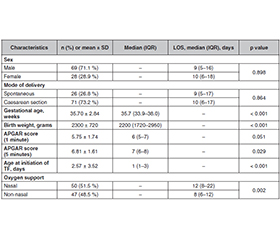
Актуальність. Тривалість перебування (ТП) у відділеннях інтенсивної терапії новонароджених (ВІТН) відображає тяжкість захворювання і використання ресурсів охорони здоров’я. Триваліша госпіталізація підвищує ризик ускладнень та створює значне економічне й психосоціальне навантаження на сім’ї. Докази щодо факторів, які впливають на ТП у ВІТН у лікарнях вторинного профілю в Індонезії, залишаються обмеженими. Матеріали та методи. Це ретроспективне обсерваційне дослідження включало 97 дітей, госпіталізованих до відділення інтенсивної терапії новонароджених у лікарні вторинного профілю в Індонезії в період з серпня 2024 року до серпня 2025 року. Незалежними змінними були стать, спосіб розродження, гестаційний вік, маса тіла при народженні, оцінка за шкалою Апгар, вік на момент початку трофічного годування і тип кисневої підтримки. ТП вимірювали в днях. Для двофакторного аналізу використовували критерій Манна — Вітні та кореляційні тести Пірсона — Спірмена. Змінні зі значенням p < 0,10 були введені в багатовимірну модель регресії Пуассона для оцінки незалежних предикторів ТП. Результати. Медіана ТП у ВІТН становила 10 днів (інтерквартильний діапазон 11; діапазон 3–72 доби), а середнє значення — 13,65 дня. Двофакторний аналіз показав статистично значущий зв’язок між ТП у ВІТН та гестаційним віком (p < 0,001), масою тіла при народженні (p < 0,001), оцінкою за шкалою Апгар на 5-й хвилині (p = 0,029), віком початку трофічного годування (p < 0,001) і типом кисневої підтримки (p = 0,002). У багатовимірному аналізі кожен додатковий тиждень гестаційного віку був пов’язаний із нижчою ТП у ВІТН (скориговане відношення показників (aRR) = 0,25; 95% довірчий інтервал (ДІ): 0,06–0,98; p = 0,047). Кожне збільшення маси тіла при народженні на 100 г також знижувало ТП у ВІТН (aRR = 0,16; 95% ДІ: 0,04–0,69; p = 0,002). З іншого боку, кожен день затримки початку трофічного годування був пов’язаний зі збільшенням ТП у ВІТН (aRR = 2,68; 95% ДІ: 1,05–6,86; p = 0,039). Висновки. Гестаційний вік, маса тіла при народженні і час початку трофічного годування були сильними предикторами тривалості перебування у відділенні інтенсивної терапії новонароджених. Раннє виявлення новонароджених високого ризику та своєчасний початок ентерального годування можуть сприяти скороченню терміну госпіталізації та поліпшити використання ресурсів. Це особливо важливо для ВІТН у лікарнях з обмеженими ресурсами.
Background. Length of stay (LOS) in the neonatal intensive care units (NICUs) shows illness severity and healthcare resource utilization. Longer hospitalizations raise the risk of complications and impose substantial economic and psychosocial burdens on families. Evidence regarding the factors influencing NICU LOS in secondary referral hospitals in Indonesia remains limited. Materials and methods. This retrospective observational study included 97 neonates admitted to the NICU of a secondary referral hospital in Indonesia between August 2024 and August 2025. Independent variables were sex, mode of delivery, gestational age, birth weight, Apgar scores, age at initiation of trophic feeding, and oxygen support category. LOS was measured in days. Mann-Whitney U and Pearson-Spearman correlation tests were used for bivariate analysis. Variables with p < 0.10 were entered into a multivariable Poisson regression model to identify independent predictors of LOS. Results. The median LOS was 10 days (interquartile range 11; range 3–72 days), and the mean was 13.65 days. Bivariate analysis showed significant associations between LOS and gestational age (p < 0.001), birth weight (p < 0.001), Apgar score at 5 minutes (p = 0.029), age at trophic feeding initiation (p < 0.001), and oxygen support category (p = 0.002). In the multivariable analysis, each additional week of gestational age was associated with a lower LOS (adjusted rate ratio (aRR) = 0.25; 95% confidence interval (CI): 0.06–0.98; p = 0.047). Each 100 g rise in birth weight also reduced LOS (aRR = 0.16; 95% CI: 0.04–0.69; p = 0.002). On the other hand, each day of delay in initiating trophic feeding was associated with a higher LOS (aRR = 2.68; 95% CI: 1.05–6.86; p = 0.039). Conclusions. Gestational age, birth weight, and the timing of trophic feeding were strong predictors of NICU length of stay. Early identification of high-risk neonates and timely initiation of enteral feeding may help shorten hospitalization and improve resource utilization. This is particularly important for NICUs in resource-limited hospitals.
інтенсивна терапія новонароджених; тривалість перебування; недоношеність; маса тіла при народженні; трофічне годування; Індонезія
neonatal intensive care; length of stay; prematurity; birth weight; trophic feeding; Indonesia
Для ознакомления с полным содержанием статьи необходимо оформить подписку на журнал.
- World Health Organization (WHO). Newborn mortality. Geneva: World Health Organization; 2024. Available from: https://www.who.int/news-room/fact-sheets/detail/newborn-mortality.
- United Nations International Children’s Emergency Fund –(UNICEF). Neonatal mortality. New York: UNICEF; 2020. Available from: https://data.unicef.org/topic/child-survival/neonatal-mortality/.
- Ismail L, Markowsky A, Adusei-Baah C, Gallizzi G, Hall M, Kalburgi S, et al. Variation in length of stay by level of neonatal care among moderate and late preterm infants. Hosp Pediatr. 2024;14(1):37-44. doi: 10.1542/hpeds.2023-007252.
- Omar SM, Hassan AA, Al-Nafeesah A, AlEed A, Alfaifi J, Adam I, et al. Length of stay and its associated factors in the neonatal intensive care unit of Gadarif Hospital, Eastern Sudan: a retrospective study. BMC Pediatr. 2024;24:821. doi: 10.1186/s12887-024-05318-5.
- Xie F, Shu Q, Chen Z-Y, Li J. Length of stay and influencing factors of NICU in the Western Hunan, an underdeveloped area of China: a 9-year retrospective study. J Int Med Res. 2022 Jun;50(6):3000605221100753. doi: 10.1177/03000605221100753.
- Fu M, Song W, Yu G, Yu Y, Yang Q. Risk factors for length of NICU stay of newborns: A systematic review. Front Pediatr. 2023;11:1121406. doi: 10.3389/fped.2023.1121406.
- Nikuee N, Rassouli M, Manuchehri H, Payandeh A, Khanali Mojen L. Correlation between Quality of Care and Length of Hospital Stay in Neonatal Intensive Care Unit. Iran J Neonatol. 2020;11(2):54-59. doi: 10.22038/IJN.2020.38372.1606.
- Mehretie Y, Amare AT, Getnet GB, Mekonnen BA. Length of hospital stay and factors associated with very-low-birth-weight preterm neonates surviving to discharge: a cross-sectional study, 2022. BMC Pediatr. 2024;24(1):80. doi: 10.1186/s12887-024-04532-5.
- Sousa FP, Curado MAS. Parental stress in the neonatology unit — the influence of hospital stay length and neonatal unit differentiation. J Neonatal Nurs. 2023;29(3):506-510. doi: 10.1016/j.jnn.2022.08.009.
- Seaton SE, Barker L, Jenkins D, Draper ES, Abrams KR, Manktelow BN. What factors predict length of stay in a neonatal unit: a systematic review. BMJ Open. 2016;6(10):e010466. doi: 10.1136/bmjopen-2015-010466.
- Pepler PT, Uys DW, Nel DG. Predicting mortality and length-of-stay for neonatal admissions to private hospital neonatal intensive care units: a southern African retrospective study. Afr Health Sci. 2012;12(2):166-173.
- Derese T, Belay Y, Tariku Z. The Median Survival Recovery Time and Associated Factors among Admitted Neonate in Intensive Care Units of Dire Dawa Public Hospitals, East Ethiopia, 2019. Ann Pediatr Child Health. 2020;8(8):1201. doi: 10.47739/2373-9312/1201.
- Różańska A, Wójkowska-Mach J, Adamski P, et al. Infections and Risk-Adjusted Length of Stay and Hospital Mortality in Polish Neonatology Intensive Care Units. International Journal of Infectious Disea–ses. 2015;35:87-92. doi: 10.1016/j.ijid.2015.04.017.
- Sahiledengle B, Tekalegn Y, Zenbaba D, Woldeyohannes D, Teferu Z. Which Factors Predict Hospital Length-of-Stay for Children Admitted to the Neonatal Intensive Care Unit and Pediatric Ward? A Hospital-Based Prospective Study. Glob Pediatr Health. 2020 Nov 3;7:2333794X20968715. doi: 10.1177/2333794X20968715.
- Murki S, Vardhelli V, Deshabhotla S, et al. Predictors of length of hospital stay among preterm infants admitted to neonatal intensive care unit: Data from a multicentre collaborative network from India (INNC: Indian National Neonatal Collaborative). J Paediatr Child Health. 2020 Oct;56(10):1584-1589. doi: 10.1111/jpc.15031.
- Della PR, Huang H, Roberts PA, Porter P, Adams E, Zhou H. Risk factors associated with 31-day unplanned hospital readmission in newborns: a systematic review. Eur J Pediatr. 2023 Apr;182(4):1469-1482. doi: 10.1007/s00431-023-04819-2.
- Mocking M, Adu-Bonsaffoh K, Osman KA, Tamma E, Ruiz AM, van Asperen R, et al. Causes, survival rates, and short-term outcomes of preterm births in a tertiary hospital in a low resource setting: an observational cohort study. Front Glob Womens Health. 2023;3:989020. doi: 10.3389/fgwh.2022.989020.
- Bonger ZT, Mamo BT, Birra SB, Yalew AW. Predictors of length of hospital stay for preterm infants in Ethiopia: a competing risk analysis. Front Pediatr. 2023;11:1268087. doi: 10.3389/fped.2023.1268087.
- Alam DS. Prevention of low birth weight. Nestlè Nutr Workshop Ser Pediatr Program. 2009;63:209-21; discussion 221-5, 259-68. doi: 10.1159/000209983.
- WHO Consultative Group on Multisectoral Programmatic Interventions to Reduce the Risk of Low Birth Weight. Integrated multisectoral interventions to mitigate the risk of low birth weight in low- and middle-income country settings: implementation considerations for programs from a WHO expert consultation. J Glob Health. 2024;14:03033. doi: 10.7189/jogh.14.03033.
- Chitale R, Ferguson K, Talej M, Yang WC, He S, Edmond KM, et al. Early Enteral Feeding for Preterm or Low Birth Weight Infants: A Systematic Review and Meta-Analysis. Pediatrics. 2022;150(Suppl 1):e2022057092E. doi: 10.1542/peds.2022-057092E.
- Bhatia MB, Nelanuthala S, Joplin TS, Anderson C, et al. Association between early enteral nutrition and length of stay in neonates with congenital bowel obstruction: a retrospective cohort study. JPEN J Pa–renter Enteral Nutr. 2025;49(1):69-76. doi: 10.1002/jpen. 2702.
- Azhar M, Yasin R, Hanif S, Bughio SA, Das JK, Bhutta ZA. Nutritional Management of Low Birth Weight and Preterm Infants in Low- and Low Middle-Income Countries. Neonatology. 2025;122(Suppl 1):209-223. doi: 10.1159/000542154.
- Wang L, Zhao XP, Liu HJ, Deng L, Liang H, Duan SQ, et al. Evidence-based standardized nutrition protocol can shorten the time to full enteral feeding in very preterm or very low birth weight infants. Zhongguo Dang Dai Er Ke Za Zhi. 2022;24(6):648-653. doi: 10.7499/j.issn.1008-8830.2202121 (in Chinese).
- Rozycki HJ, Yitayew M. The Apgar score in clinical research: for what, how and by whom it is used. J Perinat Med. 2022;51(4):580-585. doi: 10.1515/jpm-2022-0340.
- Kebede DA, Tafere Y, Eshete T, Abebaw E, Adimasu M, Endalew B. The time to initiate trophic feeding and its predictors among preterm neonate admitted to neonatal intensive care unit, Multicenter study, Northwest Ethiopia. PLoS One. 2022;17(8):e0272571. doi: 10.1371/journal.pone.0272571.
- World Health Organization (WHO). WHO recommendations for care of the preterm or low-birth-weight infant. Geneva: World Health Organization; 2022. 75 p.
- Embleton ND, Jennifer Moltu S, Lapillonne A, et al. Enteral Nutrition in Preterm Infants (2022): A Position Paper from the ESPGHAN Committee on Nutrition and Invited Experts. J Pediatr Gastroenterol Nutr. 2023 Feb 1;76(2):248-268. doi: 10.1097/MPG.0000000000003642.