Резюме
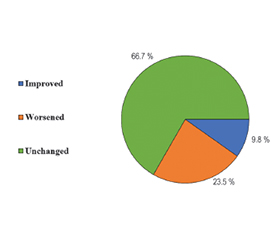
Актуальність. Порушення органів чуття у лікарів-стоматологів є актуальною професійною проблемою, адже їхня робота вимагає постійної зорової концентрації в умовах штучного освітлення, тривалого перебування у вимушено незручному положенні та впливу шуму і мікровібрації від стоматологічного обладнання. Мета: вивчити поширеність виробничо-зумовлених патологій органів чуття серед лікарів-стоматологів шляхом анонімного анкетування. Матеріали та методи. Проведено онлайн-опитування 137 лікарів-стоматологів України за допомогою спеціально розробленої анкети у вигляді Google-форми. Статистичну обробку отриманих даних здійснювали з використанням загальноприйнятих методів описової статистики й програм Statistica 6.1 та Microsoft Excel 2010. Результати. Найбільш поширеними виробничо-зумовленими патологіями органів чуття були порушення зору, які відзначили 49,6 % опитаних. При цьому лише 30,9 % респондентів із порушеннями зору застосовували в роботі системи оптичного збільшення, 66,7 % мали досвід використання оптики до 5 років. Погіршення зору з професійною діяльністю пов’язували 72 % опитаних, недостатнє освітлення робочого місця зазначили 22 % респондентів із порушеннями зору. Ознаки порушення слуху відзначили 18,2 % стоматологів, переважно лікарі терапевтичного профілю (84 %). Основ-ними скаргами були періодичний шум у вухах та зниження слуху. Порушення тактильної чутливості, оніміння й поколювання пальців верхніх кінцівок виявлено в 4,4 % опитаних. Усі ці респонденти працювали понад 8 годин на день, переважно без асистента та в умовах недостатньої ергономічної організації робочого простору. Висновки. Виробничо-зумовлені порушення органів зору, слуху й тактильної чутливості є поширеною професійною проблемою серед лікарів-стоматологів. Найбільш вразливим органом чуття є зоровий аналізатор, що може бути пов’язано із тривалим зоровим навантаженням, недостатньою ергономікою робочого місця й недотриманням режиму праці. Такі результати свідчать про необхідність подальших досліджень і розробки профілактичних заходів, спрямованих на збереження професійного здоров’я лікарів-стоматологів.
Background. Sensory organ disorders in dentists represent an important occupational problem because dental practice requires constant visual concentration under artificial lighting, prolonged work in constrained postures, and continuous exposure to noise and microvibration generated by dental equipment. The study aimed to investigate the prevalence of occupationally induced sensory organ disorders among dentists using an anonymous survey. Materials and methods. The study surveyed 137 Ukrainian dentists using a specially designed Google Form questionnaire. Statistical analysis included conventional descriptive statistical methods using Statistica 6.1 and Microsoft Excel 2010 software. Results. Visual impairment represented the most common occupationally induced sensory disorder and occurred in 49.6 % of respondents. However, only 30.9 % of participants with visual disorders worked using magnification systems, while 66.7 % had less than 5 years of experience using optical magnification. Moreover, 72 % of respondents associated visual deterioration with professional activity, whereas 22 % of participants with visual disorders reported insufficient workplace lighting. Hearing impairment occurred in 18.2 % of dentists, predominantly among therapeutic dentists (84 %). The main complaints included periodic tinnitus and hearing loss. In addition, 4.4 % of respondents reported tactile sensitivity disturbances, numbness, and tingling in the fingers of the upper extremities. All these participants worked more than 8 hours per day, predominantly without an assistant and under conditions of inadequate ergonomic workplace organization. Conclusions. Occupationally induced visual, auditory, and tactile disorders represent common professional problems among dentists. The visual system appears to be the most vulnerable sensory component, which may relate to prolonged visual strain, inadequate workplace ergonomics, and failure to maintain appropriate work-rest regimens. The obtained results indicate the need for further research and development of preventive measures aimed at preserving dentists’ occupational health.
Список литературы
1. Melnyk SV, Horzov LF, Melnyk VS. Difficulty and tension of work of dentists at the workplace. Bul Dent. 2022;118(1):109-114. doi: 10.35220/2078-8916-2022-43-1.19 (in Ukrainian).
2. Reddy KS, Majumder DS, Doshi D. Occupational Hazards in Dentistry. J Res Adv Dent. 2017;6(2):110-122.
3. Gomez-Polo С, Martin Casado AM, Montero J. Burnout syndrome in dentists: Work-related factors. Internat Dent J. 2022;121(8):1-8. doi: 10.1016/j.jdent.2022.104143.
4. Vorovenci A, Perieanu V, Cminiteanu F, Petri SA, Burlibaa L, et al. Occupational diseases among dental personnel: a scoping review. J Med Life. 2025;18(6):526-535. doi: 10.25122/jml-2024-0412.
5. Soo SY, Ang WS, Chong CH, Tew IM, Yahya NA. Occupational ergonomics and related musculoskeletal disorders among dentists: A systematic review. Work. 2023;74(2):469-476. doi: 10.3233/WOR-211094.
6. Shah SJ, Shah S, Khairnar MR, et al. Risk factors of musculoskeletal problems among dental professionals in a dental institute: A cross-sectional survey. World J Dent. 2022;13(1):35-39. doi: 10.5005/jp-journals-10015-1895.
7. Povsheniuk AV, Shinkaruk-Dykovytska MM, Pavliuk DD. Prevalence of musculoskeletal and nervous system disorders among dentists. Rep Vinnytsia Nation. Med Univ. 2024;28(1):109-112. doi: 10.31393/reports-vnmedical-2024-28(1)-19 (in Ukrainian).
8. Al-Rawi NH, Al Nuaimi AS, Sadiqi A, Azaiah E, Ezzeddine D, et al. Occupational noise-induced hearing loss among dental professionals. Quintessence Int. 2019;50(3):245-250. doi: 10.3290/j.qi.a41907.
9. Hartland JC, Tejada G, Riedel EJ, Chen AH, Masca–renhas O, Kroon J. Systematic review of hearing loss in dental professionals. Occup Med. 2023;73(7):391-397. doi: 10.1093/occmed/kqad084.
10. Suedbeck J, Ludwig EA, Blando J, Michalak N. Effects of ultrasonic use on hearing loss in dental hygienists: A matched pairs design study. J Dent Hyg. 2024;98(5):7-15.
11. Alamri A, ElSharkawy MF, Alafandi D. Occupational physical hazards and safety practices at dental clinics. Eur J Dent. 2023;17(2):439-449. doi: 1055/s-0042-1745769.
12. Vodanovic M. Occupational health hazards in contemporary dentistry — a review. Rad Hrvat Akad Znan I Umjet Med Znan. 2017;530:19-36. doi: 10.21857/ypn4oc6n89.
13. Marklund S, Mienna CS, Wahlstrm J, Englund E, Wie-singer B. Work ability and productivity among dentists: associations with musculoskeletal pain, stress, and sleep. Int Arch Occup Environ Health. 2020;93(2):271-278. doi: 10.1007/s00420-019-01478-5.
14. Pinella Vega M, Panta-Guardado OF, Cabrejo Paredes J, Lazaro Rodriguez H. Burnout syndrome in dentists. Rev Med Trujillo. 2022;17(3):91-93. Available from: https://revistas.unitru.edu.pe/index.php/RMT/article/view/4503.
15. Chorna VV, Makhniuk VM, Моhylnyi SM, Khliestova SS, Podolian VМ, et al. The state of occupational stress in medical workers, counteraction and overcoming it. Environ Amp Health. 2022;2(103):53-62. doi: 10.32402/dovkil2022.02.053 (in Ukrainian).
16. Maghsoudipour M, Hosseini F, Coh P, Garib S. Evaluation of occupational and nonoccupational risk factors associated with carpal tunnel syndrome in dentists. Work. 2021;69(1):181-186. doi: 10.3233/WOR-213467.
17. Mazur I, Chernenko L, Polanska L, Komisarenko V, Segin L, et al. Analysis of the main indicators of dental care in Ukraine for 2022. OGH. 2023;4(2):19-25. Available from: https://oralhealth-journal.com/index.php/journal/article/view/158.
18. Golovanova IA, Bielikova IV, Lyakhova NO. Fundamentals of medical statistics: a textbook for postgraduate students and clinical residents. Poltava; 2017. 113 р. (in Ukrainian).
19. Goczewski M. Ergonomic Consideration of Sight Shifts between the Microscopic and Macroscopic Environments in Microscopic Dentistry for Inexperienced Operators. Int J Environ Res Public Health. 2021;18(15):7916. doi: 10.3390/ijerph18157916.
20. Goczewski M, Stupnitskiy RM. Research methodology anatomical defects of the dental system for a choice of an orthopedic design. Stomatology. 2021;4:54-58. Available from: https://www.dentalexpert.com.ua/index.php/stomatology/article/view/428.
21. Moodley R, Naidoo S, Wyk J. The prevalence of occupational health-related problems in dentistry: A review of the literature. J Occup Health. 2018;60(2):111-125. doi: 10.1539/joh.17-0188-ra.
22. Gadzhula NG, Kostiuchyk AV. Analysis of clinical practice in root canal irrigation during endodontic treatment: results of a questionnaire survey. Rep Vinnytsia Nation Med Univ. 2025;29(3):514-520. Available from: https://reports-vnmedical.com.ua/index.php/journal/article/view/1456 (in Ukrainian).
23. Chugh A. Occupational Hazards in Prosthetic Dentistry. Dentistry. 2017;7(2). doi: 10.4172/2161-1122.1000410.
24. Dierickx M, Verschraegen S, Wierinck E, Willems G, van Wie-ringen A. Noise Disturbance and Potential Hearing Loss Due to Exposure of Dental Equipment in Flemish Dentists. International Journal of Environmental Research and Public Health. 2021;18(11):5617. doi: 10.3390/ijerph18115617.
25. Chopra A, Thomas BS, Mohan K, Sivaraman K. Auditory and Nonauditory Effects of Ultrasonic Scaler Use and Its Role in the Development of Permanent Hearing Loss. Oral Health Prev Dent. 2016;14(6):493-500. doi: 10.3290/j.ohpd.a36520.
26. Alabdulwahhab BM, Alduraiby RI, Ahmed MA, Albatli LI, Alhumain MS, et al. Hearing loss and its association with occupational noise exposure among Saudi dentists: a cross-sectional study. BDJ Open. 2016;2:16006. doi: 10.1038/bdjopen.2016.6.
27. Ma KW, Wong HM, Mak CM. Dental Environmental Noise Evaluation and Health Risk Model Construction to Dental Professionals. International Journal of Environmental Research and Public Health. 2017;14(9):1084. doi: 10.3390/ijerph14091084.
28. Turcot A, Hamel D, Tessier M. Hand-arm vibration syndrome in dentistry: A questionnaire survey among dentists and review of literature. Proceedings. 2023;86(1):17. doi: 10.3390/procee–dings2023086017.