
Международный эндокринологический журнал Том 22, №4, 2026
Вернуться к номеру
Оксидативний стрес, інсулінорезистентність і серцево-судинний ризик у пацієнтів із цукровим діабетом 2-го типу в умовах хронічного стресу воєнного часу: клініко-біохімічне дослідження 8-ізо-простагландину F2α
Авторы: Ковальчук А.В., Зінич О.В., Шишкань-Шишова К.О., Кушнарьова Н.М., Прибила О.В., Шупрович А.А.
ДУ «Інститут ендокринології та обміну речовин імені В.П. Комісаренка НАМН України», м. Київ, Україна
Рубрики: Эндокринология
Разделы: Клинические исследования
Версия для печати
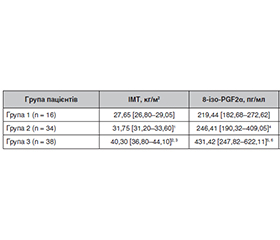
Актуальність. 8-ізо-простагландин F2α (8-ізо-PGF2α) — стабільний F2-ізопростан, визнаний золотим стандартом біомаркера системного оксидативного стресу (ОС) in vivo. Хронічне психоемоційне навантаження воєнного часу потенційно сприяє оксидативному стресу в цивільного населення із цукровим діабетом 2-го типу (ЦД2). Зв’язок між інтенсивністю ОС, інсулінорезистентністю, ожирінням і маніфестацією серцево-судинних захворювань (ССЗ) у цій популяції залишається недостатньо дослідженим. Мета: встановити відмінності в рівнях оксидативного стресу за сироватковим 8-ізо-PGF2α залежно від ступеня інсулінорезистентності й ожиріння, а також проаналізувати в цьому контексті частоту виникнення тяжких серцево-судинних захворювань у цивільних пацієнтів із ЦД2 в умовах хронічного стресу воєнного часу. Матеріали та методи. Обсерваційне поперечне дослідження включало 88 цивільних пацієнтів із ЦД2 (тривалість ≥ 6 місяців), порівнянних за віком і супутньою терапією. Індекс маси тіла (ІМТ), глікемія та інсулінемія натще, індекс HOMA-IR визначалися стандартизованими методами; сироватковий рівень 8-ізо-PGF2α — методом імуноферментного аналізу (FineTest®). Пацієнтів стратифікували за ІМТ (< 29,9; 30,0–33,9; 34,0–39,3 кг/м2) та окремо — за наявністю задокументованих тяжких серцево-судинних подій. Застосовано непараметричні методи порівняння (Крускала — Уолліса, Вілкоксона). Результати. Встановлено вірогідне зростання концентрації 8-ізо-PGF2α відповідно до збільшення ІМТ: медіана 219,44 [182,68–272,62] пг/мл у групі без ожиріння, 246,41 [190,32–409,05] пг/мл при ожирінні I ст. і 431,42 [247,82–622,11] пг/мл при ожирінні II–III ст. (p < 0,01 між групами 1 і 3). HOMA-IR зростав від 3,34 [2,13–5,07] до 6,27 [3,41–9,00] ум.од. (p < 0,05). У пацієнтів із задокументованими тяжкими ССЗ (n = 21) рівень 8-ізо-PGF2α становив 465,47 [409,05–633,68] пг/мл проти 242,72 [109,32–391,05] пг/мл у пацієнтів без ССЗ (n = 67), р < 0,001. HOMA-IR не відрізнявся (6,24 vs 5,43; р = 0,596), а ІМТ мав лише тенденцію до вищих значень у пацієнтів із ССЗ (р = 0,095). Композитний індикатор 8-ізо-PGF2α/HOMA-IR у групі із ССЗ (74,6) був у ~1,7 раза вищий за такий у групі без ССЗ (44,7), що свідчить про дисоційоване посилення ОС відносно інсулінорезистентності. Висновки. Концентрація 8-ізо-PGF2α односпрямовано зростає зі ступенем ожиріння й інсулінорезистентності в пацієнтів із ЦД2. Тяжкі серцево-судинні захворювання асоціюються з високовірогідно вищою інтенсивністю ОС незалежно від рівня інсулінорезистентності, що підкреслює роль ОС як інтегрального медіатора кардіоваскулярного ушкодження при ЦД2 в умовах хронічного воєнного стресу.
Background. 8-iso-prostaglandin F2α (8-iso-PGF2α) — a stable F2-isoprostane recognized as the gold standard biomarker of systemic oxidative stress (OS) in vivo. Chronic psychoemotional stress of wartime potentially contributes to OS in civilian patients with type 2 diabetes mellitus (T2DM). The interplay between OS intensity, insulin resistance (IR), obesity, and manifestation of cardiovascular disease (CVD) in this population remains poorly studied. The purpose of the study is to establish differences in the levels of oxidative stress, represented by serum 8-iso-PGF2α, depending on the degree of IR and obesity, and to analyse in this context the incidence of severe CVD in civilian patients with T2DM under conditions of chronic wartime stress. Materials and methods. In a cross-sectional observational study, we enrolled 88 civilian patients with T2DM (duration ≥ 6 months), matched for age and background therapy. Body mass index (BMI), fasting glycaemia/insulinaemia, HOMA-IR were measured using standardized protocols, serum 8-iso-PGF2α — using enzyme-linked immunosorbent assay, (FineTest®). Patients were stratified by BMI (< 29.9; 30.0–33.9; 34.0–39.3 kg/m2) and separately by documented major cardiovascular events. Non-parametric tests (Kruskal-Wallis, Wilcoxon) were applied. Results. Serum 8-iso-PGF2α concentrations increased significantly in accordance with an increase in BMI: median 219.44 [182.68–272.62] pg/mL in non-obese group, 246.41 [190.32–409.05] pg/mL in grade I obesity, and 431.42 [247.82–622.11] pg/mL in grade II–III obesity (p < 0.01 between groups 1 vs 3). HOMA-IR rose from 3.34 [2.13–5.07] to 6.27 [3.41–9.00] (p < 0.05). In patients with documented severe CVD (n = 21), 8-iso-PGF2α reached 465.47 [409.05–633.68] pg/mL versus 242.72 [109.32–391.05] pg/mL in those without CVD (n = 67); p < 0.001. HOMA-IR did not differ (6.24 vs 5.43; p = 0.596), while BMI showed only a trend towards higher values in patients with CVD (p = 0.095). The composite 8-iso-PGF2α/HOMA-IR index was ~ 1.7-fold higher in the CVD patients (74.6) compared to the group without CVD (44.7) indicating dissociated amplification of OS relative to IR. Conclusions. Serum 8-iso-PGF2α levels increase unidirectionally with the severity of obesity and IR in T2DM patients. Severe CVDs are associated with substantially higher OS intensity irrespective of IR level, highlighting the role of OS as an integrative mediator of cardiovascular injury in T2DM amplified by chronic wartime stress.
цукровий діабет 2-го типу; 8-ізо-простагландин F2α; оксидативний стрес; інсулінорезистентність; ожиріння; серцево-судинні захворювання; воєнний час
type 2 diabetes mellitus; 8-iso-prostaglandin F2α; oxidative stress; insulin resistance; obesity; cardiovascular disease; wartime stress
Для ознакомления с полным содержанием статьи необходимо оформить подписку на журнал.
- American Diabetes Association Professional Practice Committee. 10. Cardiovascular Disease and Risk Management: Standards of Care in Diabetes — 2025. Diabetes Care. 2025;48(Suppl 1):S207-S238. doi: 10.2337/dc25-S010. PMID: 39651970.
- Marx N, Federici M, Schütt K, Müller-Wieland D, Ajjan RA, Antunes MJ, et al. 2023 ESC Guidelines for the management of cardiovascular disease in patients with diabetes. Eur Heart J. 2023;44(39):4043-4140. doi: 10.1093/eurheartj/ehad192. PMID: 37622663.
- Milne GL, Dai Q, Roberts LJ 2nd. The isoprostanes — 25 years later. Biochim Biophys Acta. 2015;1851(4):433-445. doi: 10.1016/j.bbalip.2014.10.007. PMID: 25449649.
- Davì G, Falco A, Patrono C. Determinants of F2-isoprostane biosynthesis and inhibition in man. Chem Phys Lipids. 2004;128(1-2):149-163. doi: 10.1016/j.chemphyslip.2003.10.001. PMID: 15037160.
- Santilli F, Lapenna D, La Barba S, Davì G. Oxidative stress-related mechanisms affecting response to aspirin in diabetes mellitus. Free Radic Biol Med. 2015;80:101-110. doi: 10.1016/j.freeradbiomed.2014.12.010. PMID: 25530150.
- Santilli F, Mucci L, Davì G. TP receptor activation and inhibition in atherothrombosis: the paradigm of diabetes mellitus. Intern Emerg Med. 2011;6(3):203-212. doi: 10.1007/s11739-010-0440-3. PMID: 20734162.
- Schöttker B, Xuan Y, Gào X, Anusruti A, Brenner H. Oxidatively Damaged DNA/RNA and 8-Isoprostane Levels Are Associated With the Development of Type 2 Diabetes at Older Age: Results From a Large Cohort Study. Diabetes Care. 2020;43(1):130-136. doi: 10.2337/dc19-1379. PMID: 31653645.
- Ma N, Zhang Y, Liu B, Jia X, Wang R, Lu Q. Associations of plasma 8-iso-prostaglandin F2α levels with fasting blood glucose (FBG) and intra-abdominal fat (IAF) area in various Glycometabolism populations. BMC Endocr Disord. 2021;21(1):215. doi: 10.1186/s12902-021-00879-3. PMID: 34711211.
- Wang Z, Li L, Zheng F, Jia C, Ruan Y, Li H. Correlation between the amplitude of glucose excursion and the oxidative/antioxidative system in subjects with different types of glucose regulation. Biomed Environ Sci. 2011;24(1):68-73. doi: 10.3967/0895-3988.2011.01.009. PMID: 21440842.
- Osei F, Block A, Wippert PM. Association of primary allostatic load mediators and metabolic syndrome (MetS): A systematic review. Front Endocrinol (Lausanne). 2022;13:946740. doi: 10.3389/fendo.2022.946740. PMID: 36482995.
- Lawrence S, Scofield RH. Post traumatic stress disorder associated hypothalamic-pituitary-adrenal axis dysregulation and physical illness. Brain Behav Immun Health. 2024;41:100849. doi: 10.1016/j.bbih.2024.100849. PMID: 39280087.
- Sunena, Mishra DN. Stress Etiology of Type 2 Diabetes. Curr Diabetes Rev. 2022;18(9):e240222201413. doi: 10.2174/1573399818666220224140934. PMID: 35209829.
- Gammoh O, Al-Ameri M, Shilbayeh SAR, Aljabali AA, Aldossary KM, AlRasheed HA. PTSD symptoms in war-displaced refugees diagnosed with hypertension or type 2 diabetes: Prevalence and correlates. J Health Psychol. 2025;30(12):3185-3193. doi: 10.1177/13591053251315890. PMID: 39891420.
- Sulaieva O, Yerokhovych V, Zemskov S, Komisarenko I, Guria–nov V, Pankiv V, et al. The impact of war on people with type 2 diabetes in Ukraine: a survey study. EClinicalMedicine. 2024;79:103008. doi: 10.1016/j.eclinm.2024.103008. PMID: 39791105.
- Boulton AJM, Jenkins AJ, Makkar B, Mankovsky B, Abe–ra MA, Tesfaye S. Diabetes and natural and man-made disasters: prevention, preparation, response and recovery. Diabetologia. 2025. doi: 10.1007/s00125-025-06406-6. PMID: 40234304.
- Matthews DR, Hosker JP, Rudenski AS, Naylor BA, Trea–cher DF, Turner RC. Homeostasis model assessment: insulin resistance and beta-cell function from fasting plasma glucose and insulin concentrations in man. Diabetologia. 1985;28(7):412-419. doi: 10.1007/BF00280883. PMID: 3899825.
- Graille M, Wild P, Sauvain JJ, Hemmendinger M, Guseva Canu I, Hopf NB. Urinary 8-isoprostane as a biomarker for oxidative stress. A systematic review and meta-analysis. Toxicol Lett. 2020;328:19-27. doi: 10.1016/j.toxlet.2020.04.006. PMID: 32320775.
- Menzel A, Samouda H, Dohet F, Loap S, Ellulu MS, Bohn T. Common and Novel Markers for Measuring Inflammation and Oxidative Stress Ex Vivo in Research and Clinical Practice — Which to Use Regarding Disease Outcomes? Antioxidants (Basel). 2021;10(3):414. doi: 10.3390/antiox10030414. PMID: 33803155.
- Arjmand MH. The association between visceral adiposity with systemic inflammation, oxidative stress, and risk of post-surgical adhesion. Arch Physiol Biochem. 2022;128(4):869-874. doi: 10.1080/13813455.2020.1733617. PMID: 32141779.
- Engin A. Endothelial Dysfunction in Obesity and Therapeutic Targets. Adv Exp Med Biol. 2024;1460:489-538. doi: 10.1007/978-3-031-63657-8_17. PMID: 39287863.
- Costabile G, Della Pepa G, Bozzetto L, Annuzzi G, Vetrani C, Giacco R, et al. Urine 8-isoprostane in relation to adiposity and insulin resistance in individuals at high cardiometabolic risk. Metab Syndr Relat Disord. 2015;13(4):187-191. doi: 10.1089/met.2014.0119. PMID: 25714911.
- Caturano A, D’Angelo M, Mormone A, Russo V, Mollica MP, Salvatore T, et al. Oxidative Stress in Type 2 Diabetes: Impacts from Pathogenesis to Lifestyle Modifications. Curr Issues Mol Biol. 2023;45(8):6651-6666. doi: 10.3390/cimb45080420. PMID: 37623239.
- Vladu IM, Forțofoiu M, Clenciu D, Forțofoiu MC, Pădu–reanu R, Radu L, et al. Insulin resistance quantified by the value of HOMA-IR and cardiovascular risk in patients with type 2 diabetes. Exp Ther Med. 2022;23(1):73. doi: 10.3892/etm.2021.10996. PMID: 34934444.
- Osmenda G, Matusik PT, Sliwa T, Czesnikiewicz-Guzik M, Skupien J, Malecki MT, et al. Nicotinamide adenine dinucleotide phosphate (NADPH) oxidase p22phox subunit polymorphisms, systemic oxidative stress, endothelial dysfunction, and atherosclerosis in type 2 diabetes mellitus. Pol Arch Intern Med. 2021;131(5):447-454. doi: 10.20452/pamw.15937. PMID: 33851807.
- Abd-Elmoniem KZ, Edwan JH, Dietsche KB, Villalobos-Perez A, Shams N, Matta J, et al. Endothelial Dysfunction in Youth-Onset Type 2 Diabetes: A Clinical Translational Study. Circ Res. 2024;135(6):639-650. doi: 10.1161/CIRCRESAHA.124.324272. PMID: 39069898.
- Qiu J, Liu D, Li P, Zhou L, Zhou L, Liu X, et al. NADPH Oxidase Mediates Oxidative Stress and Ventricular Remodeling through SIRT3/FOXO3a Pathway in Diabetic Mice. Antioxidants (Basel). 2022;11(9):1745. doi: 10.3390/antiox11091745. PMID: 36139819.
- Seal SV, Turner JD. The ‘Jekyll and Hyde’ of Gluconeogenesis: Early Life Adversity, Later Life Stress, and Metabolic Disturbances. Int J Mol Sci. 2021;22(7):3344. doi: 10.3390/ijms22073344. PMID: 33805856.
- Shkoruta DP, Senkiv V, Vovchuk V, Popadynets O, Kotyk T. Impact of war on stroke incidence in Ivano-Frankivsk, Ukraine. Sci Rep. 2024;14(1):18996. doi: 10.1038/s41598-024-70270-4. PMID: 39152236.
- Butska LV, Drevitska OO, Dybkalyuk SV, Ryzhak VO. Comprehensive approach to the rehabilitation of professionals with high levels of psychophysical stress, pain syndromes and type 2 diabetes mellitus during the war. Pol Merkur Lekarski. 2025;53(1):34-39. doi: 10.36740/Merkur202501105. PMID: 40063909.
- Lushchak O, Strilbytska O, Koliada A, Storey KB. An orchestrating role of mitochondria in the origin and development of post-traumatic stress disorder. Front Physiol. 2023;13:1094076. doi: 10.3389/fphys.2022.1094076. PMID: 36703926.
- Fontes MAP, Marins FR, Patel TA, de Paula CA, Machado LRDS, de Sousa Lima EB, et al. Neurogenic Background for Emotional Stress-Associated Hypertension. Curr Hypertens Rep. 2023;25(7):107-116. doi: 10.1007/s11906-023-01235-7. PMID: 37058193.
- Luna-Marco C, Iannantuoni F, Hermo-Argibay A, Devos D, Salazar JD, Víctor VM, et al. Cardiovascular benefits of SGLT2 inhibitors and GLP-1 receptor agonists through effects on mitochondrial function and oxidative stress. Free Radic Biol Med. 2024;213:19-35. doi: 10.1016/j.freeradbiomed.2024.01.015. PMID: 38220031.
- Li X, Preckel B, Hermanides J, Hollmann MW, Zuurbier CJ, Weber NC. Amelioration of endothelial dysfunction by sodium glucose co-transporter 2 inhibitors: pieces of the puzzle explaining their cardiovascular protection. Br J Pharmacol. 2022;179(16):4047-4062. doi: 10.1111/bph.15850. PMID: 35393687.
- Preda A, Montecucco F, Carbone F, Camici GG, Lüscher TF, Kraler S, et al. SGLT2 inhibitors: from glucose-lowering to cardiovascular benefits. Cardiovasc Res. 2024;120(5):443-460. doi: 10.1093/cvr/cvae047. PMID: 38456601.