
Международный эндокринологический журнал Том 22, №4, 2026
Вернуться к номеру
Анапластичний рак щитоподібної залози: клініко-онкологічні характеристики та прогностичні чинники найлетальнішого тиреоїдного раку
Авторы: Гуда Б.Б., Тимків А.В., Комісаренко І.І., Остафійчук М.В., Гамезардашвілі І.В., Юхимчук О.О.
ДУ «Інститут ендокринології та обміну речовин імені В.П. Комісаренка НАМН України», м. Київ, Україна
Рубрики: Эндокринология
Разделы: Клинические исследования
Версия для печати
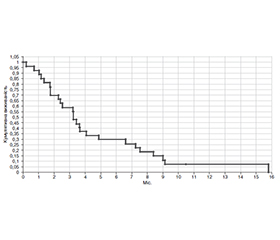
Актуальність. Дані літератури останніх років відображають суттєве підвищення наукового інтересу до етіології, молекулярних порушень, біологічних особливостей, прогностичних змінних та терапевтичних можливостей щодо анапластичного раку щитоподібної залози (ЩЗ). Рідкісність патології, складнощі у швидкій діагностиці та відсутність ефективних терапевтичних підходів для лікування зумовлюють катастрофічно низький рівень виживаності пацієнтів. Водночас комплексний підхід до проблеми (молекулярний патогенез, точна діагностика, клінічні прояви, удосконалення мультимодальної терапії) спроможний забезпечити суттєвий прогрес у лікуванні найагресивнішої серед усіх тиреоїдних пухлин карциноми. Мета: проведення ретроспективного аналізу клінічних даних пацієнтів з анапластичною карциномою ЩЗ щодо діагностики, характеристик пухлин та чинників, які можуть впливати на тривалість післяопераційного періоду життя пацієнтів та рівень їх виживаності. Матеріали та методи. Проведено ретроспективний аналіз даних 27 хворих з анапластичним раком ЩЗ, які були обстежені та прооперовані в період з 1989 до 2024 року. Аналізували: вік, стать, розміри пухлин, результати цитологічних досліджень аспіратів, наявність метастазів (регіонарних та віддалених) та інвазії карцином (у капсулу та судини пухлини, інтра- чи екстратиреоїдну), обсяг хірургічного втручання, післяопераційне лікування, а також тривалість життя та рівень виживаності хворих. Результати. Встановлена відсутність будь-яких відмінностей клінічних характеристик захворювання, а також медіани тривалості післяопераційного життя, рівня летальності і виживаності хворих різної статі, що суттєво відрізняється від такого за диференційованих тиреоїдних карцином. Такі клінічні характеристики, як значний розмір пухлин, їх широка інвазійність (що поширюється на критичні органи, які оточують залозу), регіонарне метастазування переважно у лімфовузли латеральних відділів шиї, наявність віддалених метастазів (частота їх збільшується з підвищенням розміру пухлин), катастрофічно низька тривалість післяопераційного життя хворих (яка ще більше зменшується за наявності зазначених характеристик), висока летальність, свідчать про надагресивний характер анапластичної карциноми. Інтра- та екстратиреоїдна інвазія, віддалене метастазування та розмір пухлини понад 8 см є прогностичними біологічними маркерами виживаності хворих, а повна резекція пухлини та проведення зовнішньої променевої терапії — позитивними терапевтичними факторами, що впливають на прогноз захворювання. Висновки. Спрямовані дослідження основних патогенетичних та клінічних аспектів патології, а також удосконалення мультимодальної стратегії лікування, включаючи наявні методи разом з розробкою та застосуванням таргетної та імунотерапії, можуть суттєво поліпшити загальну виживаність приречених пацієнтів.
Background. The literature data of recent years reflect a significant increase in scientific interest in etiology, molecular abnormalities, biological features, prognostic variables, and therapeutic options for anaplastic thyroid cancer. The rarity of pathology, the difficulties in rapid diagnosis, and the lack of effective approaches to treatment lead to a catastrophically low survival rate. At the same time, a comprehensive approach to the problem (molecular pathogenesis, accurate diagnosis, clinical manifestations, improved multimodal therapy) can ensure significant progress in the treatment of carcinoma, the most aggressive of all thyroid tumors. The purpose of the work is to conduct a retrospective analysis of clinical data from patients with anaplastic thyroid cancer regarding diagnosis, tumor characteristics, and factors that may affect the duration of the postoperative period and survival rate. Materials and methods. A retrospective analysis was conducted of data from 27 patients with anaplastic thyroid cancer who were examined and operated on between 1989 and 2024. The following factors were analyzed: age, gender, tumor size, cytological findings of aspirates, presence of metastases (regional and distant) and carcinoma invasion (into the tumor capsule and vessels, intra- or extrathyroidal), extent of surgical intervention, postoperative treatment, as well as life expectancy and survival rate. Results. No differences were found in the clinical characteristics of the disease, the median duration of postoperative life, the level of mortality and survival of patients of either sex, which is significantly distinct from that in differentiated thyroid carcinomas. Clinical characteristics such as significant size of tumors, their wide invasiveness (spreading to critical organs surrounding the gland), regional metastasis mainly to the lateral cervical lymph nodes, the presence of distant metastases (their frequency increases with increasing tumor size), catastrophically low postoperative life expectancy (which is even more reduced in the presence of these characteristics), and high mortality indicate the hyperaggressive nature of anaplastic carcinoma. Intra- and extrathyroidal invasion, distant metastasis, and tumor size greater than 8 cm are prognostic biological markers of patient survival, and complete tumor resection and external beam radiation therapy are positive therapeutic factors that influence disease prognosis. Conclusions. Targeted research into the main pathogenetic and clinical aspects of pathology, as well as improving the multimodal treatment strategy, including existing methods together with the development and application of targeted and immunotherapy, can significantly improve the overall survival of doomed patients.
анапластична карцинома щитоподібної залози; інвазія; метастази; розмір пухлин; лікування; тривалість життя; виживаність
anaplastic thyroid carcinoma; invasion; metastasis; tumor size; treatment; life expectancy; survival rate
Для ознакомления с полным содержанием статьи необходимо оформить подписку на журнал.
- Wang K, Zhang Y, Xing Y, Wang H, He M, Guo R. Current and future of immunotherapy for thyroid cancer based on bibliometrics and clinical trials. Discov Oncol. 2024 Feb 25;15(1):50. doi: 10.1007/s12672-024-00904-6.
- Landa I, Cabanillas ME. Genomic alterations in thyroid cancer: biological and clinical insights. Nat Rev Endocrinol. 2024 Feb;20(2):93-110. doi: 10.1038/s41574-023-00920-6.
- Howlader N, Noone AM, Krapcho M. SEER Cancer Statistics Review, 1975-2014 [Internet]. Bethesda (MD): National Cancer Institute; [cited 2022 Jul 6]. Available from: https://seer.cancer.gov/csr/1975_2014/.
- Mosoane B, McCabe M, Jackson BS, Dlamini Z. CD44 Variant Expression in Follicular Cell-Derived Thyroid Cancers: Implications for Overcoming Multidrug Resistance. Molecules. 2025 Apr 24;30(9):1899. doi: 10.3390/molecules30091899.
- Conradie W, Luvhengo T, Lübbe JA, Afrogheh A, Bestbier A, Bhuiyan M, et al. The clinicopathological landscape of thyroid cancer in South Africa — A multi-institutional review. World J Surg. 2024 Dec;48(12):2863-2870. doi: 10.1002/wjs.12353.
- Capdevila J, Awada A, Führer-Sakel D, Leboulleux S, Pauwels P. Molecular diagnosis and targeted treatment of advanced folli–cular cell-derived thyroid cancer in the precision medicine era. Cancer Treat Rev. 2022 May;106:102380. doi: 10.1016/j.ctrv.2022.102380.
- Bible KC, Kebebew E, Brierley J, Brito JP, Cabanillas ME, Clark TJ Jr, et al. 2021 American Thyroid Association Guidelines for Management of Patients with Anaplastic Thyroid Cancer. Thyroid. 2021 Mar;31(3):337-386. doi: 10.1089/thy.2020.0944. Erratum in: Thyroid. 2021 Oct;31(10):1606-1607. doi: 10.1089/thy.2020.0944.correx.
- Zhou SY, Luo LX. An overview of the contemporary diagnosis and management approaches for anaplastic thyroid carcinoma. World J Clin Oncol. 2024 Jun 24;15(6):674-676. doi: 10.5306/wjco.v15.i6.674.
- Kononenko M, Duzhiy I, Moskalenko Yu. Targeted therapy of anaplastic thyroid cancer. East Ukr Med J. 2023;11(2):113-120. https://doi.org/10.21272/eumj.2023;11(2):113-120.
- Pushkarev VM, Starenki DV, Saenko VO, Tronko MD, Yamashita S. Effects of Paclitaxel and combination of the drug with radiation therapy in an in vivo model of anaplastic thyroid carcinoma. Exp Oncol. 2011 Mar;33(1):24-27.
- Singh A, Ham J, Po JW, Niles N, Roberts T, Lee CS. The Genomic Landscape of Thyroid Cancer Tumourigenesis and Implications for Immunotherapy. Cells. 2021 May 1;10(5):1082. doi: 10.3390/cells10051082.
- Volante M, Lam AK, Papotti M, Tallini G. Molecular Patho–logy of Poorly Differentiated and Anaplastic Thyroid Cancer: What Do Pathologists Need to Know? Endocr Pathol. 2021 Mar;32(1):63-76. doi: 10.1007/s12022-021-09665-2.
- Wan Z, Wang B, Yao J, Li Q, Miao X, Jian Y, et al. Predictive factors and clinicopathological characteristics of outcome in poorly differentiated thyroid carcinoma: a single-institution study. Front Oncol. 2023 Jul 7;13:1102936. doi: 10.3389/fonc.2023.1102936.
- Smith AL, Williams MD, Stewart J, Wang WL, Krishnamurthy S, Cabanillas ME, et al. Utility of the BRAF p.V600E immunoperoxidase stain in FNA direct smears and cell block preparations from patients with thyroid carcinoma. Cancer Cytopathol. 2018 Jun;126(6):406-413. doi: 10.1002/cncy.21992.
- Baloch ZW, Asa SL, Barletta JA, Ghossein RA, Juhlin CC, Jung CK, et al. Overview of the 2022 WHO Classification of Thyroid Neoplasms. Endocr Pathol. 2022 Mar;33(1):27-63. doi: 10.1007/s12022-022-09707-3.
- Mneimneh WS, Asa SL. Divergent Lineage Markers in Anaplastic Thyroid Carcinoma. Am J Surg Pathol. 2024 Feb 1;48(2):230-237. doi: 10.1097/PAS.0000000000002153.
- Ullah A, Prasad K, Ahmed A, Lee KT, Yasinzai AQK, Iqbal A, et al. Anaplastic thyroid carcinoma: interplay of predictive factors, treatment challenges, and survival insights. Expert Rev Endocrinol Metab. 2025 Mar;20(2):129-138. doi: 10.1080/17446651.2025.2467660.
- Adedeji A, Omakobia E, Ojo C, Coatesworth A, Agada F. Disproportionately Increased Incidence of Anaplastic Thyroid Cancer in the North Yorkshire Region: A UK Tertiary Centre Study. Cureus. 2024 Oct 21;16(10):e72006. doi: 10.7759/cureus.72006.
- Filetti S, Durante C, Hartl D, Leboulleux S, Locati LD, Newbold K, et al. Thyroid cancer: ESMO Clinical Practice Guidelines for diagnosis, treatment and follow-up. Ann Oncol. 2019 Dec 1;30(12):1856-1883. doi: 10.1093/annonc/mdz400.
- Cho S, Kim H, Oh YL, Hahn SY, Kim TH, Shin JH. Comparison of clinicopathological characteristics and survival between symptomatic and asymptomatic anaplastic thyroid carcinoma. Sci Rep. 2023 Feb 24;13(1):3264. doi: 10.1038/s41598-023-30162-5.
- Coperchini F, Greco A, Caccavale P, Chiardi I, Croce L, Teliti M, et al. Sexual dimorphism in thyroid cancer: evidence from preclinical studies. Endocr Relat Cancer. 2025 Apr 22;32(5):e240348. doi: 10.1530/ERC-24-0348.
- Wang L, Liao L, Huang J, Zhang Q, Xiong Y, Tian F, et al. Global, regional, and national epidemiology of thyroid cancer in middle-aged and elderly adults from 1990 to 2021. Front Med (Lausanne). 2025 Nov 14;12:1735517. doi: 10.3389/fmed.2025.1735517.
- Rajoria S, Parmar P, Suriano R. Estrogen receptor expression in thyroid cancer and its role in tumor progression. Cancer Res. 2010;70(2):812-821. doi: 10.1016/j.biopha.2011.11.010.
- Klein SL, Flanagan KL. Sex differences in immune responses. Nat Rev Immunol. 2016 Oct;16(10):626-638. doi: 10.1038/nri.2016.90.
- Rao SN, Smallridge RC. Anaplastic thyroid cancer: An update. Best Pract Res Clin Endocrinol Metab. 2023 Jan;37(1):101678. doi: 10.1016/j.beem.2022.101678.
- Pozdeyev N, Gay LM, Sokol ES, Hartmaier R, Deaver KE, Davis S, et al. Genetic Analysis of 779 Advanced Differentiated and Anaplastic Thyroid Cancers. Clin Cancer Res. 2018 Jul 1;24(13):3059-3068. doi: 10.1158/1078-0432.CCR-18-0373.
- Maniakas A, Dadu R, Busaidy NL, Wang JR, Ferrarotto R, Lu C, et al. Evaluation of Overall Survival in Patients With Anaplastic Thyroid Carcinoma, 2000-2019. JAMA Oncol. 2020 Sep 1;6(9):1397-1404. doi: 10.1001/jamaoncol.2020.3362.
- Yin H, Tang Y, Guo Y, Wen S. Immune Microenvironment of Thyroid Cancer. J Cancer. 2020 Jun 8;11(16):4884-4896. doi: 10.7150/jca.44506.
- Wu S, Liu Y, Zeng Y, Ruan X, Tao M, Lin W, et al. Prognostic value of EMT-related genes and immune cell infiltration in thyroid carcinoma. Front Immunol. 2024 Nov 4;15:1463258. doi: 10.3389/fimmu.2024.1463258.
- Nguyen XV, Roy Choudhury K, Tessler FN, Hoang JK. Effect of Tumor Size on Risk of Metastatic Disease and Survival for Thyroid Cancer: Implications for Biopsy Guidelines. Thyroid. 2018 Mar;28(3):295-300. doi: 10.1089/thy.2017.0526.
- Yang J, Barletta JA. Anaplastic thyroid carcinoma. Semin Diagn Pathol. 2020 Sep;37(5):248-256. doi: 10.1053/j.semdp.2020.06.005.
- Xia J, Shi Y, Chen X. New insights into the mechanisms of the extracellular matrix and its therapeutic potential in anaplastic thyroid carcinoma. Scientific Reports. 2024;14:20977. https://doi.org/10.1038/s41598-024-72020-y.
- Li Z, Wang N, Li X, Xie Y, Dou Z, Xin H, et al. Thyroid cancer: From molecular insights to therapy (Review). Oncol Lett. 2025 Sep 10;30(5):520. doi: 10.3892/ol.2025.15266.
- Tao Z, Ding Z, Guo B, Fan Y, Deng X. Influence factors and survival outcomes of different invasion sites in locally advanced thyroid cancer and new site-based risk stratification system. Endocrine. 2025 May;88(2):501-510. doi: 10.1007/s12020-025-04165-3.
- Jacob J, Vordermark D, Lorenz K, Medenwald D. Prognostic factors in radiotherapy of anaplastic thyroid carcinoma: a single center study over 31 years. Radiat Oncol. 2023 Apr 19;18(1):71. doi: 10.1186/s13014-023-02249-w.
- Beddok A, Morvan JB, Boudin L, Da Silva Ribeiro Mota A, Dutheil P, Guilbert P, et al. The Role of External Beam Radiation Therapy in Thyroid Cancer Management: A Scoping Review. Int J Radiat Oncol Biol Phys. 2026 Jan 1;124(1):70-91. doi: 10.1016/j.ijrobp.2025.09.050.
- Tan JSH, Tay TKY, Ong EHW, Fehlings M, Tan DS, Sukma NB, et al. Combinatorial Hypofractionated Radiotherapy and Pembrolizumab in Anaplastic Thyroid Cancer. Eur Thyroid J. 2024 Jan 1;13(1):e230144. doi: 10.1530/ETJ-23-0144.
- Glaser SM, Mandish SF, Gill BS, Balasubramani GK, Clump DA, Beriwal S. Anaplastic thyroid cancer: Prognostic factors, patterns of care, and overall survival. Head Neck. 2016 Apr;38(Suppl 1):E2083-90. doi: 10.1002/hed.24384.