
Международный эндокринологический журнал Том 22, №4, 2026
Вернуться к номеру
Депресивні розлади у хворих із предіабетом та цукровим діабетом 2-го типу
Авторы: O. Pavlovych (1), S.S. Tkachuk (1), L.B. Pavlovych (1), O.D. Bilous (1), I.I. Kamyshna (2)
(1) - Bukovinian State Medical University, Chernivtsi, Ukraine
(2) - I. Horbachevsky Ternopil National Medical University, Ternopil, Ukraine
Рубрики: Эндокринология
Разделы: Клинические исследования
Версия для печати
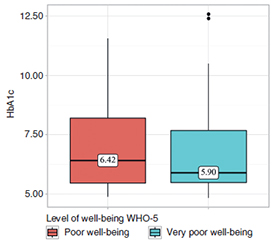
Актуальність. Депресивні розлади є поширеною коморбідністю в пацієнтів із цукровим діабетом 2-го типу (ЦД2) і предіабетом, що суттєво впливає на якість життя, функціональний стан та ефективність терапії. Наявність депресивних симптомів може посилювати метаболічну дисрегуляцію, знижувати прихильність до лікування й підвищувати ризик розвитку ускладнень. Виявлення факторів, пов’язаних із депресією, у пацієнтів із порушенням вуглеводного обміну є важливим для своєчасного втручання й індивідуалізації терапії. Оцінка депресії за допомогою стандартизованих інструментів, як-от PHQ-9, дозволяє надійно оцінити тяжкість симптомів та визначити групи ризику. Тому вивчення депресивних симптомів у пацієнтів із ЦД2 та предіабетом є надзвичайно актуальним для поліпшення як психологічних, так і метаболічних результатів лікування. Мета: оцінка поширеності й тяжкості депресивних симптомів у пацієнтів із цукровим діабетом 2-го типу, предіабетом і депресивно-тривожними розладами, а також вивчення їх взаємозв’язків з антропометричними та метаболічними показниками. Матеріали та методи. У дослідженні взяли участь 200 осіб: 50 пацієнтів із ЦД2, 50 — із предіабетом, 50 — із депресивно-тривожними розладами та 50 практично здорових осіб (група контролю). Депресивні симптоми оцінювали за допомогою опитувальника PHQ-9. Було проведено антропометричні вимірювання (маса тіла, індекс маси тіла (ІМТ)), визначено рівень глікованого гемоглобіну (HbA1c), сироваткового 25(OH)D та індекс HOMA. Статистичний аналіз включав тест Краскела — Уолліса для порівняння груп, кореляційний аналіз за шкалою Чаддока й лінійну регресію для визначення взаємозв’язків між балами за PHQ-9 та метаболічними показниками. Результати. Оцінка за опитувальником PHQ-9 була значно вищою в пацієнтів із ЦД2, переддіабетом і депресивно-тривожними розладами, ніж у контрольній групі (p < 0,001). В осіб із ЦД2 та предіабетом переважали помірна та помірно тяжка депресія, тоді як у всіх хворих із депресивно-тривожними розладами спостерігалася помірно тяжка депресія. Встановлено слабку позитивну кореляцію між балами за PHQ-9 і масою тіла (ρ = 0,173, p = 0,014) та ІМТ (ρ = 0,209, p = 0,003), водночас значущих зв’язків із HbA1c або індексом HOMA не зафіксовано. Виявлено статистично значущий обернений зв’язок між рівнями сироваткового 25(OH)D та оцінкою за опитувальником PHQ-9 (ρ = –0,586; p < 0,001). Нижчі рівні вітаміну D асоціювалися з більшою вираженістю депресивної симптоматики, що пояснювало 64,9 % варіабельності показників PHQ-9. Індекс WHO-5 продемонстрував сильну обернену кореляцію з HbA1c (ρ = –0,570, p < 0,001), що підкреслює зв’язок між рівнем самопочуття та контролем глікемії. Висновки. Депресивні симптоми є значно частішими й тяжчими в пацієнтів із ЦД2 та предіабетом, ніж у практично здорових осіб. Підвищені маса тіла й ІМТ слабко асоційовані з вищою оцінкою за PHQ-9, тоді як показники глікемічного контролю та інсулінорезистентності (HbA1c, індекс HOMA) не продемонстрували прямого зв’язку з тяжкістю депресії. Отримані дані підкреслюють важливість рутинного скринінгу депресивних симптомів та цільових втручань для поліпшення психологічного й метаболічного стану пацієнтів із порушенням вуглеводного обміну.
Background. Depressive disorders are common comorbidities in individuals with type 2 diabetes mellitus (T2DM) and prediabetes, significantly affecting quality of life, functional status, and disease management. The presence of depressive symptoms may exacerbate metabolic dysregulation, reduce adherence to treatment, and increase the risk of complications. Identifying factors associated with depression in patients with impaired glucose metabolism is essential for timely intervention and individualized care. Assessing depression using standardized tools, such as the Patient Health Questionnaire-9 (PHQ-9), enables reliable evaluation of symptom severity and facilitates the identification of at-risk populations. Therefore, studying depressive symptoms in patients with T2DM and prediabetes is highly relevant for improving both psychological and metabolic outcomes. The purpose of this study is to evaluate the prevalence and severity of depressive symptoms in patients with type 2 diabetes mellitus, prediabetes, and depressive-anxiety disorders, and to examine their associations with anthropometric and metabolic parameters. Materials and methods. The study included 200 participants: 50 patients with T2DM, 50 with prediabetes, 50 with depressive-anxiety disorders, and 50 healthy controls. Depressive symptoms were assessed using the PHQ-9 questionnaire. Anthropometric measurements (weight, body mass index (BMI)), glycated hemoglobin (HbA1c), HOMA index, serum 25(OH)D levels were recorded. Statistical analysis included Kruskal-Wallis tests for group comparisons, correlation analysis using Chaddock’s scale, and linear regression modeling to assess associations between PHQ-9 scores and metabolic parameters. Results. PHQ-9 scores were significantly higher in patients with T2DM, prediabetes, and depressive-anxiety disorders compared to controls (p < 0.001). Moderate and moderately severe depression predominated in the T2DM and prediabetes groups, while all patients with depressive-anxiety disorders exhibited moderately severe depression. Weak positive correlations were observed between PHQ-9 scores and both weight (ρ = 0.173, p = 0.014) and BMI (ρ = 0.209, p = 0.003), whereas no significant associations were found with HbA1c or HOMA index. A significant inverse association was found between serum 25(OH)D levels and PHQ-9 scores (ρ = –0.586, p < 0.001). Lower vitamin D levels were associated with greater depressive symptom severity, explaining 64.9 % of the variance in PHQ-9 scores. WHO-5 scores demonstrated a strong inverse correlation with HbA1c (ρ = –0.570, p < 0.001), highlighting the link between well-being and glycemic control. Conclusions. Depressive symptoms are significantly more prevalent and severe in patients with T2DM and prediabetes than in healthy controls. Increased weight and BMI are weakly associated with higher PHQ-9 scores, while glycemic control and insulin resistance (HbA1c, HOMA index) showed no direct correlation with depression severity. These findings underscore the importance of routine screening for depressive symptoms and targeted interventions to improve psychological and metabolic outcomes in patients with impaired glucose metabolism.
депресія; цукровий діабет 2-го типу; предіабет; PHQ-9; індекс маси тіла; глікований гемоглобін; індекс HOMA
depression; type 2 diabetes mellitus; prediabetes; PHQ-9; BMI; glycated hemoglobin; HOMA index
Для ознакомления с полным содержанием статьи необходимо оформить подписку на журнал.
- Zhao L, Lou Y, Tao Y, Wang H, Xu N. Global, regional and national burden of depressive disorders in adolescents and young adults, 1990–2021: systematic analysis of the global burden of disease study 2021. Front Public Health. 2025 Jun 11;13:1599602. doi: 10.3389/fpubh.2025.1599602.
- Jansen R, Milaneschi Y, Schranner D, Kastenmuller G, Arnold M, Han X, Dunlop BW; Mood Disorder Precision Medicine Consortium; Rush AJ, Kaddurah-Daouk R, Penninx BWJH. The meta–bolome-wide signature of major depressive disorder. Mol Psychiatry. 2024 Dec;29(12):3722-3733. doi: 10.1038/s41380-024-02613-6.
- Yu X, Kan C, Zhang K, Zhang X, Ren J, Chen J, et al. Global epidemiology and burden of type 2 diabetes in adults aged 55 and older: insights from 1990 to 2021. Ther Adv Endocrinol Metab. 2025 Aug 10;16:20420188251362011. doi: 10.1177/20420188251362011.
- Echouffo-Tcheugui JB, Perreault L, Ji L, Dagogo-Jack S. Diagnosis and Management of Prediabetes: A Review. JAMA. 2023 Apr 11;329(14):1206-1216. doi: 10.1001/jama.2023.4063.
- Serhiyenkо VA, Chemerys OM, Pankiv VI, Serhiyenko AA. Type 2 diabetes mellitus, cerebral small vessel disease and depressive disorders. International Neurological Journal (Ukraine). 2025 May 20;21(3):226-237. doi: 10.22141/2224-0713.21.3.2025.1178 (in Ukrainian).
- Cai J, Zhang S, Wu R, Huang J. Association between depression and diabetes mellitus and the impact of their comorbidity on mortality: Evidence from a nationally representative study. J Affect Disord. 2024 Jun 1;354:11-18. doi: 10.1016/j.jad.2024.03.003.
- Mroz M, Sadowska D, Zarychta M, Iwanowicz-Palus G, Kretowski A, Cybulski M. Assessment of Depressive Symptoms in Patients with Type 1 and Type 2 Diabetes Mellitus and with Diagnosed Prediabetes in Poland: A Cross-Sectional Study. J Clin Med. 2025 Mar 19;14(6):2093. doi: 10.3390/jcm14062093.
- Costantini L, Pasquarella C, Odone A, Colucci ME, Costanza A, Serafini G, et al. Screening for depression in primary care with Patient Health Questionnaire-9 (PHQ-9): A systematic review. J Affect Disord. 2021 Jan 15;279:473-483. doi: 10.1016/j.jad.2020.09.131.
- American Diabetes Association Professional Practice Committee for Diabetes. 2. Diagnosis and Classification of Diabetes: Standards of Care in Diabetes-2026. Diabetes Care. 2026 Jan 1;49(Suppl_1):S27-S49. doi: 10.2337/dc26-S002.
- Kittel-Schneider S, Bury D, Leopold K, Haack S, Bauer M, Pfeiffer S, et al. Prevalence of Prediabetes and Diabetes Mellitus Type II in Bipolar Disorder. Front Psychiatry. 2020 Apr 22;11:314. doi: 10.3389/fpsyt.2020.00314.
- Peleg O, Cohen A, Haimov I. Depressive symptoms medi–a–te the relationship between sleep disturbances and type 2 diabetes mellitus. J Diabetes. 2020 Apr;12(4):305-314. doi: 10.1111/1753-0407.12996.
- Kamyshna I, Pavlovych L, Kamyshnyi A. Prediction of the development of depression in patients with autoimmune thyroiditis and hypothyroidism. Open Access Macedonian Journal of Medical Sciences. 2022 Jan 31;10(B):137-45. doi: 10.3889/oamjms.2022.7896.
- Kamyshna II, Pavlovych LB, Sydorchuk LP, Malyk IV, Kamyshnyi AM. BDNF blood serum linkage with BDNF gene polymorphism (rs6265) in thyroid pathology patients in the West-Ukrainian population. Endocrine Regulations. 2021 Dec 7;55(4):193-203. doi: 10.2478/enr-2021-0021.
- Kamyshna II, Pavlovych LB, Malyk IV, Kamyshnyi AM. 25-OH vitamin D blood serum linkage with VDR gene polymorphism (rs2228570) in thyroid pathology patients in the West-Ukrainian po–pulation. J Med Life. 2021 Jul-Aug;14(4):549-556. doi: 10.25122/jml-2021-0101.
- Bilous II, Korda MM, Krynytska IY, Kamyshnyi AM. Nerve impulse transmission pathway-focused genes expression analysis in patients with primary hypothyroidism and autoimmune thyroiditis. Endocrine Regulations. 2020 Apr 1;54(2):109-118. doi: 10.2478/enr-2020-0013.
- Badura-Brzoza K, Główczyński P, Piegza M, Błachut M, Nabrdalik K, Gumprecht J, Gorczyca P. Comparative assessment of the relationship between emotional factors and quality of life in a group of patients with type 1 and type 2 diabetes — preliminary report. Psychiatr Pol. 2022 Feb 27;56(1):123-135. doi: 10.12740/PP/OnlineFirst/122461 (in English, Polish).
- Winkley K, Upsher R, Stahl D, Pollard D, Kasera A, Brennan A, et al. Psychological interventions to improve self-management of type 1 and type 2 diabetes: a systematic review. Health Technol Assess. 2020 Jun;24(28):1-232. doi: 10.3310/hta24280.