
Международный эндокринологический журнал Том 22, №4, 2026
Вернуться к номеру
Характеристика тиреоїдних та ядерних автоантитіл при звичному невиношуванні вагітності
Авторы: Ghufran Maytham Ali, Muntaha M.H. Al-Alouci, Reshed Zeki Obeid
College of Medicine, University of Anbar, Anbar, Iraq
Рубрики: Эндокринология
Разделы: Клинические исследования
Версия для печати
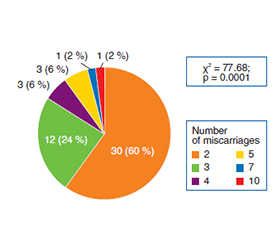
Актуальність. Звичне невиношування вагітності (ЗНВВ) — це складне репродуктивне захворювання, що включає імунологічні й автоімунні механізми. Вважається, що автоантитіла, як органоспецифічні, так і системні, пов’язані з невиношуванням вагітності, при цьому їх клінічна значущість не з’ясована. Автори провели оцінку частоти й клінічної значущості специфічних тиреоїдних, ядерних і репродуктивних автоантитіл, а саме антитіл до тиреоїдної пероксидази, тиреоглобуліну, центромерного білка B (анти-CENP-B), DFS70, у жінок зі ЗНВВ, а також дослідили їх зв’язок із ризиком викидня порівняно з вагітними жінками контрольної групи. Мета: оцінити поширеність та значущість антитіл до тиреоїдної пероксидази, тиреоглобуліну, анти-DFS70 та анти-CENP-B у жінок зі звичним невиношуванням вагітності. Матеріали та методи. Проведено проспективне когортне дослідження жінок зі ЗНВВ порівняно зі здоровими вагітними контрольної групи. Антитіла до тиреопероксидази та тиреоглобуліну, а також анти-CENP-B і анти-DFS70 були визначені за допомогою методів ІФА й лінійного імуноферментного аналізу. Проведено статистичний аналіз рівнів антитіл і частоти позитивних результатів між групами. Результати. У жінок зі ЗНВВ уміст антитіл до тиреоглобуліну, анти-CENP-B та анти-DFS70 був вірогідно вищий, ніж у контрольній групі. Показники антитіл до тиреоїдної пероксидази статистично не відрізнялися, але невелика підгрупа учасниць була серопозитивною. Аналіз залежно від триместру вагітності продемонстрував, що позитивні антитіла до тиреоглобуліну частіше асоціювалися з викиднем у другому триместрі. Висновки. Звичні втрати вагітності можуть бути пов’язані як зі змінами з боку щитоподібної залози, так і з системними автоімунними порушеннями, а не лише з ізольованою наявністю антитіл. Ці результати підтверджують гіпотезу про інтегровану участь імунної та ендокринної систем у розвитку ЗНВВ та підкреслюють необхідність додаткових проспективних досліджень для пояснення клінічних наслідків.
Background. Recurrent pregnancy loss (RPL) is a complex reproductive disease involving immunological and autoimmune pathways. Autoantibodies, either organ-specific or systemic, have been postulated to be implicated in pregnancy failure although their exact clinical relevance is unknown. The frequency and clinical relevance of specific thyroid, nuclear and reproductive autoantibodies, namely thyroid peroxidase antibodies, thyroglobulin antibodies, anti-centromere protein-B (anti-CENP-B), anti-DFS70, were assessed in women with RPL, as well as their relationship with miscarriage risk when compared to pregnant controls. This study purposed to evaluate the prevalence and significance of anti-thyroid peroxidase, anti-thyroglobulin, anti-DFS70 and anti-CENP-B antibodies in women with recurrent miscarriage. Materials and methods. This was a prospective cohort study of women with recurrent miscarriage compared to healthy pregnant controls. Anti-thyroid peroxidase and anti-thyroglobulin, in addition to anti-CENP-B and anti-DFS70 antibodies, were evaluated by enzyme-linked immunosorbent assay and line immunoassay techniques. Comparisons were statistical for differences in antibody levels and positive rates across groups. Results. In patients, thyroglobulin antibodies, anti-CENP-B and anti-DFS70 were significantly higher than in controls. Thyroid peroxidase antibodies levels were not statistically different, but a small subset of subjects was seropositive. Trimester analysis showed that positive thyroglobulin antibodies were more often associated with second-trimester miscarriage. Conclusions. Recurrent pregnancy loss may be linked to both thyroid and systemic autoimmune changes, rather than only isolated antibody positivity. These findings come back with the hypothesis of integrated immune-endocrine involvement in RPL and underline the need for additional prospective research to explain clinical consequences.
щитоподібна залоза; вагітність; антитіла до тиреопероксидази; антитіла до тиреоглобуліну; антитіла до центромерного білка B; антитіла до DFS70
thyroid gland; pregnancy; thyroid peroxidase antibodies; thyroglobulin antibodies; anti-centromere protein-B antibodies; anti-DFS70 antibodies
Для ознакомления с полным содержанием статьи необходимо оформить подписку на журнал.
- Turesheva A, Aimagambetova G, Ukybassova T, et al. Recurrent pregnancy loss etiology, risk factors, diagnosis, and management: fresh look into a full box. J Clin Med. 2023 Jun 15;12(12):4074. doi: 10.3390/jcm12124074.
- Yang T, Okada E, Todoroki M, et al. Vascular dysfunction in women with recurrent pregnancy loss: Possible association with antiphospholipid antibodies. Int J Gynaecol Obstet. 2025 Apr;169(1):206-214. doi: 10.1002/ijgo.16051.
- Li L, Baek KH. Exploring Potential Biomarkers in Recurrent Pregnancy Loss: A Literature Review of Omics Studies to Molecular Mechanisms. Int J Mol Sci. 2025 Mar 4;26(5):2263. doi: 10.3390/ijms26052263.
- Lai Y, Gu Y, Yu M, Deng J. Thyroglobulin Antibody (TgAb) Positive is an Independent Risk Factor for Lymph Node Metastasis in Patients with Differentiated Thyroid Carcinoma. Int J Gen Med. 2023 Dec 19;16:5979-5988. doi: 10.2147/IJGM.S439919.
- Washington K, Wyatt H. Exploring the link between autoimmune disorders and pain with sexual activity in ova-having individuals. J Fem Fam Ther. 2020;32(1–2):135-151. doi: 10.1080/08952833.2020.1755169.
- Kądziela M, Fijałkowska A, Kraska-Gacka M, Woźniacka A. The Art of Interpreting Antinuclear Antibodies (ANAs) in Eve–ryday Practice. J Clin Med. 2025 Jul 28;14(15):5322. doi: 10.3390/jcm14155322.
- Fijałkowska A, Schwartz RA, Woźniacka A. Dense fine speckled nuclear immunofluorescence: A mildly reassuring antinuclear antibody pattern meriting consideration. Immun Inflamm Dis. 2023 Sep;11(9):e1026. doi: 10.1002/iid3.1026.
- Bizzaro N, Pesce G, Trevisan MT, et al. Anti-DFS70 antibodies detected by specific methods in patients with thrombosis or recurrent pregnancy loss: no evidence of an association. Sci Rep. 2020 May 8;10(1):7748. doi: 10.1038/s41598-020-64550-y.
- Fan J, Liu Y, Zhong Y. Immunization with CENP-C causes aberrant chromosome segregation during oocyte meiosis in mice. J Immunol Res. 2021 Jan 30;2021:4610494. doi: 10.1155/2021/4610494.
- Wang A, Wu F, Liu M, Zhang Z, Li S, Tan Q. Analysis of Treatment and Subsequent Pregnancy Outcomes in Patients with Antinuclear Antibody-Positive Recurrent Spontaneous Abortion. Immun Inflamm Dis. 2025 Jun;13(6):e70216. doi: 10.1002/iid3.70216.
- Lee AYS, Brown DA, McDonald D, Lin MW. Longitudinal Tracking of Extractable Nuclear Antigen (ENA) Antibodies in a Quaternary Hospital Laboratory Cohort Reveals Dynamic Antibody Profiles. J Appl Lab Med. 2022 Jan 5;7(1):26-35. doi: 10.1093/jalm/jfab104.
- Wenzek C, Boelen A, Westendorf AM, Engel DR, Moeller LC, Führer D. The interplay of thyroid hormones and the immune system — where we stand and why we need to know about it. Eur J Endocrinol. 2022 Mar 23;186(5):R65-R77. doi: 10.1530/EJE-21-1171.
- Palmerola KL, Amrane S, De Los Angeles A, et al. Replication stress impairs chromosome segregation and preimplantation development in human embryos. Cell. 2022 Aug 4;185(16):2988-3007.e20. doi: 10.1016/j.cell.2022.06.028.
- Abuhassan Q, Oriquat G, Menon SV, et al. The molecular puzzle of recurrent implantation failure: integrating genetic, epigenetic, and immune mechanisms for precision reproductive medicine. J Assist Reprod Genet. 2026 May;43(5):1349-1367. doi: 10.1007/s10815-026-03832-2.
- Negi B, Ponsankaran R, Shyamal S, Modi D. Circulating markers for endometrial receptivity: current status and future prospects. Proc Indian Natl Sci Acad. 2025;91:1160-1171. doi: 10.1007/s43538-025-00614-9.
- Edoh NL, Chigboh VM, Zouo SJC, Olamijuwon J. Improving healthcare decision-making with predictive analytics: a conceptual approach to patient risk assessment and care optimization. Int J Sch Res Med Dent. 2024;3(2):1-10. doi: 10.56781/ijsrmd.2024.3.2.0034.
- Cavalcante MB, Cavalcante CTDMB, Sarno M, da Silva ACB, Barini R. Antinuclear antibodies and recurrent miscarriage: systematic review and meta-analysis. Am J Reprod Immunol. 2020 Mar;83(3):e13215. doi: 10.1111/aji.13215.
- Heo D, Yang S. Spectrum of Autoimmune Disorder: From Systemic to Organ-Specific Manifestation. In: Son YO, Ghosh M, eds. Cutting-Edge Strategies in Drug Delivery and Immunotherapy for Autoimmune Disorders. Singapore: Springer; 2025. 127-162 pp. doi: 10.1007/978-981-95-0520-3_6.
- Komisarz-Calik MA, Hubalewska-Dydejczyk A, Batko B, Trofimiuk-Müldner M. Thyroid cancer and autoimmune connective tissue disorders. Endokrynol Pol. 2024;75(5):455-460. doi: 10.5603/ep.101007.
- Cao C, Bai S, Zhang J, Sun X, Meng A, Chen H. Understanding recurrent pregnancy loss: recent advances on its etiology, clinical diagnosis, and management. Med Rev (2021). 2022 Dec 19;2(6):570-589. doi: 10.1515/mr-2022-0030.
- Song H, Cui T, Shi S, Xiao H, Wei A. Effect of anti-thyroid antibodies on recurrent miscarriage: A meta-analysis. J Obstet Gynaecol Res. 2024 Jul;50(7):1095-1105. doi: 10.1111/jog.15944.
- Wang R, Liu L, Zhang W, Zhang J, Wang K, Wang F. Association of thyroid autoimmunity and pregnancy outcomes in unexplained recurrent pregnancy loss women: a prospective cohort study. Front Endocrinol (Lausanne). 2025 Nov 25;16:1711369. doi: 10.3389/fendo.2025.1711369.
- Al-Bayati EAAT. Study the role of inhibin B, TPO antibody, and thyroid hormones in patients with hyper- and hypothyroidism. Wasit J Pure Sci. 2025;4(1):143-155. doi: 10.31185/wjps.611.
- Huisman P, Krogh J, Nielsen CH, Nielsen HS, Feldt-Rasmussen U, Bliddal S. Thyroglobulin Antibodies in Women with Recurrent Pregnancy Loss: A Systematic Review and Meta-Analysis. Thyroid. 2023 Nov;33(11):1287-1301. doi: 10.1089/thy.2023.0292.
- Zaccarelli-Marino MA, Dsouki NA, de Carvalho RP, Maciel RMB. Evaluation of Anti-Thyroperoxidase (A-TPO) and Anti-Thyroglobulin (A-Tg) Antibodies in Women with Previous Hashimoto’s Thyroiditis during and after Pregnancy. J Clin Med. 2024 Aug 2;13(15):4519. doi: 10.3390/jcm13154519.
- Mamitha ZAAJ, Al-Fatlawi ACY, Al-Tamimi MNAH. The relationships between anti-thyroid peroxidase and inhibin B as predictive biomarkers for female infertility. HAYATI J Biosci. 2025;32(6):1415-1425. doi: 10.4308/hjb.32.6.1415-1425.
- Niafar M, Samaie V, Soltani-Zangbar MS, et al. The association of Treg and Th17 cells development factors and anti-TPO autoantibodies in patients with recurrent pregnancy loss. BMC Res Notes. 2023 Oct 31;16(1):302. doi: 10.1186/s13104-023-06579-6.
- Ying Y, Zhong YP, Zhou CQ, et al. Preliminary investigation of the impact of anticentromere antibody on oocyte maturation and embryo cleavage. Fertil Steril. 2013 Dec;100(6):1585-1589. doi: 10.1016/j.fertnstert.2013.07.1998.
- Teramoto S, Ueno T, Aono F, et al. Anticentromere antibodies are the most potent antinuclear antibodies in reducing live birth outcomes after ICSI. Reprod Biomed Online. 2024 Jul;49(1):103864. doi: 10.1016/j.rbmo.2024.103864.
- Wahab AA, Jauhary EJ, Ding CH. The recognition of anti-nuclear antibody’s dense fine speckled pattern and the detection of anti-DFS70 antibodies in the laboratory practice: Its prevalence and clinical significance. Malays J Pathol. 2023 Aug;45(2):157-173.
- Vomstein K, Feil K, Strobel L, et al. Immunological risk factors in recurrent pregnancy loss: guidelines versus current state of the art. J Clin Med. 2021 Feb 20;10(4):869. doi: 10.3390/jcm10040869.
- Dinse GE, Zheng B, Co CA, et al. Anti-dense fine speckled 70 (DFS70) autoantibodies: correlates and increasing prevalence in the United States. Front Immunol. 2023 Jun 23;14:1186439. doi: 10.3389/fimmu.2023.1186439.