
Інформація призначена тільки для фахівців сфери охорони здоров'я, осіб,
які мають вищу або середню спеціальну медичну освіту.

Підтвердіть, що Ви є фахівцем у сфері охорони здоров'я.

Журнал «Травма» Том 27, №3, 2026

Вернуться к номеру

Бойові пошкодження ділянки плеча та плечового суглоба. Повідомлення перше. Клініко-епідеміологічна характеристика
Авторы: Гур’єв С.О. (1), Лазаренко Ю.В. (2), Кушнір В.А. (1), Фомін О.О. (2)
(1) - ДЗ «Український науково-практичний центр екстреної медичної допомоги та медицини катастроф МОЗ України», м. Київ, Україна
(2) - Військово-медичний клінічний центр Центрального регіону, м. Вінниця, Україна

Рубрики: Травматология и ортопедия

Разделы: Клинические исследования

Версия для печати


Резюме

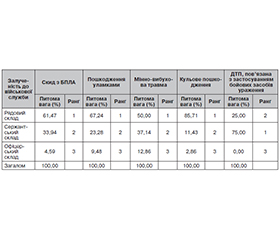
Актуальність. Сучасні бойові дії із застосуванням новітніх засобів ураження, що відбуваються зараз в Україні, призводять до зміни структури, клінічної та анатомічної характеристик бойової травми людини. Мета: надати клініко-епідеміологічну характеристику бойової травми плеча та плечового суглоба як фундаментальної основи формування системи надання медичної допомоги. Матеріали та методи. Масив дослідження охоплював 334 випадки пошкодження плеча та плечового суглоба, які виникли внаслідок впливу бойових засобів ураження. Масив дослідження перевищує показник необхідного та достатнього обсягу. Результати. У результаті дослідження встановлено, що пошкодження ділянки плеча та плечового суглоба отримують переважно особи працездатного віку 31–40 років (32,71 %), 41–50 (31,34 %), 21–30 (21,06 %). За обставинами отримання пошкодження найчастіше це уламкові пошкодження (34,73 %), скид з безпілотного літального апарата (32,63 %), мінно-вибухова травма (20,96 %). Найчастіше пошкодження отримує рядовий склад військ — 63,18 %, сержантський — 29,04 %, офіцерський — тільки 7,78 %. Висновки. 1. Пошкодження ділянки плеча та плечового суглоба внаслідок бойових дій є відображенням характеру та інтенсивності участі постраждалих у таких діях, що означає клініко-епідеміологічну характеристику пошкоджень. 2. Пошкодження ділянки плеча та плечового суглоба найчастіше трапляються у віці 21–50 років і переважають у структурі постраждалих із бойовою травмою. 3. Існує вірогідний вплив залученості до військової служби на обставини виникнення бойових пошкоджень ділянки плеча та плечового суглоба. 4. Встановлено вірогідний взаємозв’язок залученості постраждалих до військової служби та обставин травмування у генезі бойових пошкоджень ділянки плеча та плечового суглоба.

Background. Modern combat operations using the latest means of destruction, currently taking place in Ukraine, lead to changes in the structure, clinical and anatomical characteristics of human combat trauma. Research objective: to provide a clinical and epidemiological characteristic of combat trauma of the shoulder and shoulder joint as a fundamental basis for the formation of a medical care system. Materials and methods. The study array consisted of 334 cases of shoulder and shoulder joint injuries resulting from exposure to weapons of mass destruction. The research sample exceeds the required and sufficient size. Results. As a result of the study, it was found that injuries to the shoulder and shoulder joint are mainly sustained by persons of working age of 31–40 (32.71 %), 41–50 (31.34 %), 21–30 years (21.06 %). According to the circumstances of injury, it is most often fragmentary injuries (34.73 %), drone discharge (32.63 %), mine and explosive trauma (20.96 %). Most often, injuries are received by the privates — 63.18 %, sergeants — 29.04 %, officers — only 7.78 %. Conclusions. 1. Damage to the shoulder and shoulder joint as a result of combat operations is a reflection of the nature and intensity of the victims’ participation in such actions, which means the clinical and epidemiological characteristics of injuries. 2. Damage to the shoulder and shoulder joint occurs most often in people aged 21–50 and predominate in the general array of victims with combat injuries. 3. There is a likely influence of military service function on the circumstances of combat injuries to the shoulder and shoulder joint. 4. A reliable relationship was found between the functional characteristics of those injured in military service and the circumstances of injury in the origin of combat injuries to the shoulder and shoulder joint.


Ключевые слова

плече; плечовий суглоб; клініко-епідеміологія; бойові дії; постраждалі

shoulder; shoulder joint; clinical epidemiology; combat operations; victims


Для ознакомления с полным содержанием статьи необходимо оформить подписку на журнал.


Список литературы

1. Denysiuk M, Dubrov S, Cherniaiev S, Sereda S, Zaikin Y. structure of traumatic injuries and experience in the treatment of the wounded patients, as a result of hostilities in the first days of russia’s attack on Ukraine. Pain, Anaesthesia & Intensive Care. 2022;1(98):7-12. https://doi.org/10.25284/2519-2078.1(98).2022.256092.
2. Khomenko IP, Korol SO, Khalik SV, Shapovalov VY, Yenin RV, Нerasimenko OS, et al. Clinical and Epidemiological analysis of the structure of combat surgical injury during Antiterrorist operation / Joint Forces Operation. Ukrainian Journal of Military Medicine. 2021;2(2):5-13. https://doi.org/10.46847/ujmm.2021.2(2)-005.
3. Dolhopolov O, Bezruchenko S, Zinchenko V, Zanko I, Vorona A. The Analysis of Trauma Character and Severity in Patients with Shoulder Girdle Combat Injuries. Terra Orthopaedica. 2025 Dec 24;3(126):16-23. https://doi.org/10.37647/2786-7595-2025-126-3-16-23.
4. Tyler JR, Czajkowski H, Sandler AB, Brown NM, Salazar D, Scanaliato JP, et al. Shoulder Instability in the U.S. Mi–litary: A Systematic Review of Epidemiology, Operative Management, and Outcomes. J Clin Med. 2025 Dec 23;15(1):110. doi: 10.3390/jcm15010110.
5. Zavhorodnii SM, Kotenko OI. Effectiveness of the use of early secondary sutures and injections of platelet-rich autoplasma in isolated gunshot shrapnel wounds of soft tissues. Reports of Vinnytsia National Medical University. 2024;28(2):287-293. https://doi.org/10.31393/reports-vnmedical-2024-28(2)-18.
6. Tankut V, Golubeva I, Rykun M, Berenov K, Androsenkova V. Current issues of treatment and rehabilitation of victims with a combat injury of the locomotor system on the modern stage (review). Orthopaedics Traumatology and Prosthetics. 2023(2):84-90. https://doi.org/10.15674/0030-59872023284-90.
7. Karpyshyn JN, Bois AJ, Logan H, Harding GT, Bouliane MJ. 3D Printed Patient-Specific Cutting Guides for Bone Grafting in Reverse Shoulder Arthroplasty: A Novel Technique. J Shoulder Elb Arthroplast. 2023 Mar 14;7:24715492231162285. doi: 10.1177/24715492231162285.
8. To study the clinical-epidemiological and clinical-nosological characteristics of modern combat trauma. Research paper (final). State Institution “Ukrainian Scientific and Practical Center for Emergency Medical Care and Disaster Medicine of the Ministry of Health of Ukraine”. Kyiv, 2024. 235 p. State registration number: 0122U002638.
9. Abt JP, Sell TC, Lovalekar MT, Keenan KA, Bozich AJ, Morgan JS, et al. Injury epidemiology of U.S. Army Special Operations forces. Mil Med. 2014 Oct;179(10):1106-12. doi: 10.7205/MILMED-D-14-00078. PMID: 25269128.
10. Lovalekar M, Hauret K, Roy T, Taylor K, Blacker SD, Newman P, et al. Musculoskeletal injuries in military personnel-Descriptive epidemiology, risk factor identification, and prevention. J Sci Med Sport. 2021 Oct;24(10):963-969. doi: 10.1016/j.jsams.2021.03.016. Epub 2021 Mar 31. PMID: 33824080.
11. Lovalekar M, Johnson CD, Eagle S, Wohleber MF, Keenan KA, Beals K, et al. Epidemiology of musculoskeletal injuries among US Air Force Special Tactics Operators: an economic cost perspective. BMJ Open Sport Exerc Med. 2018 Dec 26;4(1):e000471. doi: 10.1136/bmjsem-2018-000471. PMID: 30622731; PMCID: PMC6307598.
12. Biner M, Klotz S, Andronic O, Karczewski DC, Zingg L, Karl W, et al. Long-Term Outcomes Following Reverse Total Shoulder Arthroplasty: A Systematic Review with a Minimum Follow-Up of 10 Years. JB JS Open Access. 2025 May 1;10(2):e25.00025. doi: 10.2106/JBJS.OA.25.00025. PMID: 40313685; PMCID: PMC12039979.
13. Ramasamy A, Hill AM, Masouros S, Gibb I, Bull AM, Clasper JC. Blast-related fracture patterns: a forensic biomechanical approach. J R Soc Interface. 2011 May 6;8(58):689-98. doi: 10.1098/rsif.2010.0476. Epub 2010 Dec 1.
14. Chorna VV, Zavodiak AY, Matviichuk MV, Ivashke–vych YM, Syvak VM, Slobodian VV, et al. Severity of injuries in case of mine-blast trauma depending on the location of the person at the time of the explosion. Ukrainian Journal of Military Medicine. 2023 Sep;4(3):70-77. https://doi.org/10.46847/ujmm.2023.3(4)-070.
15. Mathieu L, Bauer B, Lapeyre E, et al. Blast injury of the hand related to warfare explosive devices: experience from the French Military Health Service. The Journal of the Royal Army Medical Corps. 2021;167(6):393-397. doi: 10.1136/jramc-2019-001326.
16. Attum B, Thompson JH. Humerus Fractures Overview. [Updated 2023 Jul 4]. In: StatPearls [Internet]. Treasure Island (FL): StatPearls Publishing; 2025 Jan-. Available from: https://www.ncbi.nlm.nih.gov/books/NBK482281/.

Вернуться к номеру