
Інформація призначена тільки для фахівців сфери охорони здоров'я, осіб,
які мають вищу або середню спеціальну медичну освіту.

Підтвердіть, що Ви є фахівцем у сфері охорони здоров'я.

Журнал «Травма» Том 27, №3, 2026

Вернуться к номеру

Хірургічне лікування вивиху головки стегнової кістки в дітей із ДЦП: мультицентровий ретроспективний аналіз серії зі 171 пацієнта (повідомлення перше)
Авторы: D.V. Yershov (1), O.I. Korolkov (2), F.V. Klymovytskyi (1), A.V. Chornenkyi (3), P.M. Rakhman (4)
(1) - Donetsk National Medical University, Lyman — Kropyvnytskyi, Ukraine
(2) - Clinical Center of Children’s Healthcare (Lviv Regional Children’s Clinical Hospital “Okhmatdyt”), Lviv, Ukraine
(3) - Dnipro City Multidisciplinary Clinical Hospital for Mothers and Children named after prof. M.F. Rudnev (Rudnev Mother and Child Center), Dnipro, Ukraine
(4) - Medical Center “MedGarden”, Chernivtsi, Ukraine

Рубрики: Травматология и ортопедия

Разделы: Клинические исследования

Версия для печати


Резюме

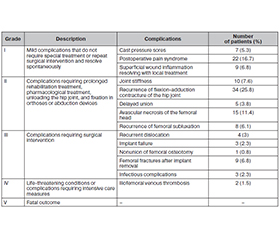
Актуальність. Вивих голівки стегнової кістки (ВГСК) залишається серйозним ортопедичним ускладненням у дітей iз діагнозом ДЦП, яке призводить до обмеження рухів у кульшовому суглобі, больового синдрому та прогресуючих порушень якості життя пацієнтів. Мета: оцінити рентгенологічні й клінічні результати, а також частоту ускладнень після реконструктивної операції з приводу ВГСК у дітей із ДЦП (рівні GMFCS III–V). Матеріали та методи. Критерії включення в дослідження: ВГСК (індекс міграції ≥ 100 %) у дітей віком від 4 до 18 років із діагнозом ДЦП, GMFCS III–V рівнів, яким виконано хірургічно відкрите вправлення та реконструкцію кульшового суглоба. У досліджувану групу увійшов 171 пацієнт (226 суглобів). Проведено аналіз коморбідності, оцінку клінічних симптомів, рентгенологічних параметрів кульшових суглобів до та після хірургічного лікування, а також ускладнень за модифікованою класифікацією Clavien — Dindo. Середній вік пацієнтів становив 8 років 8 міс. Середній термін спостереження в післяопераційному періоді дорівнював 3,0 року ± 6,5 міс. У 37 пацієнтів (21 %) відзначався високий вивих стегна. Результати. Проведене хірургічне лікування дозволило статистично значущо змінити рентгенологічні показники, як-от індекс міграції, кут Віберга, ацетабулярний індекс, шийково-діафізарний кут, та клінічні симптоми: зменшити біль в ділянці кульшового суглоба, поліпшити рухи в ньому. При цьому зафіксовано значну частоту ускладнень (n = 132, 226 стегон), серед яких 16,6 % випадків потребували проведення додаткових хірургічних втручань (рівень III–IV за класифікацією Clavien — Dindo). Найпоширенішими ускладненнями були рецидив контрактури, аваскулярний некроз та переломи стегнової кістки після видалення імплантату. Висновки. Хірургічне лікування ВГСК у дітей із ДЦП (GMFCS III–V) приводить до вірогідного поліпшення клініко-рентгенологічних показників, однак супроводжується відносно великою кількістю ускладнень. Ці результати підкреслюють важливість раннього впровадження програм спостереження та ретельного відбору пацієнтів.

Background. Hip dislocation remains a serious orthopedic complication in children with cerebral palsy (CP), leading to restricted hip joint mobility, pain syndrome, and progressive decline in the patients’ quality of life. Aim: to evaluate radiographic and clinical outcomes, as well as complication rates, following reconstructive surgery for hip dislocation in children with CP (GMFCS levels III–V). Materials and methods. Inclusion criteria: children with CP aged 4 to 18 years with hip dislocation (migration index ≥ 100 %), and GMFCS levels III–V, who underwent open reduction and hip joint reconstruction. The study group included 171 patients (226 joints). The analysis covered comorbidity, clinical symptoms, and radiographic parameters of the hip joints before and after surgery, as well as complications according to the modified Clavien-Dindo scale. The mean age of patients was 8 years and 8 months. The mean postoperative follow-up period was 3.0 years ± 6.5 months. High hip dislocation was observed in 37 patients (21.6 %). Results. Surgical reconstruction resulted in significant improvement in radiographic parameters, including reduction of migration index and acetabular index, and correction of femoral alignment. Clinical improvement was observed in pain reduction and range of motion. However, a high complication rate was recorded (132 complications in 226 hips), with 16.6 % requiring additional surgical intervention (Clavien-Dindo grade III–IV). The most common complications included recurrent contracture, avascular necrosis, and femoral fractures after implant removal. Conclusions. Reconstructive hip surgery for hip dislocation in children with CP (GMFCS III–V) results in significant improvement in radiographic parameters and clinical outcomes but is associated with a substantial complication rate. These findings highlight the importance of early surveillance programs and careful patient selection.


Ключевые слова

вивих стегна; дитячий церебральний параліч; хірургічне лікування; остеотомія таза; остеотомія стегнової кістки; хірургічні ускладнення

hip dislocation; cerebral palsy; surgical treatment; pelvic osteotomy; femoral osteotomy; surgical complications


Для ознакомления с полным содержанием статьи необходимо оформить подписку на журнал.


Список литературы

1. Howard JJ, Graham HK, Johari A, et al. Hip displacement in cerebral palsy: surveillance to surgery — a current concepts review. SICOT J. 2024;10:5. doi: 10.1051/sicotj/2024023.
2. Eldessouky A, Smeda G. Hip dislocation in cerebral palsy: treatment options. J Orthop Res Physiother. 2016;2:026. doi: 10.24966/ORP-2052/100026.
3. Pountney T, Green E. Hip dislocation in cerebral palsy. BMJ. 2006;332(7544):772-775. doi: 10.1136/bmj.332.7544.772.
4. Brunner R, Picard C, Robb J. Morphology of the ace–tabulum in hip dislocations caused by cerebral palsy. J Pediatr Orthop B. 1997;6(3):207-211. doi: 10.1097/01202412-199707000-00010.
5. Giuca G, Sanzarello I, Marletta D, et al. Incidence and risk factors of hip dislocation in children with cerebral palsy: a systematic review and pooled analysis. J Clin Orthop Trauma. 2025;69:103141.
6. Kifle YD, Woldemeskel BY, Gebregiogis BT. Prevalence of hip dislocation and subluxation among children with cerebral palsy: an institution-based cross-sectional study from a Sub-Saharan country. BMC Pediatr. 2025;25(1):893. doi: 10.1186/s12887-025-06276-2.
7. Hgglund G. Significant medical improvements with CPUP — a combined follow-up program and national quality registry for cerebral palsy. Lakartidningen. 2023;120:23136.
8. Gaston MS, Paukert M, Chugh S, et al. The CPUP Hip Score predicts displacement of the hip in children with cerebral palsy. Bone Joint J. 2022;104-B(5):640-644. doi: 10.1302/0301-620X.104B5.BJJ-2021-0301.R5.
9. Huser A, Mo M, Hosseinzadeh P. Hip surveillance in children with cerebral palsy. Orthop Clin North Am. 2018;49(2):181-190. doi: 10.1016/j.ocl.2017.11.006.
10. Wynter M, Gibson N, Willoughby KL, et al. Australian hip surveillance guidelines for children with cerebral palsy: 5-year review. Dev Med Child Neurol. 2015;57(9):808-820. doi: 10.1111/dmcn.12754.
11. Sadur A, Martinez C, Dance S, et al. From hip screening to surveillance in CP. JAAOS Glob Res Rev. 2023;7(12):e23.00236. doi: 10.5435/JAAOSGlobal-D-23-00236.
12. Alriksson-Schmidt AI, Burman Rimstedt A, Hg-glund G. CPUP — a multidisciplinary secondary prevention program for individuals with cerebral palsy. Int J Integr Care. 2019;19(4):380. doi: 10.5334/ijic.s3380.
13. Almasri NA, Saleh M, Abu-Dahab S, et al. Development of a cerebral palsy follow-up registry in Jordan (CPUP-Jordan). Child Care Health Dev. 2018;44(1):131-139. doi: 10.1111/cch.12527.
14. McGrath TM, Palmer ST. Integrated hip surveillance pathways for pain, function and quality of life in children with cerebral palsy: a systematic literature review. Eur J Paediatr Neurol. 2024;53:166-173. doi: 10.1016/j.ejpn.2024.10.012.
15. Helenius I. Cerebral palsy with dislocated hip and scoliosis: what to deal with first. J Child Orthop. 2020;14(1):24-29. doi: 10.1302/1863-2548.14.190099.
16. Ulusaloglu AC, Asma A, Rogers KJ, et al. Femoral head deformity associated with hip displacement in nonambulatory cerebral palsy: results at skeletal maturity. J Pediatr Orthop. 2023;43(3):156-161. doi: 10.1097/BPO.0000000000002333.
17. Badina A, du Cluzel de Remaurin X, Khouri N. Long-term outcomes of hip reconstruction surgery in children with GMFCS III diplegic cerebral palsy. Orthop Traumatol Surg Res. 2023;109(3):103344. doi: 10.1016/j.otsr.2022.103344.
18. Delbrck H, Wimmer J, Wirth T, et al. Redisplacement rate after bony hip reconstructive surgery in children with cerebral palsy: a systematic review and meta-analysis. EFORT Open Rev. 2024;9(8):773-784. doi: 10.1530/EOR-23-0043.
19. Montpetit K, Rhalmi S, Lalumiere M, et al. Satisfactory long-term functional and radiological outcomes following hip reconstructive surgery in children with cerebral palsy. J Pediatr Rehabil Med. 2025;18(2):110-119. doi: 10.1177/18758894251316072.
20. Poul J, Pesl M, Pokorn M. Bone surgery for unstable hips in patients with cerebral palsy. Acta Chir Orthop Traumatol Cech. 2004;71(6):360-365
21. Sarikaya A, Birsel SE, Erdal OA, et al. Treatment of hip dislocation in cerebral palsy with extraarticular intervention. Acta Chir Orthop Traumatol Cech. 2023;90(2):92-99.
22. Koch A, Jozwiak M, Idzior M, et al. Long-term outcomes of reconstructive treatment for painful neurogenic hip dislocation. J Child Orthop. 2024;18(3):315-321. doi: 10.1177/18632521241233165.
23. Kiapekos N, Sandberg L, Hgglund G, et al. Treatment comparison of femoral vs combined osteotomy. J Pediatr Orthop. 2024;44(2):89-96. doi: 10.1097/BPO.0000000000002674.
24. Tellus A, Kiapekos N, von Heideken J, et al. Orthopedic surgical procedures in 3,305 children and young adults with cerebral palsy: a register-based cohort study. Acta Orthop. 2022;93:472-477. doi: 10.2340/17453674.2022.2583.
25. Alamri SA, Khan NA, Alhumaidan IA, et al. Role of physical therapy in postural management to prevent hip dislocation in children with spastic cerebral palsy. Int J Orthop Phys Rehabil. 2025;4(11). doi: 10.62464/ce32tw86.
26. Zhou L, Willoughby K, Strobel N, et al. Classifying adverse events following lower limb orthopaedic surgery in children with cerebral palsy: reliability of the modified Clavien-Dindo system. J Pediatr Orthop. 2018;38(10):e604-e609. doi: 10.1097/BPO.0000000000001233.
27. Varas-Rodriguez E, Hanson K, Habermann EB, et al. Adverse outcomes in pediatric orthopaedic surgery: insights from the NSQIP pediatric database. J Pediatr Orthop. 2025. doi: 10.1097/BPO.0000000000003063.
28. Silva MVS, Serafim BLC, de Angeli LRA, et al. Surgical treatment of hip dysplasia in cerebral palsy: a retrospective comparison between open and closed reduction. Medicine (Baltimore). 2025;104(36):e44245. doi: 10.1097/MD.0000000000044245.

Вернуться к номеру