Резюме
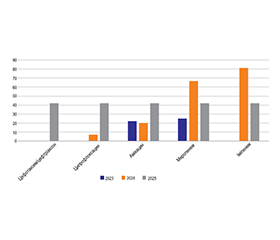
Актуальність. Антибіотикорезистентність грамнегативних патогенів є однією з найважливіших проблем сучасної хірургії, оскільки суттєво ускладнює лікування інфекцій, підвищує летальність, тривалість госпіталізації та витрати на медичну допомогу. Мета: оцінити зміни чутливості до антибіотиків грамнегативних мультирезистентних патогенів після впровадження системи преавторизації антибактеріальної терапії. Матеріали та методи. Проведено ретроспективний аналіз результатів локального мікробіологічного моніторингу. Основну увагу приділено динаміці чутливості Klebsiella pneumoniae та Acinetobacter baumannii до цефалоспоринів ІІІ покоління та фторхінолонів. Результати. Після впровадження преавторизації встановлено позитивну динаміку чутливості основних грамнегативних патогенів до антибактеріальних препаратів. Чутливість Klebsiella pneumoniae до цефалоспоринів III покоління збільшилася з 28,6 % у 2023 році до 50,0 % у 2025 році, до ципрофлоксацину — з 42,9 до 64,0 %, до амікацину — з 42,9 до 64,0 %, а до меропенему — з 42,9 до 50,0 %. Після тимчасового зниження чутливості у 2024 році до цефалоспоринів та фторхінолонів у 2025 році відзначалося її суттєве відновлення. Для Acinetobacter baumannii найбільш виражені зміни спостерігалися щодо цефалоспоринів III покоління та фторхінолонів: якщо у 2023–2024 роках практично не виявляли чутливих ізолятів, то у 2025 році близько 42 % штамів були чутливими до зазначених препаратів. Одночасно відзначено підвищення чутливості до амікацину та карбапенемів. Отримані результати свідчать про поступове зменшення селективного тиску після обмеження використання цефтріаксону та левофлоксацину і підтверджують доцільність інтеграції преавторизації в комплексні програми адміністрування антимікробних препаратів. Висновки. Преавторизація антибіотиків широкого спектра дії асоціюється з поліпшенням локальної чутливості мультирезистентних грамнегативних патогенів, насамперед Klebsiella pneumoniae та Acinetobacter baumannii, до цефалоспоринів III покоління та фторхінолонів.
Background. Antimicrobial resistance among Gram-negative bacteria is one of the most important challenges in modern surgery, as it significantly complicates the treatment of infections, increases mortality, length of stay, and healthcare costs. Objective: to assess changes in the antimicrobial susceptibility of multidrug-resistant Gram-negative pathogens following the introduction of preauthorization system for antibacterial therapy. Materials and methods. A retrospective analysis of local microbiological surveillance data was performed. Particular attention was paid to changes in the susceptibility of Klebsiella pneumoniae and Acinetobacter baumannii to third-generation cephalosporins and fluoroquinolones. Results. Following the introduction of preauthorization, a positive trend was observed in the antimicrobial susceptibility of the major Gram-negative bacteria. The susceptibility of Klebsiella pneumoniae to third-generation cephalosporins increased from 28.6 % in 2023 to 50.0 % in 2025, to ciprofloxacin from 42.9 to 64.0 %, to amikacin from 42.9 to 64.0 %, and to meropenem from 42.9 to 50.0 %. After a temporary decrease in susceptibility to cephalosporins and fluoroquinolones in 2024, a substantial recovery was observed in 2025. Regarding Acinetobacter baumannii, the most pronounced changes were observed for third-generation cephalosporins and fluoroquinolones: whereas virtually no susceptible isolates were identified in 2023–2024, approximately 42 % of strains were susceptible to these agents in 2025. An increase in susceptibility to amikacin and carbapenems was also observed. These findings indicate a gradual reduction in selective pressure following restrictions on the use of ceftriaxone and levofloxacin and support the feasibility of preauthorization introduction into comprehensive antimicrobial stewardship programs. Conclusions. Preauthorization of broad-spectrum antibiotics is associated with improved local susceptibility of multidrug-resistant Gram-negative pathogens, primarily Klebsiella pneumoniae and Acinetobacter baumannii, to third-generation cephalosporins and fluoroquinolones.
Список литературы
1. World Health Organization. Global antibiotic resistance surveillance report 2025 [Internet]. Geneva: World Health Organization; 2025 Oct 13 [cited 2026 Aug 5]. Available from: https://www.who.int/publications/i/item/9789240116337.
2. Ziaian B, Yousufzai S, Karami M, Ebrahimi A, Ghahramani S, Saadat A, et al. Evaluating antimicrobial resistance and clinical outcomes in surgical ICU using a machine learning perspective: a retrospective observational study. BMC Infect Dis. 2025 Oct 28;25(1):1434. doi: 10.1186/s12879-025-11900-8. PMID: 41152776; PMCID: PMC12570710.
3. Kundarapu V, Shelke A, Priya P, Mishra S, Chauhan R, –Dhingra S. Assessment of surgical site infections with antimicrobial resistance among cancer patients at a tertiary care hospital: A prospective study. Clin Epidemiol Glob Health. 2025 Jun 18;34:102103. doi: 10.1016/j.cegh.2025.102103.
4. Singh PK, Kumar S, Kumar A, et al. Isolation, identification, and evaluation of antibiotic susceptibility patterns of bacterial pathogens from postoperative wound infections in a tertiary care center. BMC Microbiol. 2025 Nov 7;25:721.
5. Poltorapavlov VA, Koval TI, Bodnar VA, Iziumska OM, –Pryimenko NO, Marchenko OH, et al. Antibiotics resistance of wound microflora to antibacterial drugs in patients of surgical profile and measures to optimize their use. Bulletin of Problems Biology and Medicine. 2025;177(2):77-101. doi: 10.29254/2077-4214-2025-2-177-77-101.
6. Kalim M, Zainab, Irshad Z, Ahmed N, Haq M. Antimicrobial Resistance Patterns in Pathogens Isolated from Peritoneal Drain Fluids in Abdominal Surgeries. J Popul Ther Clin Pharmacol. 2025;32(3):1494-1500. doi: 10.53555/asx3v039.
7. Panchal K, Shaikh N, Mehta T, Pethani J. Analysis of Antibiogram Trends and Antimicrobial Resistance Patterns in a Tertiary Care Setting. Microbiology Spectrum. 2026;14(7):1-16. doi: 10.1128/spectrum.03457-25.
8. NIHR Global Health Research Unit on Global Surgery. Microbio–logy testing capacity and antimicrobial drug resistance in surgical-site infections: a post-hoc, prospective, secondary analysis of the FALCON randomised trial in seven low-income and middle-income countries. Lancet Glob Health. 2024 Nov;12(11):e1816-e1825. doi: 10.1016/S2214-109X(24)00330-9. Epub 2024 Sep 5. PMID: 39245054.
9. Agrawalla S, Meher BP. Aerobic Bacteriological Profile of Surgical Site Infections and their Antibiogram. International Journal of Science and Research. 2024;13(5):245-248. doi: 10.21275/SR24503092708.
10. Birgand G, Dhar P, Holmes A. The threat of antimicrobial resistance in surgical care: the surgeon's role and ownership of antimicrobial stewardship. Br J Surg. 2023 Nov 9;110(12):1567-1569. doi: 10.1093/bjs/znad302. PMID: 37758500; PMCID: PMC10638523.
11. Kathia UM, Munir T, Fateh F, Ahmad A, Amjad A, Afzal MF. Antimicrobial Resistance Patterns: Review of the Antibiogram of a Surgical Unit in a Public Tertiary Care Hospital of Pakistan. Cureus. 2020 Oct 25;12(10):e11159. doi: 10.7759/cureus.11159. PMID: 33251067; PMCID: PMC7686934
12. Rabaan AA, Alhumaid S, Mutair AA, Garout M, Abulhamayel Y, Halwani MA, et al. Application of Artificial Intelligence in Combating High Antimicrobial Resistance Rates. Antibiotics (Basel). 2022 Jun 8;11(6):784. doi: 10.3390/antibiotics11060784. PMID: 35740190; PMCID: PMC9220767.
13. Bhargavi M, Karthikeyan R, Kumar B. Assessing Bacteriological Profiles and Targeting Resistant Bacterial Superbugs to Develop an Antibiogram Aiding in Antibiotic Selection. Cureus. 2024 Dec 12;16(12):e75574. doi: 10.7759/cureus.75574. PMID: 39803049; PMCID: PMC11724318.
14. Kourbeti I, Kamiliou A, Samarkos M. Antibiotic Stewardship in Surgical Departments. Antibiotics (Basel). 2024 Apr 4;13(4):329. doi: 10.3390/antibiotics13040329. PMID: 38667005; PMCID: PMC11047567.
15. Sartelli M, Hardcastle TC, Catena F, Chichom-Mefire A, Coccolini F, Dhingra S, et al. Antibiotic Use in Low and Middle-Income Countries and the Challenges of Antimicrobial Resistance in Surgery. Antibiotics (Basel). 2020 Aug 9;9(8):497. doi: 10.3390/antibiotics9080497. PMID: 32784880; PMCID: PMC7459633.
16. Khaitovych MV, Vityuk OO. Dynamics of antimicrobial consumption in an inpatient surgical department following the implementation of an antimicrobial stewardship programme. Medical Science of Ukraine. 2026;22(2):144-151. doi: 10.32345/2664-4738.2.2026.15.
17. Kyriakidis I, Vasileiou E, Pana ZD, Tragiannidis A. Acinetobacter baumannii Antibiotic Resistance Mechanisms. Pathogens. 2021 Mar 19;10(3):373. doi: 10.3390/pathogens10030373. PMID: 33808905; PMCID: PMC8003822.
18. Mczyska B, Frej-Mdrzak M, Sarowska J, Woronowicz K, Choroszy-Krl I, Jama-Kmiecik A. Evolution of Antibiotic Resistance in Escherichia coli and Klebsiella pneumoniae Clinical Isolates in a Multi-Profile Hospital over 5 Years (2017-2021). J Clin Med. 2023 Mar 21;12(6):2414. doi: 10.3390/jcm12062414. PMID: 36983414; PMCID: PMC10058544.
19. Liu YX, Yang Y, Le KJ, Zhang ZL, Cui M, Zhong H, et al. Antimicrobial Stewardship in Surgery: A Literature Bibliometric Analysis. Front Public Health. 2022 Apr 7;10:847420. doi: 10.3389/fpubh.2022.847420. PMID: 35462840; PMCID: PMC9021645.
20. Schuts EC, Boyd A, Muller AE, Mouton JW, Prins JM. The Effect of Antibiotic Restriction Programs on Prevalence of Antimicrobial Resistance: A Systematic Review and Meta-Analysis. Open Forum Infect Dis. 2021 Feb 13;8(4):ofab070. doi: 10.1093/ofid/ofab070. PMID: 33880388; PMCID: PMC8043261.
21. Tth H, Buchholcz G, Fss A, Balzs B, Nagy JB, Majoros L, et al. Evolution of the Gram-Negative Antibiotic Resistance Spiral over Time: A Time-Series Analysis. Antibiotics (Basel). 2021 Jun 17;10(6):734. doi: 10.3390/antibiotics10060734. PMID: 34204497; PMCID: PMC8234935.
22. Sahin M, Mert A, Tosun AI, et al. Temporal dynamics and predictors of carbapenem-resistant gram-negative bacteria in bloodstream infections in hematological patients. BMC Infect Dis. 2026;26:790. doi: 10.1186/s12879-026-13082-3.
23. Gajic I, Kabic J, Kekic D, Jovicevic M, Milenkovic M, Mitic Culafic D, et al. Antimicrobial Susceptibility Testing: A Comprehensive Review of Currently Used Methods. Antibiotics (Basel). 2022 Mar 23;11(4):427. doi: 10.3390/antibiotics11040427. PMID: 35453179; PMCID: PMC9024665.
24. Raouf M, Ghazal T, Kassem M, Agamya A, Amer A. Surveillance of surgical-site infections and antimicrobial resistance patterns in a tertiary hospital in Alexandria, Egypt. J Infect Dev Ctries. 2020 Mar 31;14(3):277-283. doi: 10.3855/jidc.12124. PMID: 32235088.
25. Parker H, Day J, Frost J, Bethune R, Hollyman M, Hand K, et al. Strategies to improve antimicrobial stewardship in surgery: insights from an ethnographic study. BMJ Open. 2026 Jan 23;16(1):e112333. doi: 10.1136/bmjopen-2025-112333. PMID: 41577355; PMCID: PMC12853513.