
Международный эндокринологический журнал Том 22, №5, 2026
Вернуться к номеру
Вплив хронічного стресу, пов’язаного з активним збройним конфліктом в Україні, на стан імунітету у хворих з автоімунним тиреоїдитом
Авторы: Караченцев Ю.І. (1, 2), Гопкалова І.В. (1), Дубовик В.М. (1), Гончарова О.А. (1, 2), Ашуров Е.М. (1), Герасименко Л.В. (1), Македонська В.О. (1)
(1) - ДУ «Інститут проблем ендокринної патології імені В.Я. Данилевського НАМН України», м. Харків, Україна
(2) - Харківський національний медичний університет, м. Харків, Україна
Рубрики: Эндокринология
Разделы: Клинические исследования
Версия для печати
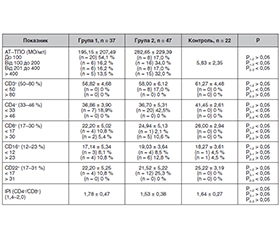
Актуальність. В умовах тривалого воєнного стресу в Україні зростає частота психоемоційних розладів, що мають виражений вплив на перебіг автоімунних захворювань. Автоімунний тиреоїдит (АІТ) поєднує ендокринну дисфункцію з хронічним імунним запаленням, яке чутливо реагує на стресові фактори. Однак особливості змін імунного статусу у хворих на АІТ за умов тривалого воєнного стресу залишаються недостатньо вивченими. Мета дослідження: визначити вплив тривалого воєнного стресу на показники імунного статусу у хворих на автоімунний тиреоїдит з різним рівнем ситуативної тривожності. Матеріали та методи. Обстежено пацієнтів з АІТ, які протягом чотирьох років перебували в умовах воєнного стресу. Хворі були поділені на дві групи — із середнім (СР) та високим (ВР) рівнем ситуативної тривожності (СТ); контрольну групу становили практично здорові особи з високим рівнем тривожності. Досліджували рівні CD3+, CD4+, CD8+, CD16+, CD22+ лімфоцитів, індекс імунорегуляції (IPI = CD4+/CD8+) та титр антитіл до тиреоїдної пероксидази (АТ-ТПО). Результати. У пацієнтів з АІТ виявлено вірогідне зниження CD3+ і CD4+ клітин порівняно з контролем (p < 0,05). У групі із середнім рівнем тривожності відмічене зниження CD8+ і IPI, що вказує на стрес-індуковане пригнічення Т-клітинної ланки імунітету. Рівень CD22+ В-клітин був нижчим, ніж у контролі, що може відображати їх міграцію до тканини щитоподібної залози. Показники CD16+ (NK-клітини) вірогідно не відрізнялися. Підсумовуючи аналіз наших досліджень, можна дійти висновку, що автоімунний тиреоїдит викликає значно більше вірогідних змін у Т-клітинному імунітеті, ніж стрес. Було виявлено вірогідне зниження кількості CD3+, CD4+ та CD22+ порівняно з контролем в обох групах з АІТ. Стрес викликав більший відсоток зниження цих параметрів від референтних значень у групі із СТ ВР (CD3+ — 17 %, CD4+ — 42,5 %, CD22+ — 25,3 %) і одночасно стимулював підвищення від референтних значень CD8+ на 10,6 % і CD16+ — на 12,8 %. Висновки. Хронічний психоемоційний стрес у хворих на АІТ супроводжується субклінічним зниженням CD3+, CD4+, CD8+ і CD22+ клітин при збереженні рівнів CD16+ NK-клітин. Отримані результати свідчать про поєднаний вплив автоімунного процесу і тривалого стресу на імунний гомеостаз, що може сприяти дестабілізації перебігу АІТ за додаткового навантаження.
Background. In the context of prolonged war-related stress in Ukraine, the prevalence of psychoemotional disorders has markedly increased, significantly influencing the course of autoimmune diseases. Autoimmune thyroiditis (AIT) combines endocrine dysfunction with chronic immune inflammation that is highly sensitive to stress exposure. However, the immunological consequences of long-term military stress in AIT patients remain poorly understood. The purpose was to determine the effect of prolonged war-induced stress on immune parameters in patients with autoimmune thyroiditis with different levels of situational anxiety. Materials and methods. Patients with AIT who had been exposed to chronic military stress for four years were examined. They were divided into two groups, with moderate and high levels of situational anxiety. The control group included apparently healthy individuals with high anxiety. Levels of CD3+, CD4+, CD8+, CD16+, and CD22+ lymphocytes, the immunoregulatory index (IRI = CD4+/CD8+) and anti-thyroid peroxidase antibodies were analyzed. Results. Patients with AIT demonstrated a significant decrease in CD3+ and CD4+ cells compared to controls (p < 0.05). In the moderate anxiety group, CD8+ levels and IRI were reduced, suggesting stress-induced suppression of T-cell immunity. CD22+ B-cell counts were lower than in controls, possibly reflecting their migration into thyroid tissue. No significant differences were observed in CD16+ (NK-cells). Summarizing analysis of our studies, we can conclude that autoimmune thyroiditis causes more significant changes in T-cell immunity than stress. There was a significant decrease in CD3+, CD4+, and CD22+ counts compared to controls in both groups with AIT. Stress caused a greater percentage of decreases in these parameters below reference values in the group with high situational anxiety (CD3+ — 17 %, CD4+ — 42.5 %, CD22+ — 25.3 %) and simultaneously stimulated an increase in CD8+ by 10.6 % and CD16+ by 12.8 % above reference values. Conclusions. Chronic psychoemotional stress in patients with AIT is associated with a subclinical decrease in CD3+, CD4+, CD8+, and CD22+ while maintaining CD16+ NK-cell levels. The findings indicate a combined effect of autoimmune inflammation and long-term stress on immune homeostasis, which may contribute to AIT destabilization under additional adverse factors.
автоімунний тиреоїдит; хронічний стрес; ситуативна тривожність; CD3+; CD4+; CD8+; CD16+; CD22+; NK-клітини
autoimmune thyroiditis; chronic stress; situational anxiety; CD3+; CD4+; CD8+; CD16+; CD22+; NK-cells
Для ознакомления с полным содержанием статьи необходимо оформить подписку на журнал.
- Rydzewska M, Jaromin M, Pasierowska IE, Stożek K, Bossow–ski A. Role of the T and B lymphocytes in pathogenesis of autoimmune thyroid diseases. Thyroid Res. 2018;11:2. doi: 10.1186/s13044-018-0046-9.
- Wrońska K, Hałasa M, Szczuko M. The Role of the Immune System in the Course of Hashimoto’s Thyroiditis: The Current State of Knowledge. Int J Mol Sci. 2024;25(13):6883. doi: 10.3390/ijms25136883.
- Batóg G, Dołoto A, Bąk E, et al. The interplay of oxidative stress and immune dysfunction in Hashimoto’s thyroiditis and polycystic ovary syndrome: a comprehensive review. Front Immunol. 2023 Jul 31;14:1211231. doi: 10.3389/fimmu.2023.1211231.
- Antonelli A, Ferrari SM, Corrado A, Di Domenicantonio A, Fallahi P. Autoimmune thyroid disorders. Autoimmun Rev. 2015;14(2):174-180. doi: 10.1016/j.autrev.2014.10.016.
- Ragusa F, Fallahi P, Elia G, Gonnella D, Paparo SR, Giu–sti C, et al. Hashimoto’s thyroiditis: Epidemiology, pathogenesis, clinic and therapy. Best Pract Res Clin Endocrinol Metab. 2019;33(6):101367. doi: 10.1016/j.beem.2019.101367.
- Caturegli P, De Remigis A, Rose NR. Hashimoto thyroiditis: clinical and diagnostic criteria. Autoimmun Rev. 2014;13(4-5):391-397. doi: 10.1016/j.autrev.2014.01.007.
- Vargas-Uricoechea H. Molecular Mechanisms in Autoimmune Thyroid Disease. Cells. 2023, 12(6):918. doi: 10.3390/cells12060918.
- Gao Y, Liu W, Liu P, Li M, Ni B. Effects of Psychological Stress on Multiple Sclerosis via HPA Axis-mediated Modulation of Natural Killer T Cell Activity. CNS Neurol Disord Drug Targets. 2024;23(12):1450-1462. doi: 10.2174/0118715273315953240528075542.
- Rudak PT, Choi J, Parkins KM, et al. Chronic stress physically spares but functionally impairs innate-like invariant T cells. Cell Rep. 2021 Apr 13;35(2):108979. doi: 10.1016/j.celrep.2021.108979.
- Taher TE, Bystrom J, Ong VH, Isenberg DA, et al. Intracellular B Lymphocyte Signalling and the Regulation of Humoral Immunity and Autoimmunity. Clin Rev Allergy Immunol. 2017, 53(2):237-264. doi: 10.1007/s12016-017-8609-4.
- Clark EA, Giltiay NV. CD22: A Regulator of Innate and Adaptive B Cell Responses and Autoimmunity. Front Immunol. 2018, 28:9:2235. doi: 10.3389/fimmu.2018.02235.
- Tywanek E, Michalak A, Świrska J, Zwolak A. Autoimmunity, New Potential Biomarkers and the Thyroid Gland-The Perspective of Hashimotoʼs Thyroiditis and Its Treatment. Int J Mol Sci. 2024 Apr 26;25(9):4703. doi: 10.3390/ijms25094703.
- Mancini A, Di Segni C, Raimondo S, Olivieri G, Silvestrini A, Meucci E, et al. Thyroid hormones, oxidative stress, and inflammation. Mediators Inflamm. 2016;2016:6757154. doi: 10.1155/2016/6757154.
- Wang Y, Fang S, Zhou H. Pathogenic role of Th17 cells in autoimmune thyroid disease and their underlying mechanisms. Best Pract Res Clin Endocrinol Metab. 2023;37(2):101743. doi: 10.1016/j.beem.2023.101743.
- Morawska K, Maciejczyk M, Popławski Ł, Popławska-Kita A, Kretowski A, Zalewska A. Enhanced Salivary and General Oxidative Stress in Hashimoto's Thyroiditis Women in Euthyreosis. J Clin Med. 2020;9(7):2102. doi: 10.3390/jcm9072102.
- da Silva GB, Yamauchi MA, Bagatini MD. Oxidative stress in Hashimoto's thyroiditis: possible adjuvant therapies to attenuate deleterious effects. Mol Cell Biochem. 2023 Apr;478(4):949-966. doi: 10.1007/s11010-022-04564-4.
- Vivier E, Tomasello E, Baratin M, Walzer T, Ugolini S. Functions of natural killer cells. Nat Immunol. 2008;9(5):503-510. doi: 10.1038/ni1582.
- Marsland AL, Walsh C, Lockwood K, John-Henderson NA. The effects of acute psychological stress on circulating and stimulated inflammatory markers: a systematic review and meta-analysis. Brain Behav Immun. 2017;64:208-219. doi: 10.1016/j.bbi.2017.01.011.
- Dhabhar FS. Effects of stress on immune function: the good, the bad, and the beautiful. Immunol Res. 2014;58(2-3):193-210. doi: 10.1007/s12026-014-8517-0.
- Bookwalter DB, Kimberly AR, Cynthia A, et al. Posttraumatic stress disorder and risk of selected autoimmune diseases among US military personnel. BMC Psychiatry. 2020 Jan 15;20(1):23. doi: 10.1186/s12888-020-2432-9.
- Agorastos A, Chrousos GP. The neuroendocrinology of stress: the stress-related continuum of chronic disease development. Mol. Psychiatry. 2022;27(1):1-12. doi: 10.1038/s41380-021-01224-9.
- Chatzitomaris A, Hoermann R, Midgley JE, et al. Thyroid allostasis-adaptive responses of thyrotropic feedback control to conditions of strain, stress, and developmental programming. Front. Endocrinol. 2017 Jul;20(8):163. doi: 10.3389/fendo.2017.00163.
- Grill E, Strong M, Sonnad SS, et al. Altered thyroid function in severely injured patients. J. Surg. Res. 2013 Jan;179(1):132-137. doi: 10.1016/j.jss.2012.09.008.
- Vyunytska LV, Yuzvenko TYu, Dashuk TI, et al. Stress-induced urgent conditions in endocrinology. 2024.20(1):81-87. doi.org/10.22141/2224-0721.20.1.2024.1360.
- Amsalem D, Haim-Nachum S, Lazarov A, et al. The effects of war-related experiences mental health symptoms of individuals living in conflict zones: a longitudinal study. Sci Rep. 2025 Jan 6;15(1):889. doi: 10.1038/s41598-024-84410-3.
- Agayev NA, Kokun OM, Pishko IO, et al. Collection of me–thods for diagnosing negative mental states of military personnel: me–thodological manual. Research and Development Center of the Armed Forces of Ukraine; 2016. P. 97-103. (In Ukrainian).
- Dikiy BV, Tovt VA, Dulo OA. Assessment of non-specific adaptive reactions of the body during rehabilitation procedures: methodolo–gical recommendations. Uzhgorod; 2013. 41 p. (In Ukrainian).
- Ballet R, Brennan M, Brandl C, Feng N, Berri J, Cheng J, et al. A CD22–Shp1 phosphatase axis controls integrin β7 display and B cell function in mucosal immunity. Nat Immunol. 2021;22:381-390. doi: 10.1038/s41590-021-00862-z.
- Jellusova J, Nitschke L. Regulation of B cell functions by the sialic acid-binding receptors Siglec-G and CD22. Front Immunol. 2012;2:96. doi: 10.3389/fimmu.2011.00096.