
Международный эндокринологический журнал Том 22, №5, 2026
Вернуться к номеру
Рівень аспрозину як біомаркер прогресування глікемії при системних метаболічних розладах
Авторы: Zahraa Salman Hashim, Sharara Fadhil Abbood, Hameed Hussein Al-Jameel
College of Medicine, University of Kаrbala, Iraq
Рубрики: Эндокринология
Разделы: Клинические исследования
Версия для печати
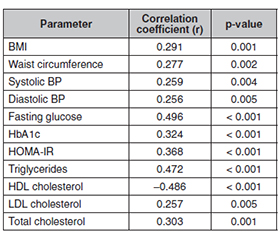
Актуальність. Метаболічний синдром — це кластер станів, що включає інсулінорезистентність та центральне ожиріння, які значно підвищують ризик серцево-судинних захворювань і цукрового діабету 2-го типу. Новий адипокін аспрозин бере участь у гомеостазі глюкози та регуляції апетиту, однак його роль у глікемічному континуумі при метаболічному синдромі залишається нез’ясованою. Метa: оцінити рівні аспрозину в сироватці крові пацієнтів із метаболічним синдромом, стратифікованих за глікемічним статусом, та оцінити його діагностичний потенціал щодо виявлення дисглікемії. Матеріали та методи. Було проведено дослідження типу «випадок — контроль» за участю 120 осіб, розділених на чотири групи: здорові особи контрольної групи, пацієнти із метаболічним синдромом без цукрового діабету, метаболічним синдромом і предіабетом, метаболічним синдромом та цукровим діабетом 2-го типу. Зібрано антропометричні дані й біохімічні показники (глюкоза натще, глікований гемоглобін, ліпідний профіль та HOMA-IR). Рівні аспрозину в сироватці крові були кількісно визначені за допомогою ELISA. Статистичний аналіз включав тести Краскела — Уолліса, кореляції Спірмена та аналіз ROC-кривої. Результати. Рівень аспрозину в сироватці крові був вірогідно підвищений у всіх когортах із метаболічним синдромом порівняно з контрольною групою (p < 0,001). Уміст аспрозину позитивно корелював з індексом маси тіла, окружністю талії, рівнем глюкози натще, HbA1c, HOMA-IR та атерогенних ліпідів, а також обернено корелював із холестерином ліпопротеїнів високої щільності. ROC-аналіз показав високу діагностичну ефективність щодо метаболічного синдрому при предіабеті (AUC = 0,863), метаболічного синдрому при цукровому діабеті 2-го типу (AUC = 0,839) та ізольованого метаболічного синдрому (AUC = 0,807). Висновки. Підвищений рівень аспрозину в крові нерозривно пов’язаний із прогресуючим погіршенням гомеостазу глюкози та несприятливим ліпідним профілем, що позиціонує його як перспективний прогностичний показник у стратифікації осіб із кардіометаболічним ризиком та глікемічними порушеннями.
Background. Metabolic syndrome is a cluster of conditions, including insulin resistance and central obesity, that significantly increase the risk of cardiovascular disease and type 2 diabetes mellitus. Asprosin, a novel fasting-induced adipokine, is implicated in glucose homeostasis and appetite regulation; however, its role across the glycemic continuum in metabolic syndrome remains unclear. This study purposed to evaluate serum asprosin levels in patients with metabolic syndrome stratified by glycemic status and to assess its diagnostic potential for identifying dysglycemia. Materials and methods. A case-control study was conducted with 120 participants divided into four groups: healthy controls, metabolic syndrome without diabetes, metabolic syndrome with prediabetes, and metabolic syndrome with type 2 diabetes mellitus. Anthropometric data and biochemical indices (fasting glucose, glycated hemoglobin, lipid profile, and HOMA-IR) were collected. Serum asprosin levels were quantified using enzyme-linked immunosorbent assay. Statistical analyses included Kruskal-Wallis tests, Spearman’s correlations, and ROC curve analyses. Results. Serum asprosin levels were significantly elevated in all metabolic syndrome cohorts compared to controls (p < 0.001). Asprosin levels correlated positively with body mass index, waist circumference, fasting glucose, HbA1c, HOMA-IR, and atherogenic lipids, and inversely correlated with high-density lipoprotein cholesterol. ROC analysis indicated strong diagnostic performance for metabolic syndrome in prediabetes (AUC = 0.863), metabolic syndrome in type 2 diabetes mellitus (AUC = 0.839), and isolated metabolic syndrome (AUC = 0.807). Conclusions. Elevated circulating asprosin levels are intrinsically linked to the progressive deterioration of glucose homeostasis and adverse lipid profiles, positioning it as a promising predictive indicator for cardiometabolic risk stratification and glycemic impairment.
цукровий діабет 2-го типу; адипокіни; аспрозин; інсулінорезистентність; предіабет; ожиріння
type 2 diabetes mellitus; adipokines; asprosin; insulin resistance; prediabetes; obesity
Для ознакомления с полным содержанием статьи необходимо оформить подписку на журнал.
- Kridin K, Lyakhovitsky K, Barhoum M, Lyakhovitsky A, Cohen AD, Weinstein O. Vitiligo and the metabolic syndrome: clarifying the inconsistent relationship by a large-scale population-based study. Arch Dermatol Res. 2024 Jun 15;316(7):408. doi: 10.1007/s00403-024-03117-7.
- Zeyad M, Saudi L, Maraqa B, Musmar B, Nazzal Z. Prevalence of prediabetes and associated risk factors in the Eastern Mediterranean Region: a systematic review. BMC Public Health. 2025 Apr 12;25(1):1382. doi: 10.1186/s12889-025-22598-3.
- Zamil AH, Amin SS. The prevalence of metabolic syndrome among university students in Wasit, Iraq. Saudi Med J. 2022 Nov;43(11):1240-1247. doi: 10.15537/smj.2022.43.11.20220558.
- Pestel J, Blangero F, Watson J, Pirola L, Eljaafari A. Adipokines in obesity and metabolic-related-diseases. Biochimie. 2023 Sep;212:48-59. doi: 10.1016/j.biochi.2023.04.008.
- Gupta A, Gupta P, Singh AK, Gupta V. Association of adipokines with insulin resistance and metabolic syndrome including obesity and diabetes. GHM Open. 2023 Aug 31;3(1):7-19. doi: 10.35772/ghmo.2023.01004.
- Noubiap JJ, Nansseu JR, Nyaga UF, Ndoadoumgue AL, Ngouo AT, Tounouga DN, et al. Worldwide trends in metabolic syndrome from 2000 to 2023: a systematic review and modelling analysis. Nat Commun. 2025 Dec 6;17(1):573. doi: 10.1038/s41467-025-67268-5.
- Romere C, Duerrschmid C, Bournat J, Constable P, Jain M, Xia F, et al. Asprosin, a Fasting-Induced Glucogenic Protein Hormone. Cell. 2016 Apr 21;165(3):566-79. doi: 10.1016/j.cell.2016.02.063.
- Jin Y, Yu B, Wang Y. Association between asprosin and metabolic syndrome in people living with human immunodeficiency virus: A case-control study. Medicine (Baltimore). 2025 Oct 17;104(42):e45373. doi: 10.1097/MD.0000000000045373.
- Zhang Z, Zhu L, Wang Z, Hua N, Hu S, Chen Y. Can the new adipokine asprosin be a metabolic troublemaker for cardiovascular di–seases? A state-of-the-art review. Prog Lipid Res. 2023 Jul;91:101240. doi: 10.1016/j.plipres.2023.101240.
- Farrag M, Ait Eldjoudi D, González-Rodríguez M, Cordero-Barreal A, Ruiz-Fernández C, Capuozzo M, et al. Asprosin in health and disease, a new glucose sensor with central and peripheral metabolic effects. Front Endocrinol (Lausanne). 2023 Jan 5;13:1101091. doi: 10.3389/fendo.2022.1101091.
- Moradi N, Fadaei R, Roozbehkia M, Nourbakhsh M, Nourbakhsh M, Razzaghy-Azar M, Larijani B. Meteorin-like Protein and Asprosin Levels in Children and Adolescents with Obesity and Their Relationship with Insulin Resistance and Metabolic Syndrome. Lab Med. 2023 Sep 5;54(5):457-463. doi: 10.1093/labmed/lmac152.
- Yoon J, Heo SJ, Lee JH, Kwon YJ, Lee JE. Comparison of METS-IR and HOMA-IR for predicting new-onset CKD in middle-aged and older adults. Diabetol Metab Syndr. 2023 Nov 14;15(1):230. doi: 10.1186/s13098-023-01214-7.
- Wang Y, Qu H, Xiong X, Qiu Y, Liao Y, Chen Y, et al. Plasma Asprosin Concentrations Are Increased in Individuals with Glucose Dysregulation and Correlated with Insulin Resistance and First-Phase Insulin Secretion. Mediators Inflamm. 2018 Mar 20;2018:9471583. doi: 10.1155/2018/9471583.
- Diao H, Fan X, Li Z, Hou L, Dong Z, Pang S. Circulating asprosin concentrations in individuals with new-onset type 2 diabetes and prediabetes. Diabetes Res Clin Pract. 2024 Jul;213:111730. doi: 10.1016/j.diabres.2024.111730.
- Ma L, Wang Z, Sun L, Li M, Wu Q, Liu M, Xu M, et al. Association analysis between serum asprosin and metabolic characteristics, complications in type 2 diabetic patients with different durations. J Diabetes Investig. 2024 Dec;15(12):1781-1787. doi: 10.1111/jdi.14313.
- Liang D, Li X, Xiang C, Xu M, Ren Y, Zheng F, et al. The correlation between serum asprosin and type 2 diabetic patients with obesity in the community. Front Endocrinol (Lausanne). 2025 May 5;16:1535668. doi: 10.3389/fendo.2025.1535668.
- Zhou J, Yuan W, Guo Y, Wang Y, Dai Y, Shen Y, Liu X. Asprosin is positively associated with metabolic syndrome in hemodialysis patients: a cross-sectional study. Ren Fail. 2023 Dec;45(1):2220425. doi: 10.1080/0886022X.2023.2220425.
- Naiemian S, Naeemipour M, Zarei M, Lari Najafi M, Gohari A, Behroozikhah MR, et al. Serum concentration of asprosin in new-onset type 2 diabetes. Diabetol Metab Syndr. 2020 Jul 23;12:65. doi: 10.1186/s13098-020-00564-w.
- Mirr M, Braszak-Cymerman A, Ludziejewska A, Kręgielska-Narożna M, Bogdański P, Bryl W, Owecki M. Serum Asprosin Correlates with Indirect Insulin Resistance Indices. Biomedicines. 2023 May 28;11(6):1568. doi: 10.3390/biomedicines11061568.
- Kościuszko M, Buczyńska A, Duraj E, Adamska A, Siewko K, Krętowski AJ, Popławska-Kita A. Associations between asprosin, insulin resistance, and oxidative stress in adults with obesity. Sci Rep. 2025 Nov 19;15(1):40849. doi: 10.1038/s41598-025-24648-7.
- Ulloque-Badaracco JR, Al-Kassab-Córdova A, Hernandez-Bustamante EA, Alarcon-Braga EA, Robles-Valcarcel P, Huayta-Cortez MA, et al. Asprosin levels in patients with type 2 diabetes mellitus, metabolic syndrome and obesity: A systematic review and meta-analysis. Diabetes Metab Syndr. 2024 Jul;18(7):103095. doi: 10.1016/j.dsx.2024.103095.
- Alkhalidy H, Assamak A, Al-Shami I, Mukattash TL, Khashman T, Liu D. Elevated asprosin in hypertension: evidence from an exploratory case-control study. Sci Rep. 2026 Jan 3;16(1):2973. doi: 10.1038/s41598-025-32824-y.
- Karapınar Göze E, Ürün Ünal B, Ünlü A, Açılan İ. Beyond glycemia: adropin, asprosin, and irisin as potential biomarkers for cardiovascular risk in diabetes and prediabetes. Sci Rep. 2026 Feb 16;16(1):7745. doi: 10.1038/s41598-026-37306-3.
- Mahat RK, Jantikar AM, Rathore V, Panda S. Circulating asprosin levels in type 2 diabetes mellitus: A systematic review and meta-analysis. Clin Epidemiol Glob Heal. 2024;25:101502. doi: 10.1016/j.cegh.2023.101502.
- Rahimi MR, Symonds ME, Faraji H, Golpasandi H. Systematic review and meta-analysis of the effect of exercise training on asprosin in randomized controlled trials. Physiol Rep. 2025 Jun;13(12):e70392. doi: 10.14814/phy2.70392.