
Международный эндокринологический журнал Том 22, №5, 2026
Вернуться к номеру
Рівні гастрину-17 при гастроезофагеальній рефлюксній хворобі з урахуванням ожиріння та респіраторних коморбідностей
Авторы: Дербак М.А., Мотильчак Е.М., Блецкан М.М., Ростока Л.М., Сіткар А.Д.
ДВНЗ «Ужгородський національний університет», м. Ужгород, Україна
Рубрики: Эндокринология
Разделы: Клинические исследования
Версия для печати
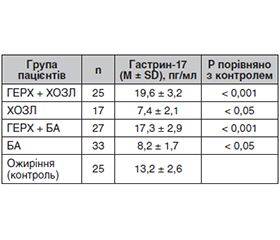
Актуальність. Сучасна клінічна медицина розглядає гастроезофагеальну рефлюксну хворобу (ГЕРХ), хронічне обструктивне захворювання легень (ХОЗЛ), бронхіальну астму (БА) та ожиріння як взаємопов’язані патологічні стани, що формують єдиний метаболічно-запальний каскад. Ключовим регулятором кислотної секреції є гастрин-17. Мета дослідження: оцінити рівні гастрину-17 у пацієнтів з ГЕРХ у поєднанні з ХОЗЛ або БА на тлі ожиріння та їх взаємозв’язок із клінічними й антропометричними показниками. Матеріали та методи. Обстежено 102 пацієнти з діагнозами ХОЗЛ (n = 42), БА (n = 60) і 25 амбулаторних пацієнтів з ожирінням різного ступеня. Рівень гастрину-17 у сироватці крові натще визначали методом ІФА. Результати. Найвищі показники гастрину-17 відзначено в пацієнтів першої групи (ГЕРХ + ХОЗЛ) — 19,6 ± 3,2 пг/мл і другої групи (ГЕРХ + БА) — 17,3 ± 2,9 пг/мл. У пацієнтів третьої (ХОЗЛ) і четвертої (БА) груп рівні гастрину-17 були практично на межі норми, тоді як у п’ятій групі (ожиріння) — проміжні, що мали тенденцію до зростання залежно від індексу маси тіла (від 13,2 ± 2,6 пг/мл до 20,2 ± 3,5 пг/мл). Виявлено чітку позитивну кореляцію між індексом маси тіла і рівнем гастрину-17 (r = +0,64; p < 0,001) і позитивний зв’язок з окружністю талії (r = +0,59; p < 0,001). Зареєстровано підвищення рівня гастрину-17 зі зростанням ступеня ожиріння. У пацієнтів з підвищеним рівнем гастрину-17 реєструвалися клінічні прояви ГЕРХ і частіше проявлялися нічними епізодами рефлюксу (r = +0,61; p < 0,001), ерозивними ураженнями слизової та зниженням ефективності антисекреторної терапії. У пацієнтів з БА вірогідно частіше спостерігалися типові стравохідні прояви рефлюксу в нічний час (OR 1,3–1,5; p < 0,05) і чіткий зв’язок: рефлюкс → бронхоспазм → напад астми. У хворих на ХОЗЛ частіше реєстрували атипові гастроінтестинальні симптоми: хронічний кашель без печії, відрижку повітрям, метеоризм і першіння в горлі, захриплість. Встановлено негативну кореляцію між FEV1 і гастрином-17 (r = –0,52; p < 0,01). Висновки. У пацієнтів з ГЕРХ на тлі ожиріння із супутніми респіраторними захворюваннями спостерігається підвищення рівня гастрину-17, який позитивно корелює з індексом маси тіла, що підкреслює важливу роль ожиріння в розвитку гіпергастринемії. Підвищений рівень гастрину-17 асоціювався з більш тяжким перебігом ГЕРХ, зокрема з частішими нічними симптомами й ерозивними ураженнями слизової оболонки.
Background. Modern clinical medicine regards gastroesophageal reflux disease (GERD), chronic obstructive pulmonary disease (COPD), bronchial asthma (BA), and obesity as interconnected pathological states that form a unified metabolic-inflammatory cascade. Gastrin-17, a hormone of the gastric antrum, is one of the key regulators of acid secretion. The purpose of the study was to evaluate gastrin-17 levels in patients with GERD combined with COPD or BA against a background of obesity, and to assess their correlation with clinical and anthropometric parameters. Materials and methods. The study involved 102 patients diagnosed with COPD (n = 42) and BA (n = 60), as well as 25 outpatients with varying degrees of obesity. Fasting serum gastrin-17 levels were determined using the enzyme-linked immunosorbent assay. Results. The highest gastrin-17 content was observed in group 1 (GERD + COPD) at 19.6 ± 3.2 pg/mL and group 2 (GERD + BA) at 17.3 ± 2.9 pg/mL. In patients of groups 3 (COPD) and 4 (BA), gastrin-17 levels were near the upper limit of the normal range, while in group 5 (obesity) they were intermediate, with a tendency to increase depending on body mass index (from 13.2 ± 2.6 pg/ml to 20.2 ± 3.5 pg/ml). A strong positive correlation was found between body mass index and gastrin-17 content (r = +0.64; p < 0.001), as well as a positive association with waist circumference (r = +0.59; p < 0.001). An increase in gastrin-17 levels was recorded alongside the progression of obesity severity. Patients with elevated gastrin-17 exhibited clinical manifestations of GERD, more frequent nocturnal reflux episodes (r = +0.61; p < 0.001), erosive mucosal lesions, and decreased efficacy of antisecretory therapy. In patients with BA, typical esophageal symptoms of reflux during the night were significantly more frequent (odds ratio 1.3–1.5; p < 0.05), showing a distinct causal sequence: reflux → bronchospasm → asthma attack. Conversely, patients with COPD more frequently presented with atypical gastrointestinal symptoms, including chronic cough without heartburn, belching, flatulence, throat irritation, and hoarseness. A negative correlation was found between FEV1 and gastrin-17 levels (r = –0.52; p < 0.01). Conclusions. In patients with GERD and comorbid respiratory diseases associated with obesity, there is an elevation in gastrin-17. This parameter correlates positively with body mass index, highlighting the significant role of obesity in the development of hypergastrinemia. Elevated gastrin-17 content is associated with a more severe course of GERD, characterized by more frequent nocturnal symptoms and erosive mucosal lesions.
хронічне обструктивне захворювання легень; бронхіальна астма; ожиріння; гастрин-17; гастроезофагеальна рефлюксна хвороба
chronic obstructive pulmonary disease; bronchial asthma; obesity; gastrin-17; gastroesophageal reflux disease
Для ознакомления с полным содержанием статьи необходимо оформить подписку на журнал.
- Katz PO, Dunbar KB, Schnoll-Sussman FH, Greer KB, Yadlapati R, Spechler SJ. ACG Clinical Guideline for the Diagnosis and Management of Gastroesophageal Reflux Disease. Am J Gastroenterol. 2022 Jan 1;117(1):27-56. doi: 10.14309/ajg.0000000000001538. PMID: 34807007; PMCID: PMC8754510.
- Venkatesan P. GOLD COPD report: 2025 update. Lancet Respir Med. 2025 Jan;13(1):e7-e8. doi: 10.1016/S2213-2600(24)00413-2. Epub 2024 Dec 5. PMID: 39647487.
- Harding SM, Sontag SJ. Asthma and gastroesophageal reflux. Am J Gastroenterol. 2000 Aug;95(8 Suppl):S23-32. doi: 10.1016/s0002-9270(00)01075-3. PMID: 10950102.
- Rogha M, Behravesh B, Pourmoghaddas Z. Association of gastroesophageal reflux disease symptoms with exacerbations of chro–nic obstructive pulmonary disease. J Gastrointestin Liver Dis. 2010 Sep;19(3):253-6. PMID: 20922187.
- El-Serag H. The association between obesity and GERD: a review of the epidemiological evidence. Dig Dis Sci. 2008 Sep;53(9):2307-12. doi: 10.1007/s10620-008-0413-9. Epub 2008 Jul 24. PMID: 18651221; PMCID: PMC2827866.
- Gómez Escudero O, Herrera Hernández MF, Valdovinos Díaz MA. Obesidad y enfermedad por reflujo gastroesofágico [Obesity and gastroesophageal reflux disease]. Rev Invest Clin. 2002 Jul-Aug;54(4):320-7. Spanish. PMID: 12415956.
- Rehfeld JF. Gastrin and the Moderate Hypergastrinemias. Int J Mol Sci. 2021 Jun 29;22(13):6977. doi: 10.3390/ijms22136977. PMID: 34209478; PMCID: PMC8269006.
- Vayal-Veettil A, Gyawali CP. Diagnosis and Management of Gastroesophageal Reflux Disease: Current Insights. Clin Exp Gastroenterol. 2025 Jul 8;18:149-162. doi: 10.2147/CEG.S507237. PMID: 40656590; PMCID: PMC12255250.
- Malfertheiner P, Megraud F, Rokkas T, Gisbert JP, Liou JM, Schulz C, et al; European Helicobacter and Microbiota Study group. Management of Helicobacter pylori infection: the Maastricht VI/Florence consensus report. Gut. 2022 Aug 8:gutjnl-2022-327745. doi: 10.1136/gutjnl-2022-327745. Epub ahead of print. PMID: 35944925.
- Sugano K, Tack J, Kuipers EJ, Graham DY, El-Omar EM, Miura S, et al; faculty members of Kyoto Global Consensus Conference. Kyoto global consensus report on Helicobacter pylori gastritis. Gut. 2015 Sep;64(9):1353-67. doi: 10.1136/gutjnl-2015-309252. Epub 2015 Jul 17. PMID: 26187502; PMCID: PMC4552923.
- Liou J-M, Malfertheiner P, Hong T-C, et al. Screening and eradication of Helicobacter pylori for gastric cancer prevention: Taipei Global Consensus II. Gut. 2025;74:1767-1791. doi: 10.1136/gutjnl-2025-336027.
- Festi D, Scaioli E, Baldi F, Vestito A, Pasqui F, Di Biase AR, Colecchia A. Body weight, lifestyle, dietary habits and gastroesophageal reflux disease. World J Gastroenterol. 2009 Apr 14;15(14):1690-701. doi: 10.3748/wjg.15.1690. PMID: 19360912; PMCID: PMC2668774.
- Safiri S, Sorkhabi AD, Aletaha R, Kolahi A-A, et al. Obesity: Global Epidemiology, Trends, Risk Factors, and Clinical Aspects. Int J Aging. 2024;2:e19. doi: 10.34172/ija.2024.e19.
- Chang P, Friedenberg F. Obesity and GERD. Gastroenterol Clin North Am. 2014 Mar;43(1):161-73. doi: 10.1016/j.gtc.2013.11.009. Epub 2013 Dec 27. PMID: 24503366; PMCID: PMC3920303.
- Nadaleto BF, Herbella FA, Patti MG. Gastroesophageal reflux disease in the obese: Pathophysiology and treatment. Surgery. 2016 Feb;159(2):475-86. doi: 10.1016/j.surg.2015.04.034. Epub 2015 Jun 6. PMID: 26054318.
- Mion F, Dargent J. Gastro-oesophageal reflux disease and obesity: pathogenesis and response to treatment. Best Pract Res Clin Gastroenterol. 2014 Aug;28(4):611-22. doi: 10.1016/j.bpg.2014.07.012. Epub 2014 Jul 21. PMID: 25194179.
- Baldomero AK, Wendt CH, Petersen A, Gaeckle NT, Han MK, Kunisaki KM; COPDGene Investigators. Impact of gastroesophageal reflux on longitudinal lung function and quantitative computed tomography in the COPDGene cohort. Respir Res. 2020 Aug 3;21(1):203. doi: 10.1186/s12931-020-01469-y. PMID: 32746820; PMCID: PMC7397645.
- Huang C, Liu Y, Shi G. A systematic review with meta-ana–lysis of gastroesophageal reflux disease and exacerbations of chronic obstructive pulmonary disease. BMC Pulm Med. 2020 Jan 8;20(1):2. doi: 10.1186/s12890-019-1027-z. PMID: 31914979; PMCID: PMC6950869.
- Dong R, Zhang Q, Peng H. Gastroesophageal reflux disease and the risk of respiratory diseases: a Mendelian randomization study. J Transl Med. 2024 Jan 16;22(1):60. doi: 10.1186/s12967-023-04786-0. PMID: 38229096; PMCID: PMC10790464.