
Международный эндокринологический журнал Том 22, №5, 2026
Вернуться к номеру
Оцінка прозапальних цитокінів IL-15, IL-18 та IFN-γ як діагностичних біомаркерів та їх зв’язок iз глікемічним контролем при цукровому діабеті 1-го типу
Авторы: Fadhil Adhab Hameed (1), Nibras S. Al-Ammar (1), Dheyaa Kadhim J. Al-Waeli (2)
(1) - College of Medicine, University of Basrah, Iraq
(2) - College of Medicine, University of Thi-Qar, Iraq
Рубрики: Эндокринология
Разделы: Клинические исследования
Версия для печати
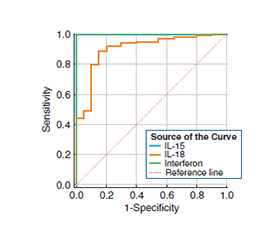
Актуальність. Цукровий діабет 1-го типу (ЦД1) є стійким порушенням імунної системи, що характеризується опосередкованою Т-клітинами облітерацією продукуючих інсулін бета-клітин підшлункової залози. Цей механізм регулюється складною системою прозапальних цитокінів, які обумовлюють хронічне запалення й імуноопосередковану загибель клітин. Розуміння взаємодії між цитокінами і регуляцією глікемії має вирішальне значення для поліпшення діагностики й лікування захворювання. Мета: оцінити рівні прозапальних цитокінів (IL-15, IL-18 та IFN-γ) у пацієнтів із цукровим діабетом 1-го типу, щоб визначити їх потенціал як біомаркерів для прогнозування перебігу захворювання та кореляцію з глікованим гемоглобіном (HbA1c). Матеріали та методи. Дослідження типу «випадок — контроль» було проведено за участю 100 пацієнтів з південного Іраку та 100 здорових контрольних осіб у період з січня до березня 2026 року. Концентрацію цитокінів у сироватці крові визначали за допомогою методу ELISA. Для оцінки кореляції між параметрами і точністю діагностики використовували статистичні методи, зокрема кореляцію Пірсона та аналіз ROC-кривої. Результати. Дослідження показало, що в пацієнтів із ЦД1 спостерігався вірогідно підвищений уміст IL-15, IL-18 та IFN-γ порівняно з контрольною групою (p < 0,01). Помітна позитивна кореляція існує між HbA1c та цими трьома цитокінами, причому найбільш сильний зв’язок виявлено з IFN-γ (r = 0,478, p = 0,000). Крім того, рівні IFN-γ були значно підвищені в пацієнтів чоловічої статі та серед молодших вікових груп (≤ 10 років). ROC-аналіз показав, що всі три цитокіни є сильними предикторами розвитку ЦД1, демонструючи значення площі під кривою від 0,903 до 1,00. Висновки. Згідно з результатами дослідження, IL-15, IL-18 та IFN-γ беруть участь у патогенезі ЦД1 і вірогідно пов’язані з хронічною гіперглікемією. Цитокіни функціонують як чутливі та специфічні біомаркери. Це вказує на те, що їх інтеграція в протоколи клінічного скринінгу може поліпшити раннє виявлення й моніторинг автоімунного запалення в пацієнтів із ЦД1.
Background. Type 1 diabetes mellitus (T1DM) is a persistent autoimmune condition marked by the T-cell-mediated obliteration of insulin-secreting pancreatic beta cells. This mechanism is governed by a complex network of pro-inflammatory cytokines that facilitate chronic inflammation and immune-mediated cell death. Comprehending the interaction between these cytokines and glycemic regulation is crucial for enhancing diagnosis and disease management. The study purposed to evaluate the levels of pro-inflammatory cytokines (IL-15, IL-18, and IFN-γ) in patients with type 1 diabetes mellitus to determine their potential as biomarkers for disease prediction and their correlation with glycated hemoglobin (HbA1c). Materials and methods. Case-control research was performed with 100 T1DM patients from southern Iraq and 100 healthy controls between January and March 2026. Serum cytokine concentrations were quantified with the enzyme-linked immunosorbent assay. Statistical methods, comprising Pearson correlation and receiver operating characteristic (ROC) curve analysis, were employed to evaluate the correlations between parameters and diagnostic accuracy. Results. The study showed the patients with T1DM demonstrated markedly elevated levels of IL-15, IL-18, and IFN-γ compared to the control group (p < 0.01). A notable positive correlation exists between HbA1c and all three cytokines, with the most robust association identified for IFN-γ (r = 0.478, p = 0.000). Furthermore, IFN-γ levels were significantly elevated in male patients and among younger age groups (≤ 10 years). ROC analysis demonstrated that all three cytokines serve as strong predictors for T1DM, exhibiting area under the curve values between 0.903 and 1.00. Conclusions. The results demonstrate that IL-15, IL-18, and IFN-γ contribute synergistically to the pathogenesis of T1DM and are significantly associated with chronic hyperglycemia. Cytokines function as sensitive and specific biomarkers indicate that their integration into clinical screening protocols may improve early detection and monitoring of autoimmune inflammation in T1DM patients.
цукровий діабет 1-го типу; глікований гемоглобін; біомаркери; прозапальні цитокіни; IL-15; IL-18; IFN-γ
type 1 diabetes mellitus; glycated hemoglobin; biomarkers; proinflammatory cytokines; IL-15; IL-18; IFN-γ
Для ознакомления с полным содержанием статьи необходимо оформить подписку на журнал.
- Arffman M, Hakkarainen P, Keskimäki I, Oksanen T, Sund R. Long-term and recent trends in survival and life expectancy for people with type 1 diabetes in Finland. Diabetes Res Clin Pract. 2023;198:110580. doi: 10.1016/j.diabres.2023.110580.
- Nyaga DM, Vickers MH, Jefferies C, Perry JK, O’Sullivan JM. The genetic architecture of type 1 diabetes mellitus. Mol Cell Endocrinol. 2018;477:70-80. doi: 10.1016/j.mce.2018.06.002.
- Syed FZ. Type 1 diabetes mellitus. Ann Intern Med. 2022;175(3):ITC33-ITC48. doi: 10.7326/AITC202203150.
- Leslie RD, Evans-Molina C, Freund-Brown J, et al. Adult-onset type 1 diabetes: current understanding and challenges. Diabetes Care. 2021;44(11):2449-2456. doi: 10.2337/dc21-0770.
- Hussein AS, Almansoob AS. Role of glycated hemoglobin (HbA1c) on severity of ischemic stroke in patients with (type 1 and 2) diabetes mellitus. Electron J Univ Aden Basic Appl Sci. 2023;4(4):347-356. doi: 10.47372/ejua-ba.2023.4.293.
- Mauvais F, van Endert PM. Type 1 diabetes: A guide to autoimmune mechanisms for clinicians. Diabetes Obes Metab. 2025;27:40-56. doi: 10.1111/dom.15934.
- Chen J, Feigenbaum L, Awasthi P, et al. Insulin-dependent diabetes induced by pancreatic beta cell expression of IL-15 and IL-15Rα. Proc Natl Acad Sci USA. 2013;110(33):13534-13539. doi: 10.1073/pnas.1306354110.
- Waldmann TA. The biology of IL-15: implications for cancer therapy and the treatment of autoimmune disorders. J Investig Dermatol Symp Proc. 2013;16(1):S28-S30. doi: 10.1038/jidsymp.2013.8.
- Harms RZ, Yarde DN, Guinn Z, et al. Increased expression of IL-18 in the serum and islets of type 1 diabetics. Mol Immunol. 2015;64(2):306-312. doi: 10.1016/j.molimm.2014.12.007.
- Volin MV, Koch AE. Interleukin-18: a mediator of inflammation and angiogenesis in rheumatoid arthritis. J Interferon Cytokine Res. 2011;31(10):745-751. doi: 10.1089/jir.2011.0050.
- Zaccone P, Phillips J, Conget I, Cooke A, Nicoletti F. IL-18 binding protein fusion construct delays the development of diabetes in adoptive transfer and cyclophosphamide-induced diabetes in NOD mouse. Clin Immunol. 2005;115(1):74-79. doi: 10.1016/j.clim.2004.12.001.
- Dinarello CA, Bufler P. Interleukin-37. Seminars in Immunology. 2013;25(6):466-468. doi: 10.1016/j.smim.2013.10.010.
- De George DJ, Ge T, Krishnamurthy B, Kay TWH, Tho–mas HE. Inflammation versus regulation: how interferon-gamma contributes to type 1 diabetes pathogenesis. Front Cell Dev Biol. 2023;11:1205590. doi: 10.3389/fcell.2023.1205590.
- Merli P, Quintarelli C, Strocchio L, Locatelli F. The role of interferon‐gamma and its signaling pathway in pediatric hematological disorders. Pediatr Blood Cancer. 2021;68(4):e28900. doi: 10.1002/pbc.28900.
- Eizirik DL, Pasquali L, Cnop M. Pancreatic β-cells in type 1 and type 2 diabetes mellitus: different pathways to failure. Nat Rev Endocrinol. 2020;16(7):349-362. doi: 10.1038/s41574-020-0355-7.
- Thomas HE, Graham KL, Chee J, et al. Proinflammatory cytokines contribute to development and function of regulatory T cells in type 1 diabetes. Ann NY Acad Sci. 2013;1283(1):81-86. doi: 10.1111/nyas.12019.
- Okab HF, Salih MB, Jarulla BA. Evaluation of CXCL 10 and IL-10 in COVID-19 pneumonia. Pneumologia. 2024;71(4):175-180. doi: 10.2478/pneum-2023-0043.
- Zubairi RB, Hasan SA, Okab HF. Effect of IL-17 and IL-23 Levels in Women with Polycystic Ovary Syndrome. Reprod Health East Eur. 2025;15(1):43-50. doi: 10.34883/PI.2025.15.1.045.
- Li J, Liang X, Zhao M, et al. Monocyte/macrophage-derived interleukin-15 mediates the pro-inflammatory phenotype of CD226+ B cells in type 1 diabetes. EBioMedicine. 2025;120:105342. doi: 10.1016/j.ebiom.2024.105342.
- Kuczyński S, Winiarska H, Abramczyk M, et al. IL-15 is elevated in serum patients with type 1 diabetes mellitus. Diabetes Res Clin Pract. 2005;69(3):231-236. doi: 10.1016/j.diabres.2005.01.002.
- Al-Dubayee M, Babiker A, Alkewaibeen A, et al. Correlation analysis between cytokines’ profile, autoimmune antibodies and the duration of type 1 diabetes: A case control study in a speciali–zed children’s centre in Riyadh. Int J Immunopathol Pharmacol. 2023;37:03946320231209821. doi: 10.1177/03946320231209821.
- Gui R, Ren Y, Wang Z, et al. Deciphering interleukin‐18 in diabetes and its complications: Biological features, mechanisms, and therapeutic perspectives. Obes Rev. 2024;25(11):e13818. doi: 10.1111/obr.13818.
- Coomans de Brachène A, Alvelos MI, Szymczak F, et al. Interferons are key cytokines acting on pancreatic islets in type 1 diabetes. Diabetologia. 2024;67(5):908-927. doi: 10.1007/s00125-024-06103-6.
- Hussein IA, AL-Abassi HM, Nasser AA. IFN-γ T/A+ 874 gene polymorphism in type 1 diabetes mellitus of Iraqi children. Ibn AL-Haitham J Pure Appl Sci. 2017;29(1):159-166. doi: 10.30526/2016.29.1.1147.
- Aldegheri L, Catamo E, Zanotta N, et al. Alterations of oral microbiota and cytokines profile in children and young adults with type 1 diabetes. Front Endocrinol (Lausanne). 2025;16:1629185. doi: 10.3389/fendo.2025.1629185.
- Vaseghi H, Jadali Z. Th1/Th2 cytokines in type 1 diabetes: Relation to duration of disease and gender. Indian J Endocrinol Metab. 2016;20(3):312-316. doi: 10.4103/2230-8210.179770.
- Halminen M, Juhela S, Vaarala O, Simell O, Ilonen J. Induction of interferon-γ and IL-4 production by mitogen and specific antigens in peripheral blood lymphocytes of type 1 diabetes patients. Autoimmunity. 2018;34(1):1-8. doi: 10.1080/08916930108994119.
- Lachmandas E, Thiem K, van den Heuvel C, et al. Patients with type 1 diabetes mellitus have impaired IL-1β production in response to Mycobacterium tuberculosis. Eur J Clin Microbiol Infect Dis. 2018;37(2):371-380. doi: 10.1007/s10096-017-3136-2.
- Dong G, Liang L, Fu J, Zou C. Serum interleukin-18 levels are raised in diabetic ketoacidosis in Chinese children with type 1 diabetes mellitus. Indian Pediatr. 2007;44(10):732-734.
- Li Y, Cheng P, An Y, et al. Identification of biomarkers and construction of discriminating model for tuberculosis patients with dia–betes mellitus based on proteomics: a cross-sectional study. Front Immunol. 2025;16:1713654. doi: 10.3389/fimmu.2025.1713654.
- Abdullah MY, Alhaddad FAK, Pambuk CIA, Marghali S. Association of interleukin polymorphisms and inflammatory mar–kers with hospitalization, survival, and COVID-19 severity in type 1 diabetes patients: A multivariate and Cox regression analysis. Cell Mol Biol (Noisy-le-grand). 2025;71(1):125-134. doi: 10.14715/cmb/2024.71.1.18.