
Международный эндокринологический журнал Том 22, №5, 2026
Вернуться к номеру
Профілі цитокінів та гормональних біомаркерів як предикторів інвазії пухлини у хворих на рак шийки матки та цукровий діабет 2-го типу
Авторы: Zainab Qassim Mohammed Hilo (1), Ghadeer Hamid AL-Ardhi (1), Osama A. Mohsein (2)
(1) - DNA Research Center, University of Babylon, Iraq, Hillah, Babylon, Iraq
(2) - Thi-Qar Health Directorate, Al Habbobi Teaching Hospital, Thi-Qar, Iraq
Рубрики: Эндокринология
Разделы: Клинические исследования
Версия для печати
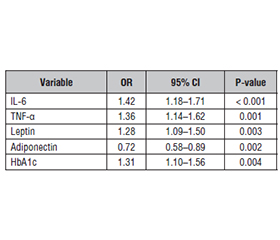
Актуальність. Розвиток раку шийки матки пов’язаний із запальними цитокінами та метаболічними розладами, особливо при цукровому діабеті 2-го типу. Гіперглікемія призводить до інвазії пухлини, ангіогенезу й виникнення метастазів. Мета: оцінити використання цитокінових і гормональних біомаркерів як предикторів пухлинної інвазії та метастазування у хворих на цукровий діабет 2-го типу і рак шийки матки. Матеріали та методи. З червня 2025 року до березня 2026 року проведено дослідження типу «випадок — контроль» за участю 100 жінок із раком шийки матки та цукровим діабетом 2-го типу і 50 осіб відповідного віку й статі. Були взяті зразки крові (5 мл), після чого методом імуноферментного аналізу встановлювали сироваткові концентрації інтерлейкіну-6 (ІЛ-6), фактора некрозу пухлини α (ФНП-α), ІЛ-10, лептину й адипонектину. Автоматичні аналізатори використовували для визначення рівня глюкози в крові натще й глікованого гемоглобіну (HbA1c). Оцінка клінічних та гістопатологічних даних допомагала встановити діагноз. Для проведення порівняльного аналізу пацієнтів було розподілено на групи з локалізованим та інвазивним пухлинним процесом відповідно до стадії захворювання. Результати. Не виявлено суттєвої різниці у віці між пацієнтками та контрольною групою (P = 0,231), а індекс маси тіла, рівень глюкози в крові натще та HbA1c були вірогідно вищими у хворих (P ≤ 0,001). Спостерігалося збільшення рівня прозапальних цитокінів (ІЛ-6, ФНП-α), ІЛ-10, лептину й інсуліну та зниження рівня адипонектину (P < 0,001). Вищий уміст ІЛ-6, ФНП-α, ІЛ-10 та лептину, нижчі концентрації адипонектину відзначалися в пацієнток з інвазією процесу (P ≤ 0,002). Встановлено тісний зв’язок між стадією пухлини й глікемічними параметрами, біомаркерами та глікемічними параметрами. Інвазію пухлини можна прогнозувати за рівнями ІЛ-6, ФНП-α, лептину й HbA1c, при цьому вміст адипонектину має протективний ефект. Висновки. Цитокіновий та гормональний дисбаланс відіграє важливу роль в інвазії пухлини при раку шийки матки на тлі цукрового діабету 2-го типу. Хронічне запалення та метаболічна дисрегуляція призводять до прогресування й метастазування пухлини, тоді як знижений рівень адипонектину має протипухлинний ефект.
Background. The development of cervical cancer is associated with inflammatory cytokines and metabolic disorders, particularly in type 2 diabetes mellitus. Hyperglycemia facilitates tumor invasion, angiogenesis and metastasis. The purpose of the study was to assess the use of cytokine and hormonal biomarkers as a predictor of tumor invasion and metastasis in patients with type 2 diabetes mellitus and cervical cancer. Materials and methods. From June 2025 to March 2026, a case-control study was carried out and involved 100 patients with cervical cancer and type 2 diabetes mellitus and 50 age and sex matched controls. Blood samples (5 mL) were taken and serum analyzed by enzyme-linked immunosorbent assay on interleukin-6 (IL-6), tumor necrosis factor-α (TNF-α), IL-10, leptin and adiponectin. Automated analyzers were used to measure fasting blood glucose and glycated hemoglobin (HbA1c). Clinical and histopathological findings helped make the diagnosis. Tumor stage was used to categorize patients into localized and invasive groups to make comparisons. Results. There was no significant difference in age between patients and controls (P = 0.231), while body mass index, fasting blood glucose, and HbA1c were significantly higher in patients (P ≤ 0.001). There was an increase in pro-inflammatory cytokines (IL-6, TNF-α), IL-10, leptin and insulin and a decrease in adiponectin (P < 0.001). Higher levels of IL-6, TNF-α, IL-10 and leptin, lower levels of adiponectin were detected in invasive cases (P ≤ 0.002). Close associations were found among the tumor stage and glycemic parameters, biomarkers and glycemic parameters. Invasion was predicted by IL-6, TNF-α, leptin and HbA1c, while adiponectin had a protective effect. Conclusions. The cytokine and hormonal imbalance plays a major role in tumor invasion in cervical cancer with type 2 diabetes mellitus, probably because chronic inflammation and metabolic dysregulation increase oncogenic signaling, whereas decreased adiponectin undermines anti-tumor functions, facilitating progression and metastasis.
цукровий діабет 2-го типу; рак шийки матки; глікований гемоглобін; цитокіни; адипокіни; інвазія пухлини
type 2 diabetes mellitus; cervical cancer; glycated hemoglobin; cytokines; adipokines; tumor invasion
Для ознакомления с полным содержанием статьи необходимо оформить подписку на журнал.
- Shrestha AD, Neupane D, Vedsted P, Kallestrup P. Cervical Cancer Prevalence, Incidence and Mortality in Low and Middle Income Countries: A Systematic Review. Asian Pac J Cancer Prev. 2018 Feb 26;19(2):319-324. doi: 10.22034/APJCP.2018.19.2.319.
- Hull R, Mbele M, Makhafola T, Hicks C, Wang SM, Reis RM, et al. Cervical cancer in low and middle-income countries. Oncol Lett. 2020 Sep;20(3):2058-2074. doi: 10.3892/ol.2020.11754.
- Habanjar O, Bingula R, Decombat C, Diab-Assaf M, Caldefie-Chezet F, Delort L. Crosstalk of Inflammatory Cytokines within the Breast Tumor Microenvironment. Int J Mol Sci. 2023 Feb 16;24(4):4002. doi: 10.3390/ijms24044002.
- Zhao H, Wu L, Yan G, Chen Y, Zhou M, Wu Y, Li Y. Inflammation and tumor progression: signaling pathways and targeted intervention. Signal Transduct Target Ther. 2021 Jul 12;6(1):263. doi: 10.1038/s41392-021-00658-5.
- Manore SG, Doheny DL, Wong GL, Lo HW. IL-6/JAK/STAT3 Signaling in Breast Cancer Metastasis: Biology and Treatment. Front Oncol. 2022 Mar 15;12:866014. doi: 10.3389/fonc.2022.866014.
- Rahman I, Athar MT, Islam M. Type 2 Diabetes, Obesity, and Cancer Share Some Common and Critical Pathways. Front Oncol. 2021 Jan 20;10:600824. doi: 10.3389/fonc.2020.600824.
- Ellulu MS, Samouda H. Clinical and biological risk factors associated with inflammation in patients with type 2 diabetes mellitus. BMC Endocr Disord. 2022 Jan 6;22(1):16. doi: 10.1186/s12902-021-00925-0.
- Cozzo AJ, Fuller AM, Makowski L. Contribution of Adipose Tissue to Development of Cancer. Compr Physiol. 2017 Dec 12;8(1):237-282. doi: 10.1002/cphy.c170008.
- Rajesh Y, Sarkar D. Association of Adipose Tissue and Adipokines with Development of Obesity-Induced Liver Cancer. Int J Mol Sci. 2021 Feb 22;22(4):2163. doi: 10.3390/ijms22042163.
- Parida S, Siddharth S, Sharma D. Adiponectin, Obesity, and Cancer: Clash of the Bigwigs in Health and Disease. Int J Mol Sci. 2019 May 22;20(10):2519. doi: 10.3390/ijms20102519.
- Méndez-García LA, Cid-Soto M, Aguayo-Guerrero JA, Carrero-Aguirre M, Trejo-Millán F, Islas-Andrade S, et al. Low Serum Interleukin-6 Is a Differential Marker of Obesity-Related Metabolic Dysfunction in Women and Men. J Interferon Cytokine Res. 2020 Mar;40(3):131-138. doi: 10.1089/jir.2019.0149.
- Ullah A, Singla RK, Batool Z, Cao D, Shen B. Pro- and anti-–inflammatory cytokines are the game-changers in childhood obesity-associated metabolic disorders (diabetes and non-alcoholic fatty liver diseases). Rev Endocr Metab Disord. 2024 Aug;25(4):783-803. doi: 10.1007/s11154-024-09884-y.
- Rašková M, Lacina L, Kejík Z, Venhauerová A, Skaličko–vá M, Kolář M, et al. The Role of IL-6 in Cancer Cell Invasiveness and Metastasis-Overview and Therapeutic Opportunities. Cells. 2022 Nov 21;11(22):3698. doi: 10.3390/cells11223698.
- Mohamed AH, Ahmed AT, Al Abdulmonem W, Bokov DO, Shafie A, Al-Hetty HRAK, et al. Interleukin-6 serves as a critical factor in various cancer progression and therapy. Med Oncol. 2024 Jun 20;41(7):182. doi: 10.1007/s12032-024-02422-5.
- Cai C, Peng X, Zhang Y. Serum IL-6 Level Predicts the Prognosis and Diagnosis in Cervical Cancer Patients. Int J Womens Health. 2022 May 3;14:655-663. doi: 10.2147/IJWH.S347740.
- Dong J, Qiang Ma. Integration of inflammation, fibrosis, and cancer induced by carbon nanotubes. Nanotoxicology. 2019;13(9):1244-1274. Available from: https://stacks.cdc.gov/view/cdc/214783.
- Laha D, Grant R, Mishra P, Nilubol N. The Role of Tumor Necrosis Factor in Manipulating the Immunological Response of Tumor Microenvironment. Front Immunol. 2021 Apr 27;12:656908. doi: 10.3389/fimmu.2021.656908.
- Rallis KS, Corrigan AE, Dadah H, Stanislovas J, Zamani P, Makker S, et al. IL-10 in cancer: an essential thermostatic regulator between homeostatic immunity and inflammation — a comprehensive review. Future Oncol. 2022 Sep;18(29):3349-3365. doi: 10.2217/fon-2022-0063.
- El-Shemi AG, Alqurashi A, Abdulrahman JA, Alzahrani HD, Almwalad KS, Felfilan HH, et al. IL-10-Directed Cancer Immunotherapy: Preclinical Advances, Clinical Insights, and Future Perspectives. Cancers (Basel). 2025 Mar 17;17(6):1012. doi: 10.3390/cancers17061012.
- Mirlekar B. Tumor promoting roles of IL-10, TGF-β, IL-4, and IL-35: Its implications in cancer immunotherapy. SAGE Open Med. 2022 Jan 25;10:20503121211069012. doi: 10.1177/20503121211069012.
- Bocian-Jastrzębska A, Malczewska-Herman A, Kos-Kudła B. Role of Leptin and Adiponectin in Carcinogenesis. Cancers (Basel). 2023 Aug 24;15(17):4250. doi: 10.3390/cancers15174250.
- Poloz Y, Stambolic V. Obesity and cancer, a case for insulin signaling. Cell Death Dis. 2015 Dec 31;6(12):e2037. doi: 10.1038/cddis.2015.381.
- Di Zazzo E, Polito R, Bartollino S, Nigro E, Porcile C, Bian–co A, et al. Adiponectin as Link Factor between Adipose Tissue and Cancer. Int J Mol Sci. 2019 Feb 15;20(4):839. doi: 10.3390/ijms20040839.
- Yu Z, Tang S, Ma H, Duan H, Zeng Y. Association of serum adiponectin with breast cancer: A meta-analysis of 27 case-control studies. Medicine (Baltimore). 2019 Feb;98(6):e14359. doi: 10.1097/MD.0000000000014359.
- Taylor RS, Taylor RJ, Bayliss S, Hagström H, Nasr P, Schattenberg JM, et al. Association Between Fibrosis Stage and Outcomes of Patients with Nonalcoholic Fatty Liver Disease: A Systematic Review and Meta-Analysis. Gastroenterology. 2020 May;158(6):1611-1625.e12. doi: 10.1053/j.gastro.2020.01.043.
- Mohammad IJ, Kashanian S, Rafipour R, Aljwaid H, Hashe–mi S. Evaluation of the relationship of cytokines concentrations tumor necrosis factor-alpha, interleukin-6, and C-reactive protein in obese diabetics and obese non-diabetics: A comparative study. Biotechnol Appl Biochem. 2024 Apr;71(2):272-279. doi: 10.1002/bab.2539.
- Alewi MH, Hatem MMA. The role of inflammation IL-6, TNF-α in type-2 Diabetes Mellitus. Al-Kufa University Journal for Biology. 2025;17(2). doi: 10.36320/ajb/v17.i2.19615.
- Yang Z, Sun Z. Influence of obesity on breast cancer development in relation to menopausal status (Review). Mol Clin Oncol. 2026 Feb 9;24(4):23. doi: 10.3892/mco.2026.2932.
- Hernández-Baraza L, Brito-Casillas Y, Valverde-Tercedor C, Recio C, Fernández-Pérez L, Guerra B, Wägner AM. Mecha–nisms of Fetal Overgrowth in Gestational Diabetes: The Potential Role of SOCS2. Nutrients. 2025 Apr 30;17(9):1519. doi: 10.3390/nu17091519.
- Cava E, Marzullo P, Farinelli D, Gennari A, Saggia C, Riso S, Prodam F. Breast Cancer Diet “BCD”: A Review of Healthy Die–tary Patterns to Prevent Breast Cancer Recurrence and Reduce Mortality. Nutrients. 2022 Jan 21;14(3):476. doi: 10.3390/nu14030476.