
Інформація призначена тільки для фахівців сфери охорони здоров'я, осіб,
які мають вищу або середню спеціальну медичну освіту.

Підтвердіть, що Ви є фахівцем у сфері охорони здоров'я.

Журнал «Травма» Том 27, №4, 2026

Вернуться к номеру

Діагностика закритої травми живота при політравмі: порівняння методів
Авторы: Махник В.В., Жаріков С.О., Кліманський Р.П., Собченко Д.А.
Донецький національний медичний університет, м. Лиман, Україна

Рубрики: Травматология и ортопедия

Разделы: Клинические исследования

Версия для печати


Резюме

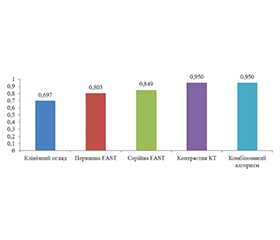
Актуальність. Закрита травма живота у пацієнтів із політравмою залишається складною діагностичною проблемою. Її складність зумовлена гемодинамічною нестабільністю, пригніченням свідомості та поєднаними ушкодженнями. Додатковий ризик пов’язаний із відтермінованим розпізнаванням кишково-мезентеріальних ушкоджень. Мета — порівняти діагностичну ефективність клінічного огляду, первинного фокусованого ультразвукового дослідження при травмі (Focused Assessment with Sonography for Trauma — FAST), серійного FAST, контрастної мультидетекторної комп’ютерної томографії (КТ) та комбінованого алгоритму у виявленні клінічно значущої закритої травми живота у дорослих пацієнтів із політравмою. Матеріали та методи. Проведено ретроспективне діагностичне дослідження, до якого включено 184 пацієнти віком 18–79 років з Injury Severity Score ≥ 16 і тупим механізмом травми. Референтним стандартом вважали інтраопераційну верифікацію або узгоджений клініко-радіологічний діагноз після 72-годинного спостереження, повторної КТ, ангіографічного втручання або хірургічного лікування. Розраховано чутливість, специфічність, прогностичні значення, точність і 95% довірчі інтервали; предиктори відтермінованого діагнозу оцінено за допомогою багатофакторної логістичної регресії. Результати. Клінічно значущу внутрішньочеревну травму встановлено у 72 із 184 пацієнтів (39,1 %). Терапевтично значущі ушкодження виявлено у 38 пацієнтів (20,7 %). Первинне FAST мало чутливість 69,4 % і специфічність 91,1 %. Серійне FAST мало чутливість 80,6 % і специфічність 89,3 %. Контрастна КТ мала чутливість 94,4 % і специфічність 95,5 %. Комбінований алгоритм мав чутливість 97,2 % і специфічність 92,9 %. Рання контрастна КТ/тотальна КТ скорочувала медіану часу до остаточного діагнозу з 88 до 49 хв (p < 0,001). Частота пропущених або відтерміновано діагностованих ушкоджень зменшилася з 10,5 до 2,0 % (p = 0,018). Негативний первинний результат FAST на тлі лактату > 2,5 ммоль/л був незалежним предиктором діагностичної затримки (OR = 3,90; 95% ДІ 1,44–10,56; p = 0,008). Висновки. FAST є інформативним методом первинного сортування. Метод не може використовуватися як самостійний інструмент виключення закритої травми живота. Найвища діагностична ефективність досягається при ранньому застосуванні контрастної КТ у стабільних або стабілізованих пацієнтів. Додаткову цінність має комбінований алгоритм, який поєднує клінічні, лабораторні й ультразвукові ознаки. Перспективним напрямом є проспективна валідація алгоритму в багатоцентрових травматологічних вибірках. Окремого вивчення потребує група пацієнтів з негативним FAST і лабораторними маркерами гіпоперфузії.

Background. Blunt abdominal trauma in polytrauma patients remains diagnostically challenging due to hemodynamic instability, depressed consciousness and combined injuries. An additional risk is associated with delayed recognition of bowel, mesenteric or retroperitoneal injuries. The purpose was to compare the diagnostic performance of clinical examination, initial Focused Assessment with Sonography for Trauma (FAST), serial FAST, contrast-enhanced multidetector computed tomography (CT) and an integrated algorithm for detecting clinically significant blunt abdominal injury in adult polytrauma patients. Materials and methods. A retrospective diagnostic study included 184 adults aged 18–79 years with blunt trauma and Injury Severity Score ≥ 16. The reference standard was operative verification or a concordant clinical-radiological diagnosis after 72-hour observation, repeat CT, angiographic intervention or surgery. Sensitivity, specificity, predictive values, accuracy and 95% confidence intervals (CI) were calculated. Predictors of delayed diagnosis were assessed using multivariable logistic regression. Results. Clinically significant intra-abdominal injury was identified in 72 of 184 patients (39.1 %). Therapeutically significant injury was found in 38 patients (20.7 %). Initial FAST showed 69.4 % sensitivity and 91.1 % specificity. Serial FAST demonstrated 80.6 % sensitivity and 89.3 % specificity. Contrast-enhanced CT showed 94.4 % sensitivity and 95.5 % specificity. The combined algorithm had 97.2 % sensitivity and 92.9 % specificity. Early contrast-enhanced CT/whole-body CT reduced the median time to definitive diagnosis from 88 to 49 min (p < 0.001). Missed or delayed diagnosed injuries decreased from 10.5 to 2.0 % (p = 0.018). Negative initial FAST with lactate > 2.5 mmol/L independently predicted diagnostic delay (odds ratio = 3.90; 95% CI 1.44–10.56; p = 0.008). Conclusions. FAST is useful for early triage but is insufficient as a stand-alone exclusion test in blunt abdominal trauma. Early contrast-enhanced CT provides the highest diagnostic yield in stable or stabilized patients. An integrated algorithm had additional value, it combines clinical, laboratory and ultrasound signs. Future studies should prospectively validate the proposed algorithm in multicenter trauma cohorts. A group of patients with negative FAST and laboratory markers of hypoperfusion requires a separate study.


Ключевые слова

політравма; закрита травма живота; FAST; комп’ютерна томографія; діагностична точність; внутрішньочеревна травма

polytrauma; blunt abdominal trauma; FAST; compu­ted tomography; diagnostic accuracy; intra-abdominal injury


Для ознакомления с полным содержанием статьи необходимо оформить подписку на журнал.


Список литературы

1. Rossaint R, Afshari A, Bouillon B, Cerny V, Cimpoesu D, Curry N, et al. The European guideline on management of major bleeding and coagulopathy following trauma: sixth edition. Crit Care. 2023;27:80. doi: 10.1186/s13054-023-04327-7.
2. Fathi M, Mirjafari A, Yaghoobpoor S, Ghanikolahloo M, Sadeghi Z, Bahrami A, et al. Diagnostic utility of whole-body computed tomography/pan-scan in trauma: a systematic review and meta-analysis study. Emerg Radiol. 2024;31:251-268. doi: 10.1007/s10140-024-02213-5.
3. Yamamoto R, Suzuki M, Funabiki T, Sasaki J. Immediate CT after hospital arrival and decreased in-hospital mortality in severely injured trauma patients. BJS Open. 2023;7(1):zrac133. doi: 10.1093/bjsopen/zrac133.
4. Fabig S, Weigert N, Migliorini F, Kleeff J, Hofmann GO, Schenk P, et al. Predictive parameters for early detection of clinically relevant abdominal trauma in multiple-injury or polytraumatised patients: a retrospective analysis. Eur J Med Res. 2024;29:394. doi: 10.1186/s40001-024-01969-3.
5. Kaewlai R, Chatpuwaphat J, Maitriwong W, Wongwaisayawan S, Shin CI, Lee CW. Radiologic imaging of traumatic bowel and mesenteric injuries: a comprehensive up-to-date review. Korean J Radiol. 2023;24(5):406-423. doi: 10.3348/kjr.2022.0998.
6. Smyth L, Bendinelli C, Lee N, Reeds MG, Loh EJ, Amico F, et al. WSES guidelines on blunt and penetrating bowel injury: diagnosis, investigations, and treatment. World J Emerg Surg. 2022;17(1):13. doi: 10.1186/s13017-022-00418-y.
7. Bella FM, Bonfichi A, Esposito C, Zanza C, Bellou A, Sfondrini D, et al. Extended focused assessment with sonography for trauma in the emergency department: a comprehensive review. J Clin Med. 2025;14(10):3457. doi: 10.3390/jcm14103457.
8. Kakran A, Singh R, Chaudhary P, Chaudhary AK, Ali MS. Sensitivity and specificity of serial focused assessment with sonography in trauma in patients with blunt abdominal trauma. Cureus. 2025;17(9):e92103. doi: 10.7759/cureus.92103.
9. Daniel E, Srinivasan C, Selvaraj K. Focused assessment with sonography in trauma as a prognostic tool in blunt abdominal trauma: a prospective observational study. Cureus. 2025;17(9):e93071. doi: 10.7759/cureus.93071.
10. Rofananda IF, Pratiwi AD, Jaya Putra ES, Budi Azhari SR, Setiawati R. Diagnostic value of focused assessment with sonography in trauma and computed tomography in blunt abdominal trauma: a systematic review and meta-analysis. Malays J Med Health Sci. 2025;21(2):205-215. doi: 10.47836/mjmhs.21.2.26.
11. Abdel Hamid MA, Abd-erRazik MA, Nagy M, El-Shinawi M, Hirshon JM, El-Setouhy M. Computed tomography benefits and cost in hemodynamically stable patients with blunt abdominal trauma at an Egyptian University Hospital. Afr J Emerg Med. 2024;14(2):96-99. doi: 10.1016/j.afjem.2023.11.006.
12. Naccache R, Scemama U, El Ahmadi AA, Habert P, Zieleskiewicz L, Chaumoitre K, et al. Can the use of whole-body CT be reduced in cases of kinetic-based polytrauma patients without a clinical severity criterion? A bi-center retrospective study. Eur J Radiol. 2024;171:111278. doi: 10.1016/j.ejrad.2023.111278.
13. Alahmad H, Hobani A, Alasmi M, Alshahrani AM, Abanomy A, Alarifi M, et al. Investigating the potential overuse of pan-computed tomography examinations in trauma cases in emergency departments. Medicina (Kaunas). 2024;60(11):1742. doi: 10.3390/medicina60111742.
14. Bonomi AM, Granieri S, Gupta S, Altomare M, Cioffi SPB, Sammartano F, et al. Traumatic hollow viscus and me–senteric injury: role of CT and potential diagnostic-therapeutic algorithm. Updates Surg. 2021;73(2):703-710. doi: 10.1007/s13304-020-00929-w.
15. Hsia CC, Wang CY, Huang JF, Hsu CP, Kuo LW, Ouyang CH, et al. Diagnostic accuracy of computed tomography for the prediction of the need for laparotomy for traumatic hollow viscus injury: systematic review and meta-analysis. J Pers Med. 2021;11(12):1269. doi: 10.3390/jpm11121269.
16. Wong HL, Shi H, Teoh WC, Liu JJ. Bowel and me–senteric injuries in blunt abdominal injury. Singapore Med J. 2024;65(6):354-359. doi: 10.4103/singaporemedj.SMJ-2022-023.
17. Delaplain PT, Tay-Lasso E, Biffl WL, Schaffer KB, Sundel M, Behdin S, et al. Excluding hollow viscus injury for abdominal seat belt sign using computed tomography. JAMA Surg. 2022;157(9):771-778. doi: 10.1001/jamasurg.2022.2770.
18. Podda M, De Simone B, Ceresoli M, Augustin G, Gori A, Boermeester MA, et al. Follow-up strategies for patients with splenic trauma managed non-operatively: the 2022 World Society of Emergency Surgery consensus document. World J Emerg Surg. 2022;17(1):52. doi: 10.1186/s13017-022-00457-5.
19. Bossuyt PM, Reitsma JB, Bruns DE, Gatsonis CA, Glasziou PP, Irwig L, et al. STARD 2015: an updated list of essential items for reporting diagnostic accuracy studies. BMJ. 2015;351:h5527. doi: 10.1136/bmj.h5527.
20. Tominaga GT, Crandall M, Cribari C, Zarzaur BL, Bernstein M, Kozar RA, et al. Organ injury scaling 2020 update: bowel and mesentery. J Trauma Acute Care Surg. 2021;91(3):e73-e77. doi: 10.1097/TA.0000000000003319.
21. Weinberg JA, Peck KA, Ley EJ, Brown CV, Moore EE, Sperry JL, et al. Evaluation and management of bowel and mesenteric injuries after blunt trauma: a Western Trauma Association critical decisions algorithm. J Trauma Acute Care Surg. 2021;91(5):903-908. doi: 10.1097/TA.0000000000003327.
22. Wandling M, Cuschieri J, Kozar R, O’Meara L, Celii A, Starr W, et al. Multi-center validation of the Bowel Injury Prediction Score for the early identification of need to operate in blunt bowel and mesenteric injuries. Injury. 2022;53(1):122-128. doi: 10.1016/j.injury.2021.07.026.
23. Boscak AR, Bodanapally UK, Elshourbagy T, Shanmuganathan K. Segmental bowel hypoenhancement on CT predicts ischemic mesenteric laceration after blunt trauma. AJR Am J Roentgenol. 2021;217(1):93-99. doi: 10.2214/AJR.20.23144.
24. Paran M, Tchernin N, Becker A, Sheffer D, Fucks L, Kessel B. Do signs of abdominal wall injury on computed tomo–graphy predict intra-abdominal injury in trauma patients with a seatbelt sign? Injury. 2022;53(9):2988-2991. doi: 10.1016/j.injury.2022.06.031.
25. Rinderknecht TN, Salcedo ES, Holcroft JW. Improved computed tomography performance in blunt abdominal trauma — has our care kept pace? JAMA Surg. 2022;157(9):778. doi: 10.1001/jamasurg.2022.2775.
26. Zarama V, Torres N, Duque E, Arango-Ibanez JP, Duran K, Azcarate V, et al. Incidence of intra-abdominal injuries in hemodynamically stable blunt trauma patients with a normal computed tomography scan admitted to the emergency department. BMC Emerg Med. 2024;24(1):103. doi: 10.1186/s12873-024-01014-w.
27. Chen F, Zhai X, Li S, Chen W, Li H, Wen X. Comparative effectiveness of FAST combined with MRI and CT in wound evaluation of blunt abdominal trauma. Front Med (Lausanne). 2026;12:1702765. doi: 10.3389/fmed.2025.1702765.
28. Hwang S, Cho SH, Jung CY, Lim KH, Kim GW. Predictive value of preoperative CT findings for bowel ischemia in patients with blunt mesenteric injury: a retrospective cohort study. J Clin Med. 2026;15(4):1330. doi: 10.3390/jcm15041330.
29. Lannes F, Scemama U, Maignan A, Boyer L, Beyer-Berjot L, Berdah SV, et al. Value of early repeated abdominal CT in selective non-operative management for blunt bowel and mesenteric injury. Eur Radiol. 2019;29(11):5932-5940. doi: 10.1007/s00330-019-06212-w.
30. Hanzalova I, Bourgeat M, Demartines N, Ageron FX, Zingg T. The use of whole body computed tomography does not lead to increased 24-h mortality in severely injured patients in circulatory shock. Sci Rep. 2024;14:2169. doi: 10.1038/s41598-024-52657-5.
31. Halvachizadeh S, Mariani D, Pfeifer R. Impact of trauma on society. Eur J Trauma Emerg Surg. 2025;51(1):155. doi: 10.1007/s00068-025-02824-8.
32. Gu D, Ou S, Liu G. Global burden of road injuries and their attributable risk factors from 1990 to 2021: a systematic analysis for the Global Burden of Disease Study 2021. Prev Med Rep. 2025;53:103051. doi: 10.1016/j.pmedr.2025.103051.
33. Seidu AS, Alhassan AR, Buunaaim ADB, Aslanturk O. Epidemiology of polytrauma at a teaching hospital in Northern Ghana: a cross-sectional study. Int J Clin Pract. 2024;2024:4131822. doi: 10.1155/2024/4131822.
34. Yadollahi M, Fazeli H, Ghasemian M, Yousefi MR, Karajizadeh M, Farajpour H. Incidence, pattern and mortality of traumatic abdominal injury, a three-year study at the largest trauma center in Southern Iran: a cross-sectional study. Health Sci Rep. 2025;8(6):e70941. doi: 10.1002/hsr2.70941.
35. World Health Organization. Global status report on road safety 2023. Geneva: World Health Organization; 2023.

Вернуться к номеру