Резюме
Біоплівкова інфекція ортопедичних імплантатів є однією з найскладніших проблем у сучасній ортопедії та травматології, оскільки вона поєднує мікробну персистенцію, обмежену ефективність системної антибактеріальної терапії, хронічне запалення, порушення остеоінтеграції, нестабільність імплантатів і функціональні наслідки лікування. Мікроорганізми прикріплюються до поверхонь ендопротезів, пластин, гвинтів, інтрамедулярних стрижнів, спінальних систем та інших фіксуючих пристроїв, утворюючи біоплівки, які є більш стійкими до антибіотиків та імунних реакцій, ніж вільноживучі бактерії. Цей огляд має на меті узагальнити поточні дані про патогенез, мікробіологічний спектр, клінічні форми, діагностику, лікування, профілактику і стратегії антибіоплівкового покриття ортопедичних імплантатів. Пошук літератури проведено в чотирьох бібліографічних базах даних — PubMed, Scopus, Web of Science і Google Scholar — та шести видавничих платформах: Elsevier, Springer Nature, Wiley, Oxford Academic, MDPI і Frontiers. Використано одинадцять груп ключових слів англійською та українською мовами, публікації з 2014 по 2026 рік були пріоритетними, а 37 джерел включено після двохетапного скринінгу назв/анотацій та повних текстів. Аналіз показав, що перипротезна інфекція суглоба (PJI) та інфекція, пов’язана з переломом (FRI), характеризуються однаковим механізмом утворення біоплівки, але відрізняються клінічно, оскільки при FRI імплантат також необхідний для підтримки стабільності перелому. Ключові діагностичні елементи включають глибокий забір тканин, ультразвукову обробку видалених імплантатів, гістологію та стандартизовані критерії PJI/FRI, тоді як поверхневі мазки недостатні для остаточного прийняття терапевтичного рішення. Ефективне лікування вимагає хірургічного контролю джерел, стабільної фіксації або ревізії імплантатів, усунення «мертвого простору», покриття м’яких тканин і системної та місцевої антимікробної терапії. В огляді було визначено 12 основних груп стратегій антибіоплівкового або антимікробного покриття, включаючи системи, що вивільняють антибіотики, гідрогелі з антибіотиками, цвяхи, покриті гентаміцином, покриття на основі іонів металів, системи на основі фосфату кальцію/гідроксиапатиту, антимікробні пептиди, хітозан, наноструктуровані поверхні, а також «розумні» покриття, чутливі до змін pH або ферментів. Багатофункціональні покриття на основі біоактивного скла, фосфату кальцію, гідроксиапатиту, срібла, антибіотиків, гідрогелів або комбінованих систем є особливо перспективними, оскільки вони можуть пригнічувати ранню адгезію бактерій, зменшувати утворення біоплівки й підтримувати остеоінтеграцію. Однак більшість доступних даних залишаються доклінічними або клінічно обмеженими, і перед рутинним використанням в ортопедичній травматології потрібна подальша валідація.
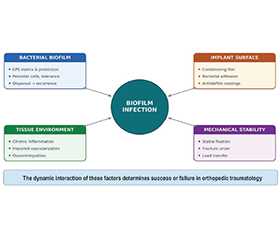
Biofilm infection of orthopedic implants is one of the most challenging problems in modern orthopedics and traumatology, as it combines microbial persistence, limited efficacy of systemic antibacterial therapy, chronic inflammation, impaired osseointegration, implant instability, and functional consequences of treatment. Microorganisms attach to the surfaces of endoprostheses, plates, screws, intramedullary rods, spinal systems, and other fixation devices, forming biofilms that are more tolerant to antibiotics and immune responses than free-living bacteria. This review purposed to summarize current data on the pathogenesis, microbiological spectrum, clinical forms, diagnosis, treatment, prevention, and antibiofilm coating strategies for orthopedic implants. A narrative literature search was performed in four bibliographic databases — PubMed, Scopus, Web of Science, and Google Scholar — and six publisher platforms: Elsevier, Springer Nature, Wiley, Oxford Academic, MDPI, and Frontiers. Eleven keyword groups were used in English and Ukrainian, publications from 2014 to 2026 were prioritized, and 37 sources were included after two-stage screening of titles/abstracts and full texts. The analysis showed that periprosthetic joint infection (PJI) and fracture-related infection (FRI) share the same biofilm mechanism but differ clinically because in FRI, the implant is also required to maintain fracture stability. Key diagnostic elements include deep tissue sampling, sonication of removed implants, histology, and standardized PJI/FRI criteria, whereas superficial swabs are insufficient for final therapeutic decision-making. Effective treatment requires surgical source control, stable fixation or implant revision, dead-space management, soft tissue coverage, and systemic and local antimicrobial therapy. The review identified 12 main groups of antibiofilm or antimicrobial coating strategies, including antibiotic-releasing systems, anti-biotic-loaded hydrogels, gentamicin-coated nails, metal-ion coatings, calcium phosphate-/hydroxyapatite-based systems, antimicrobial peptides, chitosan, nanostructured surfaces, and smart pH- or enzyme-responsive coatings. Multifunctional coatings based on bioactive glass, calcium phosphate, hydroxyapatite, silver, antibiotics, hydrogels, or combined systems are especially promising because they can inhibit early bacterial adhesion, reduce biofilm formation, and support osseointegration. However, most available evidence remains preclinical or clinically limited, and further validation is required before routine use in orthopedic traumatology.
Список литературы
1. Costerton JW, Stewart PS, Greenberg EP. Bacterial biofilms: a common cause of persistent infections. Science. 1999;284(5418):1318-1322. doi: 10.1126/science.284.5418.1318.
2. Donlan RM, Costerton JW. Biofilms: survival mechanisms of clinically relevant microorganisms. Clin Microbiol Rev. 2002;15(2):167-193. doi: 10.1128/CMR.15.2.167-193.2002.
3. Zimmerli W, Trampuz A, Ochsner PE. Prosthetic-joint infections. N Engl J Med. 2004;351(16):1645-1654. doi: 10.1056/NEJMra040181.
4. Trampuz A, Piper KE, Jacobson MJ, Hanssen AD, Unni KK, Osmon DR, et al. Sonication of removed hip and knee prostheses for diagnosis of infection. N Engl J Med. 2007;357(7):654-663. doi: 10.1056/NEJMoa061588.
5. Osmon DR, Berbari EF, Berendt AR, Lew D, Zimmerli W, Steckelberg JM, et al. Diagnosis and management of prosthetic joint infection: clinical practice guidelines by the Infectious Diseases Society of America. Clin Infect Dis. 2013;56(1):e1-e25. doi: 10.1093/cid/cis803.
6. Metsemakers WJ, Morgenstern M, McNally MA, Moriarty TF, McFadyen I, Scarborough M, et al. Fracture-related infection: a consensus on definition from an international expert group. Injury. 2018;49(3):505-510. doi: 10.1016/j.injury.2017.08.040.
7. Govaert GAM, Kuehl R, Atkins BL, Trampuz A, Morgenstern M, Obremskey WT, et al. Diagnosing fracture-related infection: current concepts and recommendations. J Orthop Trauma. 2020;34(1):8-17. doi: 10.1097/BOT.0000000000001614.
8. Metsemakers WJ, Morgenstern M, Senneville E, Borens O, Govaert GAM, Onsea J, et al. General treatment principles for fracture-related infection: recommendations from an international expert group. Arch Orthop Trauma Surg. 2020;140(8):1013-1027. doi: 10.1007/s00402-019-03287-4.
9. Metsemakers WJ, Fragomen AT, Moriarty TF, Morgenstern M, Egol KA, Zalavras C, et al. Evidence-based recommendations for local antimicrobial strategies and dead space management in fracture-related infection. J Orthop Trauma. 2020;34(1):18-29. doi: 10.1097/BOT.0000000000001615.
10. Depypere M, Kuehl R, Metsemakers WJ, Senneville E, McNally MA, Obremskey WT, et al. Recommendations for systemic antimicrobial therapy in fracture-related infection: a consensus from an international expert group. J Orthop Trauma. 2020;34(1):30-41. doi: 10.1097/BOT.0000000000001626.
11. McNally M, Sousa R, Wouthuyzen-Bakker M, Chen AF, Soriano A, Vogely HC, et al. The EBJIS definition of periprosthetic joint infection. Bone Joint J. 2021;103-B(1):18-25. doi: 10.1302/0301-620X.103B1.BJJ-2020-1381.R1.
12. Sousa R, Ribau A, Alfaro P, Burch MA, Ploegmakers J, McNally M, et al. The European Bone and Joint Infection Society definition of periprosthetic joint infection is meaningful in clinical practice: a multicentric validation study with compa–riso with previous definitions. Acta Orthop. 2023;94:8-18. doi: 10.2340/17453674.2023.5670.
13. Liu X, Ma P, Liu X, Liu S, Liu X, Wang R, Gao H. Resistance mechanisms of bacterial biofilms on orthopedic implants and research progress on novel anti-biofilm coatings. Front Bioeng Biotechnol. 2026;14:1707232. doi: 10.3389/fbioe.2026.1707232.
14. Jeyaraman M, Migliorini F, Schfer L, Jeyaraman N. Management of Periprosthetic Joint Infections: A Multidisciplinary Approach. Antibiotics. 2026;15(6):614. doi: 10.3390/antibiotics15060614.
15. Matsuo T, Thompson AL, Yuan BJ, et al. The latest approaches to fracture-related infection. Curr Infect Dis Rep. 2025;27(1):15. doi: 10.1007/s11908-025-00864-0.
16. Jennings JA, Abdelbary H, Abdulla FS, et al. 2025 International Consensus Meeting on Musculoskeletal Infection: summary from Biofilm Workgroup on treatment of biofilm-related infection and preclinical models. J Orthop Res. 2026;44(3):e70169. doi: 10.1002/jor.70169.
17. Arciola CR, Campoccia D, Speziale P, Montanaro L, Costerton JW. Biofilm formation in Staphylococcus implant infections: a review of molecular mechanisms and implications for biofilm-resistant materials. Biomaterials. 2012;33(26):5967-5982. doi: 10.1016/j.biomaterials.2012.05.031.
18. Yang S, Abu Mukh A, Abdelatif E, Schmidt A, Batailler C, Ferry T, et al. Bacteriophage therapy as an innovative strategy for the treatment of periprosthetic joint infection: a systematic review. Int Orthop. 2024;48(11):2809-2825. doi: 10.1007/s00264-024-06295-1.
19. Mills H, Donnelly L, Platt S. Locally delivered antibio–tics in fracture-related infection. Cureus. 2024;16(11):e73210. doi: 10.7759/cureus.73210.
20. Malizos K, Blauth M, Danita A, Capuano N, Mezzoprete R, Logoluso N, et al. Fast-resorbable antibiotic-loaded hydrogel coating to reduce post-surgical infection after internal osteosynthesis: a multicenter randomized controlled trial. J Orthop Traumatol. 2017;18(2):159-169. doi: 10.1007/s10195-017-0442-2.
21. Akshaya S, Rowlo PK, Dukle A, Nathanael AJ. Antibacterial coatings for titanium implants: recent trends and future perspectives. Antibiotics. 2022;11(12):1719. doi: 10.3390/antibiotics11121719.
22. Chen X, Zhou J, Qian Y, Zhao L. Antibacterial coatings on orthopedic implants. Mater Today Bio. 2023;19:100586. doi: 10.1016/j.mtbio.2023.100586.
23. Akay S, Yaghmur A. Recent advances in antibacterial coatings to combat orthopedic implant-associated infections. Molecules. 2024;29(5):1172. doi: 10.3390/mole–cules29051172.
24. Li B, Thebault P, Labat B, Ladam G, Alt V, Rupp M, et al. Implants coating strategies for antibacterial treatment in fracture and defect models: A systematic review of animal studies. J Orthop Translat. 2024;45:24-35. doi: 10.1016/j.jot.2023.12.006.
25. Liu F, Xue Y, Zhou Y, Zhang J, Wang A, Shi R. Trends and advances in antimicrobial surface modification for orthopedic implants (2014–2024). Tissue Eng Part C Methods. 2025;31(1). doi: 10.1089/ten.tec.2024.0266.
26. Zhang BG, Myers DE, Wallace GG, Brandt M, Choong PF. Bioactive coatings for orthopedic implants: recent trends in development of implant coatings. Int J Mol Sci. 2014;15(7):11878-11921. doi: 10.3390/ijms150711878.
27. Drevet R, Faur J, Benhayoune H. Bioactive calcium phosphate coatings for bone implant applications: a review. Coatings. 2023;13(6):1091. doi: 10.3390/coatings13061091.
28. Su Y, Cockerill I, Zheng Y, Tang L, Qin YX, Zhu D. Biofunctionalization of metallic implants by calcium phosphate coatings. Bioact Mater. 2019;4:196-206. doi: 10.1016/j.bioactmat.2019.05.001.
29. Aboaziza Y, Aghaian E, Hillock R. Emerging surface coating innovations for orthopedic implants: a review. J Orthop Exp Innov. 2026;7(1). doi: 10.60118/001c.146425.
30. Kaspiris A, Vasiliadis E, Pantazaka E, Lianou I, Melissaridou D, Savvidis M, et al. Current progress and future perspectives in contact and releasing-type antimicrobial coatings of orthopedic implants: a systematic review analysis emanated from in vitro and in vivo models. Infect Dis Rep. 2024;16(2):298-316. doi: 10.3390/idr16020025.
31. Wang M, Zheng Y, Yin C, Dai S, Fan X, Jiang Y, et al. Recent progress in antibacterial hydrogel coatings for targe–ting biofilm to prevent orthopedic implant-associated infections. Front Microbiol. 2023;14:1343202. doi: 10.3389/fmicb.2023.1343202.
32. De Meo D, Cera G, Pica R, Perfetti F, Martini P, Perciballi B, et al. Antibiotic-loaded coatings to reduce fracture-rela–ted infections: retrospective case series of patients with increased infectious risk. Antibiotics. 2023;12(2):287. doi: 10.3390/antibiotics12020287.
33. Li H, Wang D, Zhang W, Xu G, Xu C, Liu W, et al. Potential side effects of antibacterial coatings in orthopedic implants: a systematic review of clinical studies. Front Bioeng Biotechnol. 2023;11:1111386. doi: 10.3389/fbioe.2023.1111386.
34. Speijker LTD, Fechter J, Bargon R, Dingemans J, Arts JJ, Savelkoul PHM, van Loo IHM. Silver multilayer coating on orthopedic implant material of different alloys and surfaces significantly reduces bacterial colonization. Front Cell Infect Microbiol. 2025;15:1707694. doi: 10.3389/fcimb.2025.1707694.
35. Morimoto T, Hirata H, Eto S, Hashimoto A, Kii S, Kobayashi T, et al. Development of silver-containing hydro-xyapatite-coated antimicrobial implants for orthopedic and spinal surgery. Medicina. 2022;58(4):519. doi: 10.3390/medicina58040519.
36. Zhou P, Garcia BL, Kotsakis GA. Comparison of antibacterial and antibiofilm activity of bioactive glass compounds S53P4 and 45S5. BMC Microbiol. 2022;22(1):212. doi: 10.1186/s12866-022-02617-8.
37. Gonzalez Moreno M, Butini ME, Maiolo EM, Sessa L, Trampuz A. Antimicrobial activity of bioactive glass S53P4 against representative microorganisms causing osteomyelitis. Colloids Surf B Biointerfaces. 2020;189:110853. doi: 10.1016/j.colsurfb.2020.110853.