
Журнал «Медицина неотложных состояний» Том 22, №5, 2026
Вернуться к номеру
Технологія етапного закриття кукси у постраждалих при мінно-вибухових пораненнях нижніх кінцівок
Авторы: Кіх А.Ю. (1), Смик О.О. (1), Саленко М.С. (1), Бур’янов О.А. (2)
(1) - Військово-медичний клінічний лікувально-реабілітаційний центр, м. Ірпінь, Україна
(2) - Національний медичний університет імені О.О. Богомольця, м. Київ, Україна
Рубрики: Медицина неотложных состояний
Разделы: Клинические исследования
Версия для печати
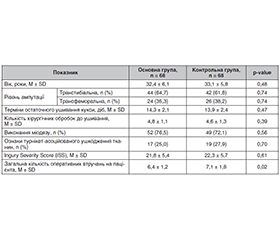
Актуальність. Бойові ампутації нижніх кінцівок, спричинені мінно-вибуховими пораненнями, характеризуються значним ушкодженням м’яких тканин, високим ризиком інфекційних ускладнень та складністю формування функціонально придатної кукси. Одним з перспективних підходів у сучасній військовій хірургії є Staged Closure Surgery (SCS) із виконанням Second Look Surgery (SLS), що відповідає концепції Damage Control Traumatology (DCT). Мета: провести порівняльну оцінку ефективності етапного SCS та одномоментного ушивання кукси після ампутації нижньої кінцівки у військовослужбовців із бойовими ушкодженнями, оцінити частоту ранніх ускладнень та терміни готовності кукси до протезування. Матеріали та методи. Проведено ретроспективно-проспективне клінічне дослідження за участю 136 військовослужбовців з бойовими ушкодженнями нижньої кінцівки внаслідок мінно-вибухового поранення. Пацієнтів розділено на 2 групи по 68 осіб. В основній групі застосовували етапне ушивання рани кукси: на першому етапі виконували ушивання глибоких тканин з міодезом чи без нього, на другому, через 36–48 годин — ревізію рани, повторну хірургічну обробку та ушивання шкіри. У контрольній групі проводили одномоментне ушивання кукси. Оцінювали частоту ранніх післяопераційних ускладнень, кількість оперативних втручань та терміни готовності до протезування. Результати. Загальна частота ранніх ускладнень після ушивання кукси була вірогідно нижчою в основній групі — 1,5 % порівняно з контрольною групою — 20,6 % (р < 0,001). Середній термін готовності кукси до протезування був вірогідно меншим в основній групі (43,0 ± 4,7 доби) порівняно з групою контролю (68,0 ± 6,4 доби; р < 0,001). Аналіз Kaplan-Meier продемонстрував швидше досягнення готовності кукси до протезування в основній групі (HR 2,85, 95% ДІ 2,05–3,96, log-rank p < 0,001). За результатами багатофакторного аналізу SCS-підхід був незалежним предиктором зниження ризику післяопераційних ускладнень (OR 0,08, 95% ДІ 0,01–0,52, p = 0,02). Незважаючи на необхідність другого етапу закриття рани кукси, загальна кількість оперативних втручань на одного пацієнта була меншою в основній групі (6,4 ± 1,2 проти 7,1 ± 1,8, p = 0,02), що зумовлено необхідністю виконання додаткових хірургічних втручань з приводу ускладнень у контрольній групі. Висновки. Етапне ушивання кукси є ефективною хірургічною тактикою при бойових ампутаціях нижньої кінцівки, що дозволяє знизити частоту ранніх ускладнень, скоротити терміни готовності кукси до протезування та зменшити потребу в повторних оперативних втручаннях. Методика відповідає сучасним принципам DCT та може бути рекомендована для широкого застосування у військовій хірургії.
Background. Combat amputations of the lower extremities caused by mine-explosive injuries are characterized by significant soft tissue damage, a high risk of infectious complications, and the difficulty of forming a functionally suitable stump. One of the promising approaches in modern military surgery is staged closure surgery (SCS) with second look surgery, which corresponds to the concept of damage control traumatology. The purpose was to conduct a comparative assessment of the effectiveness of SCS and single-stage stump suturing after lower limb amputation in servicemen with combat injuries, to assess the frequency of early complications and the timing of stump readiness for prosthetic treatment. Materials and methods. A retrospective-prospective clinical study was conducted in 136 servicemen with combat injuries of the lower limb due to mine-explosive injuries. Patients were divided into 2 groups of 68 people each. In the main group, staged stump wound closure was used: the first stage was deep tissue closure with or without myodesis; the second stage after 36–48 hours was wound revision, repeated surgical treatment and skin closure. In the control group, one-stage stump closure was performed. The frequency of early postoperative complications, the number of surgical interventions and the time of readiness for prosthetic treatment were assessed. Results. The overall incidence of early complications after stump suturing was significantly lower in the main group — 1.5 % compared to 20.6 % in the control group (p < 0.001). The average time of stump readiness for prosthetic treatment was significantly shorter in the main group: 43.0 ± 4.7 days vs. 68.0 ± 6.4 days in the control group (p < 0.001). Kaplan-Meier analysis demonstrated faster achievement of stump readiness for prosthetic treatment in the main group (HR 2.85, 95 % CI 2.05–3.96, log-rank p < 0.001). According to the results of multivariate analysis, the SCS approach was an independent predictor of a decreased risk of postoperative complications (OR 0.08, 95% CI 0.01–0.52, p = 0.02). Despite the need for a second stage of stump wound closure, the total number of surgical interventions per patient was lower in the main group (6.4 ± 1.2 vs. 7.1 ± 1.8, p = 0.02), which is due to the need for additional surgical interventions for complications in the control group. Conclusions. Staged stump suturing is an effective surgical tactic in combat amputations of the lower limb, which allows reducing the frequency of early complications, shortening the time of readiness of the stump for prosthetic treatment and reducing the need for repeated surgical interventions. The technique corresponds to modern principles of damage control traumatology and can be recommended for widespread use in military surgery.
мінно-вибухова травма; бойова травма; інфекція; ампутація; кукса; Staged Closure Surgery; Second Look Surgery; Damage Control Surgery; протезування; Negative Pressure Wound Therapy; війна в Україні
mine-explosive trauma; combat injury; infection; amputation; stump; staged closure surgery; second look surgery; damage control surgery; prosthetic treatment; negative pressure wound therapy; war in Ukraine
Для ознакомления с полным содержанием статьи необходимо оформить подписку на журнал.
- U.S. Department of Veterans Affairs; Department of Defense. VA/DoD clinical practice guideline for rehabilitation of individuals with lower limb amputation. Version 3.0. 2024.
- Defense Health Agency. DoD and VA release 2026 Lower limb amputation clinical practice guideline to improve patient care. 2026.
- World Health Organization. Rehabilitation in Health Systems: Guide for action. Geneva: WHO; 2023.
- Vogt D, Hackl S, Tjardes T, et al. Amputation versus limb salvage after gunshot wounds and combat injuries: Considerations for an integrative concept of surgical care and rehabilitation therapy. Injury. 2025;56(Suppl 1):112535. doi: 10.1016/j.injury.2025.112535.
- Dickens JF, Schmidt A. The extremity war injury symposium: emerging combat and readiness research. J Am Acad Orthop Surg 2022;30(5):185-188. doi: 10.5435/JAAOS-D-20-01030.
- Mathieu L, et al. Management of combat-related extremity injuries in modern armed conflicts. Orthopaedics & Traumatology: Surgery & Research. 2025;111(Suppl 1):104055. doi: 10.1016/j.otsr.2024.104055.
- Petfield JL, Lewandowski LR, Stewart L, et al. IDCRP combat-related extremity wound infection research. Military Medicine. 2022;187(Suppl 2):25-33. doi: 10.1093/milmed/usab065.
- Tribble DR, Petfield JL, Murray CK, et al. IDCRP trauma-related infection research. Military Medicine. 2022;187(Suppl 2):2-6. doi: 10.1093/milmed/usab508.
- Mende K, Akers KS, Tyner SD, et al. Multidrug-resistant and virulent organisms trauma infections: trauma infectious disease outcomes study initiative. Military Medicine. 2022;187(Suppl 2):42-51. doi: 10.1093/milmed/usab131.
- Holubnycha VM, Kholodylo OV. War impact on antimicrobial resistance and bacteriological profile of wound infections in Ukraine. Communications Medicine. 2025;5(1):394. doi: 10.1038/s43856-025-01056-6.
- Pursel A, Nichols R, Lindquist K. Combat amputee care for Global War on Terror Veterans: A systematic review. Journal of Military, Veteran and Family Health. 2024;10(5):7-29. doi: 10.3138/jmvfh-2023-0106.
- Snelling S, Claireaux H, Roocroft H, et al. Clinical guidelines for complex extremity war wound management: update and consensus using a mixed-method approach. BJS Open. 2026;10(1):zraf173. doi: 10.1093/bjsopen/zraf173.
- Topaz M, Carmel NN, Topaz G, Li MS, Li YZ. Minimizing treatment complexity of combat-related soft tissue injuries using regulated negative pressure-assisted wound therapy and novel skin stretching devices. Burns & Trauma. 2021;9:tkab007. doi: 10.1093/burnst/tkab007.
- Sivash II, Koval BM. Negative pressure wound therapy for combat-related extremity vascular injuries: clinical experience from the war in Ukraine. Scandinavian Journal of Trauma, Resuscitation and Emergency Medicine. 2025;33:188. doi: 10.1186/s13049-025-01502-3.
- Volianskyi V, Kikh A. Evaluation of quality criteria for rehabilitation of military personnel with lower limb amputees. Ukrainian Journal of Military Medicine. 2025;6(1):72-81. doi: 10.46847/ujmm.2025.1(6)-072.
- Coccolini F, Sartelli M, Sawyer R, Rasa K, Viaggi B, Abu-Zidan F, et al. Source control in emergency general surgery: WSES, GAIS, SIS-E, SIS-A guidelines. World J Emerg Surg. 2023. doi: 10.1186/s13017-023-00509-4.
- Kountouri I, Christidis P, Christidis G, et al. External fixators as a tool for damage control orthopedics in severely injured or polytrauma patients. Cureus. 2024;16(9):e69255. doi: 10.7759/cureus.69255.
- Poletti FL, Macmull S, Mushtaq N, et al. Current concepts and principles in open tibial fractures — Part II Management and Controversies. MOJ Orthop Rheumatol. 2017;8(2):00305. doi: 10.15406/mojor.2017.08.00305.
- Millán-Reyes MJ, et al. Reducing infections and improving healing in complex wounds: a systematic review. Journal of Clinical Medicine. 2025;14(9):3237. doi: 10.3390/jcm14093237.
- Perez KG, et al. A Focus on non-amputation combat extremity injury: 2001–2018. Military Medicine. 2022;187(5-6):e638-e643. doi: 10.1093/milmed/usab143.
- Shchepetov MV, Gumeniuk KV. Treatment of combat injuries to major arteries with extensive soft tissue defects. Surgery of Ukraine. 2025. doi: 10.30978/GS-2025-1-15.
- Karembé B, et al. Place of delayed primary closure in ballistic wounds and by explosive devices at the Somine Dolo hospital in Mopti. SAS Journal of Surgery. 2024;10(4):526-531. doi: 10.36347/sasjs.2024.v10i04.030.
- Tintle SM, Keeling JJ, Shawen SB, Forsberg JA, Potter BK. Traumatic and trauma-related amputations: Part I: General principles and lower-extremity amputations. Journal of Bone and Joint Surgery American. 2010;92(17):2852-2868. doi: 10.2106/JBJS.J.00257.
- Trutyak I, Zhukovskiy V, Lovga V, Ivashchenko V, Trunkvalter V, Kudla O. Local infectious complications of the lower extremity open fractures in combat and non-combat trauma. Proceedings of the Shevchenko Scientific Society. Medical Sciences. 2025;77(1). doi: 10.25040/ntsh2025.01.07.
- Murray CK, Wilkins K, Molter NC, Yun HC, Dubick MA, Spott MA, et al. Infections in combat casualties during Operations Iraqi and Enduring Freedom. Journal of Trauma and Acute Care Surgery. 2009;66(4):S138-S144. doi: 10.1097/TA.0b013e31819d894c.
- Tanasiienko PV, Guryev SO, Derkach RV. Analysis of traumatic injuries among civilian casualties as a result of mo–dern hostilities. Trauma. 2026;27(1):71-75. doi: 10.22141/1608-1706.1.27.2026.1068.
- Eskridge SL, MacGregor AJ, Dougherty AL, et al. Healthcare utilization among United States service members with combat-related lower extremity limb salvage. Healthcare. 2025;13(10):1164. doi: 10.3390/healthcare13101164.
- Katiyar AK, Agarwal H, Priyadarshini P, et al. Primary vs delayed primary closure in patients undergoing lower limb amputation following trauma: A randomised control study. International Wound Journal. 2020;17(2):419-428. doi: 10.1111/iwj.13288.
- Chang H, Maldonado TS, Rockman CB, Cayne NS, Berland TL, Barfield ME, et al. Closed incision negative pressure wound therapy may decrease wound complications in major lower extremity amputations. Journal of Vascular Surgery 2021;73(3):1041-1047. doi: 10.1016/j.jvs.2020.07.061.