
Журнал «Медицина неотложных состояний» Том 22, №5, 2026
Вернуться к номеру
Прогностичне значення факторів ризику в перебігу уросепсису
Авторы: Антонян І.М., Геглюк О.М.
Харківський національний медичний університет, м. Харків, Україна
Рубрики: Медицина неотложных состояний
Разделы: Клинические исследования
Версия для печати
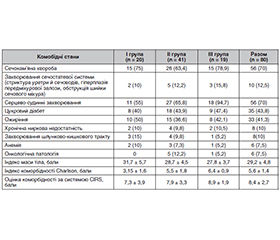
Актуальність. Уросепсис — загрозлива для життя органна дисфункція, спричинена порушенням регуляції відповіді на інфекцію сечовивідних шляхів. Основними факторами ризику розвитку уросепсису є обструкція сечових шляхів на будь-якому рівні, вроджені уропатії, нейрогенний сечовий міхур, а також ендоскопічні втручання на сечових шляхах. Мета: оцінка факторів ризику в пацієнтів з уросепсисом, що призводять до летального кінця. Матеріали та методи. Проведено ретроспективний аналіз факторів смертності від уросепсису 80 пацієнтів, яких було розподілено за віковим критерієм, визначеним ВООЗ, на 3 групи: I група (n = 20) — пацієнти середнього віку — від 46 до 60 років (середній вік 51,2 ± 6,1 року); II група (n = 41) — хворі похилого віку — від 60 до 75 років (середній вік 66,7 ± 4,8 року) та III група (n = 19) — пацієнти старечого віку — від 75 до 90 років (середній вік 78,5 ± 3,1 року). Дослідження проведено відповідно до вимог і критеріїв доказової медицини з дотриманням вимог Гельсінської декларації, схвалено комісією з біоетики Харківського національного медичного університету. Результати. При аналізі кореляційних взаємозв’язків факторів, що ускладнюють перебіг уросепсису, залежно від віку пацієнтів можна відзначити обернені середні кореляційні зв’язки між двобічною сечокам’яною хворобою та кардіологічною патологією (r = –0,50; p = 0,02) у пацієнтів середнього віку та прямий середній зв’язок між гнійним пієлонефритом і кардіологічною патологією (r = 0,35; p = 0,02) у пацієнтів похилого віку. Індекс коморбідності Charlson у пацієнтів середнього віку мав помірний кореляційний зв’язок з ожирінням (r = 0,58; p = 0,007) і цукровим діабетом (r = 0,62; p = 0,003), а у хворих похилого віку — тільки з кардіологічною патологією (r = 0,42; p = 0,01). Оцінка коморбідності за системою CIRS прямо корелювала із цукровим діабетом у пацієнтів як середнього віку (r = 0,59; p = 0,006), так і похилого (r = 0,41; p = 0,01). У хворих старечого віку був виявлений помірний кореляційний зв’язок між захворюваннями сечостатевої системи та кардіологічною патологією (r = –0,54; p = 0,02). Висновки. Найчастіше фактором ризику уросепсису була сечокам’яна хвороба (70 %). Тяжкий перебіг і летальність у пацієнтів обумовлені сильним кореляційним зв’язком і вірогідним впливом кардіологічної патології (r = 0,80; p = 0,00003), цукрового діабету (r = 0,90; p < 0,001) та ожиріння (r = 0,93; p = 0,02). Незважаючи на своєчасне надання стаціонарної медичної допомоги та виконання оперативних втручань: накладання пункційної нефростомії (43 %), виконання нефректомії (17,5 %) і декапсуляції нирки (13,8 %), через пізнє звернення пацієнтів позитивного результату не було досягнуто.
Background. Urosepsis is a life-threatening organ dysfunction caused by a disruption in the regulation of the response to a urinary tract infection. The main risk factors for the development of urosepsis are urinary tract obstruction at any level, congenital uropathies, neurogenic bladder, and endoscopic procedures on the urinary tract. The purpose of the study was to assess risk factors leading to fatal outcomes in patients with urosepsis. Materials and methods. A retrospective analysis was conducted of the factors contributing to mortality from urosepsis in 80 patients, who were divided into three groups based on the age criteria defined by the WHO: group I (n = 20) — middle-aged patients, from 46 to 60 years (mean age 51.2 ± 6.1 years); group II (n = 41) — elderly patients aged 60 to 75 years (66.7 ± 4.8 years) and group III (n = 19) — senile patients aged 75 to 90 years (78.5 ± 3.1 years). The study was conducted in accordance with the requirements and criteria of evidence-based medicine, in compliance with the Declaration of Helsinki, and was approved by the Bioethics Committee of Kharkiv National Medical University. Results. When analyzing the relationship between factors complicating the course of urosepsis depending on the patients’ age, inverse moderate correlations can be noted between bilateral urolithiasis and cardiac pathology (r = –0.50, p = 0.02) in middle-aged patients and a positive moderate correlation between pyelonephritis and cardiac pathology (r = 0.35, p = 0.02) in elderly patients. The Charlson Comorbidity Index in middle-aged patients showed a moderate correlation with obesity (r = 0.58, p = 0.007) and diabetes mellitus (r = 0.62, p = 0.003), whilst in the elderly, it was associated only with cardiac pathology (r = 0.42, p = 0.01). The CIRS comorbidity score correlated directly with diabetes mellitus in both middle-aged (r = 0.59, p = 0.006) and elderly (r = 0.41, p = 0.01) patients. As for senile patients, a moderate correlation was found between genitourinary diseases and cardiac pathology (r = –0.54; p = 0.02). Conclusions. The most common risk factor for urosepsis was urolithiasis (70 %). The severe course and mortality in patients were due to a high correlation and significant influence of cardiac pathology (r = 0.80, p = 0.00003), diabetes mellitus (r = 0.90, p < 0.001) and obesity (r = 0.93, p = 0.02). Despite the timely provision of inpatient medical care and conducting surgical interventions, including percutaneous nephrostomy (43 %), nephrectomy (17.5 %) and renal decapsulation (13.8 %), no positive outcome was achieved due to patients presenting late.
уросепсис; сечокам’яна хвороба; цукровий діабет; ожиріння; кардіальна патологія; фактори ризику
urosepsis; urolithiasis; diabetes mellitus; obesity; cardiac pathology; risk factors