
Журнал «Медицина неотложных состояний» Том 22, №5, 2026
Вернуться к номеру
Оцінка якості виконання розширених реанімаційних заходів бригадами екстреної медичної допомоги: обсерваційне дослідження в умовах клінічних симуляційних сценаріїв
Авторы: Цимбалюк Г.Ю. (1, 2), Черватюк А.М. (2), Крилюк В.О. (1), Денисюк Ю.А. (2)
(1) - ДЗ «Український науково-практичний центр екстреної медичної допомоги та медицини катастроф МОЗ України», м. Київ, Україна
(2) - Тернопільський національний медичний університет імені І.Я. Горбачевського, м. Тернопіль, Україна
Рубрики: Медицина неотложных состояний
Разделы: Клинические исследования
Версия для печати
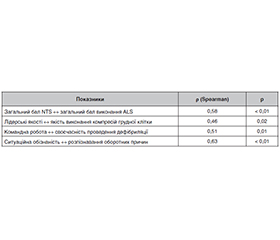
Актуальність. Раптова зупинка кровообігу залишається однією з провідних причин смертності, а якість виконання розширених реанімаційних заходів (Advanced Life Support, ALS) на догоспітальному етапі є важливим чинником, що потенційно впливає на результати допомоги пацієнтам. Рекомендації Європейської ради реанімації (European Resuscitation Council, ERC) підкреслюють необхідність поєднання високоякісних технічних навичок і ефективної командної взаємодії для забезпечення належної якості реанімаційної допомоги. Водночас дані щодо об’єктивної оцінки якості виконання ALS бригадами екстреної медичної допомоги у стандартизованих симуляційних умовах залишаються обмеженими. Мета: провести комплексну оцінку якості виконання розширених реанімаційних заходів бригадами екстреної медичної допомоги в умовах стандартизованих симуляційних сценаріїв із використанням критеріїв, заснованих на рекомендаціях ERC. Матеріали та методи. В обсерваційному аналітичному дослідженні взяли участь 25 бригад екстреної медичної допомоги в рамках національного чемпіонату, проведеного у травні 2025 року. Бригади виконували один із 13 реалістичних сценаріїв раптової зупинки кровообігу у дорослого пацієнта, спричинених різними критичними станами. Оцінювання проводили за чотирма блоками: діагностика (30 %), тактика ведення пацієнта (40 %), використання додаткових ресурсів (10 %) та нетехнічні навички (Non-Technical Skills, NTS; 20 %). Якість компресій грудної клітки оцінювали за об’єктивними параметрами, зареєстрованими вбудованими системами моніторингу високореалістичних манекенів-симуляторів. Для аналізу взаємозв’язків між показниками використовували коефіцієнт кореляції Спірмена (ρ). Результати. Середній інтегральний показник виконання ALS становив 66 % від максимально можливого бала (діапазон 4–85 %). Найвищу точність зафіксовано на етапі оцінки безпеки та первинного враження про пацієнта (96,2 %). Під час першого аналізу серцевого ритму коректність дій становила 80,9 %, однак під час подальших повторних оцінок вона поступово знижувалася і на п’ятому аналізі досягла 54,0 %. Відновлення спонтанного кровообігу (Return of Spontaneous Circulation, ROSC) було досягнуто у 57,8 % бригад. Середня якість компресій грудної клітки становила 74,3 %. Коректне усунення оборотних причин раптової зупинки кровообігу за принципом 4H/4T продемонстрували 38,5 % бригад, а повноцінну післяреанімаційну підтримку — 28,6 %. У блоці NTS найнижчий показник отримано за доменом ухвалення рішень (30,5 %); ознаки фіксаційної помилки, або так званої групової сліпоти, виявлено у 23,0 % бригад. Кореляційний аналіз показав статистично значущий зв’язок між загальним балом NTS та ефективністю виконання ALS (ρ = 0,58; p < 0,01), а також між загальним балом NTS і досягненням ROSC (ρ = 0,55; p = 0,01). Лідерські якості позитивно корелювали з якістю компресій грудної клітки (ρ = 0,46; p = 0,02), а ситуаційна обізнаність — із розпізнаванням оборотних причин зупинки кровообігу (ρ = 0,63; p < 0,01). Висновки. Результати дослідження свідчать, що стандартизовані симуляційні сценарії можуть бути ефективним інструментом оцінки якості виконання ALS бригадами екстреної медичної допомоги відповідно до критеріїв, заснованих на рекомендаціях ERC. Виявлені взаємозв’язки між нетехнічними навичками та ефективністю реанімаційних дій підкреслюють доцільність їх цілеспрямованої інтеграції в програми навчання та безперервного професійного розвитку персоналу екстреної медичної допомоги.
Background. Сardiac arrest remains one of the leading causes of mortality, and the quality of Advanced Life Support (ALS) at the prehospital stage is an important factor that may influence patient care outcomes. The European Resuscitation Council (ERC) guidelines emphasize the need to combine high-quality technical skills with effective teamwork to ensure appropriate resuscitation. However, data on the objective assessment of ALS performance by emergency medical services teams in standardized simulation settings remain limited. The purpose was to conduct a comprehensive assessment of the quality of ALS performed by emergency medical services teams in standardized simulation scenarios using criteria based on ERC guidelines. Materials and methods. This observational analytical study included 25 emergency medical services teams participating in a national championship held in May 2025. The teams managed one of 13 realistic adult cardiac arrest scenarios caused by different critical conditions. Assessment was performed across four domains: diagnosis (30 %), patient management (40 %), use of additional resources (10 %), and non-technical skills (NTS; 20 %). Chest compression quality was assessed using objective parameters recorded by the built-in monitoring systems of high-fidelity manikin simulators. Spearman’s rank correlation coefficient (ρ) was used to assess associations between variables. Results. The mean integrated ALS performance score was 66 % of the maximum possible score (range 4–85 %). The highest accuracy was observed during the safety assessment and initial clinical impression (96.2 %). Correct performance during the first rhythm analysis was 80.9 %; however, it progressively declined during subsequent rhythm reassessments, reaching 54.0 % by the fifth analysis. Return of spontaneous circulation (ROSC) was achieved by 57.8 % of teams. The mean chest compression quality score was 74.3 %. Correct management of reversible causes of cardiac arrest according to the 4H/4T approach were demonstrated by 38.5 % of teams, while comprehensive post-resuscitation care was provided by 28.6 %. Within the NTS domain, the lowest score was observed for decision-making (30.5 %), and signs of fixation error, or so-called “group blindness”, were identified in 23 % of teams. Correlation analysis demonstrated a statistically significant association between the total NTS score and overall ALS performance (ρ = 0.58; p < 0.01), as well as between the total NTS score and ROSC achievement (ρ = 0.55; p = 0.01). Leadership positively correlated with chest compression quality (ρ = 0.46; p = 0.02), whereas situational awareness correlated with the recognition of reversible causes of cardiac arrest (ρ = 0.63; p < 0.01). Conclusions. The study findings suggest that standardized simulation scenarios may serve as an effective tool for assessing the quality of ALS by emergency medical services teams using criteria based on ERC guidelines. The identified associations between NTS and resuscitation performance support the purposeful integration of these skills into training programs and continuing professional development for emergency medical services personnel.
екстрена медична допомога; серцево-легенева реанімація; розширені реанімаційні заходи; симуляційне навчання; нетехнічні навички
emergency medical services; cardiopulmonary resuscitation; Advanced Life Support; simulation-based training; non-technical skills
Для ознакомления с полным содержанием статьи необходимо оформить подписку на журнал.
- Cheng A, Nadkarni VM, Mancini MB, et al. Resuscitation Education Science: Educational Strategies to Improve Outcomes From Cardiac Arrest: A Scientific Statement From the American Heart Association. Circulation. 2018;138(6):e82-e122. doi: 10.1161/CIR.0000000000000583.
- Vestergaard LD, Lauridsen KG, Krarup NHV, et al. Quality of Cardiopulmonary Resuscitation and 5-Year Survival Following in-Hospital Cardiac Arrest. Open Access Emerg Med. 2021;13:553-560. doi: 10.2147/OAEM.S341479.
- Smyth MA, van Goor S, Hansen CM, et al. European Resuscitation Council Guidelines 2025 Adult Basic Life Support. Resuscitation. 2025;215(Suppl 1):110771. doi: 10.1016/j.resuscitation.2025.110771.
- Soar J, Böttiger BW, Carli P, et al. European Resuscitation Council Guidelines 2025 Adult Advanced Life Support. Resuscitation. 2025;215(Suppl 1):110769. doi: 10.1016/j.resuscitation.2025.110769.
- Lott C, Karageorgos V, Abelairas-Gomez C, et al. European Resuscitation Council Guidelines 2025 Special Circumstances in Resuscitation. Resuscitation. 2025;215(Suppl 1):110753. doi: 10.1016/j.resuscitation.2025.110753.
- Vincent A, Semmer NK, Becker C, et al. Does stress influence the performance of cardiopulmonary resuscitation? A narrative review of the literature. J Crit Care. 2021;63:223-230. doi: 10.1016/j.jcrc.2020.09.020.
- Liu CH, Yang CW, Lockey A, et al. Factors influencing workload and stress during resuscitation — A scoping review. Resusc Plus. 2024;18:100630. doi: 10.1016/j.resplu.2024.100630.
- Nabecker S, de Raad T, Abelairas-Gomez C, et al. European Resuscitation Council Guidelines 2025 Education for Resuscitation. Resuscitation. 2025;215(Suppl 1):110739. doi: 10.1016/j.resuscitation.2025.110739.
- Bdiri Gabbouj S, Zedini C, Naija W. Effect of Simulation-Based Education of Adult BLS-CPR on Nursing Students’ Skills and Knowledge Acquisition. Adv Med Educ Pract. 2025;16:663-673. doi: 10.2147/AMEP.S500156.
- Cashen K, Sutton RM, Reeder RW, et al. Association of CPR simulation program characteristics with simulated and actual performance during paediatric in-hospital cardiac arrest. Resuscitation. 2023;191:109939. doi: 10.1016/j.resuscitation.2023.109939.
- Sundelin A, Fagerlund MJ, Flam B, Djärv T. In-situ simulation of CPR in the emergency department — A tool for continuous improvement of the initial resuscitation. Resusc Plus. 2023;15:100413. doi: 10.1016/j.resplu.2023.100413.
- Li X, Yin X, Huang G, Wang X. Effectiveness of extended reality technologies in cardiopulmonary resuscitation training: a baye–sian network meta-analysis. BMC Emerg Med. 2025;25(1):94. doi: 10.1186/s12873-025-01256-2.
- Koukourikos K, Tsaloglidou A, Kourkouta L, et al. Simulation in Clinical Nursing Education. Acta Inform Med. 2021;29(1):15-20. doi: 10.5455/aim.2021.29.15-20.
- Zhang Y, Wang Y, Jiang M, Sun X, Tang L. Effectiveness of non-technical skills training for healthcare professionals in emergency departments: a systematic review. Scand J Trauma Resusc Emerg Med. 2026 Feb 2. doi: 10.1186/s13049-026-01574-9.
- Dewolf P, Clarebout G, Wauters L, et al. The effect of teaching nontechnical skills in advanced life support: a systematic review. AEM Educ Train. 2020;5(3):e10522. doi: 10.1002/aet2.10522.
- Kerins J, Keay R, Smith SE, Tallentire VR. Assessing team behaviours and time to defibrillation during simulated cardiac arrest: a pilot study of internal medicine trainees. Int J Healthc Simul. 2022;1(1):1-7. doi: 10.54531/cope7296.
- Ingrassia PL, Franc JM, Carenzo L. A novel simulation competition format as an effective instructional tool in post-graduate medical education. Adv Simul (Lond). 2018;3:17. doi: 10.1186/s41077-018-0075-4.
- Gue S, Cohen S, Tassone M, et al. Disaster day: a si–mulation-based competition for educating emergency medicine residents and medical students on disaster medicine. Int J Emerg Med. 2023;16(1):59. doi: 10.1186/s12245-023-00520-1.
- Zanetto L, Cavallin F, Doglioni N, et al. A Simulation Competition on Neonatal Resuscitation as a New Educational Tool for Pediatric Residents. Children (Basel). 2023;10(10):1621. doi: 10.3390/children10101621.
- Zhan L, Yang LJ, Huang Y, He Q, Liu GJ. Continuous chest compression versus interrupted chest compression for cardiopulmonary resuscitation of non-asphyxial out-of-hospital cardiac arrest. Cochrane Database Syst Rev. 2017;3(3):CD010134. doi: 10.1002/14651858.CD010134.pub2.
- Groombridge CJ, Kim Y, Maini A, Smit V, Fitzgerald MC. Stress and decision-making in resuscitation: a systematic review. Resuscitation. 2019;144:115-122. doi: 10.1016/j.resuscitation.2019.09.023.
- Fillmore H, Heisler T, Nadeau M, et al. Pre-clinical case competition to assess confidence in responding to select out-of-hospital medical emergencies. J Educ Teach Emerg Med. 2026;11(1):SG29-SG58. doi: 10.5070/M5.52198.
- Eddy K, Jordan Z, Stephenson M. Health professionals’ experience of teamwork education in acute hospital settings: a systematic review of qualitative literature. JBI Database System Rev Implement Rep. 2016;14(4):96-137. doi: 10.11124/JBISRIR-2016-1843.
- Bashir K, Mohammad Umar A, Elmoheen A, et al. Simulation-based education in an emergency medicine clerkship in Qatar: impact on academic performance and student perceptions. Int J Emerg Med. 2026;19(1):37. doi: 10.1186/s12245-025-01114-9.