
Інформація призначена тільки для фахівців сфери охорони здоров'я, осіб,
які мають вищу або середню спеціальну медичну освіту.

Підтвердіть, що Ви є фахівцем у сфері охорони здоров'я.

Журнал «Медицина неотложных состояний» Том 22, №5, 2026

Вернуться к номеру

PPV-керована персоналізована стратегія інфузійної терапії при ранньому септичному шоці: рандомізоване контрольоване дослідження
Авторы: Матолінець Н.В. (1), Якименко І.І. (1, 2)
(1) - ДНТ «Львівський національний медичний університет імені Данила Галицького», м. Львів, Україна
(2) - Перше територіальне медичне об’єднання міста Львова, м. Львів, Україна

Рубрики: Медицина неотложных состояний

Разделы: Клинические исследования

Версия для печати


Резюме

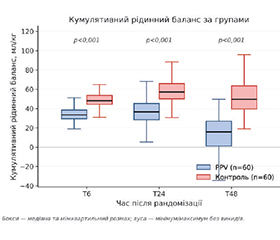
Актуальність. Оптимальна стратегія інфузійної ресусцитації при септичному шоці залишається дискутабельною: фіксовані об’ємні підходи асоціюються з ризиком рідинного перевантаження, тоді як динамічні показники, зокрема варіабельність пульсового тиску (pulse pressure variation, PPV), дозволяють індивідуалізувати інфузійну терапію. Мета: порівняти ефективність і безпеку інфузійної ресусцитації, керованої PPV, зі стандартизованим фіксованим об’ємним підходом у пацієнтів із раннім септичним шоком на інвазивній штучній вентиляції легень (ШВЛ). Матеріали та методи. Проведено одноцентрове проспективне рандомізоване контрольоване дослідження не меншої ефективності (non-inferiority; межа –15 %; n = 120). Пацієнтів рандомізовано у співвідношенні 1 : 1 у групу PPV-керованої ресусцитації або фіксованого введення кристалоїду 30 мл/кг протягом 3 годин. Первинна кінцева точка — кліренс лактату ≥ 10 % через 6 годин. Вторинні точки: рідинний баланс, показники застою (venous excess ultrasound score, VExUS; B-лінії; внутрішньочеревний тиск), динаміка шкали Sequential Organ Failure Assessment (SOFA), клінічні результати, безпека. Аналіз — за принципом наміру лікувати (intention-to-treat) із застосуванням лінійної змішаної моделі для повторних вимірювань. Результати. Кліренсу лактату ≥ 10 % досягли 75,0 % пацієнтів групи PPV проти 58,3 % контрольної групи (різниця +16,7 %; нижня межа 95% ДІ +2,5 %; p < 0,001), що підтвердило не меншу ефективність з ознаками потенційної переваги. У групі PPV були нижчими об’єм інфузії, кумулятивний рідинний баланс, прояви венозного (VExUS ≥ 2: 16,7 % проти 48,3 %), легеневого й абдомінального застою. Скоротилися тривалість ШВЛ та перебування у відділенні інтенсивної терапії. Профіль безпеки — порівнянний або кращий у групі PPV. Висновки. PPV-керована інфузійна ресусцитація забезпечує адекватну перфузію при меншому рідинному навантаженні та зменшенні застою. Результати одноцентрового дослідження потребують мультицентрової валідації перед широким клінічним впровадженням.

Background. The optimal fluid resuscitation strategy in septic shock remains controversial: fixed-volume approaches are associated with the risk of fluid overload, whereas dynamic indices such as pulse pressure variation (PPV) enable individualized fluid therapy. This study aimed to compare the efficacy and safety of PPV-guided fluid resuscitation with a standardized fixed-volume approach in patients with early septic shock requiring mechanical ventilation. Materials and methods. A single-center prospective randomized controlled non-inferiority trial (margin –15 %; n = 120) was conducted. Patients were randomized 1 : 1 to PPV-guided resuscitation or fixed-volume crystalloid administration (30 ml/kg over 3 hours). The primary endpoint was lactate clearance ≥ 10 % at 6 hours. Secondary outcomes included fluid balance, congestion markers (venous excess ultrasound score, VExUS; B-lines; intra-abdominal pressure), Sequential Organ Failure Assessment dynamics, clinical outcomes, and safety. Data were analyzed on an intention-to-treat basis using a linear mixed-effects model for repeated measures. Results. Lactate clearance ≥ 10 % was achieved in 75.0 % of patients in the PPV group versus 58.3 % in the control group (diffe­rence +16.7 %; lower bound of 95% CI +2.5 %; p < 0.001), confir­ming non-inferiority with a trend toward superiority. The PPV group had lower fluid volume, lower cumulative fluid balance, and reduced venous (VExUS ≥ 2: 16.7 vs 48.3 %), pulmonary, and abdominal congestion. Duration of mechanical ventilation and intensive care unit stay were shorter. Safety outcomes were comparable or favored the PPV group. Conclusions. PPV-guided fluid resuscitation provides adequate perfusion with reduced fluid burden and congestion. These single-center findings warrant multicenter validation before broader clinical implementation.


Ключевые слова

септичний шок; інфузійна терапія; варіабельність пульсового тиску; гемодинамічний моніторинг; персоналізована медицина; рідинний баланс; ультразвукова оцінка венозного застою

septic shock; fluid therapy; pulse pressure variation; hemodynamic monitoring; precision medicine; fluid balance; venous congestion ultrasound


Для ознакомления с полным содержанием статьи необходимо оформить подписку на журнал.


Список литературы

1. Singer M, Deutschman CS, Seymour CW, Shankar-Hari M, Annane D, Bauer M, et al. The third international consensus definitions for sepsis and septic shock (Sepsis-3). JAMA. 2016;315(8):801-10. doi: 10.1001/jama.2016.0287.
2. Evans L, Rhodes A, Alhazzani W, Antonelli M, Coopersmith CM, French C, et al. Surviving sepsis campaign: international guidelines for management of sepsis and septic shock 2021. Intensive Care Med. 2021;47(11):1181-247. doi: 10.1007/s00134-021-06506-y.
3. Vincent JL. Fluid management in the critically ill. Kidney Int. 2019;96(1):52-7. doi: 10.1016/j.kint.2018.11.047.
4. Malbrain MLNG, Marik PE, Witters I, Cordemans C, Kirkpatrick AW, Roberts DJ, et al. Fluid overload, de-resuscitation, and outcomes in critically ill or injured patients: a systematic review with suggestions for clinical practice. Anaesthesiol Intensive Ther. 2014;46(5):361-80. doi: 10.5603/AIT.2014.0060.
5. Vandervelden S, Malbrain MLNG. Initial resuscitation from severe sepsis: one size does not fit all. Anaesthesiol Intensive Ther. 2015;47(Suppl 1):S44-55. doi: 10.5603/AIT.a2015.0075.
6. Monnet X, Shi R, Teboul JL. Prediction of fluid responsiveness: what’s new? Ann Intensive Care. 2022;12(1):46. doi: 10.1186/s13613-022-01022-8.
7. Beaubien-Souligny W, Rola P, Haycock K, Bouchard J, Lamarche Y, Spiegel R, et al. Quantifying systemic congestion with point-of-care ultrasound: development of the venous excess ultrasound grading system. Ultrasound J. 2020;12:16. doi: 10.1186/s13089-020-00163-w.
8. Jury D, Shaw AD. Utility of bedside ultrasound-derived hepatic and renal parenchymal flow patterns to guide management of acute kidney injury. Curr Opin Crit Care. 2021;27(6):587-92. doi: 10.1097/MCC.0000000000000899.
9. Douglas IS, Alapat PM, Corl KA, Exline MC, Forni LG, Holder AL, et al. Fluid response evaluation in sepsis hypotension and shock: a randomized clinical trial. Chest. 2020;158(4):1431-45. doi: 10.1016/j.chest.2020.04.025
10. Chaves RCF, Barbas CSV, Queiroz VNF, Serpa Neto A, Deliberato RO, Pereira AJ, et al. Assessment of fluid responsiveness using pulse pressure variation, stroke volume variation, plethysmographic variability index, central venous pressure, and inferior vena cava variation in patients undergoing mechanical ventilation: a systematic review and meta-analysis. Crit Care. 2024;28(1):289. doi: 10.1186/s13054-024-05078-9.
11. Meyhoff TS, Hjortrup PB, Wetterslev J, Sivapalan P, Laake JH, Cronhjort M, et al. Restriction of intravenous fluid in ICU patients with septic shock. N Engl J Med. 2022;386(26):2459-70. doi: 10.1056/NEJMoa2202707.
12. Shapiro NI, Douglas IS, Brower RG, et al. Early Restrictive or Liberal Fluid Management for Sepsis-Induced Hypotension. N Engl J Med. 2023;388(6):499-510. doi: 10.1056/NEJMoa2212663.
13. De Backer D, Cecconi M, Chew MS, Hajjar L, Monnet X, Ospina-Tascón GA, et al. A plea for personalization of the hemodynamic management of septic shock. Crit Care. 2022;26(1):372. doi: 10.1186/s13054-022-04255-y.
14. Hernández G, Ospina-Tascón GA, Damiani LP, Estenssoro E, Dubin A, Hurtado J, et al. Effect of a resuscitation strategy targeting peripheral perfusion status vs serum lactate levels on 28-day mortality among patients with septic shock: the ANDROMEDA-SHOCK randomized clinical trial. JAMA. 2019;321(7):654-64. doi: 10.1001/jama.2019.0071.
15. Klompmaker P, Mousa A, Allard DJ, Hagen BS, Banki T, Vermeulen W, et al. The association between venous excess ultrasound grading system (VExUS) and major adverse kidney events after 30 days in critically ill patients: a prospective cohort study. J Crit Care. 2025;86:154089. doi: 10.1016/j.jcrc.2025.155097.
16. Beaubien-Souligny W, Galarza L, Buchannan B, Lau VI, Adhikari NK, Deschamps J, et al. Prospective study of ultrasound markers of organ congestion in critically ill patients with acute kidney injury. Kidney Int Rep. 2024;9(3):694-702. doi: 10.1016/j.ekir.2023.12.018.
17. Melo RH, Gioli-Pereira L, Melo E, et al. Venous excess ultrasound score association with acute kidney injury in critically ill patients: a systematic review and meta-analysis of observational stu–dies. Ultrasound J. 2025;17(1):16. doi: 10.1186/s13089-025-00413-9.
18. Song J, Liu X, Zhai Q, Chen J, Huang Y, Wu Z, et al. Association between the venous excess ultrasound (VExUS) score and acute kidney injury in critically ill patients with sepsis: a multicenter prospective observational study. Ann Intensive Care. 2025;15(1):105. doi: 10.1186/s13613-025-01529-w.
19. Theerawit P, Touman N, Sutherasan Y, Kiatboonsri S. Transthoracic ultrasound assessment of B-lines for identifying the increment of extravascular lung water in shock patients requiring fluid resuscitation. Indian J Crit Care Med. 2014;18(4):195-9. doi: 10.4103/0972-5229.130569.
20. Wang RJ, Katha G, Phiri M, Delbridge P, Gordon SB, Calfee CS, et al. Sonographic B-lines, fluid resuscitation, and hypo–xemia in Malawian patients with suspected sepsis. Ann Am Thorac Soc. 2020;17(9):1135-42. doi: 10.1164/rccm.202003-0640LE.
21. Malbrain MLNG, Van Regenmortel N, Saugel B, et al. Principles of fluid management and stewardship in septic shock: it is time to consider the four D’s and the four phases of fluid therapy. Ann Intensive Care. 2018;8:66. doi: 10.1186/s13613-018-0402-x.
22. Ince C. Hemodynamic coherence and the rationale for monitoring the microcirculation. Crit Care. 2015;19(Suppl 3):S8. doi: 10.1186/cc14726.
23. Mallinckrodt CH, Lane PW, Schnell D, Peng Y, Mancuso JP. Recommendations for the primary analysis of continuous endpoints in longitudinal clinical trials. Drug Inf J. 2008;42(4):303-19. doi: 10.1177/009286150804200402.
24. Piaggio G, Elbourne DR, Pocock SJ, Evans SJW, Altman DG; CONSORT Group. Reporting of noninferiority and equivalence randomized trials: extension of the CONSORT statement. JAMA. 2006;295(10):1152-60. doi: 10.1001/jama.295.10.1152.
25. Marik PE. Fluid responsiveness and the six guiding principles of fluid resuscitation. Crit Care Med. 2016;44(10):1920-2. doi: 10.1097/CCM.0000000000001483.
26. Monnet X, Teboul JL. Prediction of fluid responsiveness: an update. Ann Intensive Care. 2016;6:111. doi: 10.1186/s13613-016-0216-7.
27. Schulz KF, Grimes DA. Blinding in randomised trials: hiding who got what. Lancet. 2002;359(9307):696-700. doi: 10.1016/S0140-6736(02)07816-9.
28. Pocock SJ, Stone GW. The primary outcome fails — what next? N Engl J Med. 2016;375(9):861-70. doi: 10.1056/NEJMra1510064.
29. Kattan E, Bakker J, Estenssoro E, Ospina-Tascón GA, Biasi Cavalcanti A, De Backer D, et al. Hemodynamic phenotype-based, capillary refill time-targeted resuscitation in early septic shock: the ANDROMEDA-SHOCK-2 randomized clinical trial study protocol. Rev Bras Ter Intensiva. 2022;34(1):96-106. doi: 10.5935/0103-507X.20220004-en.
30. Ospina-Tascón GA, Teboul JL, Hernandez G, et al. How I personalize fluid therapy in septic shock. Crit Care. 2023;27:123. doi: 10.1186/s13054-023-04363-3.

Вернуться к номеру