
Журнал "Гастроэнтерология" Том 60, №3, 2026
Вернуться к номеру
Фактори ризику і ризик-орієнтований підхід до профілактики та діагностики раку шлунка
Авторы: K. Zhelyazkov
II Department of Internal Diseases, Medical University of Plovdiv, Plovdiv, Bulgaria
Рубрики: Гастроэнтерология
Разделы: Клинические исследования
Версия для печати
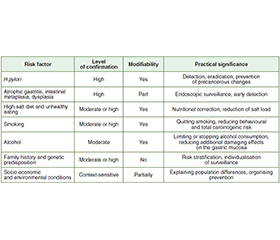
Мета: обґрунтувати профілактичний і діагностичний підхід до карциноми шлунка шляхом узагальнення факторів ризику, пов’язаних із виникненням та прогресуванням шлункового онкогенезу. Матеріали та методи. Дослідження ґрунтувалося на теоретичному аналізі 72 наукових джерел, опублікованих у період із 2020 року до квітня 2026 року. Аналіз застосовували для визначення груп ризику раку шлунка і механізмів їх канцерогенного впливу. Синтез дав змогу узагальнити епідеміологічні, клінічні й молекулярно-біологічні дані. Порівняння використовували для оцінки значущості окремих чинників з огляду на рівень доказовості та профілактичну цінність, а систематизацію — для їх класифікації за етіологічною природою, можливістю модифікації і потенціалом профілактичної корекції. Результати. Аналіз показав, що рак шлунка має багатофакторну природу. Його ризик формується під впливом інфекційних, харчових, поведінкових, спадкових, соціально-економічних та екологічних чинників. Інфекція Helicobacter pylori має найвищу доказову й профілактичну значущість, оскільки пов’язана з хронічним запаленням і передраковими змінами слизової оболонки шлунка. Водночас це модифікований інфекційний фактор, на який можна впливати за допомогою ерадикаційної терапії. Атрофічний гастрит, кишкова метаплазія та дисплазія визначені як ключові морфологічні маркери підвищеного ризику. Дієтичні й поведінкові фактори переважно є модифікованими, а сімейний анамнез і генетична схильність мають важливе значення для стратифікації ризику. Своєчасна діагностика потребує поєднання ендоскопії, біопсії, гістологічного дослідження, серологічних показників і молекулярних маркерів. Найбільш обґрунтованим є ризик-орієнтований підхід, за якого інтенсивність спостереження визначається сукупністю факторів ризику, передракових змін і доступністю діагностичних методів. Висновки. Результати підтверджують, що запобігання пізньому виявленню раку шлунка потребує інтегрованої моделі, що поєднує оцінювання причинних факторів ризику, моніторинг передракових станів і диференційований вибір діагностичних методів. Ці результати можуть бути використані гастроентерологами, онкологами, сімейними лікарями та фахівцями громадського здоров’я для визначення груп високого ризику, планування ендоскопічного спостереження, організації профілактичної роботи і вдосконалення алгоритмів раннього виявлення раку шлунка.
Background. The purpose of the study was to substantiate a preventive and diagnostic approach to gastric carcinoma by generalising risk factors associated with the initiation and progression of gastric oncogenesis. Materials and methods. The study was based on a theoretical analysis of 72 scientific sources published between 2020 and April 2026. Analysis was used to identify groups of gastric cancer risk factors and the mechanisms of the carcinogenic effect. Synthesis made it possible to generalise epidemiological, clinical and molecular biological data. Comparison was applied to assess the significance of individual factors in terms of evidence level and preventive value, while systematisation was used to organise these factors by aetiological nature, modifiability, and potential for preventive correction. Results. The analysis showed that gastric cancer has a multifactorial nature. Its risk develops under the influence of infectious, nutritional, behavioural, hereditary, socio-economic and environmental factors. Helicobacter pylori infection has the strongest evidential and preventive significance, as it is associated with chronic inflammation and precancerous changes in the gastric mucosa. It is also a modifiable infectious factor that can be targeted through eradication therapy. Atrophic gastritis, intestinal metaplasia and dysplasia were identified as key morphological markers of increased risk. Dietary and behavioural factors are mainly modifiable, whereas family history and genetic predisposition are important for risk stratification. Timely diagnosis requires a combination of endoscopy, biopsy, histological examination, serological indicators and molecular markers. A risk-based approach is the most justified, with surveillance intensity determined by the combination of risk factors, precancerous changes and access to diagnostic methods. Conclusions. The findings confirm that preventing the late detection of gastric cancer requires an integrated model combining causal risk assessment, monitoring of precancerous conditions and differentiated selection of diagnostic methods. These results may be used by gastroenterologists, oncologists, family doctors and public health specialists to identify high-risk groups, plan endoscopic surveillance, organise preventive work and improve algorithms for the early detection of gastric cancer.
Helicobacter pylori; атрофічний гастрит; кишкова метаплазія; дисплазія; ендоскопія; біопсія; канцерогенез
Helicobacter pylori; atrophic gastritis; intestinal metaplasia; dysplasia; endoscopy; biopsy, carcinogenesis
Для ознакомления с полным содержанием статьи необходимо оформить подписку на журнал.
- Ferlay J, Ervik M, Lam F, et al. Global cancer observatory: Cancer today. Lyon: International Agency for Research on Cancer; 2024.
- Shweikeh E, Lu J, Al-Rajab M. Detection of cancer in medi–cal images using deep learning. Int J Online Biomed Eng. 2021 Dec;17(14):164-171. doi: 10.3991/IJOE.V17I14.27349.
- Marku E, Geneva-Popova MG, Popova-Belova S, Ugurbas MV, Nikolaev E. Innovative methods of early cancer diagnosis: From genetic screening to liquid biopsy. Libri Oncol. 2026 Feb;53(2-3):121-138. doi: 10.20471/LO.2025.53.02-03.13.
- Sebesta C, Sebesta CG, Sebesta MC, Köcher M, Müllner-Ammer K, Zottl J. How the fight against stomach cancer can be won: Decline in incidence of gastric cancer in Europe: A review of epidemiologic trends, contributing factors and recent treatment standards. J Cancer Sci Clin Ther. 2024 Oct;8(4):295-309. doi: 10.26502/jcsct.5079252.
- Nikolov A, Georgieva L. Influence of behavioral and social factors on gastric cancer incidence and mortality. Int J Sci Ann. 2023 Jun;6(1):40-45. doi: 10.26697/ijsa.2023.1.4.
- Morgan E, Arnold M, Camargo MC, et al. The current and future incidence and mortality of gastric cancer in 185 countries, 2020-40: A population-based modelling study. EClinicalMedicine. 2022 May;47:101404. doi: 10.1016/j.eclinm.2022.101404.
- Niyazbekova L, Marku E, Petkov P, Karimova N, Ulmasov F. Innovations in oncology diagnostics: genetic research and liquid biopsy as tools of personalised medicine. Asian Pac J Cancer Prev. 2025 Dec;26(12):4549-4561. doi: 10.31557/APJCP.2025.26.12.4549.
- Boyanova L, Boyanova L, Hadzhiyski P, et al. Mixed (multiple-genotype) Helicobacter pylori infections in Bulgarian patients. Diagn Microbiol Infect Dis. 2023 Dec;107(4):116073. doi: 10.1016/j.diagmicrobio.2023.116073.
- Dyankov G, Eftimov T, Hikova E, et al. SPR and double resonance LPG biosensors for Helicobacter pylori BabA antigen detection. Sensors. 2024 Mar;24(7):2118. doi: 10.3390/s24072118.
- Collatuzzo G, Pelucchi C, Negri E, et al. Exploring the interactions between Helicobacter pylori infection and other risk factors of gastric cancer: A pooled analysis in the Stomach Cancer Pooling (StoP) Project. Int J Cancer. 2021 May;149(6):1228-1238. doi: 10.1002/ijc.33678.
- Balendra V, Amoroso C, Galassi B, et al. High-salt diet exa–cerbates H. pylori infection and increases gastric cancer risks. J Pers Med. 2023 Aug;13(9):1325. doi: 10.3390/jpm13091325.
- Sabri M. Prophylactic examinations for cervical cancer-mandatory precaution that can save a life. Varna Med Forum. 2021 Aug;10(2):443-448.
- Liou JM, Malfertheiner P, Hong TC, et al. Screening and eradication of Helicobacter pylori for gastric cancer prevention. Taipei Global Consensus II. Gut. 2025 Oct;74:1767-1791. doi: 10.1136/gutjnl-2025-336027.
- Yao K, Uedo N, Kamada T, et al. Guidelines for endoscopic diagnosis of early gastric cancer. Dig Endosc. 2020 Jul;32(5):663-698. doi: 10.1111/den.13684.
- Angelov K, Nachev N, Yordanov E, et al. Diagnostic and therapeutic approaches in the treatment of gastric cancer — A scoping review. Bulg Med Acts. 2026 Feb;53(1):232-238. doi: 10.2478/AMB-2026-0035.
- Vladov N, Trichkov T, Mihaylov V, Takorov I, Kostadinov R, Lukanova T. Are multivisceral resections for gastric cancer acceptable? Experience from a high-volume center and extended literature review. Surg J. 2023 Feb;9(1):28-35. doi: 10.1055/s-0043-1761278.
- Goxharaj A, Suyunov N, Nikolaev E, Bazhanova A, Li N. Current developments and innovations in early detection and subsequent treatment of cancer. J Cancer Res Updates. 2024 Dec;13:85-99. doi: 10.30683/1929-2279.2024.13.12.
- Ko CW, Siddique SM, Patel A, et al. AGA clinical practice guidelines on the gastrointestinal evaluation of iron deficiency anemia. Gastroenterology. 2020 Sep;159(3):1085-1094. doi: 10.1053/j.gastro.2020.06.046.
- Snook J, Bhala N, Beales ILP, et al. British Society of Gastroenterology guidelines for the management of iron deficiency anaemia in adults. Gut. 2021 Nov;70:2030-2051. doi: 10.1136/gutjnl-2021-325210.
- Morgan DR, Corral JE, Li D, et al. ACG clinical guideline: Diagnosis and management of gastric premalignant conditions. Am J Gastroenterol. 2025 Mar;120(4):709-737. doi: 10.14309/ajg.0000000000003350.
- Park JY, ed. Population-based Helicobacter pylori screen-and-treat strategies for gastric cancer prevention: Guidance on implementation. IARC Working Group Reports No. 12. Lyon: International Agency for Research on Cancer; 2025.
- Link A, Bornschein J, Thon C. Helicobacter pylori-induced gastric carcinogenesis — The best molecular model we have? Best Pract Res Clin Gastroenterol. 2021 Mar-Apr;50-51:101743. doi: 10.1016/j.bpg.2021.101743.
- Yang L, Ying X, Liu S, et al. Gastric cancer: Epidemiology, risk factors and prevention strategies. Chin J Cancer Res. 2020 Dec;32(6):695-704. doi: 10.21147/j.issn.1000-9604.2020.06.03.
- Zhang R, Li H, Li N, et al. Risk factors for gastric cancer: A large-scale, population-based case-control study. Chin Med J. 2021 Jul;134(16):1952-1958. doi: 10.1097/CM9.0000000000001652.
- Man J, Ni Y, Yang X, et al. Healthy lifestyle factors, cancer family history, and gastric cancer risk: A population-based case-control study in China. Front Nutr. 2021 Dec;8:774530. doi: 10.3389/fnut.2021.774530.
- Ko KP. Risk factors of gastric cancer and lifestyle modification for prevention. J Gastric Cancer. 2024 Jan;24(1):99-107. doi: 10.5230/jgc.2024.24.e10.
- Kumo AB. Gastric cancer: Diet and Helicobacter pylori as major modifiable risk factors. In: Lazăr DC, ed. Gastric Cancer — Progress and Challenges in the Era of Precision Medicine. London: IntechOpen; 2024 Sep. doi: 10.5772/intechopen.1004434.
- Lee SW. Risk factors and prevention of stomach cancer, excluding Helicobacter pylori. Korean J Helicobacter Upper Gastrointest Res. 2024 Sep;24(3):243-251. doi: 10.7704/kjhugr.2024.0035.
- Thrift AP, Wenker TN, El-Serag HB. Global burden of gastric cancer: Epidemiological trends, risk factors, screening and prevention. Nat Rev Clin Oncol. 2023 May;20:338-349. doi: 10.1038/s41571-023-00747-0.
- Wang S, Zheng R, Li J, et al. Global, regional, and national lifetime risks of developing and dying from gastrointestinal cancers in 185 countries: A population-based systematic analysis of GLOBOCAN. Lancet Gastroenterol Hepatol. 2024 Mar;9:229-237. doi: 10.1016/S2468-1253(23)00366-7.
- Lin CR, Wang MX, Guo XY, et al. Global trends and sociodemographic inequalities in smoking and high-salt diet attributable to gastric cancer: A secondary analysis based on the Global Burden of Disease 2021 study. BMC Cancer. 2025 Jul;25:1248. doi: 10.1186/s12885-025-14605-y.
- Grantham T, Ramachandran R, Parvataneni S, Budh D, Gollapalli S, Gaduputi V. Epidemiology of gastric cancer: Global trends, risk factors and premalignant conditions. J Community Hosp Intern Med Perspect. 2023 Nov;13(6):100-106. doi: 10.55729/2000-9666.1252.
- He P, Li X, Zou D, Tang F, Chen H, Li Y. Environmental factors inducing gastric cancer: Insights into risk and prevention strategies. Discov Oncol. 2025 Jan;16:25. doi: 10.1007/s12672-025-01771-5.
- Liu Z, Ji J, Yang Q, Pang F, Qiu Y. Diagnostic performance of white light endoscopy, narrow band imaging, and flexible spectral imaging color enhancement for early gastric cancer: A systematic review and meta-analysis. Quant Imaging Med Surg. 2025 Jun;15(6):5534-5545. doi: 10.21037/qims-24-482.
- Hu Y, Chen X, Hendi M, Si J, Chen S, Deng Y. Diagnostic ability of magnifying narrow-band imaging for the extent of early gastric cancer: A systematic review and meta-analysis. Gastroenterol Res Pract. 2021 Apr;2021:5543556. doi: 10.1155/2021/5543556.
- Miyaoka M, Yao K, Tanabe H, et al. Diagnosis of early gastric cancer using image-enhanced endoscopy: A systematic approach. Transl Gastroenterol Hepatol. 2020 Oct;5:50. doi: 10.21037/tgh.2019.12.16.
- Gašenko E, Bogdanova I, Sjomina O, et al. Assessing the utility of pepsinogens and gastrin-17 in gastric cancer detection. Eur J Cancer Prev. 2023 Sep;32(5):478-484. doi: 10.1097/CEJ.0000000000000791.
- Lee SY, Moon HW, Ahn YS, Song JH, Kim JH, Sung IK. A prospective study on the detection of gastric neoplasms using pepsinogen and gastrin-17 levels. Gut Liver. 2025 Jul;19(4):548-558. doi: 10.5009/gnl240544.
- Sánchez-López JY, Díaz-Herrera LC, Rizo-de la Torre LC. Pepsinogen I, pepsinogen II, gastrin-17, and Helicobacter pylori serological biomarkers in the diagnosis of precursor lesions of gastric cancer. Arch Med Sci. 2024 Jun;20(3):1016-1021. doi: 10.5114/aoms/189971.
- White JR, Banks M. Identifying the premalignant stomach: From guidelines to practice. Transl Gastroenterol Hepatol. 2022 Jan;7:8. doi: 10.21037/tgh.2020.03.03.
- Tjandra D, Busuttil RA, Boussioutas A. Gastric intestinal metaplasia: Challenges and the opportunity for precision prevention. Cancers. 2023 Aug;15(15):3913. doi: 10.3390/cancers15153913.
- Shaker F, Razi S, Rezaei N. Circulating miRNA and circulating tumor DNA application as liquid biopsy markers in gastric cancer. Clin Biochem. 2024 Jul;129:110767. doi: 10.1016/j.clinbiochem.2024.110767.
- Zhang Z, Wu H, Chong W, Shang L, Jing C, Li L. Liquid bio–psy in gastric cancer: Predictive and prognostic biomarkers. Cell Death Dis. 2022 Oct;13:903. doi: 10.1038/s41419-022-05350-2.
- Izumi D, Zhu Z, Chen Y, et al. Assessment of the diagnostic efficiency of a liquid biopsy assay for early detection of gastric cancer. JAMA Netw Open. 2021 Aug;4(8):e2121129. doi: 10.1001/jamanetworkopen.2021.21129.
- Klymenko M. Progress and prospects in research on low-grade diffuse chronic inflammation: A literature review. Ukr J Med Biol Sports. 2025 Mar;10(1):16-29. doi: 10.63341/ujmbs/1.2025.16.
- Bortnyi M. Computer vision as a tool for optimising the early diagnosis of abdominal organ diseases. Med Sci Ukraine. 2026 Mar;22(1):194-206. doi: 10.32345/2664-4738.1.2026.22.
- Sharshembiev J, Karaeva R, Tokhtiev I. To the question of the structural organization of the immune apparatus of the human stomach (literature review). Eurasian Health J. 2023 Nov;15(4):18-25. doi: 10.54890/1694-6405_2023_3_18.
- Kyrylenko Ye, Ziablitsev S. Carcinogenic consequences of missile and drone strikes in Ukraine: Fuel toxicology, mechanisms of carcinogenesis, and cancer incidence forecast (literature review). Med Sci Ukraine. 2026 Mar;22(1):179-193. doi: 10.32345/2664-4738.1.2026.21.
- Murzagulov N, Telmanova Zh, Shishkin I, Rustemova K, Igissin N. Risk factors and prevention of colonic diseases: Modern approaches and perspectives (literature review). Eurasian Health J. 2026 Feb;18(1):157-179. doi: 10.54890/1694-8882-2026-1-157.
- Collatuzzo G, Dajti E, Secco M, Bazzoli F, Boffetta P, Zagari RM. Burden of gastric cancer attributable to Helicobacter pylori in 27 countries from seven geographic regions in 2022. Gastric Cancer. 2026 Jan;29:16-26. doi: 10.1007/s10120-025-01677-9.
- Salvatori S, Marafini I, De Vico P, Fonsi A, Monteleone G. Molecular insights into Helicobacter pylori-induced gastritis and gastric cancer. Cancers. 2026 Jan;18(2):331. doi: 10.3390/cancers18020331.
- Zhang T, Hu L, Zhang B, Tang X. Spasmolytic polypeptide-expressing metaplasia: The hidden linchpin in gastric carcinoge–nesis beyond the Correa cascade. Int J Surg. 2025 Dec;112(3):7951-8035. doi: 10.1097/JS9.0000000000004273.
- Tulewicz-Marti E, Stępień-Wrochna B, Maciejewska K, et al. Awareness and Compliance with the Recommendations of Primary and Secondary Prevention of Cancer in Patients with Inflammatory Bowel Disease. J Pers Med. 2023 May;13(6):913. doi: 10.3390/jpm13060913.
- Portillo-Miño JD, Uribe J, Latorre G, et al. Individuals and family-screen-to-treat-based Helicobacter pylori eradication strategy for gastric cancer prevention: A Latin American perspective. Helicobacter. 2026 Apr;31(2):e70110. doi: 10.1111/hel.70110.
- Hamashima C. Forthcoming step in gastric cancer prevention: How can risk stratification be combined with endoscopic screening for gastric cancer? Gut Liver. 2022 Nov;16(6):811-824. doi: 10.5009/gnl210313.
- Wu R, Yang C, Ji L, Fan ZN, Tao YW, Zhan Q. Prevalence of gastric cancer precursors in gastroscopy-screened adults by family history of gastric cancer and of cancers other than gastric. BMC Cancer. 2020 Nov;20:1110. doi: 10.1186/s12885-020-07612-8.
- Luu MN, Quach DT, Hiyama T. Screening and surveillance for gastric cancer: Does family history play an important role in shaping our strategy? Asia Pac J Clin Oncol. 2022 Aug;18(4):353-362. doi: 10.1111/ajco.13704.
- Trinh TTK, Lee K, Oh JK, Suh M, Jun JK, Choi KS. Cluster of lifestyle risk factors for stomach cancer and screening behaviors among Korean adults. Sci Rep. 2023 Oct;13:17503. doi: 10.1038/s41598-023-44470-3.
- Brito Filho MF, de Santana ME, Mendes CP, et al. Cultural, social, and healthcare access factors associated with delays in gastric cancer presentation, diagnosis, and treatment: A cross-sectional study. J Cancer Policy. 2021 Jun;28:100277. doi: 10.1016/j.jcpo.2021.100277.
- Kim JY, Hong JY, Kim SM, et al. Socio-economic factors and medical conditions affecting regular stomach cancer screening in Korea: A retrospective longitudinal study using national public health data for 11 years. Public Health. 2024 Feb;227:70-77. doi: 10.1016/j.puhe.2023.11.029.
- Santellano B, Agrawal R, Duchesne G, et al. Social determinants of health and upper gastrointestinal cancer outcomes in the United States: A systematic review. Front Public Health. 2024 Nov;12:1477028. doi: 10.3389/fpubh.2024.1477028.
- Li W, Zhang T. Precancerous pathways to gastric cancer: A review of experimental animal models recapitulating the Correa cascade. Front Cell Dev Biol. 2025 Jul;13:1620756. doi: 10.3389/fcell.2025.1620756.
- Botezatu A. Gastric intestinal metaplasia and gastric epithelial dysplasia — Precursor lesions of gastric cancer. Mold J Health Sci. 2025 Mar;12(1):54-60. doi: 10.52645/MJHS.2025.1.09.
- Domanchuk TI, Chornenka ZA, Hrytsiuk MI. Comparative analysis of incidence and mortality from gastric cancer among the popu–lation of Europe and Ukraine. Med News. 2021 Mar;74(3):596-602. doi: 10.36740/WLek202103206.
- Matsuoka T, Yashiro M. Novel biomarkers for early detection of gastric cancer. World J Gastroenterol. 2023 May;29(17):2515-2533. doi: 10.3748/wjg.v29.i17.2515.
- Roy S, Kanda M, Nomura S, et al. Diagnostic efficacy of circular RNAs as noninvasive, liquid biopsy biomarkers for early detection of gastric cancer. Mol Cancer. 2022 Feb;21:42. doi: 10.1186/s12943-022-01527-7.
- Xiao M, Zhang Z, Liao G, Liu M, Chen X. Analysis of the va–lue of Helicobacter pylori test in combination with the determination of plasma propepsin and gastrin 17 in screening the precancerous status of gastric cancer. Cell Mol Biol. 2022 Aug;68(8):110-115. doi: 10.14715/cmb/2022.68.8.20.
- Horiuchi Y, Hirasawa T, Ishizuka N, et al. Diagnostic performance in gastric cancer is higher using endocytoscopy with narrow-band imaging than using magnifying endoscopy with narrow-band imaging. Gastric Cancer. 2021 Oct;24:417-427. doi: 10.1007/s10120-020-01125-w.
- Yoo IK, Park JC, Lee H, et al. A comparative study of magnifying endoscopy with narrow-band imaging and endocytoscopy in the diagnosis of gastric neoplasm: A pilot study. Eur J Gastroenterol Hepatol. 2023 May;35(5):530-536. doi: 10.1097/MEG.0000000000002539.
- Shah SC, Gawron AJ, Mustafa RA, Piazuelo MB. Histologic subtyping of gastric intestinal metaplasia: Overview and considerations for clinical practice. Gastroenterology. 2020 Feb;158(3):745-750. doi: 10.1053/j.gastro.2019.12.004.
- Chen H, Xu H. Effect of gastrin G-17 combined with pepsinogen PGI and PGII on the early screening of gastric cancer in the department of gastroenterology. Altern Ther Health Med. 2024 Sep;30(9):141-145.
- Ollila I, Puustinen L, Tykkä E, Paajanen M, Punkkinen J, Arkkila P. Can the indications for gastroscopy in dyspeptic patients be tightened? Scand J Gastroenterol. 2026 Apr;61(7):723-730. doi: 10.1080/00365521.2026.2654975.