
Архів офтальмології та щелепно-лицевої хірургії України Том 3, №1, 2026
Вернуться к номеру
Структура бойових травматичних ушкоджень щелепно-лицьової ділянки в Україні: ретроспективне одноцентрове дослідження
Авторы: A.R. Goldak (1, 2), Yu.B. Pasternak (1, 2), Yu.O. Medvid (1, 2), N. Lozynska (1, 2), Ya.Ya. Vares (1, 2), Ya.E. Vares (1, 2)
(1) - Danylo Halytsky Lviv National Medical University, Lviv, Ukraine
(2) - Superhumans Center (Charitable Organization “Charitable Fund “Superhumans”), Lviv — Vynnyky, Ukraine
Рубрики: Хирургия, Офтальмология
Разделы: Клинические исследования
Версия для печати
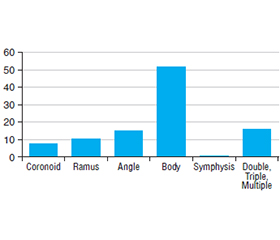
Актуальність. Повномасштабне російське вторгнення в Україну, яке розпочалося в лютому 2022 року, супроводжувалося значними гуманітарними й медичними викликами, пов’язаними з великою кількістю постраждалих серед цивільного населення і військових, а також недостатнім досвідом українських клініцистів у діагностиці та лікуванні вогнепальних і вибухових поранень. Поряд зі швидкою адаптацією цивільних та військових медичних закладів до нових умов роботи й залученням великої кількості міжнародних медичних місій одним із ключових пріоритетів української системи охорони здоров’я стало створення центрів передового досвіду в галузі бойової травми, наприклад фонду Superhumans. Мета: проаналізувати поширеність і характер щелепно-лицьових ушкоджень у пацієнтів, які отримували медичну допомогу в Центрі пластичної та реконструктивної хірургії Superhumans. Матеріали та методи. Проведено ретроспективне одноцентрове дослідження, у якому оцінювали демографічні показники, етіологію і локалізацію бойових травм щелепно-лицьової ділянкі та їх поєднання з травмами інших органів і тканин. Отримані дані порівнювали з результатами аналогічних досліджень, проведених в Україні та зарубіжних країнах, які пережили військові конфлікти протягом останніх 20 років. Результати. Серед 215 проаналізованих пацієнтів чоловіків було 97,6 %. Співвідношення військовослужбовців та цивільних — 29,7 : 1. Понад 75,0 % постраждалих були молодшими за 44 роки. Вибухові поранення щелепно-лицьової ділянки становили 75,3 % усіх випадків, а вогнепальні — 24,7 %. Найчастіше (52,1 %) виявляли ушкодження нижньої щелепи або навколишніх м’яких тканин; рідше траплялися травми верхньої щелепи (27,4 %) та вилице-орбітального комплексу (23,7 %). У 73,5 % осіб присутні поєднані ушкодження, найчастіше — травми кінцівок і нейротравми. Висновки. Вибухові травми, зумовлені дією різних типів боєприпасів, є основною причиною щелепно-лицьових ушкоджень, а частка останніх у загальній структурі травматичних ушкоджень залишається стабільно високою. Той факт, що 73,5 % постраждалих із щелепно-лицьовими пораненнями мають супутні травми, зокрема головного мозку, свідчить про нагальну потребу в міждисциплінарному підході до діагностики й лікування зазначеної категорії хворих.
Background. The full-scale Russian invasion of Ukraine which began in February 2022 has been accompanied by significant humanitarian and medical challenges, linked to a high number of civilian and military casualties as well as the Ukrainian clinicians’ lack of experience in diagnosis and treatment of gunshot and blast injuries. Alongside the rapid adaptation of civilian and military medical facilities to the new working conditions and involvement of a high number of international medical missions, one of the key priorities of the Ukrainian healthcare system has been the creation of centers of excellence in the area of war trauma. One example of such a facility is Superhumans Center. The objective of this study was to analyze the prevalence and nature of maxillofacial injuries in patients who received care at the Superhumans Center for Plastic and Reconstructive Surgery. Materials and methods. A retrospective monocentric study was conducted, evaluating demographics, etiology, and localization of combat-related maxillofacial injuries and their combination with trauma of other organs and tissues. The obtained results were compared with those of similar studies conducted in Ukraine and foreign countries that experienced military conflict during the past 20 years. Results. Among the 215 reviewed cases, men constituted 97.6 %. The military to civilian ratio was 29.7 : 1. Over 75.0 % of the casualties were younger than 44 years. Maxillofacial blast injuries constituted 75.3 % of all cases, and gunshot injuries comprised 24.7 %. Most frequently (52.1 %), an injury of the mandible or the surrounding soft tissues was present; injuries of the maxilla (27.4 %) and the zygomatico-orbital complex (23.7 %) were rarer. In 73.5 % of cases, concomitant injuries were present, most commonly trauma of extremities and neurotrauma. Conclusions. Blast injury from different munition types is the main cause of maxillofacial injuries, and the proportion of such injuries in the overall scope of traumatic injuries is consistently high. The fact that 73.5 % of casualties with maxillofacial injuries have concomitant injuries, particularly of the brain, suggests the urgency of need in the interdisciplinary approach to diagnosis and treatment of the aforementioned segment of casualties.
щелепно-лицьові травми; травматичні ушкодження; супутні травми
maxillofacial injuries; traumatic injuries; concomitant injuries
Для ознакомления с полным содержанием статьи необходимо оформить подписку на журнал.
- Palyvoda R, Kaniura O, Vares Y, Fedirko I, Uhryn M, Chepur–nyi Y, et al. Maxillofacial surgery in Ukraine during a war: Challenges and perspectives — a national survey. Mil Med. 2024;189(9–10):1968-1975. doi: 10.1093/milmed/usad465.
- Epstein A, Lim R, Johannigman J, Fox CJ, Inaba K, Vercruys–se GA, et al. Putting medical boots on the ground: Lessons from the war in Ukraine and applications for future conflict with near-peer adversaries. J Am Coll Surg. 2023;237(2):364-373. doi: 10.1097/xcs.0000000000000707.
- Fuzaylov G, Bean C. Logistics of surgical missions during the war in Ukraine: Lessons learned. Discov Health Syst. 2023;2:47.
- Antonyshyn K, Teshima TL, Al-Shaqsi S, Enepekidis D, Higgins K, Levis C, et al. A mobile craniofacial surgery unit: Recon–structing casualties of war in Ukraine. J Craniofac Surg. 2025;36:156-161. doi: 10.1097/scs.0000000000010802.
- Burdeina N, Fedchenko O, Vensyuk A. Modern challenges of military logistics: Analysis of the supply of the Armed Forces of Ukraine in the conditions of war with Russia. Soc Dev Sec. 2025;15(3):83-91. doi: 10.33445/sds.2025.15.3.9.
- Lawry LL, Janvrin M, Korona-Bailey J, Betancourt C, Maddox J, Apilado KP, et al. Health system organization and logistics of trauma care since the Russian invasion of Ukraine: A qualitative assessment. Inquiry. 2025;62. doi: 10.1177/00469580251333327.
- Hodgetts TJ, Naumann DN, Bowley DM. Transferable military medical lessons from the Russo-Ukraine war. BMJ Mil Health. 2023;171(2):e002435. doi: 10.1136/military-2023-002435.
- In Lviv region, the Superhumans prosthetics and rehabilitation center was opened. Suspilne Lviv. 2023 Apr 14. Available from: https://suspilne.media/lviv/446304-na-lvivsini-vidkrili-centr-protezuvanna-ta-reabilitacii-superhumans-so-vidomo/ (in Ukrainian).
- Prysiazhniuk O, Palyvoda R, Chepurnyi Y, Pavlychuk T, Chernogorskyi D, Fedirko I, et al. War-related maxillofacial injuries in Ukraine: A retrospective multicenter study. Arch Craniofac Surg. 2025;26(2):51-58. doi: 10.7181/acfs.2024.0074.
- Adebayo ET, Iyogun CA. Maxillofacial injuries sustained during military peace keeping mission in Liberia: The Nigerian experience (1990–1997). Niger J Dent Res. 2020;5(2):118-122.
- Levin L, Zadik Y, Peleg K, Bigman G, Givon A, Lin S. Incidence and severity of maxillofacial injuries during the second Lebanon war among Israeli soldiers and civilians. J Oral Maxillofac Surg. 2008;66(8):1630-1633. doi: 10.1016/j.joms.2007.11.028.
- Mardassi A, Turki S, Mbarek H, Hachicha A, Chebbi G, Benzarti S, Abouda M. Management of combat-related facial injuries. Tunis Med. 2016;94(12):856.
- Daniels JS, Albakry I, Braimah RO, Samara MI, Albala–si RA, Al-Rayshan SMA. Management of maxillofacial gunshot injuries with emphasis on damage control surgery during the Yemen civil war: Review of 173 victims from a level 1 trauma hospital in Najran, Kingdom of Saudi Arabia. Craniomaxillofac Trauma Reconstr. 2022;15(1):58-65. doi: 10.1177/19433875211012211.
- Aşık MB, Akay S, Eksert S. Analyses of combat-related injuries to the maxillofacial and cervical regions and experiences in an operational field hospital. Ulus Travma Acil Cerrahi Derg. 2018;24:56-60. doi: 10.5505/tjtes.2017.75333.
- Daniels JS, Albakry I, Braimah RO, Samara MI, Albala–si RA, Begum F. Management of maxillofacial injuries among child and adolescent victims during Yemeni civil conflict: Experience from a tertiary referral center in Najran, southwestern Saudi Arabia. Eur J Oral Maxillofac Surg. 2021;5(1):16-22. doi: 10.23736/s2532-3466.20.00229-5.
- Bahouth H, Ghantous Y, Rachmiel A, Amodi O, Abu-Elnaaj I. Maxillofacial injuries related to the Syrian war in the civi–lian population. J Oral Maxillofac Surg. 2017;75(5):995-1103. doi: 10.1016/j.joms.2017.01.007.
- Zaggut AW, Rahman MM, Youssef G, Holmes S, Ellamu–shi H, Shibu M, et al. Craniomaxillofacial war injuries in Misrata, Libya. J Dent Open Access. 2020;2(2):1-4. doi: 10.31487/j.jdoa.2020.02.05.
- Denysiuk MV, Dubrov SO, Poniatovska HB, Lianskorun–skyi VM. Analysis of the structure and features of traumatic injuries in victims with combat trauma. Med Perspektivi. 2025;30(2):156-163. doi: 10.26641/2307-0404.2025.2.333655.
- D’Souza EW, MacGregor AJ, Dougherty AL, Olson AS, Champion HR, Galarneau MR. Combat injury profiles among US mili–tary personnel who survived serious wounds in Iraq and Afghanistan: A latent class analysis. PLoS One. 2022;17(4):e0266588. doi: 10.1371/journal.pone.0266588.
- Belmont PJ, McCriscin BJ, Sieg RN, Burks R, Schoen–feld AJ. Combat wounds in Iraq and Afghanistan from 2005 to 2009. J Trauma Acute Care Surg. 2012;73(1):3-12. doi: 10.1097/ta.0b013e318250bfb4.
- Xydakis MS, Frawell MD, Nasser KF, Casler JD. Analysis of battlefield head and neck injuries in Iraq and Afghanistan. Otolaryngol Head Neck Surg. 2005;133(4):497-504. doi: 10.1016/j.otohns.2005.07.003.
- Owens BD, Kragh JF, Wenke JC, Macaitis J, Wade CE, Holcomb JB. Combat wounds in operation Iraqi Freedom and operation Enduring Freedom. J Trauma. 2008;64(2):295-299. doi: 10.1097/ta.0b013e318163b875.
- Lew TA, Walker JA, Wenke JC, Blackbourne LH, Hale RG. Characterization of craniomaxillofacial battle injuries sustained by United States service members in the current conflicts of Iraq and Afghanistan. J Oral Maxillofac Surg. 2010;68(1):3-7.
- Breeze J, Gibbons AJ, Opie NJ, Monaghan A. Maxillofacial injuries in military personnel treated at the Royal Centre for Defence Medicine June 2001 to December 2007. Br J Oral Maxillofac Surg. 2010;48(8):613-616.
- Keller MW, Han PP, Galarneau MR, Gaball CW. Chara–cteristics of maxillofacial injuries and safety of in-theater facial fracture repair in severe combat trauma. Mil Med. 2015;180(3):315-320. doi: 10.7205/milmed-d-14-00345.
- Guryev CO, Kushnir VA, Lisun DM, Panasenko SI, Solo–vyov OS. Modern combat injuries of the extremities. The first report: Clinical and anatomical structure and structure of injury combinations. Ukr J Clin Surg. 2023;90(4):31-35.
- MacGregor AJ, Zouris JM, Watrous JW, McCabe CT, Dougherty AL, Galarneau MR, Fraser JJ. Multimorbidity and quality of life after blast-related injury among US military personnel: A cluster analysis of retrospective data. BMC Public Health. 2020;20(1):578. doi: 10.1186/s12889-020-08696-4.
- Grillo R, Bottura L, Lima BC, Kalline de Oliveira N, Melhem-Elias F, Deboni MC. The complex dynamics of maxillofacial trauma in blast and fragmentation injuries: Current understanding and gaps in scientific evidence. J Cranio-Maxillofac Surg. 2025;53(10):1762-1768. doi: 10.1016/j.jcms.2025.07.017.
- Wade AL, Dye JL, Mohrle CR, Galarneau MR. Head, face, and neck injuries during Operation Iraqi Freedom II: Results from the US Navy-Marine Corps Combat Trauma Registry. J Trauma. 2007;63(4):836-840. doi: 10.1097/01.ta.0000251453.54663.66.
- Rustemeyer J, Kranz V, Bremerich A. Injuries in combat from 1982–2005 with particular reference to those to the head and neck: A review. Br J Oral Maxillofac Surg. 2007;45(7):556-560. doi: 10.1016/j.bjoms.2007.01.003.
- Chiniard T, Boutonnet M, Duron S, Bertho K, Travers S, Pasquier P. Profile of injuries in recent warfare. J Trauma Acute Care Surg. 2023;95(2):S79-S87. doi: 10.1097/ta.0000000000004034.
- Abdullahi MAH, Bala M, Rasheed SA, Ahmed MA, Modibbo MA, Shehu IM. Improvised explosive device injuries to the maxillofacial region: Diagnostic findings and treatment approaches in north-eastern Nigeria. South Sudan Med J. 2024;17(4):179-184. doi: 10.4314/ssmj.v17i4.5.