
Архів офтальмології та щелепно-лицевої хірургії України Том 3, №1, 2026
Вернуться к номеру
Використання інструментів на основі штучного інтелекту в рутинній практиці лікаря стоматолога-хірурга
Авторы: Астахов М.О., Паливода Р.С.
Національний медичний університет імені О.О. Богомольця, м. Київ, Україна
Рубрики: Хирургия, Офтальмология
Разделы: Клинические исследования
Версия для печати
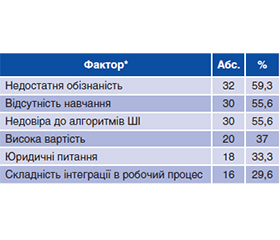
Актуальність. Штучний інтелект (ШІ) стрімко інтегрується в сучасну стоматологію, демонструючи значний потенціал у діагностиці, аналізі медичних зображень, плануванні й прогнозуванні результатів лікування. Водночас його практичне застосування залишається обмеженим через недостатню підготовку фахівців, обмежений доступ до технологій, юридичні аспекти й недовіру до алгоритмів. Подальша ефективна інтеграція ШІ в клінічну практику потребує не лише технологічного розвитку, а й системного навчання стоматологів, формування цифрової компетентності. Метою даного дослідження було оцінити рівень обізнаності щодо сфери практичного використання технологій штучного інтелекту в клінічній практиці і персональне ставлення до них лікарів стоматологів-хірургів. Матеріали та методи. Було розроблено анонімну анкету з 29 запитань, що складалась із соціального блоку і спеціальних запитань з однією правильною відповіддю, для оцінки рівня обізнаності та зацікавленості стоматологів щодо застосування інструментів на основі ШІ, зокрема в плануванні й проведенні дентальної імплантації. Анкетування відбувалось у травні — червні 2026 року, участь була добровільною. Для аналізу даних було застосовано методи описової та аналітичної статистики. Результати. Розрив між декларованим інтересом (81,5 %) і фактичним упровадженням (33,3 %) ШІ в рутинну практику є відчутним, що чітко ілюструє technology adoption gap. 70,4 % респондентів мають лише часткове або нульове розуміння ШІ-інструментів, при цьому 81,5 % зацікавлені в їх використанні. Підтвердженням тому є загальний наративний показник «сприйнята корисність ШІ» (коефіцієнт α Кронбаха = 0,84 (95% ДІ 0,76–0,90)). Висновки. Зацікавленість лікарів у використанні технологій ШІ є високою, основними перешкодами для інтеграції ШІ в рутинну клінічну практику є недостатній рівень знань і практичних навичок. Водночас інструменти на основі ШІ мають значний потенціал для виявлення й аналізу ключових факторів, пов’язаних з ризиком розвитку післяопераційних ускладнень.
Background. Artificial intelligence (AI) is rapidly being integrated into modern dentistry, demonstrating significant potential in diagnosis, medical image analysis, treatment planning, and outcome prediction. At the same time, its practical application remains limited due to insufficient training among specialists, limited access to technology, legal considerations, and distrust of algorithms. Further effective integration of AI into clinical practice requires not only technological development but also systematic training of dentists and formation of digital competencies. The aim of this study was to assess dental surgeons’ level of awareness of the practical applications of AI technologies, as well as their personal attitudes toward these technologies in clinical practice. Materials and methods. An anonymous questionnaire comprising 29 questions was developed, consisting of a social section and specific single-choice questions assessing dentists’ level of awareness of, and interest in, AI-based tools, particularly in the planning and performance of dental implantation. The survey was conducted from May to June 2026; participation was voluntary. Descriptive and analytical statistical methods were used for data analysis. Results. The gap between declared interest (81.5 %) and actual implementation (33.3 %) of AI in routine practice was substantial, clearly illustrating a technology adoption gap. A total of 70.4 % of respondents had only partial or no understanding of AI tools, while 81.5 % expressed interest in using them. This was confirmed by the overall composite indicator “perceived usefulness of AI” (Cronbach’s α = 0.84; 95% confidence interval: 0.76–0.90). Conclusions. Physicians’ interest in using AI technologies is high; the main obstacles to integrating AI into routine clinical practice are insufficient knowledge and inadequate practical skills. At the same time, AI-based tools have significant potential for identifying and analyzing key factors associated with the risk of postoperative complications.
штучний інтелект; нейронні мережі; дентальна імплантація; планування; практичні навички
artificial intelligence; neural networks; dental implantology; planning; practical skills
Для ознакомления с полным содержанием статьи необходимо оформить подписку на журнал.
- Surdu A, Budala DG, Luchian I, Foia LG, Botnariu GE, Scutariu MM. Using AI in optimizing oral and dental diagnoses — A narrative review. Diagnostics. 2024;14(24):Article 2804. https://doi.org/10.3390/diagnostics14242804.
- Huang YK, Hsu LP, Chang YC. Artificial intelligence in clinical dentistry: The potentially negative impacts and future actions. Journal of Dental Sciences. 2022;17(4):1817-1818. https://doi.org/10.1016/j.jds.2022.07.013.
- Najeeb M, Islam S. Artificial intelligence (AI) in resto–rative dentistry: Current trends and future prospects. BMC Oral Health. 2025;25(1):Article 592. https://doi.org/10.1186/s12903-025-05989-1.
- Liu TY, Lee KH, Mukundan A, Karmakar R, Dhiman H, Wang HC. AI in dentistry: Innovations, ethical considerations, and integration barriers. Bioengineering. 2025;12(9):Article 928. https://doi.org/10.3390/bioengineering12090928.
- Ivanišević A, Tadin A. Artificial intelligence and modern technology in dentistry: Attitudes, knowledge, use, and barriers among dentists in Croatia — A survey-based study. Clinics and Practice. 2024;14(6):2623-2636. https://doi.org/10.3390/clinpract14060207.
- Ellakany P, Tauqir S, Ali S, Mikhail SS. Artificial intelligence usage among dental students/dentists of different educational level: A multi-country survey. BMC Oral Health. 2025;26(1):Article 81. https://doi.org/10.1186/s12903-025-07476-z.
- Kostov II, Yordanova GR. Attitudes of dentists and patients towards the introduction of artificial intelligence in dentistry. Journal of Medicine and Life. 2025;18(5):472-477. https://doi.org/10.25122/jml-2024-0382.
- Hegde S, Nanayakkara S, Jordan A, Jeha O, Patel U, Luu V, et al. Attitudes and perceptions of Australian dentists and dental students towards applications of artificial intelligence in dentistry: A survey. European Journal of Dental Education. 2025;29(1):9-18. https://doi.org/10.1111/eje.13042.
- Mishra P, Singh AV, Kar P, Chaturvedi A. Knowledge, attitudes, and perceptions of dental professionals regarding robotics and artificial intelligence in dentistry: A cross-sectional study in Lucknow, India. Cureus. 2025;17(2):Article e78882. https://doi.org/10.7759/cureus.78882.
- Jeong H, Han SS, Jung HI, Lee W, Jeon KJ. Perceptions and attitudes of dental students and dentists in South Korea toward artificial intelligence: A subgroup analysis based on professional seniority. BMC Medical Education. 2024;24(1):Article 430. https://doi.org/10.1186/s12909-024-05441-y.
- Ahmed N, Abbasi MS, Zuberi F, Qamar W, Halim MSB, Maqsood A, et al. Artificial intelligence techniques: Analysis, application, and outcome in dentistry — A systematic review. BioMed Research International. 2021;2021:Article 9751564. https://doi.org/10.1155/2021/9751564.
- Fontenele RC, Gerhardt MDN, Picoli FF, Van Gerven A, Nomidis S, Willems H, et al. Convolutional neural network-based automated maxillary alveolar bone segmentation on cone-beam computed tomography images. Clinical Oral Implants Research. 2023;34(6):565-574. https://doi.org/10.1111/clr.14063.
- Vázquez-Sebrango G, Anitua E, Macía I, Arganda-Carre–ras I. The role of artificial intelligence in implant dentistry: A systematic review. International Journal of Oral and Maxillofacial Surgery. 2025;54(11):1098-1122. https://doi.org/10.1016/j.ijom.2025.04.005.
- Elgarba BM, Fontenele RC, Du X, Mureșanu S, Tarce M, Meeus J, et al. Artificial intelligence versus human intelligence in presurgical implant planning: A preclinical validation. Clinical Oral Implants Research. 2025;36(7):835-845. https://doi.org/10.1111/clr.14429.
- Issa J, Olszewski R, Dyszkiewicz-Konwińska M. The effectiveness of semi-automated and fully automatic segmentation for inferior alveolar canal localization on CBCT scans: A systematic review. International Journal of Environmental Research and Public Health. 2022;19(1):Article 560. https://doi.org/10.3390/ijerph19010560.