
Архів офтальмології та щелепно-лицевої хірургії України Том 3, №1, 2026
Вернуться к номеру
Прогностична цінність аполіпопротеїну J в оцінці ризику прогресування діабетичної ретинопатії залежно від модифікуючих чинників
Авторы: Венгер А.Ю.
Одеський національний медичний університет, м. Одеса, Україна
Рубрики: Хирургия, Офтальмология
Разделы: Клинические исследования
Версия для печати
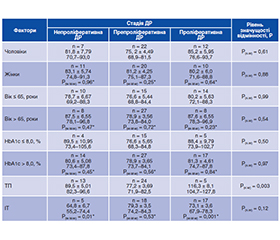
Актуальність. Важливим чинником впливу на стан гематоретинального бар’єра є хемокін аполіпопротеїн (APO), визначення його ролі у патогенезі діабетичної ретинопатії (ДР) може допомогти у прогностичній оцінці перебігу захворювання. Мета: встановлення прогностичної значущості APO J в оцінці ризику прогресування ДР залежно від стадії та модифікуючих чинників. Матеріали та методи. У дослідження було залучено 114 пацієнтів (212 очей), хворих на цукровий діабет (ЦД) 2-го типу, середній вік 62,92 ± 3,90 року, середній стаж ЦД 14,82 ± 2,45 року, середній вміст HbA1c — 9,20 ± 0,83 %. Пацієнтів з ДР І стадії було 27, з ДР ІІ стадії — 54 та з ДР ІІІ стадії — 33. Вміст хемокіну APO J у сироватці крові встановлювали за допомогою набору для визначення APO J (кластерину) людини методом імуноферментного аналізу. Результати. Виявлено вірогідне збільшення концентрації APO J сироватки крові (P = 0,003) у хворих на ЦД 2-го типу залежно від виду антидіабетичного лікування у міру переходу від непроліферативної стадії ДР до проліферативної у групі таблетованих препаратів. При порівнянні хворих цих груп між собою за стадіями ДР виявлено значне вірогідне зменшення концентрації цього хемокіну на непроліферативній (P = 0,01) і проліферативній (P = 0,001) стадіях ДР у групі ін’єкційної терапії. При застосуванні двофакторного регресійного аналізу (Tests of Between-Subjects Effects) при стандартизації за видом антидіабетичного лікування виникає вірогідна залежність вмісту APO J від стадії ДР (Р = 0,003). Висновки. Вірогідна залежність вмісту APO J від стадії ДР (Р = 0,003) виникає при стандартизації за видом антидіабетичного лікування. Більш впливовим модифікуючим чинником прогресування ДР із урахуванням APO J є вік пацієнтів.
Background. The chemokine apolipoprotein (APO) is a significant factor influencing the state of the blood-retinal barrier; determining its role in the pathogenesis of diabetic retinopathy (DR) may assist in the prognostic assessment of the disease course. This study aimed to evaluate the prognostic significance of APO J in assessing the risk of DR progression depending on stage and modifying factors. Materials and methods. The study was conducted in 114 adults (212 eyes) with type 2 diabetes, their average age was 62.92 ± 3.90 years, duration of diabetes was 14.82 ± 2.45 years, the average HbA1c content was 9.20 ± 0.83 %. There were 27 participants with stage I DR, 54 with stage II DR, and 33 with stage III DR. Serum level of the chemokine APO J was determined using a human APO J (clusterin) ELISA kit. Results. A significant increase in serum APO J concentration (P = 0.003) was observed in patients with type 2 diabetes — depending on the type of antidiabetic treatment — as the condition progressed from the non-proliferative to the proliferative stage of DR in the group receiving oral medication. When comparing patients across DR stages, a significant decrease in the concentration of this chemokine was found at both the non-proliferative (P = 0.01) and proliferative (P = 0.001) stages of DR in the group receiving injectable therapy. Two-factor regression analysis (Tests of Between-Subjects Effects), standardized for the type of antidiabetic treatment, revealed a significant association between APO J levels and the stage of DR (P = 0.003). Conclusions. A significant dependence of APO J content on the stage of DR (P = 0.003) was found during standardization by the type of antidiabetic treatment. The age of patients was a more influential modifying factor for DR progression taking into account APO J.
діабетична ретинопатія; цукровий діабет 2-го типу; аполіпопротеїн J; фактори ризику; прогноз
diabetic retinopathy; type 2 diabetes mellitus; apolipoprotein J; risk factors; prognosis
Для ознакомления с полным содержанием статьи необходимо оформить подписку на журнал.
- Kalyani RR, Neumiller JJ, Maruthur NM, Wexler DJ. Diagnosis and treatment of type 2 diabetes in adults: a review. JAMA. 2025;334(11):984-1002. doi: 10.1001/jama.2025.5956.
- Flaxel CJ, Adelman RA, Bailey ST, et al. Diabetic retinopathy preferred practice pattern. Ophthalmology. 2020;127(1):66-145. doi:10.1016/j.ophtha.2019.09.025.
- Ren J, Zhang S, Pan Y, et al. Diabetic retinopathy: Involved cells, biomarkers, and treatments. Front Pharmacol. 2022;13:953691. doi: 10.3389/ fphar.2022.953691.
- Antonetti DA, Silva PS, Stitt AW. Current understanding of the molecular and cellular pathology of diabetic retinopathy. Nat Rev Endocrinol. 2021;17:195-206. https://doi.org/10.1038/s41574-020-00451-4.
- Gross C, Guérin L-P, Socol BG, Germain L, Guérin SL. The Ins and Outs of Clusterin: Its Role in Cancer, Eye Diseases and Wound Healing. International Journal of Molecular Sciences. 2023;24(17):13182. https://doi.org/10.3390/ijms241713182.
- Kim YS, Kim YH, Cheon EW, et al. Retinal expression of Apo Jsterin in the streptozotocin-induced diabetic rat. Brain Res. 2003;76(1):53-59. doi: 10.1016/s0006-8993(03)02636-2.
- Wang H, et al. Characterisation of the vitreousproteome in proliferative diabetic retinopathy. Proteome Science. 2012;10(1):15. doi: 10.1186/1477-5956-10-15.
- Fayez Safa S. Evaluation of Serum Apo Jsterin Levels in Type 2 Diabetic Men with and without Cardiovascular Disease. Iraqi Journal оf Science. 2020;61(5):978-984. https://doi.org/10.24996/ijs.2020.61.5.5.
- Head J, Shen D, Zhou M, Garfinkel RA, Chan C-C. Expression of Apo Jsterin and VEGF in Diabetic Retinopathy. IOVS. 2007;48(13):4976. https://iovs.arvojournals.org/article.aspx?articleid=2387648.
- Wilson MR, Satapathy SJ, Shinwu, Fini ME. Apo Jsterin, other extracellular chaperones, and eye disease. Progress in Retinal and Eye Research. 2022;89:101032. https://doi.org/10.1016/j.preteyeres.2021.101032.
- American Diabetes Association Professional Practice Committee for Diabetes. Glycemic goals, hypoglycemia, and hyperglycemic crises: Standards of Care in Diabetes. Diabetes Care. 2026;49:132-149. https://doi.org/10.2337/dc26-S006.
- de Campos TDP, da Cruz Rodrigues K, Pereira RM, et al. The protective roles of Apo Jsterin in ocular diseases caused by obesity and diabetes mellitus type 2. Mol Biol Rep. 2021;48:4637-4645. https://doi.org/10.1007/s11033-021-06419-5.
- Kostopoulou E, Kalavrizioti D, Davoulou P, et al. Monocyte Chemoattractant Protein-1 (MCP-1), Activin-A and Apo Jsterin in Children and Adolescents with Obesity or Type-1 Diabetes Mellitus. Diagnostics. 2024;14(4):450. https://doi.org/10.3390/diagnostics14040450.
- Suk SА, Rykov SO, Kyryliuk ML. The role of Apo Jsterin as an antiapoptotic glial factor in the development of diabetic machular edema in patients with type 2 diabetes mellitus. Archive of Ukrainian Ophthalmology. 2019;7(2):30-35. (In Ukrainian). https://doi.org/10.22141/2309-8147.7.2.2019.169686.
- Werner H. The IGF1 Signaling Pathway: From Basic Concepts to Therapeutic Opportunities. Int J Mol Sci. 2023;24(19):14882. doi: 10.3390/ijms241914882.