
Архів офтальмології та щелепно-лицевої хірургії України Том 3, №1, 2026
Вернуться к номеру
Cumulative Burden Index як інтегральний маркер резистентного перебігу неоваскулярної глаукоми після транссклеральної циклофотокоагуляції: проспективне 36-місячне дослідження
Авторы: Гузун О.В. (1), Коновалова Н.В. (2)
(1) - ДУ «Інститут очних хвороб і тканинної терапії ім. В.П. Філатова НАМН України», м. Одеса, Україна
(2) - Одеський національний медичний університет, м. Одеса, Україна
Рубрики: Хирургия, Офтальмология
Разделы: Клинические исследования
Версия для печати
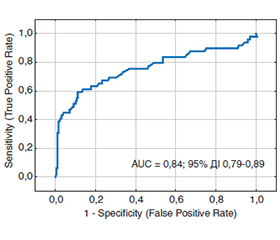
Актуальність. Неоваскулярна глаукома характеризується агресивним перебігом, високою частотою повторних хірургічних втручань та значною варіабельністю довгострокових результатів лікування. Кумулятивна складність терапії може відображати біологічну резистентність захворювання. Інтегральна оцінка лікувального навантаження може мати прогностичне значення для результатів транссклеральної циклофотокоагуляції. Мета дослідження: оцінити прогностичне значення індексу лікувального навантаження (Cumulative Burden Index, CBI) як інтегрального маркера резистентності перебігу неоваскулярної глаукоми після транссклеральної циклофотокоагуляції. Матеріали та методи. Проведено проспективне когортне дослідження, яке включало 224 пацієнтів (224 ока) із неоваскулярною глаукомою, яким виконували транссклеральну циклофотокоагуляцію. Період спостереження становив 36 місяців. CBI визначали як суму кількості курсів циклофотокоагуляції та індексу тяжкості клінічних ускладнень, пов’язаних з перебігом захворювання. Незалежні предиктори неефективного результату лікування визначали за допомогою багатофакторної логістичної регресії. Дискримінаційну здатність показника оцінювали за допомогою ROC-аналізу. Результати. Через 36 місяців ефективний результат лікування було досягнуто у 155 пацієнтів (69,2 %), тоді як у 69 пацієнтів (30,8 %) лікування було неефективним. Середній CBI становив 3,9 у групі ефективного лікування та 6,6 у групі резистентного лікування (p < 0,001). У багатофакторній логістичній регресійній моделі CBI був незалежним предиктором резистентного лікування (OR = 1,58; 95% ДІ 1,32–1,90; p < 0,001). ROC-аналіз продемонстрував високу прогностичну точність показника (AUC = 0,84; 95% ДІ 0,79–0,89). Оптимальне порогове значення CBI ≥ 5 забезпечувало чутливість 78 % та специфічність 81 %. Висновки. Індекс лікувального навантаження (Cumulative Burden Index, CBI) є інтегральним показником, що відображає кумулятивну складність лікування при неоваскулярній глаукомі. Підвищення значення CBI асоціюється з вищим ризиком резистентного до лікування перебігу після транссклеральної циклофотокоагуляції. Індекс може бути використаний для клінічної стратифікації ризику у цієї категорії пацієнтів.
Background. Neovascular glaucoma is characterized by an aggressive clinical course, a high rate of repeated surgical interventions, and considerable variability in long-term treatment outcomes. The cumulative complexity of therapy may reflect the biological resistance of the disease. An integrative assessment of treatment burden may therefore have prognostic value for outcomes after transscleral cyclophotocoagulation. The purpose was to evaluate the prognostic significance of the Cumulative Burden Index (CBI) as an integrative marker of treatment resistance in neovascular glaucoma after transscleral cyclophotocoagulation. Materials and methods. This prospective cohort study included 224 patients (224 eyes) with neovascular glaucoma treated with transscleral cyclophotocoagulation. The follow-up period was 36 months. CBI was calculated as the sum of the number of cyclophotocoagulation procedures and the severity score of clinical complications related to the disease course. Independent predictors of treatment failure were assessed using multivariable logistic regression. The discriminative performance of CBI was evaluated using receiver operating characteristic (ROC) analysis. Results. At 36 months, treatment success was achieved in 155 patients (69.2 %), whereas 69 participants (30.8 %) were classified as having treatment failure. The mean CBI was 3.9 in the success group and 6.6 in the failure group (p < 0.001). In the multivariable logistic regression model, CBI was an independent predictor of treatment failure (odds ratio = 1.58; 95% confidence interval (CI) 1.32–1.90; p < 0.001). ROC analysis demonstrated good predictive performance of the index (area under the ROC curve = 0.84; 95% CI 0.79–0.89). The optimal cut-off value of CBI ≥ 5 yielded a sensitivity of 78 % and a specificity of 81 %. Conclusions. CBI is an integral indicator that reflects the cumulative complexity of treatment in neovascular glaucoma. Higher CBI values are associated with an increased risk of a treatment-resistant course after transscleral cyclophotocoagulation and may serve as a useful tool for clinical risk stratification of these patients.
неоваскулярна глаукома; діабетична ретинопатія; оклюзія вен сітківки; транссклеральна циклофотокоагуляція; лікувальне навантаження; Cumulative Burden Index; прогностичні моделі; РОС-аналіз; внутрішньоочний тиск
neovascular glaucoma; diabetic retinopathy; retinal vein occlusion; transscleral cyclophotocoagulation; treatment burden; Cumulative Burden Index; predictive models; ROC analysis; intraocular pressure
Для ознакомления с полным содержанием статьи необходимо оформить подписку на журнал.
- Hayreh, S.S. (2007). Neovascular glaucoma. Progress in Retinal and Eye Research, 26(5), 470-485. https://doi.org/10.1016/j.preteyeres.2007.06.001.
- Aiello, L.P., Avery, R.L., Arrigg, P.G., Keyt, B.A., Jam–pel, H.D., Shah, S.T., et al. (1994). Vascular endothelial growth factor in ocular fluid of patients with diabetic retinopathy and other retinal disorders. The New England Journal of Medicine, 331(22), 1480-1487. https://doi.org/10.1056/NEJM199412013312203.
- Shazly, T.A., & Latina, M.A. (2009). Neovascular glaucoma: Etiology, diagnosis and prognosis. Seminars in Ophthalmology, 24(2), 113-121. https://doi.org/10.1080/08820530902800707.
- Weinreb, R.N., Aung, T., & Medeiros, F.A. (2014). The pathophysiology and treatment of glaucoma. JAMA, 311(18), 1901-1911. https://doi.org/10.1001/jama.2014.3192.
- Senthil, S., Garudadri, C.S., & Rao, H.L. (2021). Management of neovascular glaucoma. Indian Journal of Ophthalmology, 69(4), 1047-1056. https://doi.org/10.4103/ijo.IJO_2246_20.
- Guzun, O.V., Zadorozhnyy, O.S., Sytnikova, V.O., Konovalo–va, N.V., & Kovalchouk, A.G. (2026). Morphometry of the ciliary body and systemic inflammation in neovascular glaucoma secon–dary to diabetic retinopathy and/or retinal vein occlusion. Ukrainian Journal of Ophthalmology, (1), 46-54. https://doi.org/10.31288/Ukr.j.ophthalmol.202614654.
- Kahook, M.Y., & Schuman, J.S. (2009). Medical and surgical management of neovascular glaucoma. International Ophthalmology Clinics, 49(4), 85-92. https://doi.org/10.1097/IIO.0b013e3181b79d7f.
- Rotchford, A.P., Jayasawal, R., Madhusudhan, S., Ho, S., & King, A.J. (2010). Transscleral diode laser cycloablation in patients with refractory glaucoma. British Journal of Ophthalmology, 94(9), 1180-1183. doi: 10.1136/bjo.2008.145565.
- Grueb, M., Rohrbach, J.M., Bartz-Schmidt, K.U., & Schlote, T. (2006). Long-term results of transscleral diode laser cyclophotocoagulation in refractory glaucoma. Graefe’s Archive for Clinical and Experimental Ophthalmology, 244(12), 1463-1467. https://doi.org/10.1007/s00417-006-0327-7.
- Schlote, T., Derse, M., Rassmann, K., Nicaeus, T., Dietz, K., & Thiel, H.J. (2001). Efficacy and safety of contact transscle–ral diode laser cyclophotocoagulation. Graefe’s Archive for Clinical and Experimental Ophthalmology, 239(10), 783-792. https://doi.org/10.1007/s004170100336.
- Aquino, M.C., Barton, K., Tan, A.M., Sng, C., Li, X., Loon, S.C., et al. (2015). Micropulse versus continuous-wave transscleral cyclophotocoagulation in refractory glaucoma. Ophthalmology, 122(12), 2450-2457. https://doi.org/10.1016/j.ophtha.2015.08.029.
- Khodeiry, M.M., Abdelrahman, A.M., & Hafez, T.A. (2023). Slow coagulation transscleral cyclophotocoagulation in neovascular glaucoma. Journal of Glaucoma, 32(4), 314-320. https://doi.org/10.1097/IJG.0000000000002154.
- Sari, C., Alagoz, N., Omeroglu, A., Cakir, I., Pasaoglu, I., Altan, C., et al. (2024). Long-term results of transscleral diode laser cyclophotocoagulation in glaucoma: A real-life study. Journal of Glaucoma, 33(6), 437-443. https://doi.org/10.1097/IJG.0000000000002346.
- Sav, A., Kendall, E., McMillan, S.S., Kelly, F., Whitty, J.A., King, M.A., et al. (2013). Treatment burden in chronic illness: A systematic review. BMC Health Services Research, 13, 115. https://doi.org/10.1186/1472-6963-13-115.
- Sav, A., McMillan, S.S., Kelly, F., King, M.A., Whitty, J.A., Kendall, E., et al. (2015). Treatment burden and chronic illness: Patients’ perspectives. The Patient, 8(3), 239-250. https://doi.org/10.1007/s40271-014-0103-2.
- Guzun, O., Zadorozhnyy, O., Nasinnyk, I., & Korol, A. (2025). Efficacy of modified diode transscleral cyclophotocoagulation in patients with painful neovascular glaucoma secondary to retinal vein occlusion. Journal of Ophthalmology (Ukraine), (3), 3-10. https://doi.org/10.31288/oftalmolzh20253310.
- Sanchez, F.G., Peirano-Bonomi, J.C., & Grippo, T.M. (2022). Micropulse transscleral cyclophotocoagulation: A review of the literature. Clinical Ophthalmology, 16, 2647-2656. https://doi.org/10.2147/OPTH.S347735.
- Kuchar, S., Moster, M.R., Reamer, C.B., & Waisbourd, M. (2023). Treatment outcomes of transscleral cyclophotocoagulation in neovascular glaucoma. Journal of Glaucoma, 32(6), 451-457. https://doi.org/10.1097/IJG.0000000000002191.
- Lim, R., Shah, M., & Aref, A.A. (2024). Current perspectives on cyclophotocoagulation in refractory glaucoma. Current Opinion in Ophthalmology, 35(2), 117-123. https://doi.org/10.1097/ICU.0000000000000932.
- Steyerberg, E.W. (2019). Clinical prediction models: A practical approach to development, validation, and updating. 2nd ed. Cham: Springer; 2019. 558 p. doi: 10.1007/978-3-030-16399-0.
- Vickers, A.J., & Elkin, E.B. (2006). Decision curve ana–lysis: A novel method for evaluating prediction models. Medical Decision Making, 26(6), 565-574. https://doi.org/10.1177/0272989X06295361.
- Collins, G.S., Reitsma, J.B., Altman, D.G., & Moons, K.G. (2015). Transparent reporting of a multivariable prediction model for individual prognosis or diagnosis (TRIPOD). Annals of Internal Medicine, 162(1), 55-63. https://doi.org/10.7326/M14-0697.