
Международный эндокринологический журнал Том 22, №6, 2026
Вернуться к номеру
Поширеність та структура респіраторних захворювань в осіб із цукровим діабетом 2-го типу
Авторы: O.Ye. Hryniuk, M.I. Hryniuk, S.S. Tkachuk, O.D. Liakhovych
Bukovinian State Medical University, Chernivtsi, Ukraine
Рубрики: Эндокринология
Разделы: Клинические исследования
Версия для печати
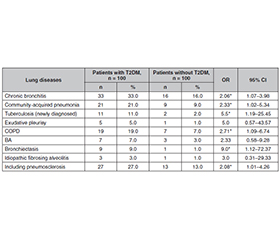
Актуальність. Сьогодні на цукровий діабет у світі страждають 589 мільйонів людей. За прогнозами фахівців, до 2030 року їхня кількість зросте до 670 мільйонів. Протягом останніх років у світовій та вітчизняній літературі з’явилися дослідження, у яких легені вважають ще одним органом-мішенню при цукровому діабеті, що зумовлює вивчення механізмів взаємообтяження цукрового діабету й респіраторної патології та наслідків цієї коморбідності. Мета: дослідити структуру коморбідності гострих та хронічних захворювань бронхолегеневого апарату в госпіталізованих пацієнтів із цукровим діабетом 2-го типу (ЦД2) порівняно з особами без коморбідності. Матеріали та методи. Проведено ретроспективний аналіз 100 медичних карт стаціонарних хворих, госпіталізованих у терапевтичне відділення з діагнозом ЦД2, з оцінкою наявності, частоти виникнення й структури супутньої респіраторної патології. Для порівняння проаналізовано 100 медичних карт осіб без ЦД2, госпіталізованих у терапевтичне відділення. Результати. Пацієнтів із ЦД2 та загостренням хронічного бронхіту (ХБ) було у 2,1 раза більше, ніж тих, хто був госпіталізований з приводу загострення ХБ, але не мав ЦД2 (p < 0,05), а осіб із негоспітальною пневмонією (НГП) та коморбідним ЦД2 — у 2,3 раза більше порівняно з хворими на НГП без ЦД2 (p < 0,05). Кількість пацієнтів із хронічним обструктивним захворюванням легень (ХОЗЛ) та супутнім ЦД2 перевищувала частку осіб без діабету у 2,7 раза (p < 0,05), а кількість хворих із загостренням бронхіальної астми статистично не відрізнялася між групами (р > 0,05). Осіб із бронхоектатичною хворобою (БЕХ) та коморбідним ЦД2 було в 9,0 раза більше, ніж пацієнтів із БЕХ без ЦД2 (p < 0,05). Кількість хворих на туберкульоз легень на тлі ЦД2 перевищувала частку осіб без ЦД у 5,5 раза (p < 0,05). Хворих із дифузним пневмосклерозом та ЦД2 було 27,0 % проти 13,0 % осіб без супутнього ЦД2, що статистично вірогідно відрізнялося у 2,1 раза (p < 0,05). Висновки. У пацієнтів із ЦД2 зростає ризик розвитку бронхолегеневих захворювань: ХБ — у 2,1 раза, НГП — у 2,3 раза, туберкульозу — у 5,5 раза, ХОЗЛ — у 2,7 раза, БЕХ — у 9,0 раза, дифузного пневмосклерозу — у 2,1 раза (p < 0,05) порівняно з показниками в популяції.
Background. Diabetes mellitus currently affects 589 million people worldwide. Experts predict this number will grow to 670 million by 2030. Over the past few years, studies have appeared in the international and Ukrainian literature suggesting that the lungs may be another target organ in diabetes mellitus, which necessitates the investigation of mechanisms underlying the interdependence of diabetes mellitus and respiratory disease, as well as the consequences of this comorbidity. Aim was to investigate the pattern of comorbidity of acute and chronic diseases of the bronchopulmonary system among hospitalized patients with type 2 diabetes mellitus (T2DM) compared to individuals without such comorbidity. Materials and methods. A retrospective analysis was conducted of 100 medical cards of patients admitted to the therapeutic department with a diagnosis of T2DM, assessing the presence, incidence, and pattern of concomitant bronchopulmonary diseases. For the comparative analysis, 100 medical cards of patients hospitalized in the therapeutic department without concomitant T2DM were analysed. Results. The number of patients with T2DM and exacerbation of chronic bronchitis (CB) was significantly higher (by 2.1 times) compared to those hospitalised with exacerbation of CB without T2DM (p < 0.05), and the number of patients with comorbidity of T2DM and community-acquired pneumonia (CAP) was 2.3 times higher than the number of patients with CAP without T2DM (p < 0.05). The number of patients with chronic obstructive pulmonary disease (COPD) and accompanying T2DM was 2.7 times higher compared to those without diabetes (p < 0.05), whereas in cases of exacerbation of bronchial asthma, there was no statistically significant difference between the groups (p > 0.05). The number of patients with comorbidity of T2DM and bronchiectasis (BE) was 9.0 times higher compared to the number of patients with BE without T2DM (p < 0.05). There were by 5.5 times more patients with pulmonary tuberculosis and T2DM than those without T2DM (p < 0.05). The percentage of patients with diffuse pneumosclerosis and T2DM was 27.0 vs. 13.0 % for those without associated T2DM, a statistically significant difference of 2.1-fold (p < 0.05). Conclusions. Patients with T2DM have an increased risk of developing bronchopulmonary diseases: CB (2.1 times), CAP (2.3 times), tuberculosis (5.5 times), COPD (2.7 times), BE (9.0 times), diffuse pneumosclerosis (2.1 times) (p < 0.05) in comparison with the population indicator.
цукровий діабет; пневмосклероз; пневмонія; хронічне обструктивне захворювання легень; бронхіальна астма; бронхоектатична хвороба; туберкульоз
diabetes mellitus; pneumosclerosis; pneumonia; chronic obstructive pulmonary disease; bronchial asthma; bronchiectatic disease; tuberculosis
Для ознакомления с полным содержанием статьи необходимо оформить подписку на журнал.
- Foer D, Wu TD, Celedón JC, Burak MF, Aroda VR. Type 2 Diabetes and the Lung — Cause and Consequence. Curr Diab Rep. 2026 May 7;26(1):12. doi: 10.1007/s11892-026-01625-6.
- Anghel L, Ciubară A, Patraș D, Ciubară AB. Chronic Obstructive Pulmonary Disease and Type 2 Diabetes Mellitus: Complex Interactions and Clinical Implications. J Clin Med. 2025 Mar 7;14(6):1809. doi: 10.3390/jcm14061809.
- Bezerra FS, Lanzetti M, Nesi RT, et al. Oxidative stress and inflammation in acute and chronic lung injuries. Antioxidants (Basel). 2023;12(3):548. doi: 10.3390/antiox12030548.
- Mihai AM, Marc M, Lucaciu F, Sima A. The Diabetes-Viral Respiratory Syndemic: Pathophysiological Insights and Precision Mana–gement: A Scoping Review. Medicina. 2026;62(4):770. doi: 10.3390/medicina62040770.
- Muhammad Azeem ur Rehman, Bilal Mahmood, Roha Fiaz, Muhammad Zubair, Asma Ali, Abdul Mutalib. Prevalence, Patterns, and Clinical Factors Associated with Pulmonary Complications in Patients with Diabetes Mellitus: A Cross-Sectional Study. IJPRT. 2026 Apr. 8;16(1):1445-51. Available from: https://ijprt.org/index.php/pub/article/view/1720.
- Yu M, Wang R, Pei L, et al. The relationship between the use of GLP-1 receptor agonists and the incidence of respiratory illness: a meta-analysis of randomized controlled trials. Diabetol Metab Syndr. 2023;15(1):164. doi: 10.1186/s13098-023-01118-6.
- Alanazi AH, Selim MS, Liu F, Zhang D, Narayanan SP, Somanath PR. Pre-Existing Diabetes Alters Pulmonary Inflammatory Gene Expression Priming for Injury. FASEB J. 2025 Jul 31;39(14):e70804. doi: 10.1096/fj.202500816R.
- Sun J, Chen J, Shen Y, Yao X, Sun H, Chen B, Feng J. Dia–betes mellitus-driven pulmonary injury: multidimensional mechanisms linking metabolic dysregulation to gut-lung axis and promi–sing therapies. Front Pharmacol. 2025;16:1689522. doi: 10.3389/fphar.2025.1689522.
- Javed S, Mohamed M, Altaf B, Wan Ghazali WS. Systematic Review: Surfactant Protein-D, Diabetes Mellitus, Oxidative Stress, Infections and Inflammation on the Crossroad. J Pak Med Assoc. 2024;74:534-543. doi: 10.47391/JPMA.9977.
- Hamblin PS, Russell AW, Talic S, Zoungas, S. The gro–wing range of complications of diabetes mellitus. Trends in endocrinology and metabolism. 2025;36(10):943-954. doi: 10.1016/j.tem.2024.12.006.
- Xie Y, Zhang A, Wang Y, Wang R. Community-Acquired Pneumonia in Patients with Diabetes: Narrative Review. JMIR Diabetes. 2026;11:e82215. doi: 10.2196/82215.
- Tarar P, Bandi V, Sarwar H, et al. Exploring the Interrelationship Between Diabetes Mellitus and Chronic Lung Diseases: A Comprehensive Review. Cureus. 2025;16(9):e69617. doi: 10.7759/cureus.69617.
- Yang Q, Zhang R, Gao Y, et al. Computed tomography fin–dings in patients with pulmonary tuberculosis and diabetes at an infectious disease hospital in China: a retrospective cross-sectional study. BMC Infect Dis. 2023;23:436. doi: 10.1186/s12879-023-08386-7.
- Tong X, Wang D, Wang H, Liao Y, Song Y, Li Y, et al. Clinical features in pulmonary tuberculosis patients combined with diabetes mellitus in China: an observational study. Clin Respir J. 2021;15(9):1012-8. doi: 10.1111/crj.13405.
- Su J, Li M, Wan X, Yu H, Wan Y, Hang D, et al. Associa–tions of diabetes, prediabetes and diabetes duration with the risk of chronic obstructive pulmonary disease: A prospective UK Biobank study. Diabetes Obes Metab. 2023 Sep;25(9):2575-2585. doi: 10.1111/dom.15142.
- Raslan AS, Quint JK, Cook S. All-Cause, Cardiovascular and Respiratory Mortality in People with Type 2 Diabetes and Chronic Obstructive Pulmonary Disease (COPD) in England: A Cohort Study Using the Clinical Practice Research Datalink (CPRD). Int J Chron Obstruct Pulmon Dis. 2023 Jun 13;18:1207-1218. doi: 10.2147/COPD.S407085.
- Meng J, Lu D, Huang J, Liu L, Huang C, Ye J, Huang X. Association Between Asthma and the Risk of Type 2 Diabetes Mellitus: Results from NHANES 2009–2016 Data. Int J Endocrinol. 2026 Jan 31;2026:4046954. doi: 10.1155/ije/4046954.
- Wang X, Cao Y. A Narrative Review: Relationship Between Glycemic Variability and Emerging Complications of Diabetes Mellitus. Biomolecules. 2025;15:188. doi: 10.3390/biom15020188.
- Teague TT, Payne SR, Kelly BT, et al. Evaluation for clinical benefit of metformin in patients with idiopathic pulmonary fibrosis and type 2 diabetes mellitus: a national claims-based cohort analysis. Respir Res. 2022;23(1):91. doi: 10.1186/s12931-022-02001-0.
- Gojevic T, Van Ryckeghem L, Jogani S, et al. Pulmonary hypertension during exercise underlies unexplained exertional dyspnoea in patients with type 2 diabetes. Eur J Prev Cardiol. 2023;30(1):37-45. doi: 10.1093/eurjpc/zwac153.
- Yu H, Liu J, He X. From Glucotoxicity to Lung Injury: Emer–ging Perspectives on Diabetes-Associated Respiratory Complications. Lung. 2025;203:80. doi: 10.1007/s00408-025-00834-2.
- Meyyazhagan P, Kanagaraj T, Annamalai N. A cross-sectio–nal study on effect of glycaemic status and duration of type II diabetes mellitus on the pulmonary function. J Basic Clin Physiol Pharmacol. 2025 Jan 21;36(1):39-50. doi: 10.1515/jbcpp-2024-0190.
- Hull R, Liu Y, Cao Z, et al. Comorbid diabetes disease seve–rity and microbial changes in patients with bronchiectasis: a combined analysis of data from the EMBARC, EMBARC-India, Australian, and BE-China registries. The Lancet Respiratory Medicine. 2026. doi: 10.1016/S2213-2600(26)00057-3.
- Abhishek Kumar Singh, Danish Rastogi, Shraddha Singh. Effect of duration of type 2 diabetes mellitus on impairment of lung functions: a cross-sectional study. Int J Health Sci Res. 2026;16(2):268-274. doi: 10.52403/ijhsr.20260230.