
Международный эндокринологический журнал Том 22, №6, 2026
Вернуться к номеру
Атерогенний індекс плазми як неінвазивний критерій діагностики метаболічно асоційованої стеатотичної хвороби печінки в пацієнтів із цукровим діабетом 2-го типу
Авторы: O.O. Plokhotnichenko (1), T.V. Tyzhnenko (1), K.V. Misiura (1), I.A. Tykha (1), N.O. Kravchun (1, 2,) I.A. Lurin (3, 4), M.Yu. Gorshunska (5), A.K. Pocherniaiev (1, 6), V.V. Kurinnyi (7, 8), Zh.A. Leshchenko (1), A.O. Kolesnikova (1), K.B. Pamuła (9), A.S. Smirnov (10), N.M. Brechka (10), I.O. Marakhovskyi (1), R.S. Nikolaiev (1), A.Yu. Moroziuk (1)
(1) - SI “V. Danilevsky Institute for Endocrine Pathology Problems of NAMS of Ukraine”, Kharkiv, Ukraine
(2) - Kharkiv National Medical University, Kharkiv, Ukraine
(3) - National Academy of Medical Sciences of Ukraine, Kyiv, Ukraine
(4) - SI “Scientific and Practical Center of Preventive and Clinical Medicine” of the State Administration of Affairs, Kyiv, Ukraine
(5) - V.N. Karazin Kharkiv National University, Kharkiv, Ukraine
(6) - Poltava Scientific Research Forensic Center of the Ministry of Internal Affairs of Ukraine, Poltava, Ukraine
(7) - Military Medical Clinical Center of the Northern Region, Kharkiv, Ukraine
(8) - Medical Service of the Kharkiv Military Garrison, Kharkiv, Ukraine
(9) - 5th Military Clinical Hospital SPZOZ, Krakow, Poland
(10) - University of Medicine and Social Sciences, Kharkiv, Ukraine
Рубрики: Эндокринология
Разделы: Клинические исследования
Версия для печати
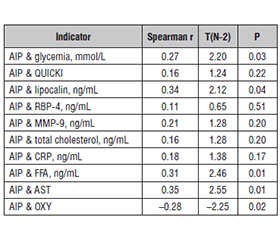
Актуальність. Визначення факторів ризику й органів-мішеней на ранніх стадіях формування захворювань серцево-судинної системи, печінки, нирок та інших ускладнень із корекцією виявлених порушень є невід’ємною частиною успішного зниження захворюваності та смертності серед населення. Цукровий діабет (ЦД) — це синдром різної етіології, що характеризується переважно хронічною гіперглікемією з порушеннями, пов’язаними з білковим і ліпідним обміном. Мета: визначити наявність та характер зв’язку нового непрямого індексу з наявністю (або відсутністю) метаболічно асоційованої стеатотичної жирової хвороби печінки (МАСЖХП) у пацієнтів із ЦД 2-го типу, а також внесок атерогенного індексу плазми (AIP) у ризик розвитку захворювань печінки й охарактеризувати його діагностичну цінність за допомогою логістичної регресії та ROC-аналізу. Матеріали та методи. Обстежено 60 пацієнтів із ЦД 2-го типу (33 чоловіки/27 жінок; вік 53,00 ± 1,20 року; тривалість захворювання 13,36 ± 3,49 року), із них 24 особи із МАСЖХП, 36 — без. Діагноз МАСЖХП було встановлено на основі клінічного аналізу захворювання, показників ліпідного і вуглеводного обміну, активності аспартат- та аланінамінотрансферази й ультразвукового дослідження печінки. Результати. Виявлено значний та статистично значущий зв’язок між AIP та наявністю метаболічно асоційованої жирової хвороби печінки. Чітку й значущу кореляцію знайдено між AIP і глікемією, а також деякими показниками оксидативного стресу (зокрема, індексом вільних жирних кислот та рівнем OXY) і вмістом адипокіну ліпокаліну. Розроблено діагностичну модель для виявлення груп ризику розвитку МАСЖХП у пацієнтів із ЦД 2-го типу на основі AIP. Висновки. Розроблено діагностичну модель для формування груп ризику метаболічно асоційованої жирової хвороби печінки серед осіб із цукровим діабетом 2-го типу за допомогою логістичної регресії та ROC-аналізу. Діагностичним критерієм є новий неінвазивний показник — атерогенний індекс плазми, порогове значення предиктора визначено як 0,60.
Background. Identification of risk factors and detection of target organs in the early stages of the formation of cardiovascular diseases, liver and kidney diseases and other complications with the correction of identified disorders is an integral part of the successful reduction of morbidity and mortality among the population. Diabetes mellitus (DM) is a syndrome of various etiologies, characterized mainly by chronic hyperglycemia with disorders associated with protein and lipid metabolism. The purpose of the study was to determine the presence and nature of the relationship of a new indirect index with the presence (or absence) of metabolically associated steatotic fatty liver disease (MASLD) in patients with T2DM, to determine the contribution of the atherogenic index of plasma (AIP) to the risk of developing liver disease and to characterize its diagnostic value using logistic regression and ROC analysis. Materials and methods. Sixty patients with T2DM were examined (33/27 men/women; age 53.00 ± 1.20 years; disease duration 13.36 ± 3.49 years), of them 24 participants with MASLD and 36 without it. The diagnosis of MASLD was established on the basis of clinical analysis of the disease, lipid and carbohydrate metabolism indicators, aspartate aminotransferase and alanine aminotransferase activity and ultrasound examination of the liver. Results. A significant and statistically significant relationship was found between the AIP and the presence of metabolically associated fatty liver disease. A distinct and significant correlation was established between the AIP and glycemia, as well as some indicators of oxidative stress (in particular, the index of free fatty acids and OXY levels) and the level of lipocalin, an adipokine. A diagnostic model was developed to identify risk groups for the development of MASLD in patients with T2DM based on the AIP. Conclusions. A diagnostic model was developed to form risk groups for MASLD among patients with T2DM using logistic regression and ROC analysis. The diagnostic criterion is a new non-invasive indicator — the AIP, the threshold value of the predictor is defined as 0.60.
атерогенний індекс плазми; цукровий діабет 2-го типу; метаболічно асоційована стеатотична жирова хвороба печінки; логістична регресія; ROC-аналіз; інсулінорезистентність
atherogenic index of plasma; type 2 diabetes mellitus; metabolically associated steatotic fatty liver disease; logistic regression; ROC analysis; insulin resistance
Для ознакомления с полным содержанием статьи необходимо оформить подписку на журнал.
- Cole JB, Florez JC. Genetics of diabetes mellitus and diabetes complications. Nat Rev Nephrol. 2020 Jul;16(7):377-390. doi: 10.1038/s41581-020-0278-5.
- Rheinheimer J, de Souza BM, Cardoso NS, Bauer AC, Cris–pim D. Current role of the NLRP3 inflammasome on obesity and insulin resistance: a systematic review. Metabolism. 2017 Sep;74:1-9. doi: 10.1016/j.metabol.2017.06.002.
- Gadi R, Samaha FF. Dyslipidemia in T2DM mellitus. Curr Diab Rep. 2007 Jun;7(3):228-234. doi: 10.1007/s11892-007-0036-0.
- Constantino MI, Molyneaux L, Limacher-Gisler F, et al. Long-term complications and mortality in young-onset diabetes: T2DM is more hazardous and lethal than type 1 diabetes. Diabetes Care. 2013 Dec;36(12):3863-3869. doi: 10.2337/dc12-2455
- Smelyakov KS, Lurin IA, Misiura KV, Chupryna AS, Tyzhnenko TV, Dolhanenko OD, Repikhov VM. Smart diabetes management: remote monitoring and predictive health insights. Internatio–nal Journal of Endocrinology (Ukraine). 2025;21(4):433-440. doi: 10.22141/2224-0721.21.4.2025.1571.
- Li XM, Liu SL, He YJ, Shu JC. Using new indices to predict metabolism dysfunction-associated fatty liver disease (MASLD): analysis of the national health and nutrition examination survey database. BMC Gastroenterol. 2024 Mar 15;24(1):109. doi: 10.1186/s12876-024-03190-2.
- Bugianesi E, Moscatiello S, Ciaravella MF, Marchesini G. Insulin resistancein nonalcoholic fatty liver disease. Curr Pharm Des. 2010;16(17):1941-1951. doi: 10.2174/138161210791208875.
- Misiura KV. Specific features of hemodynamics in individuals with different body mass: correlation with composition of the body and insulin resistance. Endokrynologia. 2017;22(4):315-325.
- Tyzhnenko TV, Misyura KV, Kravchun NO, et al. Investigation of 2548G > A leptine gene polymorphic variant impact on risk of nonalcoholic fatty liver disease in patients with T2DM mellitus. Problems of Endocrine Pathology. 2022;3:42-52. doi: 10.21856/j-PEP.2022.3.06.
- Sokol Y, Shchapov P, Kolisnyk K, Misiura K, Bernadskaya T, Chepurko A. Using multivariate regression models for restoring endocrinological indicators. In: Proceedings of the 2024 IEEE 5th KhPI Week on Advanced Technology (KhPI Week). doi: 10.1109/khpiweek61434.2024.10878003.
- Pei K, Gui T, Kan D, et al. An overview of lipid metabolism and nonalcoholic fatty liver disease. Biomed Res Int. 2020;2020:4020249. doi: 10.1155/2020/4020249.
- Akhtar DH, Iqbal U, Vazquez-Montesino LM, Dennis BB, Ahmed A. Pathogenesis of insulin resistance and atherogenic dyslipi–demia in nonalcoholic fatty liver disease. J Clin Transl Hepatol. 2019 Dec 28;7(4):362-370. doi: 10.14218/JCTH.2019.00028.
- Rabe K, Lehrke M, Parhofer KG, et al. Adipokines and Insulin Resistance. Mol Med. 2008;14:741-751. doi: 10.2119/2008-00058.Rabe.
- Plohotnichenko OA, Gorshunska MY, Tyzhnenko TV, Krasova NS, Leshchenko ZhA, Gladkih AI, Poltorak VV. Assessment of non-alcoholic fatty liver disease risk in patients with type 2 diabetes mellitus by leptine and triglyceride levels (mathemathic model). Problems of Endocrine Pathology. 2018;66(4):7-15. doi: 10.21856/j-PEP.2018.4.01.
- Lv J, Yao J, Zheng L, et al. Association between atherogenic index of plasma and all-cause mortality and cardiovascular disease among individuals with non-alcoholic fatty liver disease or metabolic dysfunction-associated steatotic liver disease. Diabetol Metab Syndr. 2025 May 14;17(1):153. doi: 10.1186/s13098-025-01715-7.
- Rinella ME, Lazarus JV, Ratziu V, et al. A multisociety Delphi consensus statement on new fatty liver disease nomenclature. Hepato–logy. 2023;78(6):1966-1986. doi: 10.1097/HEP.0000000000000520.
- Younossi ZM, et al. Global epidemiology of nonalcoholic fatty liver disease — meta-analytic assessment of prevalence. Hepatology. 2023;77(2):775-789. doi: 10.1002/hep.32666.
- Zheng H, Sechi LA, Navarese EP, et al. Metabolic dysfunction-associated steatotic liver disease and cardiovascular risk: a comprehensive review. Cardiovasc Diabetol. 2024;23:346. doi: 10.1186/s12933-024-02434-5.
- Wang D, Miao J, Zhang L, Zhang L. Research advances in the diagnosis and treatment of MASLD/MASH. Ann Med. 2025 Dec;57(1):2445780. doi: 10.1080/07853890.2024.2445780.
- Lin J, Li H, Wan Q. A cross-sectional study of the correlation between the atherogenic index of plasma and nonalcoholic fatty liver disease in patients with T2DM. Diabetes Metab Syndr Obes. 2022 Jul 30;15:2227-2234. doi: 10.2147/DMSO.S375300.
- Li Y, Men X, Liu Y, et al. Association with the plasma athe–rogenic index with hepatic steatosis and fibrosis in the US population. Medicine (Baltimore). 2024 Feb 23;103(8):e37152. doi: 10.1097/MD.0000000000037152.
- Hernandez-Rodas MC, Valenzuela R, Videla LA. Relevant aspects of nutritional and dietary interventions in non-alcoholic fatty liver disease. Int J Mol Sci. 2015 Oct;16(10):25168-25198. doi: 10.3390/ijms161025168.
- Won KB, Heo R, Park HB, et al. Atherogenic index of plasma and the risk of rapid progression of coronary atherosclerosis beyond traditional risk factors. Atherosclerosis. 2021 Jun;324:46-51. doi: 10.1016/j.atherosclerosis.2021.03.009.
- Hamzeh B, Pasdar Y, Mirzaei N, et al. Visceral adiposity index and atherogenic index of plasma as useful predictors of risk of cardiovascular diseases: evidence from a cohort study in Iran. Lipids Health Dis. 2021 May 1;20(1):82. doi: 10.1186/s12944-021-01505-w.
- Wang J, Yan S, Cui Y. The diagnostic and prognostic value of the triglyceride-glucose index in metabolic dysfunction-associated fatty liver disease (MASLD): a systematic review and meta-analysis. Nutrients. 2022 Dec;14(23):4969. doi: 10.3390/nu14234969.
- Ferro D, Baratta F, Pastori D, et al. New insights into the pathogenesis of non-alcoholic fatty liver disease: gut-derived lipopolysaccharides and oxidative stress. Nutrients. 2020 Sep;12(9):2762. doi: 10.3390/nu12092762.
- Lee K-C, et al. Pathogenesis and treatment of non-alcoholic steatohepatitis and its fibrosis. Clin Mol Hepatol. 2023 Jan;29(1):77-98. doi: 10.3350/cmh.2022.0237.
- Dobiásová M. Atherogenic index of plasma log(triglycerides/HDL-cholesterol): theoretical and practical implications. Clin Chem. 2004 Jul;50(7):1113-1115. doi: 10.1373/clinchem.2004.033175.
- Matthews DR, Hosker JP, Rudenski AS, Naylor BA, Trea–cher DF, Turner RC. Homeostasis model assessment: insulin resistance and beta-cell function from fasting plasma glucose and insulin concentrations in man. Diabetologia. 1985 Jul;28(7):412-419. doi: 10.1007/BF00280883.
- Katz A, Nambi SS, Mather K, Baron AD, Follmann DA, Sullivan G, Quon MJ. Quantitative insulin sensitivity check index: a simple, accurate method for assessing insulin sensitivity in humans. J Clin Endocrinol Metab. 2000 Jul;85(7):2402-2410. doi: 10.1210/jcem.85.7.6661.
- Fawcett T. An introduction to ROC analysis. Pattern Recognit Lett. 2006;27(8):861-874 doi: 10.1016/j.patrec.2005.10.010.
- Hajian-Tilaki K. Receiver operating characteristic (ROC) curve analysis for medical diagnostic test evaluation. Caspian J Intern Med. 2013 Spring;4(2):627-635.
- Ismaiel A, Ciobanu OS, Ismaiel M, Leucuta DC, Popa SL, David L, et al. Atherogenic index of plasma in non-alcoholic fatty liver disease: systematic review and meta-analysis. Biomedicines. 2022;10(9):2101. doi: 10.3390/biomedicines10092101.
- Wang Q, Zheng D, Liu J, Fang L, Li Q. Atherogenic index of plasma is associated with non-alcoholic fatty liver disease in obese participants: a cross-sectional study. Lipids in Health and Disease. 2018;17:1-8. doi: 10.1186/s12944-018-0680-z.
- Shen S, Lu Y, Wu L, et al. Association between atherogenic index of plasma and abdominal obesity in adults: evidence from a large population-based study. Frontiers in Endocrinology. 2021;12:738871. doi: 10.3389/fendo.2021.738871.
- Plohotnichenko OO, Tyzhnenko TV, Misiura KV, Krav–chun NA, Gorshunska MY, Pochernyaev AK, et al. Triglyceride-glucose index as novel noninvasive indicator of non-alcoholic fatty liver disease diagnostics in type 2 diabetes mellitus patients. Problems of Endocrine Pathology. 2025;82(1):25-32. doi: 10.21856/j-PEP.2025.1.03.