
Международный эндокринологический журнал Том 22, №6, 2026
Вернуться к номеру
Зв’язок рівня кортизолу сироватки з біомаркерами запального процесу в пацієнтів із больовою формою м’язово-кісткових розладів
Авторы: Alaa Mohammed Hussain, Rawaa Hadi Shareef
Faculty of Pharmacy, University of Kufa, Iraq
Рубрики: Эндокринология
Разделы: Клинические исследования
Версия для печати
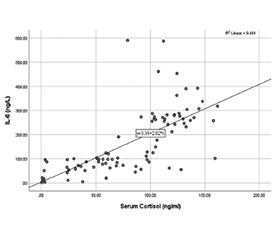
Актуальність. Больові розлади опорно-рухового апарату є основними причинами хронічного болю, інвалідності та зниження якості життя. У деяких дослідженнях виявлено зв’язок підвищеного рівня кортизолу зі збільшенням показників запалення й інтенсивності болю, тоді як в інших продемонстровано гіпокортицизм при хронічних больових станах. Зростаюча кількість доказів свідчить про те, що психосоціальний стрес та активація гіпоталамо-гіпофізарно-надниркової осі можуть призводити до запальних процесів, пов’язаних із розладами опорно-рухового апарату. Мета: дослідити зв’язок між рівнем кортизолу в сироватці крові й запальними біомаркерами, включаючи інтерлейкін-6 та С-реактивний білок, у пацієнтів із больовими розладами опорно-рухового апарату. Матеріали та методи. Перехресне дослідження було проведено в закладах Al-Furat Al-Awsat Teaching Hospital і Al-Sadder Teaching Hospital/Joint and Physical Therapy Center (Al-Najaf, Ірак) з грудня 2025 року до березня 2026 року. У ньому взяли участь 180 осіб із больовою формою розладів опорно-рухового апарату. Для кожного пацієнта були зібрані такі дані: вік, стать, індекс маси тіла, частота серцевих скорочень та інтенсивність болю. Крім того, проаналізовано біохімічні маркери. Статистичний аналіз проведено за допомогою програми SPSS, зі значущістю при p < 0,05. Результати. Під спостереженням перебувало 56 чоловіків (31,1 %) та 124 жінки (68,9 %), середній вік яких становив 42,32 ± 11,53 року. Середній рівень кортизолу в сироватці крові дорівнював 80,18 ± 45,34 нг/мл. Учасників розділили на групи з високим та низьким умістом кортизолу. Серед пацієнтів із високим його рівнем спостерігалася статистично значуща різниця (p < 0,05) у концентрації С-реактивного білка, тоді як суттєвої різниці щодо вмісту інтерлейкіну-6 не виявлено. Показники інтенсивності болю були вірогідно вищі у хворих із вищими рівнями кортизолу (8.13 ± 0.78). Висновки. Зростання вмісту кортизолу пов’язане з посиленням системного запалення, зокрема збільшенням концентрації С-реактивного білка, що підтверджує роль дисрегуляції гіпоталамо-гіпофізарно-надниркової осі в розвитку больових розладів опорно-рухового апарату. Оцінка рівня кортизолу й запальних біомаркерів може надати корисну клінічну інформацію для виявлення пацієнтів із високим ризиком опорно-рухового болю та поліпшення індивідуалізованих стратегій лікування.
Background. Musculoskeletal pain disorders are major causes of chronic pain, disability, and reduced quality of life worldwide. Some studies reported elevated cortisol levels associated with increased inflammation and pain severity, while others demonstrated hypocortisolism in chronic pain conditions. Increasing evidence suggests that psychosocial stress and activation of the hypothalamic-pituitary-adrenal axis may contribute to inflammatory processes involved in musculoskeletal pain disorders. This study purposed to investigate the relationship between serum cortisol levels and inflammatory biomarkers including interleukin-6 and C-reactive protein (CRP) among patients with musculoskeletal pain disorders. Materials and methods. This cross-sectional study was conducted at Al-Furat Al-Awsat Teaching Hospital and Al-Sadder Teaching Hospital/Joint and Physical Therapy Center in Al-Najaf, Iraq, from December 2025 to March 2026. It included 180 patients with musculoskeletal pain. The following data were collected for each patient: age, sex, body mass index, heart rate, and severity of pain. In addition, biochemical markers were analyzed. Statistical analysis was performed using SPSS, with significance at p < 0.05. Results. The study included 56 males (31.1 %) and 124 females (68.9 %), mean age of 42.32 ± 11.53 years. The mean serum cortisol level was 80.18 ± 45.34 ng/mL. Рarticipants were divided into high and low cortisol groups. Patients in high-cortisol group showed statistically significant difference (p < 0.05) in CRP levels, while no significant difference was observed in interleukin-6 levels. Pain scores were higher in participants with higher cortisol levels (8.13 ± 0.78). Conclusions. Elevated cortisol levels were associated with increased systemic inflammation, particularly CRP, supporting the role of hypothalamic-pituitary-adrenal axis dysregulation in musculoskeletal pain disorders. Assessment of cortisol and inflammatory biomarkers may provide useful clinical insights for identifying high-risk musculoskeletal pain patients and improving individualized management strategies.
кортизол; гіпоталамо-гіпофізарно-надниркова вісь; опорно-руховий біль; системне запалення; запальні біомаркери
cortisol; hypothalamic-pituitary-adrenal axis; musculoskeletal pain; systemic inflammation; inflammatory biomarkers
Для ознакомления с полным содержанием статьи необходимо оформить подписку на журнал.
- Beaudart C, Biver E, Bruyère O, Cooper C, Al-Daghri N, Reginster JY, Rizzoli R. Quality of life assessment in musculo-skeletal health. Aging Clin Exp Res. 2018 May;30(5):413-418. doi: 10.1007/s40520-017-0794-8.
- El-Tallawy SN, Nalamasu R, Salem GI, LeQuang JAK, Pergolizzi JV, Christo PJ. Management of Musculoskeletal Pain: An Update with Emphasis on Chronic Musculoskeletal Pain. Pain Ther. 2021 Jun;10(1):181-209. doi: 10.1007/s40122-021-00235-2.
- Shanshal AM, Aljorani RH, Hussain SA. Targeting IL-6 signaling pathways for musculoskeletal disorders treatment: Risks and benefits. Al-Rafidain J Med Sci. 2023;4:34-43. doi: 10.54133/ajms.v4i.101.
- Hu J, Tong H, Zhang J, Jiang L. Acupotomy for Musculoskele–tal Pain: Exploring Therapeutic Potential and Future Directions. J Pain Res. 2025 Jun 17;18:3027-3036. doi: 10.2147/JPR.S518705.
- Favalli EG. Understanding the Role of Interleukin-6 (IL-6) in the Joint and Beyond: A Comprehensive Review of IL-6 Inhibition for the Management of Rheumatoid Arthritis. 2020;6:473-516. doi: 10.1007/s40744-020-00219-2.
- Selmi C, Kon E, De Santis M, Favalli EG, Cimaz R, Generali E, Sinigaglia L. How advances in personalized medicine will change rheumatology. Per Med. 2018 Mar;15(2):75-78. doi: 10.2217/pme-2017-0079.
- Vinstrup J, Sundstrup E, Andersen LL. Psychosocial stress and musculoskeletal pain among senior workers from nine occupational groups: Cross-sectional findings from the SeniorWorkingLife study. BMJ Open. 2021 Mar 29;11(3):e043520. doi: 10.1136/bmjopen-2020-043520.
- Gaultney W, O’Brien JR, Heierle J, Battison EAJ, Wilson A, Rovnaghi C, et al. Hair cortisol sampling as a measure of physiological stress in youth with acute musculoskeletal pain. Compr Psychoneuroendocrinology. 2024;20:100267. doi: 10.1016/j.cpnec.2024.100267.
- Mohamed El-Sawy EA, Abdul Hakim MM, Kadry El-Zohie–ry AA, Salama SM. Significance of Inflammatory Markers in Primary Fibromyalgia Syndrome and Their Relation in Assessing the Disease Severity. QJM An Int J Med. 2024;117. doi: 10.55133/eji.310108.
- Otero E, Isabel G, Ortega E. Influence of Chronic Fatigue Syndrome Codiagnosis on the Relationship between Perceived and Objective Psychoneuro-Immunoendocrine Disorders in Women with Fibromyalgia. 2023. doi: 10.3390/biomedicines11051488.
- Rosa S, Martins D, Martins M, Guimarães B, Cabral L, Horta L, et al. Body mass index and musculoskeletal pain: a cross-sectional study. Cureus. 2021;13(2). doi: 10.7759/cureus.13400.
- Milan T, Václav V. Musculoskeletal disorders and working. Cent Eur J Public Health. 2020;28(88):6-11. doi: 10.21101/cejph.a6183.
- Müller A, Kob R, Sieber CC, Freiberger E, Rohleder N, Britting S. Relationship between stress systems and inflammation in older adults concerned about falling — findings from the FEARFALL study. Exp Gerontol. 2025;112899. doi: 10.1016/j.exger.2025.112899.
- Najafi F, Darbandi M, Neya SK, Belasi MT, Izadi N, Pasdar Y. Epidemiology of musculoskeletal disorders among Iranian adults: results from a non-communicable disease cohort study. 2023;1-7. doi: 10.1186/s12891-023-06435-5.
- Paananen M, O’Sullivan P, Straker L, Beales D, Coenen P, Karppinen J, et al. A low cortisol response to stress is associated with musculoskeletal pain combined with increased pain sensitivity in young adults: a longitudinal cohort study. Arthritis Res Ther. 2015;17(1):355. doi: 10.1186/s13075-015-0875-z.
- Sengar M, Gupta A, Kunwar R. Correspondence analysis to demonstrate the relationship between musculoskeletal pain and body mass index. Cureus. 2023;15(6). doi: 10.7759/cureus.40570.
- Reynolds CA, Minic Z. Chronic Pain-Associated Cardiovascular Disease: The Role of Sympathetic Nerve Activity. 2023. doi: 10.3390/ijms24065378.
- Cao R, Huang Y, Rahmani AM, Lindsay K. Prenatal Cortisol Levels Estimation Using Heart Rate and Heart Rate Variability: A Weak Supervised Learning Based Approach. Annual International Conference of the IEEE Engineering in Medicine & Biology Society. 2022 Jul:2022:4430-4433. doi: 10.1109/EMBC48229.2022.9871718.
- Generaal E, Vogelzangs N, Macfarlane GJ, Geenen R, Smit JH, Penninx BWJH, et al. Reduced hypothalamic-pituitary-adrenal axis activity in chronic multi-site musculoskeletal pain: partly masked by depressive and anxiety disorders. BMC Musculoskelet Disord. 2014;15(1):227. doi: 10.1186/1471-2474-15-227.
- Tuckey B, Srbely J, Rigney G, Vythilingam M, Shah J. Impaired Lymphatic Drainage and Interstitial Inflammatory Stasis in Chronic Musculoskeletal and Idiopathic Pain Syndromes: Exploring a Novel Mechanism. 2021;2(Aug):1-15. doi: 10.3389/fpain.2021.691740.
- Moreira E, João P, Neves R, Laranjeira M, Reis J. The importance of inflammatory biomarkers in non‑specific acute and chronic low back pain: a systematic review. Eur Spine J. 2023;32(9):3230-44. doi: 10.1007/s00586-023-07717-1.
- Vachon-Presseau E, Roy M, Martel M Olivier, Caron E, Plante I, Sullivan MJ, et al. The stress model of chronic pain: evidence from basal cortisol and hippocampal structure and function in humans. 2013. doi: 10.1093/brain/aws371.
- Muhtz C, Rodriguez-Raecke R, Hinkelmann K, Moeller-Bertram T, Kiefer F, Wiedemann K, et al. Cortisol Response to Experimental Pain in Patients with Chronic Low Back Pain and Patients with Major Depression. 2013;498-503. doi: 10.1111/j.1526-4637.2012.01514.x.