
Международный эндокринологический журнал Том 22, №6, 2026
Вернуться к номеру
Синдром інсулінорезистентності і порушення глюкозного гомеостазу у хворих на первинну хронічну подагр
Авторы: Черняєва А.О. (1, 2), Микитюк М.Р. (1), Караченцев Ю.І. (1, 2)
(1) - ДУ «Інститут проблем ендокринної патології імені В.Я. Данилевського НАМН України», м. Харків, Україна
(2) - Харківський національний медичний університет, м. Харків, Україна
Рубрики: Эндокринология
Разделы: Клинические исследования
Версия для печати
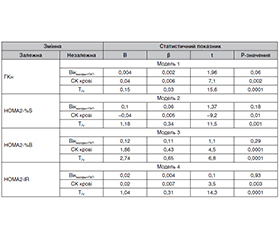
Актуальність. За результатами популяційних досліджень, гіперурикемію (ГУ) визнано фактором ризику інсулінорезистентності (ІР), предіабету і цукрового діабету (ЦД) 2-го типу. Встановлено, що підвищення сироваткової концентрації сечової кислоти (СК) на 1 мг/дл призводить до збільшення ризику ЦД 2-го типу на 17 %. Мета: вивчити особливості проявів синдрому інсулінорезистентності у хворих на первинну хронічну подагру (ПХП), її зв’язок з гіперурикемією та ураженням суглобів для встановлення хронологічного зв’язку між окремими компонентами метаболічного синдрому (МС) і розвитком хронічного подагричного артриту. Матеріали та методи. Обстежено 92 хворі на ПХП з МС. Сформовано три групи хворих чоловічої статі: 1-ша група (n = 11) — з індексом HOMA-IR ≤ 2,7 ум.од.; 2-га група (n = 13) — з індексом HOMA-IR > 2,7 ум.од.; 3-тя група (n = 25) — з ЦД 2-го типу. Групу порівняння становили хворі на МС без ПХП (n = 46). Результати. Частота МС у хворих на ПХП становила 78,3 %. ЦД 2-го типу діагностували у кожного другого хворого на ПХП і у кожного 15-го хворого на МС. Для хворих на ПХП за відсутності ІР і порушень глюкозного гомеостазу (ПГГ) типовим був інтермітуючий перебіг захворювання з чергуванням рідких суглобових атак і тривалих періодів ремісії; для хворих з ІР і ЦД 2-го типу — тяжкий хронічний перебіг захворювання з високим рівнем урикемії, частими затяжними суглобовими атаками із залученням більшої кількості суглобів. Наведені математичні моделі апроксимації вказують на разючі відхилення параметрів глюкозного гомеостазу у хворих на ПХП з ІР і ЦД 2-го типу порівняно з хворими на ПХП без ІР і ПГГ, які потребують залучення більш складних компенсаторних механізмів, спрямованих на їх підтримку. Висновки. У хворих на ПХП рівень урикемії і період тривалості ГУ визначають дисперсію параметрів глюкозного гомеостазу і є предикторами розвитку його порушень.
Background. According to the results of population studies, hyperuricemia (HU) was recognized as a risk factor for insulin resistance (IR) and type 2 diabetes mellitus (DM). It was found that an increase in serum uric acid concentration by 1 mg/dL leads to a 17% increase in the risk of type 2 DM. The aim is to study the features of the manifestations of IR syndrome in patients with gout, its connection with HU and joint damage to establish a chronological relationship between individual components of metabolic syndrome (MS) and the development of chronic gouty arthritis. Materials and methods. Ninety-two patients with gout and MS were examined. Three groups of male patients were formed: group 1 (n = 11) — with the HOMA-IR index ≤ 2.7 units; group 2 (n = 13) — with the HOMA-IR index > 2.7 units; group 3 (n = 25) — with type 2 DM. The comparison group consisted of patients with MS without gout (n = 46). Results. The incidence of MS in gout patients was 78.3 %. Type 2 DM was diagnosed in every second patient with gout and in every 15th patient with MS. For patients with gout in the absence of IR and impaired glucose homeostasis, an intermittent course of the disease with alternating rare joint attacks and long periods of remission was typical; for patients with IR and type 2 DM — a severe chronic course of the disease with a high level of uricemia, frequent protracted joint attacks involving more joints. The presented mathematical models of approximation indicate more striking deviations in the parameters of glucose homeostasis in patients with gout, IR and type 2 DM, compared to those with gout and without IR and impaired glucose homeostasis, who require the involvement of more complex compensatory mechanisms aimed at maintaining them. Conclusions. In patients with gout, the level of uricemia and the period of HU duration determine the variance of glucose homeostasis parameters and act as predictors for the development of its disorders.
сечова кислота; гіперурикемія; первинна хронічна подагра; інсулінорезистентність; метаболічний синдром; цукровий діабет 2-го типу; кардіоваскулярний ризик
uric acid; hyperuricemia; gout; insulin resistance; metabolic syndrome; type 2 diabetes mellitus; cardiovascular risk
Для ознакомления с полным содержанием статьи необходимо оформить подписку на журнал.
- Krishnan E, Pandya BJ, Chung L, et al. Hyperuricemia in young adults and risk of insulin resistance, prediabetes, and diabetes: a 15-year follow-up study. Am J Epidemiol. 2012;176(2):108-16. doi: 10.1093/aje/kws002.
- Juraschek SP, McAdams-Demarco M, et al. Temporal relationship between uric acid concentration and risk of diabetes in a community-based study population. Am J Epidemiol. 2014;179(6):684-91. doi: 10.1093/aje/kwt320.
- Lv Q, Meng XF, He FF, et al. High serum uric acid and increased risk of type 2 diabetes: a systemic review and meta-analysis of prospective cohort studies. PLoS One. 2013;8(2):e56864. doi: 10.1371/journal.pone.0056864.
- Ismail L, Materwala H, Al Kaabi J. Association of risk factors with type 2 diabetes: A systematic review. Comput Struct Biotechnol J. 2021;19:1759-1785. doi: 10.1016/j.csbj.2021.03.003.
- Jiang J, Zhang T, Liu Y, et al. Prevalence of Diabetes in Patients with Hyperuricemia and Gout: A Systematic Review and Meta-analysis. Curr Diab Rep. 2023;23(6):103-117. doi: 10.1007/s11892-023-01506-2.
- Ng HY, Lee YT, Kuo WH, et al. Alterations of Renal Epithelial Glucose and Uric Acid Transporters in Fructose Induced Metabo–lic Syndrome. Kidney Blood Press Res. 2018;43(6):1822-1831. doi: 10.1159/000495814.
- Battelli MG, Bortolotti M, Polito L, et al. The role of xanthine oxidoreductase and uric acid in metabolic syndrome. Biochim Biophys Acta Mol Basis Dis. 2018;1864(8):2557-2565. doi: 10.1016/j.bbadis.2018.05.003.
- Cicerchi C, Li N, Kratzer J, et al. Uric acid-dependent inhibition of AMP kinase induces hepatic glucose production in diabetes and starvation: evolutionary implications of the uricase loss in hominids. FASEB J. 2014;28(8):3339-50. doi: 10.1096/fj.13-243634.
- Ogino K, Kato M, Furuse Y, et al. Uric acid-lowering treatment with benzbromarone in patients with heart failure: a double-blind placebo-controlled crossover preliminary study. Circ Heart Fail. 2010;3(1):73-81. doi: 10.1161/CIRCHEARTFAILURE.109.868604.
- Perez-Pozo SE, Schold J, Nakagawa T, et al. Excessive fructose intake induces the features of metabolic syndrome in healthy adult men: role of uric acid in the hypertensive response. Int J Obes (Lond). 2010;34(3):454-61. doi: 10.1038/ijo.2009.259.
- Alberti KG, Zimmet P, Shaw J. Metabolic syndrome — a new world-wide definition. A Consensus Statement from the International Diabetes Federation. Diabet Med. 2006;23(5):469-80. doi: 10.1111/j.1464-5491.2006.01858.x.
- Uthoff H, Staub D, Socrates T, et al. PROCAM-, FRAMINGHAM-, SCORE- and SMART-risk score for predicting cardiovascular morbidity and mortality in patients with overt atherosclerosis. Vasa. 2010;39(4):325-33. doi: 10.1024/0301-1526/a000057.
- SCORE2-OP working group and ESC Cardiovascular risk collaboration. SCORE2-OP risk prediction algorithms: estimating incident cardiovascular event risk in older persons in four geographical risk regions. Eur Heart J. 2021;42(25):2455-2467. doi: 10.1093/eurheartj/ehab312.
- 2018 ESC/ESH Guidelines for the management of arterial hypertension. Rev Esp Cardiol (Engl Ed). 2019;72(2):160. English, Spanish. doi: 10.1016/j.rec.2018.12.004.
- American Diabetes Association Professional Practice Committee. 2. Diagnosis and Classification of Diabetes: Standards of Care in Diabetes-2024. Diabetes Care. 2024;47(Suppl 1):S20-S42. doi: 10.2337/dc24-S002.
- Sui X, Church TS, Meriwether RA, et al. Uric acid and the development of metabolic syndrome in women and men. Metabolism. 2008;57(6):845-52. doi: 10.1016/j.metabol.2008.01.030.
- Sahebkar A, Serban MC, Penson P, et al. Lipid and Blood Pressure Meta-analysis Collaboration (LBPMC) Group. The Effects of Tamoxifen on Plasma Lipoprotein(a) Concentrations: Systema–tic Review and Meta-Analysis. Drugs. 2017;77(11):1187-1197. doi: 10.1007/s40265-017-0767-4.
- Li L, Zhong H, Shao Y, et al. Association between the homeostasis model assessment of insulin resistance and coronary artery calcification: a meta-analysis of observational studies. Front Endocrinol (Lausanne). 2023;14:1271857. doi: 10.3389/fendo.2023.1271857.
- Doualla-Bija M, Lobe Batchama Y, Moutchia-Suh J, et al. Prevalence and characteristics of metabolic syndrome in gout patients in a hospital setting in sub-Saharan Africa. Diabetes Metab Syndr. 2018;12(6):1007-1011. doi: 10.1016/j.dsx.2018.06.015.
- Borghi C, Agabiti-Rosei E, Johnson RJ, et al. Hyperuricaemia and gout in cardiovascular, metabolic and kidney disease. Eur J Intern Med. 2020;80:1-11. doi: 10.1016/j.ejim.2020.07.006.
- Lytvyn Y, Škrtić M, Yang GK, et al. Glycosuria-mediated urinary uric acid excretion in patients with uncomplicated type 1 diabetes mellitus. Am J Physiol Renal Physiol. 2015;308(2):F77-83. doi: 10.1152/ajprenal.00555.2014.
- Choi HK, Ford ES, Li C, Curhan G. Prevalence of the meta–bolic syndrome in patients with gout: the Third National Health and Nutrition Examination Survey. Arthritis Rheum. 2007;57(1):109-15. doi: 10.1002/art.22466.
- Abbasi F, Okeke Q, Reaven GM. Evaluation of fasting plasma insulin concentration as an estimate of insulin action in nondiabetic individuals: comparison with the homeostasis model assessment of insulin resistance (HOMA-IR). Acta Diabetol. 2014;51(2):193-7. doi: 10.1007/s00592-013-0461-2.
- Tan L, Liu Y, Liu J, et al. Associations of individual and mixture exposure to volatile organic compounds with metabolic syndrome and its components among US adults. Chemosphere. 2024;347:140683. doi: 10.1016/j.chemosphere.2023.140683.
- Du L, Zong Y, Li H, Wang Q, Xie L, Yang B, Pang Y, Zhang C, Zhong Z, Gao J. Hyperuricemia and its related diseases: mechanisms and advances in therapy. Signal Transduct Target Ther. 2024;9(1):212. doi: 10.1038/s41392-024-01916-y. PMID: 39191722; PMCID: PMC11350024.
- Zhu Y, Pandya BJ, Choi HK. Comorbidities of gout and hyperuricemia in the US general population: NHANES 2007-2008. Am J Med. 2012;125(7):679-687.e1. doi: 10.1016/j.amjmed.2011.09.033.
- Krishnan E, Svendsen K, Neaton JD, et al. MRFIT Research Group. Long-term cardiovascular mortality among middle-aged men with gout. Arch Intern Med. 2008;168(10):1104-10. doi: 10.1001/archinte.168.10.1104.
- Singh JA, Gaffo A. Gout epidemiology and comorbidities. Semin Arthritis Rheum. 2020 Jun;50(3S):S11-S16. doi: 10.1016/j.semarthrit.2020.04.008.
- Bardin T, Richette P. Impact of comorbidities on gout and hyperuricaemia: an update on prevalence and treatment options. BMC Med. 2017;15(1):123. doi: 10.1186/s12916-017-0890-9. PMID: 28669352; PMCID: PMC5494879.
- Yoshida Y, Chen Z, Baudier RL, et al. Sex Differences in the Progression of Metabolic Risk Factors in Diabetes Development. JAMA Netw Open. 2022;5(7):e2222070. doi: 10.1001/jamanetworkopen.2022.22070.
- Alem MM. Allopurinol and endothelial function: A systematic review with meta-analysis of randomized controlled trials. Cardiovasc Ther. 2018;36(4):e12432. doi: 10.1111/1755-5922.12432.
- Maedler K, Sergeev P, Ris F, et al. Glucose-induced β cell production of IL-1β contributes to glucotoxicity in human pancreatic islets. J Clin Invest. 2017;127(4):1589. doi: 10.1172/JCI92172. Epub 2017 Apr 3. Erratum for: J Clin Invest. 2002;110(6):851-60. doi: 10.1172/JCI15318.
- Bahadoran Z, Mirmiran P, Kashfi K, et al. Hyperuricemia-induced endothelial insulin resistance: the nitric oxide connection. Pflugers Arch. 2022;474(1):83-98. doi: 10.1007/s00424-021-02606-2.
- Mortada I. Hyperuricemia, Type 2 Diabetes Mellitus, and Hypertension: an Emerging Association. Curr Hypertens Rep. 2017;19(9):69. doi: 10.1007/s11906-017-0770-x.
- Vareldzis R, Perez A, Reisin E. Hyperuricemia: An Intriguing Connection to Metabolic Syndrome, Diabetes, Kidney Disease, and Hypertension. Curr Hypertens Rep. 2024;26(6):237-245. doi: 10.1007/s11906-024-01295-3.
- Facchini F, Chen YD, Hollenbeck CB, et al. Relationship between resistance to insulin-mediated glucose uptake, urinary uric acid clearance, and plasma uric acid concentration. JAMA. 1991;266(21):3008-11.
- Ramos GK, Goldfarb DS. Update on Uric Acid and the Kidney. Curr Rheumatol Rep. 2022;24(5):132-138. doi: 10.1007/s11926-022-01069-3.
- Zhu Y, Hu Y, Huang T, et al. High uric acid directly inhibits insulin signalling and induces insulin resistance. Biochem Biophys Res Commun. 2014;447(4):707-14. doi: 10.1016/j.bbrc.2014.04.080.
- Pankiv V, Yuzvenko T, Kobyliak N, Pankiv I. Correction of Androgen Deficiency in Men with Type 2 Diabetes. Rev Recent Clin Trials. 2022;17(1):34-39. doi: 10.2174/1574887116666211202155304. PMID: 34856912.
- Romanens M, Adams A, Warmuth W. PROCAM based myocardial infarction risk in relation to global vascular disease risk: observations from the ARCO cohort study. Swiss Med Wkly. 2022;152:w30111. doi: 10.4414/smw.2022.w30111.