
Журнал «Медицина неотложных состояний» Том 22, №6, 2026
Вернуться к номеру
Гостре пошкодження нирок у дітей з гострою лімфобластною лейкемією: можливості ранньої верифікації та ризик хронізації
Авторы: Одинець П.І., Макєєва Н.І.
Харківський національний медичний університет, м. Харків, Україна
Рубрики: Медицина неотложных состояний
Разделы: Клинические исследования
Версия для печати
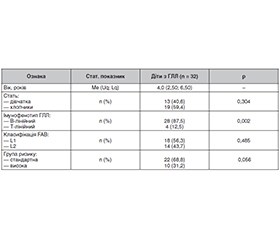
Актуальність. Гостре пошкодження нирок (ГПН) є одним з найнебезпечніших ускладнень поліхіміотерапії (ПХТ) у дітей з гострою лімфобластною лейкемією (ГЛЛ). Обмежена чутливість традиційних методів діагностики зумовлює необхідність пошуку ранніх біомаркерів тубулярного ушкодження для своєчасного виявлення нефротоксичності й оптимізації моніторингу функції нирок. Мета дослідження: оцінити стан ниркової функції та верифікувати ознаки субклінічного ГПН у дітей з ГЛЛ на етапі завершення І фази І протоколу ПХТ і в періоді ремісії шляхом порівняльного аналізу рівнів біомаркерів (KIM-1, β2-мікроглобуліну (β2-МГ) у сечі), сироваткового креатиніну та розрахункової швидкості клубочкової фільтрації (рШКФ). Матеріали та методи. Проведено проспективне когортне дослідження за участю 32 дітей з уперше діагностованою ГЛЛ, які отримували лікування за протоколом ALL IC BFM 2009, і 20 практично здорових дітей контрольної групи. На етапі інтенсивної ПХТ і в періоді ремісії оцінювали рівні сечових біомаркерів KIM-1 і β2-МГ, концентрацію сироваткового креатиніну і рШКФ за формулами Шварца (1976, 2009). Статистичну обробку даних виконували із застосуванням програми Statistica (Tusla: StatSoft Inc, USA, version 8.0). Результати. Рівень сироваткового креатиніну (р = 0,377) і рШКФ за формулою Bedside Schwartz (2009) (р = 0,216) статистично значуще не змінювалися між етапами інтенсивної поліхіміотерапії та ремісії. Концентрація KIM-1 у сечі дітей з ГЛЛ зросла з 0,1 [0,0; 0,16] нг/мл під час ПХТ до 0,17 [0,0; 0,3] нг/мл у періоді ремісії (р = 0,001), а рівень β2-МГ — з 0,03 [0,0; 0,1] до 0,2 [0,06; 0,31] мг/л (р < 0,001). У контрольній групі патологічний рівень KIM-1 не був виявлений в жодної дитини (0/20), а підвищення β2-мікроглобуліну зареєстровано лише в 1 випадку (5 %). Підвищена екскреція KIM-1 у дітей з ГЛЛ виявлена в 59,4 % (19/32) пацієнтів на етапі інтенсивної ПХТ і в 65,6 % (21/32) — у періоді ремісії, що статистично значуще перевищувало показники контрольної групи (р < 0,001). Патологічний рівень β2-МГ визначено в 40,6 % (13/32) дітей під час лікування та у 81,3 % (26/32) — у ремісії, також з вірогідною різницею з контролем (р = 0,008 і р < 0,001 відповідно). Персистуюче підвищення KIM-1 на обох етапах спостереження виявлено в 53,1 % дітей. У 43,8 % пацієнтів екскреція β2-МГ була вперше виявлена в періоді ремісії. Висновки. Традиційні показники оцінки функції нирок (сироватковий креатинін і рШКФ) не дозволяють своєчасно виявляти субклінічне ГПН у дітей з ГЛЛ. Визначення сечових біомаркерів KIM-1 і β2-МГ є більш чутливим методом ранньої діагностики тубулярного ушкодження, яке може зберігатись і прогресувати навіть у періоді ремісії. Отримані результати обґрунтовують необхідність тривалого нефромоніторингу дітей з ГЛЛ із включенням маркерів тубулярного ушкодження до алгоритмів спостереження.
Background. Acute kidney injury (AKI) is one of the most severe complications of polychemotherapy (PCT) in children with acute lymphoblastic leukemia (ALL). The limited sensitivity of conventional diagnostic methods necessitates the search for early biomarkers of tubular injury to enable timely detection of nephrotoxicity and improve renal function monitoring. The purpose was to assess renal function and verify signs of subclinical AKI in children with ALL at the end of phase I of protocol I of PCT and during remission through comparative analysis of biomarker levels (urinary KIM-1, β2-microglobulin (β2-MG)), serum creatinine, and estimated glomerular filtration rate (eGFR). Materials and methods. A prospective cohort study was conducted involving 32 children with newly diagnosed ALL who received treatment according to the ALL IC-BFM 2009 protocol and 20 practically healthy children in the control group. Urinary KIM-1 and β2-MG, serum creatinine concentration, and eGFR calculated using the Schwartz equations (1976 and 2009) were assessed during the intensive PCT phase and remission period. Statistical analysis was performed using Statistica software (StatSoft Inc., Tulsa, USA, version 8.0). Results. Serum creatinine levels (p = 0.377) and eGFR calculated using the Bedside Schwartz equation (2009) (p = 0.216) did not demonstrate statistically significant changes between the intensive PCT and remission. In children with ALL, urinary KIM-1 concentration increased from 0.1 [0.0; 0.16] ng/mL during PCT to 0.17 [0.0; 0.3] ng/mL during remission (p = 0.001), while urinary β2-MG increased from 0.03 [0.0; 0.1] to 0.2 [0.06; 0.31] mg/L (p < 0.001). In the control group, pathological KIM-1 levels were not detected in any child (0/20), whereas elevated β2-MG was identified in only one case (5 %). Urinary KIM-1 excretion was increased in 59.4 % (19/32) of children with ALL during intensive PCT and in 65.6 % (21/32) during remission, which was significantly higher compared to the control group (p < 0.001). Pathological β2-MG levels were observed in 40.6 % (13/32) of children during treatment and in 81.3 % (26/32) during remission, also demonstrating a significant difference compared to controls (p = 0.008 and p < 0.001, respectively). Persistent KIM-1 elevation at both observation points was detected in 53.1 % of children, whereas newly developed β2-MG elevation during remission was observed in 43.8 % of patients. Conclusions. Conventional indicators of renal function (serum creatinine and eGFR) do not allow timely detection of subclinical AKI in children with ALL. Assessment of urinary biomarkers KIM-1 and β2-MG represents a more sensitive approach for early detection of tubular injury, which may persist and progress even during remission. The obtained results support the need for long-term nephrological monitoring of children with ALL, including tubular injury biomarkers in follow-up algorithms.
педіатрія; онкогематологія; гостра лімфобластна лейкемія; гостре пошкодження нирок; біомаркери сечі; тубулярна дисфункція
pediatrics; oncohematology; acute lymphoblastic leukemia; acute kidney injury; urinary biomarkers; tubular dysfunction
Для ознакомления с полным содержанием статьи необходимо оформить подписку на журнал.
- Inaba H, Pui CH. Advances in the Diagnosis and Treatment of Pediatric Acute Lymphoblastic Leukemia. J Clin Med. 2021;10(9):1926. doi: 10.3390/jcm10091926.
- Bartram J, Veys P, Vora A. Improvements in outcome of childhood acute lymphoblastic leukaemia (ALL) in the UK — a success story of modern medicine through successive UKALL trials and international collaboration. Br J Haematol. 2020;191(4):562-567. doi: 10.1111/bjh.17162.
- Kato M, Manabe A. Treatment and biology of pediatric acute lymphoblastic leukemia. Pediatr Int. 2018;60(1):4-12. doi: 10.1111/ped.13457.
- Raina R, Mawby I, Chakraborty R, et al. Acute kidney injury in COVID-19 pediatric patients in North America: Analysis of the virtual pediatric systems data. PLoS One. 2022;17(4):e0266737. doi: 10.1371/journal.pone.0266737.
- Sutherland SM, Byrnes JJ, Kothari M, et al. AKI in hospita–lized children: comparing the pRIFLE, AKIN, and KDIGO definitions. Clin J Am Soc Nephrol. 2015 Apr 7;10(4):554-561. doi: 10.2215/CJN.01900214.
- Chirico V, Lacquaniti A, Tripodi F, et al. Acute Kidney Injury in Neonatal Intensive Care Unit: Epidemiology, Diagnosis and Risk Factors. J Clin Med. 2024 Jun 13;13(12):3446. doi: 10.3390/jcm13123446.
- Kellum JA, Romagnani P, Ashuntantang G, et al. Acute kidney injury. Nat Rev Dis Primers. 2021 Jul 15;7(1):52. doi: 10.1038/s41572-021-00284-z.
- He J, Chen Y, Li Y, Feng Y. Molecular mechanisms and therapeutic interventions in acute kidney injury: a literature review. BMC Nephrol. 2025 Mar 22;26(1):144. doi: 10.1186/s12882-025-04077-4.
- Palmer BF, Clegg DJ. Physiology and pathophysiology of potassium homeostasis. Adv Physiol Educ. 2016 Dec;40(4):480-490. doi: 10.1152/advan.00121.2016.
- Su Y, Yang X, Cheng WW, et al. Kidney injury molecule 1 in the early detection of acute kidney injury — a systematic review and meta-analysis. Front Med. 2025;12:1574945. doi: 10.3389/fmed.2025.1574945.
- Obert LA, Elmore SA, Ennulat D, Frazier KS. A Review of Specific Biomarkers of Chronic Renal Injury and Their Potential Application in Nonclinical Safety Assessment Studies. Toxicol Pathol. 2021 Jul;49(5):996-1023. doi: 10.1177/0192623320985045.
- Zachwieja K, Korohoda P, Kwinta-Rybicka J, et al. Modification of the Schwartz equations for children increases their accuracy at eGFR > 60 mL/min/1.73 m(2). Ren Fail. 2016 Jun;38(5):787-798. doi: 10.3109/0886022X.2016.1163152.
- Kooijmans EC, Bökenkamp A, Tjahjadi NS, et al. Early and late adverse renal effects after potentially nephrotoxic treatment for childhood cancer. Cochrane Database Syst Rev. 2019 Mar 11;3(3):CD008944. doi: 10.1002/14651858.CD008944.pub3.
- Kellum JA, Romagnani P, Ashuntantang G, et al. Acute kidney injury. Nat Rev Dis Primers. 2021 Jul 15;7(1):52. doi: 10.1038/s41572-021-00284-z.
- Ostermann M, Zarbock A, Goldstein S, et al. Recommendations on Acute Kidney Injury Biomarkers From the Acute Disease Quality Initiative Consensus Conference: A Consensus Statement. JAMA Netw Open. 2020 Oct 1;3(10):e2019209. doi: 10.1001/jamanetworkopen.2020.19209.
- Jančič SG, Močnik M, Marčun Varda N. Glomerular Filtration Rate Assessment in Children. Children (Basel). 2022 Dec 19;9(12):1995. doi: 10.3390/children9121995.
- Pottel H, Schwartz GJ. Measuring and estimating the GFR in children: state of the art in 2025. Pediatr Nephrol. 2025 Nov;40(11):3347-3357. doi: 10.1007/s00467-025-06724-2.
- Lyrio RMDC, Rocha BRA, Corrêa ALRM, et al. Chemothe–rapy-induced acute kidney injury: epidemiology, pathophysiology, and therapeutic approaches. Front Nephrol. 2024 Aug 9;4:1436896. doi: 10.3389/fneph.2024.1436896.
- Song J, Yu J, Prayogo GW, et al. Understanding kidney injury molecule 1: a novel immune factor in kidney pathophysiology. Am J Transl Res. 2019 Mar 15;11(3):1219-1229.
- Nielsen R, Christensen EI, Birn H. Megalin and cubilin in proximal tubule protein reabsorption: from experimental models to human disease. Kidney Int. 2016 Jan;89(1):58-67. doi: 10.1016/j.kint.2015.11.007.
- Hasan H, Al-Fatlawi A, Al-Obaidy Q. Kidney Injury Molecule-1 (KIM-1), Neutrophil Gelatinase-Associated Lipocalin (NGAL), and CRP: a potential biomarker for early prediction of Acute Kidney Injury (AKI) in pediatric male patients. Fam Med Prim Care Rev. 2024;26(4):464-470. doi: 10.5114/fmpcr.2024.144914.
- Hsiao W, Li Y, Getz K, et al. Acute and chronic kidney injury during therapy for pediatric acute leukemia: A report from the Leukemia Electronic Abstraction of Records Network (LEARN). Pediatr Blood Cancer. 2023 Dec;70(12):e30696. doi: 10.1002/pbc.30696.
- Perazella MA. Onco-nephrology: renal toxicities of chemotherapeutic agents. Clin J Am Soc Nephrol. 2012 Oct;7(10):1713-1721. doi: 10.2215/CJN.02780312.
- Kidney Disease: Improving Global Outcomes (KDIGO) CKD Work Group. KDIGO 2024 Clinical Practice Guideline for the Evaluation and Management of Chronic Kidney Disease. Kidney Int. 2024;105(4 Suppl):S117-S314. doi: 10.1016/j.kint.2023.10.018.
- Venkatachalam MA, Weinberg JM, Kriz W, Bidani AK. Failed Tubule Recovery, AKI-CKD Transition, and Kidney Disease Progression. J Am Soc Nephrol. 2015 Aug;26(8):1765-1776. doi: 10.1681/ASN.2015010006.