Резюме
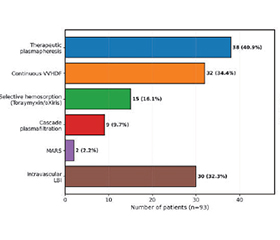
Актуальність. Тяжкий холангіогенний сепсис пов’язаний із рівнем смертності 18–35 %, незважаючи на досягнення сучасної медицини. Ендогенна інтоксикація є одним із ключових патогенетичних компонентів, а методи екстракорпоральної детоксикації (ECD) забезпечують безпосередню елімінацію бактеріальних ендотоксинів, прозапальних цитокінів та медіаторів запалення. Однак доказові дані щодо їх диференційованого використання залежно від тяжкості холангіогенного сепсису залишаються обмеженими. Мета: оцінити клінічну ефективність алгоритму диференційованого застосування методів ECD з урахуванням тяжкості стану в пацієнтів із тяжким холангіогенним сепсисом. Матеріали та методи. Проведено проспективне обсерваційне когортне дослідження за участю 93 хворих із холангіогенним сепсисом, госпіталізованих до хірургічних відділень Самаркандської філії Республіканського наукового центру екстреної медичної допомоги (Узбекистан) у період із січня 2021 року до грудня 2024 року. Пацієнтів стратифікували відповідно до Токійських рекомендацій 2018 року (I ступінь: n = 27 (29,0 %); II ступінь: n = 39 (41,9 %); III ступінь: n = 27 (29,0 %)). Використано трирівневий алгоритм ECD, заснований на кількісній оцінці ендогенної інтоксикації (молекули середньої маси, MMM) і дисфункції органів (SOFA): базову детоксикацію — при легкій інтоксикації; терапевтичний плазмаферез та низькоінтенсивне лазерне опромінення крові — при помірній; розширену програму, що включає безперервну вено-венозну гемодіафільтрацію (CVVHDF), селективну гемосорбцію (Toraymyxin PMX-20R чи oXiris) або систему рециркуляції молекулярного адсорбенту (MARS) — при тяжкій. Первинною кінцевою точкою було зниження рівнів MMM, прокальцитоніну, інтерлейкіну-6, фактора некрозу пухлини α й ендотоксину ліпополісахариду. Статистичний аналіз проводили за допомогою IBM SPSS Statistics версії 26.0 із використанням U-критерію Манна — Уітні, ANOVA Фрідмана та log-rank тесту; статистичну значущість встановлювали на рівні p < 0,05. Результати. Методи ECD застосовано в 46 пацієнтів (49,5 %): терапевтичний плазмаферез — у 38 (40,9 %), CVVHDF — у 32 (34,4 %), селективну гемосорбцію — у 15 (16,1 %), каскадну плазмофільтрацію — у 9 (9,7 %) та MARS — у 2 (2,2 %). Після трьох сеансів терапевтичний плазмаферез забезпечив зменшення вмісту MMM на 54,0 ± 6,0 % і прокальцитоніну — на 48,0 ± 5,0 %. CVVHDF знизив рівень інтерлейкіну-6 на 64,0 ± 8,0 % та фактора некрозу пухлини α — на 52,0 ± 6,0 % протягом 24 годин. За допомогою селективної гемосорбції (система Toraymyxin) вдалося зменшити концентрацію ендотоксину ліпополісахариду на 58,0 ± 6,0 % після одного сеансу й на 78,0 ± 8,0 % — після двох, що супроводжувалося зниженням оцінки за шкалою SOFA на 3,2 ± 0,5 бала протягом 48 годин. Медіана часу до нормалізації MMM (≤ 0,24 ум.од.) була значно коротшою при застосуванні розширеної програми детоксикації (3,5 дня, 95% ДІ 3,0–4,0) порівняно зі стандартною інфузійною терапією (8,5 дня, 95% ДІ 8,0–9,0; log-rank p < 0,001). Загрозливих для життя ускладнень не спостерігалося; незначні побічні ефекти виникли під час 12 із 282 сеансів (4,3 %). Висновки. Диференційоване застосування методів ECD з урахуванням тяжкості холангіогенного сепсису, що ґрунтується на кількісній оцінці ендогенної інтоксикації та органної дисфункції, забезпечує прискорене усунення ендотоксемії і системної запальної відповіді. Алгоритм є клінічно застосовною основою для індивідуалізованого лікування пацієнтів із цим станом, який характеризується високою летальністю, та потребує валідації в більших багатоцентрових рандомізованих дослідженнях.
Background. Severe cholangiogenic sepsis is associated with mortality rates of 18–35 % despite advances in modern medicine. Endogenous intoxication represents one of the key pathogenetic components, and extracorporeal detoxification (ECD) methods provide direct elimination of bacterial endotoxins, pro-inflammatory cytokines, and inflammation mediators. However, evidence supporting differentiated, severity-stratified application of these techniques in cholangiogenic sepsis remains limited. The purpose was to evaluate the clinical efficacy of a differentiated, severity-stratified algorithm of extracorporeal detoxification methods in patients with severe cholangiogenic sepsis. Materials and methods. A prospective observational cohort study was conducted in 93 consecutive patients with cholangiogenic sepsis admitted to the surgical departments of the Samarkand Branch of the Republican Research Center of Emergency Medicine (Uzbekistan) between January 2021 and December 2024. Patients were stratified according to Tokyo Guidelines 2018 (grade I: n = 27 (29.0 %); grade II: n = 39 (41.9 %); grade III: n = 27 (29.0 %)). A three-tier ECD algorithm was applied based on quantitative assessment of endogenous intoxication (middle-mass molecules, MMM) and organ dysfunction (Sequential Organ Failure Assessment, SOFA): basic detoxification for mild intoxication; therapeutic plasmapheresis and low-intensity laser blood irradiation for moderate intoxication; an extended program including continuous veno-venous hemodiafiltration (CVVHDF), selective hemosorption (Toraymyxin PMX-20R or oXiris), or molecular adsorbent recirculating system (MARS) for severe intoxication. Primary endpoints included reduction in MMM, procalcitonin, interleukin-6, tumor necrosis factor α, and lipopolysaccharide endotoxin. Statistical analysis was performed using IBM SPSS Statistics v.26.0 with Mann-Whitney U-test, Friedman ANOVA, and log-rank test; significance was set at p < 0.05. Results. ECD methods were applied in 46 patients (49.5 %): therapeutic plasmapheresis in 38 (40.9 %), CVVHDF in 32 (34.4 %), selective hemosorption in 15 (16.1 %), cascade plasmafiltration in 9 (9.7 %), and MARS in 2 (2.2 %). Therapeutic plasmapheresis achieved 54.0 ± 6.0 % reduction in MMM and 48.0 ± 5.0 % reduction in procalcitonin after three sessions. CVVHDF reduced interleukin-6 by 64.0 ± 8.0 % and tumor necrosis factor α by 52.0 ± 6.0 % within 24 hours. Selective hemosorption with Toraymyxin reduced lipopolysaccharide endotoxin levels by 58.0 ± 6.0 % after one session and by 78.0 ± 8.0 % after two sessions, accompanied by a 3.2 ± 0.5-point reduction in SOFA score within 48 hours. Median time to MMM normalization (≤ 0.24 AU) was significantly shorter in the extended detoxification program (3.5 days, 95% CI 3.0–4.0) compared with standard infusion therapy (8.5 days, 95% CI 8.0–9.0; log-rank p < 0.001). No life-threatening complications were observed; minor adverse events occurred in 12 of 282 sessions (4.3 %). Conclusions. A differentiated, severity-stratified application of extracorporeal detoxification methods in severe cholangiogenic sepsis, based on quantitative assessment of endogenous intoxication and organ dysfunction, provides accelerated resolution of endotoxemia and systemic inflammatory response. The algorithm represents a clinically applicable framework for individualized management of this high-mortality condition and warrants validation in larger multicenter randomized trials.
Список литературы
1. Kiriyama S, Kozaka K, Takada T, Strasberg SM, Pitt HA, Gabata T, et al. Tokyo Guidelines 2018: diagnostic criteria and seve–rity grading of acute cholangitis (with videos). J Hepatobiliary Pancreat Sci. 2018;25(1):17-30. doi: 10.1002/jhbp.512.
2. Lan Cheong Wah D, Christophi C, Muralidharan V. Acute cholangitis: current concepts. ANZ J Surg. 2017;87(7–8):554-559. doi: 10.1111/ans.13981.
3. Kimura Y, Takada T, Strasberg SM, Pitt HA, Gouma DJ, Garden OJ, et al. TG13 current terminology, etiology, and epidemiology of acute cholangitis and cholecystitis. J Hepatobiliary Pancreat Sci. 2013;20(1):8-23. doi: 10.1007/s00534-012-0564-0.
4. Cozma MA, Găman MA, Srichawla BS, et al. Acute cholangitis: a state-of-the-art review. Ann Med Surg (Lond). 2024 May 15;86(8):4560-4574. doi: 10.1097/MS9.0000000000002169.
5. Park N, Lee SH, You MS, Kim JS, Huh G, Chun JW, et al. Optimal timing of endoscopic retrograde cholangiopancreatography for acute cholangitis associated with distal malignant biliary obstruction. BMC Gastroenterol. 2021;21(1):175. doi: 10.1186/s12876-021-01755-z.
6. Lee F, Ohanian E, Rheem J, Laine L, Che K, Kim JJ. Delayed endoscopic retrograde cholangiopancreatography is associated with persistent organ failure in hospitalised patients with acute cholangitis. Aliment Pharmacol Ther. 2015;42(2):212-220. doi: 10.1111/apt.13253.
7. Karasawa Y, Kato J, Kawamura S, Kojima K, Ohki T, Seki M, et al. Risk factors for acute cholangitis caused by Enterococcus faecalis and Enterococcus faecium. Gut Liver. 2021;15(4):616-624. doi: 10.5009/gnl20214.
8. Mosler P. Diagnosis and management of acute cholangitis. Curr Gastroenterol Rep. 2011;13(2):166-172. doi: 10.1007/s11894-010-0171-7.
9. Marinova PG. Surgical Sepsis of Hepatobiliary Origin: Cоmplications and Prognosis. Journal of Biomedical and Clinical Research. 2023 Dec 11;16(2):153-162. doi: 10.2478/jbcr-2023-0021.
10. Oura H, Nishino T, Murakami D, et al. Diagnostic value of the serum lactate level as a predictor of bacteremia in patients with acute cholangitis. J Hepatobiliary Pancreat Sci. 2023 Aug;30(8):1055-1064. doi: 10.1002/jhbp.1343.
11. Evans L, Rhodes A, Alhazzani W, Antonelli M, Coopersmith CM, French C, et al. Surviving Sepsis Campaign: International Guidelines for Management of Sepsis and Septic Shock 2021. Crit Care Med. 2021;49(11):e1063-e1143. doi: 10.1097/CCM.0000000000005337.
12. Putzu A, Schorer R, Lopez-Delgado JC, Cassina T, Lan–doni G. Blood purification and mortality in sepsis and septic shock: a systematic review and meta-analysis of randomized trials. Anesthesio–logy. 2019;131(3):580-593. doi: 10.1097/ALN.0000000000002820.
13. Snow TAC, Littlewood S, Corredor C, Singer M, Arulkumaran N. Effect of extracorporeal blood purification on mortality in sepsis: a meta-analysis and trial sequential analysis. Blood Purif. 2021;50(4–5):462-472. doi: 10.1159/000510982.
14. Honoré PM, Hoste E, Molnár Z, Jacobs R, Joannes-Boyau O, Malbrain MLNG, et al. Cytokine removal in human septic shock: where are we and where are we going? Ann Intensive Care. 2019;9(1):56. doi: 10.1186/s13613-019-0530-y.
15. Cruz DN, Antonelli M, Fumagalli R, Foltran F, Brienza N, Donati A, et al. Early use of polymyxin B hemoperfusion in abdominal septic shock: the EUPHAS randomized controlled trial. JAMA. 2009;301(23):2445-2452. doi: 10.1001/jama.2009.856.
16. Schädler D, Pausch C, Heise D, Meier-Hellmann A, Bre–derlau J, Weiler N, et al. The effect of a novel extracorporeal cytokine hemoadsorption device on IL-6 elimination in septic patients: a randomized controlled trial. PLoS One. 2017;12(10):e0187015. doi: 10.1371/journal.pone.0187015.
17. Bañares R, Nevens F, Larsen FS, Jalan R, Albillos A, Dol–linger M, et al. Extracorporeal albumin dialysis with the molecular adsorbent recirculating system in acute-on-chronic liver failure: the RELIEF trial. Hepatology. 2013;57(3):1153-1162. doi: 10.1002/hep.26185.
18. Monard C, Rimmelé T, Ronco C. Extracorporeal blood purification therapies for sepsis. Blood Purif. 2019;47(Suppl 3):2-15. doi: 10.1159/000499520.
19. Ankawi G, Neri M, Zhang J, Breglia A, Ricci Z, Ronco C. Extracorporeal techniques for the treatment of critically ill patients with sepsis beyond conventional blood purification therapy: the promises and the pitfalls. Crit Care. 2018;22(1):262. doi: 10.1186/s13054-018-2181-z.
20. Von Elm E, Altman DG, Egger M, Pocock SJ, Gøtzsche PC, Vandenbroucke JP. The Strengthening the Reporting of Observational Studies in Epidemiology (STROBE) statement: guidelines for reporting observational studies. Lancet. 2007;370(9596):1453-1457. doi: 10.1016/S0140-6736(07)61602-X.
21. Mayumi T, Okamoto K, Takada T, Strasberg SM, Solomkin JS, Schlossberg D, et al. Tokyo Guidelines 2018: management bundles for acute cholangitis and cholecystitis. J Hepatobiliary Pancreat Sci. 2018;25(1):96-100. doi: 10.1002/jhbp.519.
22. Singer M, Deutschman CS, Seymour CW, Shankar-Hari M, Annane D, Bauer M, et al. The Third International Consensus Definitions for Sepsis and Septic Shock (Sepsis-3). JAMA. 2016;315(8):801-810. doi: 10.1001/jama.2016.0287.
23. Toma EA, Enciu O, Popa GL, et al. The Evolving Microbio–logy and Antimicrobial Resistance in Peritonitis of Biliary Origin: An Evidence-Based Update of the Tokyo Guidelines (TG18) for Clinicians. Diagnostics (Basel). 2025 Dec 5;15(24):3095. doi: 10.3390/diagnostics15243095.
24. Mardonov BA, Kurbaniyazov ZB, Rakhmanov KE, Davlatov SS, Nazarov ZN, Nasimov AM. Effective approaches to reconstructive surgeries for fresh injuries and scar constrictions of common bile ducts. Gastroenterologia. 2026 Mar 27;60(1):8-12. doi: 10.22141/2308-2097.60.1.2026.713.
25. Davlatov S, Rakhmanov K, Qurbonov N, Vafayeva I, Abdu–raxmanov D. Current State of The Problem Treatment of Mirizzi Syndrome (Literature Review). International Journal of Pharmaceutical Research. 2020 Jul 2. doi: 10.31838/ijpr/2020.SP2.340.
26. Usenko OY, Hrynenko OV, Melnychuk VM, et al. Surgical treatment of proximal biliary and biliovascular lesions. Ukrainian Journal of Clinical Surgery. 2024 Dec 24;91(6):2-12. doi: 10.26779/2786-832X.2024.6.02.
27. De Backer D, Cecconi M, Lipman J, Machado F, Myatra SN, Ostermann M, et al. Challenges in the management of septic shock: a narrative review. Intensive Care Med. 2019;45(4):420-433. doi: 10.1007/s00134-019-05544-x.
28. Reinhart K, Daniels R, Kissoon N, Machado FR, Schachter RD, Finfer S. Recognizing sepsis as a global health prio–rity — a WHO resolution. N Engl J Med. 2017;377(5):414-417. doi: 10.1056/NEJMp1707170.
29. Zhang L, Wang G, Chen YR, Zhao XY, Jiang J, Weng YB. Modified Double Filtration Plasmapheresis Exchange for Mana–ging Sepsis-Induced Shock. Clin Lab. 2026 Jun 1;72(6):1337. doi: 10.7754/Clin.Lab.2025.250615.
30. Kuklin V, Sovershaev M, Bjerner J, et al. Influence of therapeutic plasma exchange treatment on short-term mortality of critically ill adult patients with sepsis-induced organ dysfunction: a systematic review and meta-analysis. Crit Care. 2024 Jan 4;28(1):12. doi: 10.1186/s13054-023-04795-x.
31. Davlatov SS, Rakhmanov QE, Saydullaev ZYa, Sherbekov UA. Algorithm for the management of patients with bile duct after cholecystectomy. International Journal of Pharmaceutical Research. 2020 Jul 2. doi: 10.31838/ijpr/2020.SP2.004.
32. Knaup H, Stahl K, Schmidt BMW, Idowu TO, Busch M, Wiesner O, et al. Early therapeutic plasma exchange in septic shock: a prospective open-label nonrandomized pilot study focusing on safety, hemodynamics, vascular barrier function, and biologic markers. Crit Care. 2018;22(1):285. doi: 10.1186/s13054-018-2220-9.
33. Stahl K, Schmidt JJ, Seeliger B, Schmidt BMW, Welte T, Haller H, et al. Effect of therapeutic plasma exchange on endothelial activation and coagulation-related parameters in septic shock. Crit Care. 2020;24(1):71. doi: 10.1186/s13054-020-2799-5.
34. Ronco C, Bellomo R, Kellum JA. Acute kidney injury. Lancet. 2019;394(10212):1949-1964. doi: 10.1016/S0140-6736(19)32563-2.
35. Joannes-Boyau O, Honoré PM, Perez P, Bagshaw SM, Grand H, Canivet JL, et al. High-volume versus standard-volume haemofiltration for septic shock patients with acute kidney injury (IVOIRE study): a multicentre randomized controlled trial. Intensive Care Med. 2013;39(9):1535-1546. doi: 10.1007/s00134-013-2967-z.
36. Gaudry S, Hajage D, Schortgen F, Martin-Lefevre L, Pons B, Boulet E, et al. Initiation strategies for renal-replacement therapy in the intensive care unit. N Engl J Med. 2016;375(2):122-133. doi: 10.1056/NEJMoa1603017.
37. Bagshaw SM, Wald R, Adhikari NKJ, Bellomo R, da Costa BR, Dreyfuss D, et al. Timing of initiation of renal-replacement therapy in acute kidney injury. N Engl J Med. 2020;383(3):240-251. doi: 10.1056/NEJMoa2000741.
38. Bottari G, Ranieri VM, Ince C, et al. Use of extracorporeal blood purification therapies in sepsis: the current paradigm, available evidence, and future perspectives. Crit Care. 2024 Dec 25;28(1):432. doi: 10.1186/s13054-024-05220-7.
39. Dellinger RP, Bagshaw SM, Antonelli M, Foster DM, Klein DJ, Marshall JC, et al. Effect of targeted polymyxin B hemoperfusion on 28-day mortality in patients with septic shock and elevated endotoxin level: the EUPHRATES randomized clinical trial. JAMA. 2018;320(14):1455-1463. doi: 10.1001/jama.2018.14618.
40. Klein DJ, Foster D, Walker PM, Bagshaw SM, Mekonnen H, Antonelli M. Polymyxin B hemoperfusion in endotoxemic septic shock patients without extreme endotoxemia: a post hoc analysis of the –EUPHRATES trial. Intensive Care Med. 2018;44(12):2205-2212. doi: 10.1007/s00134-018-5463-7.
41. Klein DJ, Foster D, Schorr CA, Kazempour K, Walker PM, Dellinger RP. The EUPHRATES trial (Evaluating the Use of Polymy–xin B Hemoperfusion in a Randomized controlled trial of Adults Trea–ted for Endotoxemia and Septic shock): study protocol for a randomized controlled trial. Trials. 2014;15:218. doi: 10.1186/1745-6215-15-218.
42. Kribben A, Gerken G, Haag S, Herget-Rosenthal S, Treichel U, Betz C, et al. Effects of fractionated plasma separation and adsorption on survival in patients with acute-on-chronic liver failure. Gastroenterology. 2012;142(4):782-789. doi: 10.1053/j.gastro.2011.12.056.
43. Brunkhorst FM, Engel C, Bloos F, Meier-Hellmann A, Ragaller M, Weiler N, et al. Intensive insulin therapy and pentastarch resuscitation in severe sepsis. N Engl J Med. 2008;358(2):125-139. doi: 10.1056/NEJMoa070716.
44. Borthwick EM, Hill CJ, Rabindranath KS, Maxwell AP, McAuley DF, Blackwood B. High-volume haemofiltration for sepsis in adults. Cochrane Database Syst Rev. 2017;1(1):CD008075. doi: 10.1002/14651858.CD008075.pub3.