
Журнал «Медицина неотложных состояний» Том 22, №6, 2026
Вернуться к номеру
Післяопераційний больовий синдром після реконструкції черевної стінки при серединних інцизійних грижах: порівняльний аналіз різних методів герніопластики
Авторы: Козлов В.В. (1, 3), Бондарєв Р.В. (2), Василюк С.М. (3)
(1) - Національний медичний університет імені О.О. Богомольця, м. Київ, Україна
(2) - Перший Європейський університет, м. Київ, Україна
(3) - Івано-Франківський національний медичний університет, м. Івано-Франківськ, Україна
Рубрики: Медицина неотложных состояний
Разделы: Клинические исследования
Версия для печати
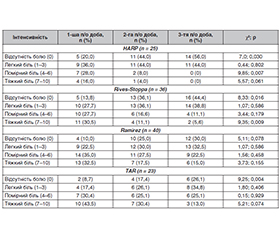
Актуальність. Післяопераційний біль є одним із ключових критеріїв оцінки ефективності реконструкції черевної стінки. Він визначає перебіг раннього післяопераційного періоду, можливість ранньої мобілізації пацієнтів та швидкість функціонального відновлення. Однак вплив різних методів герніопластики на інтенсивність післяопераційного больового синдрому при серединних інцизійних грижах залишається недостатньо вивченим. Мета: оцінити інтенсивність і тривалість післяопераційного болю у пацієнтів з інцизійними вентральними грижами W2–W3 після різних методів реконструкції черевної стінки. Матеріали та методи. Це проспективне дослідження включало 124 пацієнти із серединними інцизійними грижами M1–M4, W2–W3. У 25 (20,2 %) виконали поперечну підсилену шовну пластику (операцію HARP), у 36 (29,0 %) — операцію Rives-Stoppa, у 40 (32,3 %) — операцію Ramirez та у 23 (18,5 %) — вивільнення поперечного м’яза (TAR). Оцінку післяопераційного болю проводили за шкалою NRS-11 (Numeric Rating Scale) у перші три післяопераційні доби. Результати. У всіх досліджуваних групах відзначалося поступове зменшення інтенсивності післяопераційного болю протягом перших трьох післяопераційних діб. Найнижчі показники болю в усі терміни спостереження зареєстровано після HARP (2,88 ± 1,77; 1,20 ± 1,68 та 0,44 ± 0,51 бала за NRS-11 відповідно), тоді як найвищі — після TAR (5,52 ± 4,32; 4,04 ± 2,72 та 2,55 ± 1,45 бала). Після HARP частка пацієнтів без болю статистично значуще збільшилася з 20,0 до 56,0% (р = 0,030), а помірний біль повністю зник до третьої післяопераційної доби (р = 0,007). Після операції Rives-Stoppa також встановлено статистично значуще збільшення частки пацієнтів без болю (р = 0,016) та зменшення частоти тяжкого болю (р = 0,009). У групах Ramirez і TAR відзначалися лише тенденції до зниження інтенсивності больового синдрому без статистично значущих змін більшості досліджуваних показників. Висновки. Інтенсивність післяопераційного болю поступово зменшувалася в усіх групах протягом перших трьох післяопераційних діб, однак вираженість цієї динаміки залежала від методу герніопластики. Найкращі результати отримано після HARP, що характеризувалася найнижчою інтенсивністю больового синдрому в усі терміни спостереження та найбільш швидким зменшенням частоти помірного і тяжкого болю, тоді як після TAR відзначалися найвищі показники післяопераційного болю, а операції Rives-Stoppa і Ramirez займали проміжне положення.
Background. Postoperative pain is one of the key indicators for evaluating the effectiveness of abdominal wall reconstruction, as it determines the course of the early postoperative period, the possibility of early patient mobilization, and the rate of functional recovery. However, the impact of different hernia repair techniques on the intensity of postoperative pain in patients with midline incisional hernias remains poorly investigated. The purpose was to evaluate the intensity and duration of postoperative pain in patients with EHS W2-W3 incisional ventral hernias following different abdominal wall reconstruction techniques. Materials and methods. This prospective study included 124 patients with EHS M1-M4, W2-W3 incisional hernias. Twenty-five (20.2 %) of them underwent horizontal aponeurotic reinforced procedure (HARP), 36 (29.0 %) underwent Rives-Stoppa repair, 40 (32.3 %) underwent Ramirez anterior component separation, and 23 (18.5 %) underwent transversus abdominis release (TAR). Postoperative pain was assessed using the 11-point Numeric Rating Scale (NRS-11) during the first three postoperative days. Results. A gradual decrease in postoperative pain intensity was observed in all study groups during the first three postoperative days. The lowest pain scores at all assessment time points were recorded after HARP (NRS-11: 2.88 ± 1.77, 1.20 ± 1.68, and 0.44 ± 0.51, respectively), whereas the highest scores were observed after TAR (5.52 ± 4.32, 4.04 ± 2.72, and 2.55 ± 1.45, respectively). Following HARP, the proportion of pain-free patients increased significantly from 20.0 to 56.0 % (p = 0.030), while moderate pain was completely eliminated by postoperative day 3 (p = 0.007). After Rives-Stoppa repair, there was also a significant increase in the proportion of pain-free patients (p = 0.016) and a significant reduction in the incidence of severe pain (p = 0.009). In the Ramirez and TAR groups, only trends towards a decrease in pain intensity were noted, without statistically significant changes in most of the studied indicators. Conclusions. Postoperative pain intensity gradually decreased in all groups during the first three postoperative days; however, the magnitude of this dynamics depended on the hernia repair technique. HARP demonstrated the most favorable outcomes, with the lowest postoperative pain intensity throughout the observation period and the most rapid reduction in the frequency of moderate and severe pain. In contrast, TAR was associated with the highest postoperative pain scores, whereas Rives-Stoppa repair and Ramirez anterior component separation showed intermediate results.
інцизійна грижа; вентральна грижа; черевна стінка; післяопераційний біль; сепарація компонентів; органи черевної порожнини; хірургія
incisional hernia; ventral hernia; abdominal wall; postoperative pain; component separation; abdominal organs; surgery
Для ознакомления с полным содержанием статьи необходимо оформить подписку на журнал.
- Внесок авторів. Козлов В.В. — дизайн дослідження, збір та опрацювання матеріалу, формулювання висновків; Бондарєв Р.В. — збір та опрацювання матеріалу, підготовка статті до друку; Василюк С.М. — визначення мети, концепції дослідження, написання тексту.
- Hoffmann H, Köckerling F, Adolf D, Mayer F, Weyhe D, Reinpold W, et al. Analysis of 4,015 recurrent incisional hernia repairs from the Herniamed registry: risk factors and outcomes. Hernia. 2021 Feb;25(1):61-75. https://doi.org/10.1007/s10029-020-02263-x.
- Gillies M, Anthony L, Al-Roubaie A, Rockliff A, Phong J. Trends in Incisional and Ventral Hernia Repair: A Population Analysis from 2001 to 2021. Cureus. 2023 Mar 3;15(3):e35744. https://doi.org/10.7759/cureus.35744.
- Al-Mansour MR, Ding DD, Yergin CG, Tamer R, Huang LC. The association of hernia-specific and procedural risk factors with early complications in ventral hernia repair: ACHQC analysis. Am J Surg. 2024 Jul;233:100-107. https://doi.org/10.1016/j.amjsurg.2024.02.028
- Vasilyuk SM, Petrash AV. Analysis of the course of the early postoperative period in patients with diastasis of the rectus abdominis after different methods of its surgical correction. The Ukrainian Journal of Clinical Surgery. 2023; 90(6):2-6. https://doi.org/10.26779/2786-832X.2023.6.02.
- Pirie K, Traer E, Finniss D, Myles PS, Riedel B. Current approaches to acute postoperative pain management after major abdominal surgery: a narrative review and future directions. Br J Anaesth. 2022 Sep;129(3):378-393. https://doi.org/10.1016/j.bja.2022.05.029.
- Pavlushynskyi Y, Makarchuk O, Vasyliuk S, Ostrovska O, Kupchak I, Glushko N, et al. Characteristics of metabolic homeostasis and hematological indicators in young women with menstrual disorders against the background of overweight and obesity. Rom J Diabetes Nutr Metab Dis. 2023; 30(2):173-81. https://doi.org/10.46389/rjd-2023-1324.
- Proshchenko O, Ventskivska I, Vasyliuk S, Mykytiuk A. Accelerated rehabilitation after hysterectomy in reproductive age patients. HJOG. 2023;22(2):63-75. https://doi.org/10.33574/hjog.0526.
- Yang MMH, Hartley RL, Leung AA, Ronksley PE, Jetté N, Casha S, et al. Preoperative predictors of poor acute postoperative pain control: a systematic review and meta-analysis. BMJ Open. 2019 Apr 1;9(4):e025091. https://doi.org/10.1136/bmjopen-2018-025091.
- Witthøft C, Ahmed U, Á Lakjuni Guttesen E, Rosenberg J, Baker JJ. Association Between Mesh Placement and Recurrence and Chronic Pain After Incisional Hernia Repair: A Systematic Review and Network Meta-Analysis. World J Surg. 2026 Jun;50(6):1545-1556. https://doi.org/10.1002/wjs.70390.
- Michot N, Ortega-Deballon P, Karam E, Pabst-Giger U, Ouaissi M. Is there a Clinical Benefit of Abdominal Binders after Abdominal Surgery: A Systematic Literature Review. J Abdom Wall Surg. 2024 Oct 17;3:13506. https://doi.org/10.3389/jaws.2024.13506.
- Wobith M, Weimann A. Oral Nutritional Supplements and Enteral Nutrition in Patients with Gastrointestinal Surgery. Nutrients. 2021 Jul 30;13(8):2655. https://doi.org/10.3390/nu13082655.
- Fang A, Ding W, Zeng W, Zhou J, Zhu H, Yan J, Wang N. Impact of early postoperative activities on postoperative reco–very in patients undergoing abdominal surgery: A protocol for syste–matic review and meta-analysis. Medicine (Baltimore). 2021 Nov 5;100(44):e27556. https://doi.org/10.1097/MD.0000000000027556.
- Hjermstad MJ, Fayers PM, Haugen DF, Caraceni A, Hanks GW, Loge JH, et al.; European Palliative Care Research Collaborative (EPCRC). Studies comparing Numerical Rating Scales, Verbal Rating Scales, and Visual Analogue Scales for assessment of pain intensity in adults: a systematic literature review. J Pain Symptom Manage. 2011 Jun;41(6):1073-93. https://doi.org/10.1016/j.jpainsymman.2010.08.016.
- Brummett CM, Waljee JF, Goesling J, Moser S, Lin P, Englesbe MJ, et al. New Persistent Opioid Use After Minor and Major Surgical Procedures in US Adults. JAMA Surg. 2017 Jun 21;152(6):e170504. https://doi.org/10.1001/jamasurg.2017.0504.
- Yun DH, Plymale MA, Oyler DR, Slavova SS, Davenport DL, Roth JS. Predictors of postoperative opioid use in ventral and incisional hernia repair. Surg Endosc. 2024 Jun;38(6):3052-3060. https://doi.org/10.1007/s00464-024-10808-9.
- Mathes T, Prediger B, Walgenbach M, Siegel R. Mesh fixation techniques in primary ventral or incisional hernia repair. Cochrane Database Syst Rev. 2021 May 28;5(5):CD011563. https://doi.org/10.1002/14651858.CD011563.pub2.
- Paic V, Radu PA, Cartu D, Garofil D, Tigora A, Zurzu M, et al. Open and Laparoscopic Surgical Approache in Incisio–nal Hernias: A Descriptive Analysis. Chirurgia (Bucur). 2023 Dec;118(6):654–665. https://doi.org/10.21614/chirurgia.2023.v.118.i.6.p.654.