Резюме
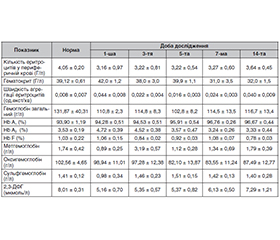
Актуальність. У статті детально висвітлено доцільність використання гіпербаричної оксигенації (ГБО) як нейропротектора при тяжкій черепно-мозковій травмі (ТЧМТ). Мета: на підставі змін реологічних властивостей крові та стану еритрону визначити вплив курсу ГБО на тривалість коми та результати при ТЧМТ. Матеріали та методи. Згідно з критеріями включення та виключення обстежено 165 осіб чоловічої статі із ТЧМТ, підтвердженою за допомогою комп’ютерної томографії (КТ). Залежно від варіанта інтенсивної терапії хворі були розподілені на дві групи. Перша група (n = 116) отримувала стандартизоване лікування з урахуванням сучасних доказових рекомендацій. Постраждалим другої групи (n = 49) з кінця 1-ї доби додавали курс ГБО, який складався із 14 сеансів (по одному на добу) тривалістю 90 хвилин під тиском 1,5 атм. Усім постраждалим здійснювали моніторинг вітальних функцій, огляд невролога. У 1-шу, 3-тю, 5-ту, 7-му, 10-ту та 14-ту добу захворювання визначали в’язкість крові, швидкість агрегації та дезагрегації еритроцитів і тромбоцитів, рівень форм гемоглобінів та 2,3-дифосфогліцерату (2,3-ДФГ). Результати. Ступінь порушень свідомості при надходженні у 90 % обстежених був на рівні коми 1-го або 2-го ступеня. У 1-й групі середня летальність дорівнювала 42,4 %, на тлі курсу ГБО — не перевищувала 36,7 %. У хворих 1-ї групи тривалість коматозного періоду становила 7,5 доби, у постраждалих 2-ї групи — не перевищувала 5,6 доби. Гіпербаротерапія сприяла нормалізації динамічної в’язкості крові, яка була меншою проти контрольної групи на 30–35 %. Паралельно з 1-ї доби після ТЧМТ вірогідно знижувалася швидкість агрегації еритроцитів з 450 % у контрольній групі до 237 % — у дослідній. Також поліпшувалася віддача кисню еритроцитами як за рахунок нормалізації зменшеного у контрольній групі рівня 2,3-ДФГ, так і за рахунок збільшення фракції оксигемоглобіну. Водночас аналіз швидкостей агрегації та дезагрегації тромбоцитів показав зменшення явищ коагулопатії, притаманних пацієнтам 1-ї групи. Висновки. Проведення курсу ГБО при гострій ТЧМТ поліпшує реологічні властивості крові та зменшує еритронопатію, що скорочує тривалість коматозного періоду майже на 2 доби, летальність — на 5,7 %.
Background. The article highlights the feasibility of using hyperbaric oxygenation (HBO) as a neuroprotector in severe traumatic brain injury (STBI). Objective: to determine the effect of an HBO course on the duration of coma and STBI outcomes based on changes in blood rheology and the state of erythron. Materials and methods. According to the inclusion and exclusion criteria, 165 male patients with STBI confirmed by computed tomography were examined. Depending on the intensive care option, they were divided into two groups. The first group (n = 116) received standardized treatment taking into account modern evidence-based recommendations. Victims of group 2 (n = 49) from the end of day 1 were additionally given an HBO course, consisting of 14 sessions (one per day) lasting 90 minutes under a pressure of 1.5 atm. All patients were monitored for vital functions and examined by a neurologist. On days 1, 3, 5, 7, 10 and 14 of the disease, blood viscosity, aggregation and disaggregation rate of erythrocytes and platelets, level of hemoglobin forms and 2,3-diphosphoglycerate (2,3-DPG) were determined. Results. The degree of consciousness disorders upon admission was at the level of mild and moderate coma in 90 % of the examinees. In group 1, the average mortality was 42.4 %, while against the background of an HBO course, it did not exceed 36.7 %. In patients of group 1, the duration of coma was 7.5 days, and in group 2, it did not exceed 5.6 days. Hyperbaric oxygenation contributed to the normalization of dynamic blood viscosity, which was lower than in the control group by 30–35 %. In parallel, from day 1 after TBI, the rate of erythrocyte aggregation significantly decreased from 450 % in the control group to 237 % in the experimental group. Oxygen delivery by erythrocytes also improved, both due to the normalization of 2,3-DPG level, which was reduced in the control group, and due to an increase in the oxyhemoglobin fraction. At the same time, the analysis of the rates of platelet aggregation and disaggregation showed a decrease in the phenomena of coagulopathy in patients of group 1. Conclusions. Conducting a course of HBO in acute STBI improves blood rheology and decreases erythronopathy, which reduces the duration of coma by almost 2 days, and mortality by 5.7 %.
Список литературы
Dewan MC, Rattani A, Gupta S, Baticulon RE, Hung YC, Punchak M, et al. Estimating the global incidence of trauma–tic brain injury. J Neurosurg. 2018 Apr;130(4):1080-1097. doi: 10.3171/2017.10.JNS17352.
Rao V, Lyketsos C. Neuropsychiatric sequelae of traumatic brain injury. Psychosomatics. 2000 Mar-Apr;41(2):95-103. doi: 10.1176/appi.psy.41.2.95.
National Center for Injury Prevention and Control. Report to Congress on mild traumatic brain injury in the United States: steps to prevent a serious public health problem. Atlanta (GA): Centers for Disease Control and Prevention; 2003. 56 p.
Zhong H, Feng Y, Shen J, Rao T, Dai H, Zhong W, et al. Global burden of traumatic brain injury in 204 countries and territories from 1990 to 2021. Am J Prev Med. 2025 Apr;68(4):754-763. doi: 10.1016/j.amepre.2025.01.001.
Iaccarino C, Carretta A, Nicolosi F, Morselli C. Epidemiology of severe traumatic brain injury. J Neurosurg Sci. 2018 Oct;62(5):535-541. doi: 10.23736/S0390-5616.18.04532-0.
Alves OL, Bullock R. Excitotoxic damage in traumatic brain injury. In: Clark RSB, Kochanek PM, editors. Brain injury. Boston: Kluwer Academic Publishers; 2001. Р. 1-36.
Ng SY, Lee AYW. Traumatic brain injuries: pathophysio–logy and potential therapeutic targets. Front Cell Neurosci. 2019 Nov 27;13:528. doi: 10.3389/fncel.2019.00528.
Thapa K, Khan H, Singh TG, Kaur A. Traumatic brain injury: mechanistic insight on pathophysiology and potential therapeutic targets. J Mol Neurosci. 2021 Sep;71(9):1725-1742. doi: 10.1007/s12031-021-01841-7.
Bouzat P, Sala N, Payen JF, Oddo M. Beyond intracranial pressure: optimization of cerebral blood flow, oxygen, and substrate delivery after traumatic brain injury. Ann Intensive Care. 2013 Jul 10;3(1):23. doi: 10.1186/2110-5820-3-23.
Hill CS, Coleman MP, Menon DK. Traumatic axonal injury: mechanisms and translational opportunities. Trends Neurosci. 2016 May;39(5):311-324. doi: 10.1016/j.tins.2016.03.002.
Kinoshita K. Traumatic brain injury: pathophysiology for neurocritical care. J Intensive Care. 2016 Apr 27;4:29. doi: 10.1186/s40560-016-0138-3.
Werner C, Engelhard K. Pathophysiology of traumatic brain injury. Br J Anaesth. 2007 Jul;99(1):4-9. doi: 10.1093/bja/aem131.
Jusoh AF, Ismail I, Yahaya R, Hassan A, Yusoff HM. Hyperbaric oxygen therapy in traumatic brain injury: a comprehensive structure review. Undersea Hyperb Med. 2026 First Quarter;53(1):65-82. PMID: 41979527.
Shahid S, Saeed H, Ali M, Hassan M, Hira S, Kakakhel M, et al. Hyperbaric oxygen therapy (HBOT) for neurocognitive deficits following traumatic brain injury: a systematic review and meta-analysis. Ann Med Surg (Lond). 2025 Sep 17;87(11):7490-7498. doi: 10.1097/MS9.0000000000003902.
Hadanny A, Maroon J, Efrati S. The efficacy of hyperbaric oxygen therapy in traumatic brain injury patients: literature review and clinical guidelines. Med Res Arch. 2023 Jul;11(7.2). doi: 10.18103/mra.v11i7.2.4161.
Rockswold SB, Rockswold GL, Vargo JM, Erickson CA, Sutton RL, Bergman TA, et al. Effects of hyperbaric oxygenation therapy on cerebral metabolism and intracranial pressure in severely brain injured patients. J Neurosurg. 2001 Mar;94(3):403-11. doi: 10.3171/jns.2001.94.3.0403. PMID: 11235943.
Palzur E, Zaaroor M, Vlodavsky E, Milman F, Soustiel JF. Neuroprotective effect of hyperbaric oxygen therapy in brain injury is mediated by preservation of mitochondrial membrane properties. Brain Res. 2008 Jul 24;1221:126-33. doi: 10.1016/j.brainres.2008.04.078. Epub 2008 May 11. PMID: 18561900.
Vlodavsky E, Palzur E, Soustiel JF. Hyperbaric oxygen therapy reduces neuroinflammation and expression of matrix metalloproteinase-9 in the rat model of traumatic brain injury. Neuropathol Appl Neurobiol. 2006 Feb;32(1):40-50. doi: 10.1111/j.1365-2990.2005.00698.x. PMID: 16409552.
Lim SW, Wang CC, Wang YH, Chio CC, Niu KC, Kuo JR. Microglial activation induced by traumatic brain injury is suppressed by postinjury treatment with hyperbaric oxygen therapy. J Surg Res. 2013 Oct;184(2):1076-84. doi: 10.1016/j.jss.2013.04.070. Epub 2013 May 21. PMID: 23726237.
Palzur E, Vlodavsky E, Mulla H, Arieli R, Feinsod M, Soustiel JF. Hyperbaric oxygen therapy for reduction of secondary brain damage in head injury: an animal model of brain contusion. J Neurotrauma. 2004 Jan;21(1):41-8. doi: 10.1089/089771504772695931. PMID: 14987464.
Calvert JW, Cahill J, Zhang JH. Hyperbaric oxygen and cerebral physiology. Neurol Res. 2007 Mar;29(2):132-141. doi: 10.1179/016164107X174156.
Raj S, Thanneeru SK, Mondithokha S, Chouksey P, Janjua T, Singh B, et al. Role of hyperbaric oxygen therapy in traumatic brain injury: a systematic review of randomized controlled trials. Indian J Neurotrauma. 2024;22(1):10-17. doi: 10.1055/s-0044-1782609.
Nader E, Skinner S, Romana M, Fort R, Lemonne N, Guillot N, et al. Blood rheology: key parameters, impact on blood flow, role in sickle cell disease and effects of exercise. Front Physiol. 2019 Oct 17;10:1329. doi: 10.3389/fphys.2019.01329. PMID: 31749708; PMCID: PMC6842957.
Baskurt OK, Meiselman HJ. Blood rheology and hemodyna–mics. Semin Thromb Hemost. 2003 Oct;29(5):435-450. doi: 10.1055/s-2003-44551. PMID: 14631543.
Bennett MH, Trytko B, Jonker B. Hyperbaric oxygen therapy for the adjunctive treatment of traumatic brain injury. Cochrane Database Syst Rev. 2012 Dec 12;12(12):CD004609. doi: 10.1002/14651858.CD004609.pub3. PMID: 23235612.
Karsheva M, Dinkova P, Pentchev I, Ivanova T. Blood rheo–logy — a key for blood circulation in human body. J Univ Chem Technol Metall. 2009;44(1):50-54.
Carney N, Totten AM, O’Reilly C, Ullman JS, Hawryluk GWJ, Bell MJ, et al. Guidelines for the management of severe traumatic brain injury, fourth edition. Neurosurgery. 2017 Jan 1;80(1):6-15. doi: 10.1227/NEU.0000000000001432. PMID: 27654000.
Mutti A, Bergamaschi E, Ghiggeri GM, Righetti PG, Spaggiari M, Alinovi R, et al. What is measured by the alcian blue bin–ding to red blood cells? Br J Ind Med. 1989 Apr;46(4):286-287. doi: 10.1136/oem.46.4.286.
Некрасова Н.О. Визначення вмісту 2,3-дифосфогліцерату в еритроцитах та біогенних амінів у сироватці крові пацієнтів молодого віку зі спондилогенною вертебробазилярною недостатністю. Український неврологічний журнал. 2014;(3-4):32-35.
Литвинчук В.Г. Реологічні властивості крові та їх динаміка при крововтратах. Клінічна та експериментальна патологія. 2015;3(53):81-84.
Born GV, Cross MJ. The aggregation of blood platelets. J Physiol. 1963 Aug;168(1):178-195. doi: 10.1113/jphysiol.1963.sp007185.
Born GV. Aggregation of blood platelets by adenosine diphosphate and its reversal. Nature. 1962 Jun 9;194:927-929. doi: 10.1038/194927b0.
Победьонний А.Л. Поширення та структура черепно-мозкової травми у великому промисловому регіоні. Український нейрохірургічний журнал. 2011;3:32-35.
Jaafar LS, Kourie CMR, El-Mallah CA, Obeid O. 2,3-Diphosphoglycerate: the forgotten metabolic regulator of oxygen affinity. Br J Nutr. 2025 Nov 28;134(10):803-815. doi: 10.1017/S0007114525105345.
Morgan TJ, Koch D, Morris D, Clague A, Purdie DM. Reduced red cell 2,3-diphosphoglycerate concentrations in critical illness without decreased in vivo P50. Anaesth Intensive Care. 2001 Oct;29(5):479-83. doi: 10.1177/0310057X0102900505. PMID: 11669427.
MacDonald R. Red cell 2,3-diphosphoglycerate and oxygen affinity. Anaesthesia. 1977 Jun;32(6):544-53. doi: 10.1111/j.1365-2044.1977.tb10002.x. PMID: 327846.
Ni J, Zhao J, Chen H, Liu W, Le M, Guo X, Dong X. 2,3-Diphosphoglyceric Acid Alleviating Hypoxic-Ischemic Brain Damage through p38 MAPK Modulation. Int J Mol Sci. 2024 Aug 15;25(16):8877. doi: 10.3390/ijms25168877. PMID: 39201562; –PMCID: PMC11354455.
Zhang J, Jiang R, Liu L, Watkins T, Zhang F, Dong JF. Traumatic brain injury-associated coagulopathy. J Neurotrauma. 2012 Nov 20;29(18):2597-2605. doi: 10.1089/neu.2012.2348.