
Інформація призначена тільки для фахівців сфери охорони здоров'я, осіб,
які мають вищу або середню спеціальну медичну освіту.

Підтвердіть, що Ви є фахівцем у сфері охорони здоров'я.

Международный неврологический журнал Том 22, №4, 2026

Вернуться к номеру

Вплив психічного та фізичного бойового травмування на формування афективних розладів у військовослужбовців
Авторы: Гринь К.В., Герасименко Л.О.
Полтавський державний медичний університет, м. Полтава, Україна

Рубрики: Неврология

Разделы: Клинические исследования

Версия для печати


Резюме

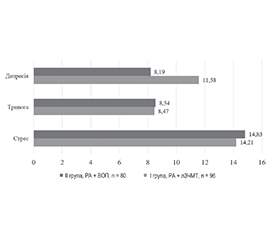
Актуальність. Повномасштабна війна в Україні суттєво змінила структуру сучасної бойової травми та актуалізувала проблему її віддалених медичних наслідків не тільки для фізичного, але й для психічного здоров’я. Окрему категорію становлять бойові психічні травми, які включають широке коло психічної патології, найпоширенішими з яких є гострі реакції на стрес, посттравматичний стресовий розлад та розлади адаптації. Саме поєднання фізичного ушкодження із сихотравмувальним досвідом формує складний комплекс взаємопов’язаних соматичних, неврологічних та психопатологічних порушень, що потребує мультидисциплінарного підходу до лікування та реабілітації. Мета: вивчення впливу психічного та фізичного бойового травмування на формування афективних розладів у військовослужбовців при розладах адаптації. Матеріали та методи. У дослідженні взяли участь 176 пацієнтів чоловічої статі, військовослужбовців, що отримали фізичне та психологічне травмування — легку закриту черепно-мозкову мінно-вибухову травму та непроникні вогнепальні чи осколкові поранення під час виконання бойових обов’язків — та страждали на розлад адаптації. У дослідженні застосований комплекс методів: клініко-анамнестичний, клініко-психопатологічний, психодіагностичний із використанням шкали депресії, тривоги та стресу
(DASS-21), опитувальника вираженості психопатологічної симптоматики (SCL-90-R), статистичний. Результати. У пацієнтів з комбінацією психологічного та фізичного травмування наявний широкий спектр психопатологічних розладів. При поєднанні розладу адаптації та вогнепального чи осколкового поранення вірогідно більш виражені прояви тривожності (р < 0,05), ворожості
(р < 0,01), паранояльності (р < 0,01) та психотизму (р < 0,05), що свідчить про значний вплив саме тілесних ушкоджень на психопатологічний стан. У багатьох випадках пацієнти сприймали свої фізичні ушкодження як покарання, відчуваючи почуття провини, також мали думки про тілесну неповноцінність внаслідок фізичних поранень, що і спричинило вірогідно вищі показники за вище­вказаними шкалами. Висновки. Встановлені клініко-психопатологічні особливості свідчать про необхідність диференційованого підходу до медико-психологічної реабілітації військовослужбовців із розладами адаптації з урахуванням характеру бойового фізичного травмування. Пацієнти з вогнепальними та осколковими пораненнями потребують більш інтенсивних психотерапевтичних і психосоціальних втручань, спрямованих на корекцію тривожності, ворожості, порушень сприйняття власного тіла та вираженого психологічного дистресу, тоді як у військовослужбовців після легкої закритої черепно-мозкової травми особливу увагу доцільно приділяти ранньому виявленню та лікуванню депресивної симптоматики.

Background. The full-scale war in Ukraine has significantly altered the nature of modern combat-related injuries and brought to the fore the issue of their long-term medical consequen­ces, not only for physical but also for mental health. Combat-related psychological trauma constitutes a separate category, encompas­sing a wide range of mental health conditions, the most common of which are acute stress reactions, post-traumatic stress disorder and adjustment disorders. It is the combination of physical injury and a psychologically traumatic experience that gives rise to a complex set of interrelated somatic, neurological and psychopathological disorders, requiring a multidisciplinary approach to treatment and rehabilitation. The aim was to investigate the impact of psychological and phy-sical combat-related trauma on the development of affective ­disorders in military personnel with adjustment disorders. Materials and methods. The study involved 176 male patients, military personnel who had sustained physical and psychological injuries (mild closed traumatic brain injury caused by mine or explosive blast, and non-penetrating gunshot or shrapnel wounds) whilst carrying out combat duties, and who were suffering from an adjustment disorder. The study employed a range of methods: clinical and anamnestic, clinical and psychopathological, psychodiagnostic — using the Depression, Anxiety, Stress Scale-21, the Symptom Checklist-90-Revised — and statistical ones. Results. Patients with a combination of psychological and physical trauma show a wide range of psychopathological disorders. When an adjustment disorder is combined with a gunshot or shrapnel wound, there are significantly more pronounced manifestations of anxiety (p < 0.05), hostility (p < 0.01), paranoia (p < 0.01) and psychoticism (p < 0.05), indicating a significant influence of physical injuries on the psychopathological state. In many cases, patients perceived their physical injuries as a punishment, experiencing feelings of guilt; they also harbored thoughts of physical inadequacy as a result of their injuries, which likely led to higher scores on the scales mentioned above. Conclusions. The clinical and psychopathological characteristics point to the need for a differentiated approach to the medical and psychological rehabilitation of military personnel with adjustment disorders, taking into account the nature of combat-related physical injuries. Patients with gunshot and shrapnel wounds require more intensive psychotherapeutic and psychosocial interventions aimed at addressing anxiety, hostility, body image disturbances and severe psychological distress, whereas in service personnel with a mild closed traumatic brain injury, particular attention should be paid to the early detection and treatment of depressive symptoms.


Ключевые слова

розлади адаптації; легка закрита черепно-мозкова травма; вогнепальні та осколкові поранення; воєнні дії; тривога; депресія; стрес; психічне травмування

adjustment disorders; mild closed traumatic brain injury; gunshot and shrapnel wounds; military operations; anxiety; depression; stress; psychological trauma


Для ознакомления с полным содержанием статьи необходимо оформить подписку на журнал.


Список литературы

1. Mishchenko T, Mishchenko V, Zdesenko I. War and its impact on the human nervous system: psychoneurological aspects. Psychiatry, Neurology and Medical Psychology. 2025;12(3(29):372-382. https://doi.org/10.26565/2312-5675-2025-29-07. 
2. Denysiuk MV, Dubrov SO, Poniatovska HB, et al. Analysis of the structure and features of traumatic injuries in victims with combat trauma. Medicni Perspektivi. 2025;30(2):156-163. doi: 10.26641/2307-0404.2025.2.333655. 
3. Tin D, Barten DG, Granholm F, et al. Hybrid warfare and counter-terrorism medicine. European Journal of Trauma and Emergency Surgery. 2023;2:583-593. doi: https://doi.org/10.1007/s00068-023-02230-y. 
4. Jarrassier A, Py N, de Rocquigny G, et al. Lessons learned from the war in Ukraine for the anesthesiologist and intensivist: A scoping review. Anaesthesia Critical Care & Pain Medicine. 2024;43(5):101409. doi: https://doi.org/10.1016/j.accpm.2024.101409. 
5. Kazmirchuk A, Yarmoliuk Y, Lurin I, et al. Ukraine’s Experience with Management of Combat Casualties Using NATO’s Four-Tier “Changing as Needed” Healthcare System. World J Surg. 2022;46(12):2858-2862. doi: https://doi.org/10.1007/s00268-022-06718-3. 
6. Spagnolello O, Gatti S, Shahir MAA, et al. Civilian war victims in Afghanistan: five-year report from the Kabul EMERGENCY NGO hospital. European Journal of Trauma and Emergency Surgery. 2022;49(3):1401-1405. doi: https://doi.org/10.1007/s00068-022-02137-0. 
7. Kuchyn I, Horoshko V. Chronic pain in patients with gunshot wounds. BMC Anesthesiol. 2023;23(1):47. doi: https://doi.org/10.1186/s12871-023-02005-3. 
8. Van Praag DL, Cnossen MC, Polinder S, et al. Post-traumatic stress disorder after civilian traumatic brain injury: A systematic review and meta-analysis of prevalence rates. J. Neurotrauma 2019;36:3220-3232. doi: 10.1089/neu.2018.5759. 
9. Hryn KV. Psychopathological symptom complex in adjustment disorders among military personnel. Actual Problems of Mo–dern Medicine: Bulletin of Ukrainian Medical Stomatological Aca–demy. 2026;26(2):12-16. Ukrainian. https://doi.org/10.31718/2077-1096.26.2.12. 
10. Herasymenko L, Isakov R, Zolochevsky I. Impairments in the adaptive resources of participants in intense combat operations. Psychosomatic Medicine and General Practice. 2024;9(4). Ukrainian. https://doi.org/10.26766/pmgp.v9i4.554. 
11. Borinuoluwa R, Ahmed Z. Does Blast Mild Traumatic Brain Injury Have an Impact on PTSD Severity? A Systematic Review and Meta-Analysis. Trauma Care. 2023;3(1):9-21. doi: 10.3390/traumacare3010002.
12. Chernenko I, Markova M. Comparative analysis of depressive, anxiety and post-traumatic symptoms in patients with a history of combat traumatic brain injury depending on its severity and duration. Psychiatry, Neurology and Medical Psychology. 2025;12(1(27):7-21. https://doi.org/10.26565/2312-5675-2025-27-01. 
13. Busuttil W. Understanding military-related mental illness for effective health care. Trends Urol Men’s Health. 2022;13:11-16. https://doi.org/10.1002/tre.854. 
14. Duong H, Garcia A, Hilfiker R, Leger B, Lu-thi F. Syste–matic review of biopsychosocial prognostic factors for return to work after acute orthopedic trauma. Front Rehabil Sci. 2022;2:791351. doi: https://doi.org/10.3389/fresc.2021.791351. 
15. Chernenko I, Markova M, Mankovskyi D, Chernenko R, Romanenko Y. Scientific justification for differentiation of approaches to care for patients with combat traumatic brain injury: clinical-neurolo-gical and clinical-psychological correlates of long-term consequences. Psychiatry, Neurology and Medical Psychology. 2026;13(1(33):8-24. https://doi.org/10.26565/2312-5675-2026-33-01. 
16. Hutchenko K, Kozachuk V, Hutchenko O, et al. Clinical and psychological features of combined trauma in servicemen of the Armed Forces of Ukraine in the Russian-Ukrainian war. Medicni Perspektivi. 2025;30(1):102-108. https://doi.org/10.26641/2307-0404.2025.1.325366. 
17. Chebotaryova L, Kovalenko O, Solonovych A, Solonovych O. Posttraumatic Stress Disorder and Mild Traumatic Brain Injury — Common Consequences of War: Issues of Pathogenesis and Differential Diagnosis (Review). Family Medicine. European Practices. 2023;2:64-72. Ukrainian. https://doi.org/10.30841/2786-720X.2.2023.282496. 
18. Chernenko I. Combat traumatic brain injury: pathogenetic mechanisms of long-term consequences. Psychiatry, Neuro–logy and Medical Psychology. 2025;12(2(28):162-177. https://doi.org/10.26565/2312-5675-2025-28-02. 
19. Asieieva YuO, Aymedov КV, Yatsyshyna AM. Definition of ptsd in the military: theoretical foundations, clinical manifestations and risk factors. Mental Health. 2024;2:8-17. Ukrainian. doi: https://doi.org/10.32782/3041-2005/2024-2-2. 
20. Romanenko Yu, Kolyadenko N. Post-traumatic stress disorder as a medical, psychological and social problem. Prospects and Іnnovations in Science. 2021;2(2):297-304. https://doi.org/10.52058/2786-4952-2021-2(2)-297-304. 
21. Guryev СO, Kushnir VA, Lisun DM, Panasenko SI, Solo–vyov OS. Modern combat injuries of the extremities. The first report: clinical and anatomical structure and structure of injury combinations The Ukrainian Journal of Clinical Surgery. 2023;90(4):31-35. doi: 10.26779/2786-832X.2023.4.31. 
22. Unified clinical protocol of primary and specialized medical care «Acute stress reaction. Post-traumatic stress disorder. Adjustment Disorder». Kyiv: Ministry of Health of Ukraine, 2024. 45 р. Ukrainian. URL: https://www.dec.gov.ua/mtd/posttravmatychnyj-stresovyj-rozlad/.
23. Derogatis L, Fitzpatrick M. The SCL-90-R, the Brief Symptom Inventory (BSI), and the BSI-18. The use of Psychological Testing for Treatment Planning and Outcomes Assessment. New Jersey; London: Lawrence Erlbaum Associated Publishers. 2004;3:1-42. URL: https://www.semanticscholar.org/paper/The-SCL-90-R %2CtheBrief-Symptom-Inventory-(BSI) %2C-Derogatis-Fitzpatrick/a82a74ac7086197cb9b46bce1368b130aad38472. 

Вернуться к номеру