
Журнал «Здоровье ребенка» Том 21, №6, 2026
Вернуться к номеру
Зв’язок між щоденним часом користування екранами, поширеністю карієсу й оральними парафункціональними звичками в дітей шкільного віку в м. Ан-Наджаф (Ірак): перехресне дослідження
Авторы: Juman Mohammed Taqi Baqer, Noor Mohammed Hadi Layedh, Batool M. Al-Fahham
Department of Pediatric, Orthodontic and Preventive Dentistry, College of Dentistry, University of Kufa, Najaf, Iraq
Рубрики: Педиатрия/Неонатология
Разделы: Клинические исследования
Версия для печати
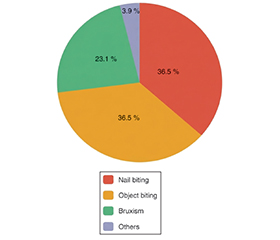
Актуальність. Термін «час користування екранами» позначає тривалість активної взаємодії дітей із цифровими пристроями, як-от телевізори, смартфони та планшети. Запропоновано два механізми, що пов’язують тривале перебування перед екраном зі станом здоров’я ротової порожнини: заміщення повноцінних прийомів їжі частими перекусами, нерідко карієсогенними, під час малорухливого користування гаджетами та психологічне перезбудження, що може проявлятися оральними парафункціональними звичками, як-от бруксизм і гризіння нігтів. Дані щодо дитячих популяцій у країнах Близького Сходу залишаються обмеженими. Мета: вивчити зв’язок між тривалістю щоденного часу, проведеного перед екранами, та віком початку їх використання, — з одного боку, і показниками карієсу (DMFT/dmft), індексом зубного нальоту (PI) і стану ясен (GI), а також наявністю парафункціональних звичок — з іншого у дітей шкільного віку (6–12 років), які відвідували стоматологічні клініки в м. Ан-Наджаф (Ірак). Основним результатом була вираженість карієсу постійних зубів (DMFT). Матеріали та методи. У цьому перехресному обсерваційному дослідженні протягом трьох місяців (листопад 2025 р. — січень 2026 р.) послідовно відібрано 140 здорових дітей віком 6–12 років, які відвідували стоматологічні клініки кафедри дитячої, ортодонтичної та профілактичної стоматології Університету Куфи. Соціально-демографічні дані, інформацію про час користування екранами, гігієну ротової порожнини й парафункціональні звички збирали шляхом структурованого опитування батьків. Потім один дослідник проводив огляд кожної дитини відповідно до критеріїв Всесвітньої організації охорони здоров’я, фіксуючи показники DMFT/dmft, PI та GI. Дітей розподілено на групи за тривалістю щоденного часу перед екранами (≤ 2 год проти > 2 год) та віком початку користування ними (≤ 2 роки проти > 2 років). Наведено показники величини ефекту з 95% довірчими інтервалами (ДІ) та значення p. Результати. Зі 140 дітей (67 хлопчиків, 47,9 %; середній вік 8,51 ± 1,81 року) 79 (56,4 %) проводили перед екранами понад дві години на добу. Діти з групи, де час користування екранами перевищував 2 години на добу, були старшими (середня різниця 0,78 року; 95% ДІ: 0,18–1,38; d Коена = 0,44; p = 0,011) і мали вищий середній показник DMFT (1,92 проти 1,02; середня різниця 0,90; 95% ДІ: 0,24–1,56; d = 0,46; p = 0,008), що свідчить про зв’язок слабкої або помірної сили. Відповідної різниці щодо карієсного ураження тимчасових зубів (dmft 5,35 проти 5,69; середня різниця –0,34; 95% ДІ: –1,66… 0,98; d = –0,09; p = 0,611), PI (p = 0,081) чи GI (p = 0,659) не виявлено. Поширеність парафункціональних звичок не залежала від тривалості щоденного часу перед екранами (38,0 проти 36,1 %; відношення шансів 1,09; 95% ДІ: 0,54–2,17; p = 0,956). Такі звички частіше спостерігалися серед дітей, які почали користуватися екранами у віці до двох років (48,7 проти 32,7 %; відношення шансів 1,96; 95% ДІ: 0,92–4,16), однак ця різниця не досягла рівня статистичної значущості (p = 0,117). Найпоширенішими звичками були гризіння нігтів і предметів (по 36,5 % випадків серед дітей, які мали парафункціональні звички) та бруксизм (23,1 %). Висновки. У цій клінічній вибірці триваліше щоденне користування екранами асоціювалося з вищим рівнем ураження карієсом постійних зубів, тоді як зв’язку з карієсом тимчасових зубів, показниками гігієни ротової порожнини чи парафункціональними звичками не виявлено. Оскільки дослідження має перехресний дизайн, а дані щодо харчування й соціально-економічного статусу не збиралися, отримані результати слід інтерпретувати як свідчення взаємозв’язку, а не причинно-наслідкового впливу; також не можна виключити ймовірність залишкового впливу сторонніх чинників. Необхідні проспективні дослідження, що враховують особливості харчування, перш ніж рекомендації щодо обмеження екранного часу можна буде вважати доказово обґрунтованою складовою рутинної стоматологічної допомоги дітям.
Background. Screen time denotes the duration for which children are actively engaged with digital devices such as televisions, smartphones and tablets. Two pathways have been proposed to link prolonged screen exposure with oral health: the displacement of structured meals by frequent, often cariogenic, snacking during sedentary screen use; and psychological overstimulation, which may be expressed through oral parafunctional behaviors such as bruxism and nail biting. Data from Middle Eastern pediatric populations remain limited. The purpose was to examine the association between daily screen time duration and age at screen introduction on the one hand, and dental caries experience (DMFT/dmft), the Plaque (PI) and the Gingival Index (GI), and the presence of oral parafunctional habits on the other, among school-aged children aged 6–12 years attending dental clinics in Al-Najaf, Iraq. Caries experience in the permanent dentition (DMFT) was designated the primary outcome. Materials and methods. In this cross-sectional observational study, 140 healthy children aged 6–12 years attending the dental clinics of the Department of Pediatric, Orthodontic and Preventive Dentistry, University of Kufa, were recruited consecutively over three months (November 2025 — January 2026). Sociodemographic data, screen exposure, oral hygiene practices and parafunctional habits were recorded by structured parental interview. A single calibrated examiner then assessed each child according to WHO criteria, recording DMFT/dmft, the PI and the GI. Children were grouped by daily screen time (≤ 2 h vs > 2 h) and by age at first screen exposure (≤ 2 vs > 2 years). Effect sizes with 95% confidence intervals (CI) are reported alongside p-values. Results. Of the 140 children (67 boys, 47.9 %; mean age 8.51 ± 1.81 years), 79 (56.4%) exceeded two hours of daily screen exposure. Children in the > 2 h group were older (mean difference 0.78 years, 95% CI 0.18 to 1.38; Cohen’s d = 0.44; p = 0.011) and had a higher mean DMFT (1.92 vs 1.02; mean difference 0.90, 95% CI 0.24 to 1.56; d = 0.46; p = 0.008), an association of small-to-moderate magnitude. No corresponding difference was observed for primary-dentition caries (dmft 5.35 vs 5.69; mean difference –0.34, 95% CI –1.66 to 0.98; d = –0.09; p = 0.611), the PI (p = 0.081) or the GI (p = 0.659). The prevalence of parafunctional habits did not differ by daily screen time (38.0 vs 36.1 %; odds ratio 1.09, 95% CI 0.54 to 2.17; p = 0.956). Habits were more frequent among children first exposed to screens before the age of two (48.7 vs 32.7 %; odds ratio 1.96, 95% CI 0.92 to 4.16), but this difference did not reach statistical significance (p = 0.117). Nail biting and object biting were the most frequently reported habits (each 36.5 % of affected children), followed by bruxism (23.1 %). Conclusions. In this clinic-based sample, longer daily screen time was associated with greater caries experience in the permanent dentition, whereas no association was demonstrated with primary-dentition caries, oral hygiene indices or parafunctional habits. Because the design is cross-sectional and dietary and socioeconomic data were not collected, these findings should be interpreted as associations rather than causal effects, and residual confounding cannot be excluded. Prospective studies incorporating dietary assessment are needed before screen-time counselling can be recommended as an evidence-based component of routine pediatric dental care.
час перед екраном; дитина; карієс; індекс DMF; індекс зубного нальоту; індекс гінгівіту; парафункціональні звички; бруксизм; гризіння нігтів; Ірак
screen time; child; dental caries; DMF index; plaque index; gingival index; parafunctional habits; bruxism; nail biting; Iraq
Для ознакомления с полным содержанием статьи необходимо оформить подписку на журнал.
- Gupta P, Shah D, Bedi N, Galagali P, Dalwai S, Agrawal S, et al. Indian Academy of Pediatrics guidelines on screen time and digital wellness in infants, children and adolescents. Indian Pediatr. 2022;59(3):35-44.
- Kalaivanan D, Lakshmanan M, Das M, Saleem S, Akr SP, Chamarthi VR. Exploring the link between screen time and severity of early childhood caries in primary molars: a cross-sectional study. BMC Oral Health. 2025;25(1):1181. doi: 10.1186/s12903-025-06135-7.
- Garg N, Khatri A, Kalra N, Tyagi R. The association of screen time with intake of potentially cariogenic food and oral health of school children aged 8–14 years — a cross-sectional study. J Clin Pediatr Dent. 2023;47(5):116-23. doi: 10.22514/jocpd.2023.060.
- Robin A, Padmanabhan V, Swaminathan K, Kc V, K V, Haridoss S. Association between screen time, dietary patterns, and oral health among children: a cross-sectional study. Cureus. 2025;17(3):e81348. doi: 10.7759/cureus.81348.
- Alanzi A, AlHayyan W, Hashem N. Impact of media use on oral health, parafunctional habits, and nutritional status in preschoolers: a cross-sectional study. BMC Oral Health. 2025;25(1):1143. doi: 10.1186/s12903-025-06536-8.
- Yilmaz N, Avci G. Exposure to screen time and dental neglect. J Paediatr Child Health. 2022;58(10):1855-61. doi: 10.1111/jpc.16177.
- World Health Organization. Guidelines on physical activity, se–dentary behaviour and sleep for children under 5 years of age. Geneva: World Health Organization; 2019.
- Council on Communications and Media. Media use in schoo–l-aged children and adolescents. Pediatrics. 2016;138(5):e20162592. doi: 10.1542/peds.2016-2592.
- Council on Communications and Media. Media and young minds. Pediatrics. 2016;138(5):e20162591. doi: 10.1542/peds.2016-2591.
- Mitova N, Dimitrova M. Screen time and sleep bruxism — a comparison between the present time and the COVID-19 pandemic. Children (Basel). 2025;12(10):1396. doi: 10.3390/children12101396.
- World Health Organization. Oral health surveys: basic methods. 5th ed. Geneva: World Health Organization; 2013.
- Löe H, Silness J. Periodontal disease in pregnancy. I. Prevalence and severity. Acta Odontol Scand. 1963;21(6):533-51. doi: 10.3109/00016356309011240.
- Silness J, Löe H. Periodontal disease in pregnancy. II. Correlation between oral hygiene and periodontal condition. Acta Odontol Scand. 1964;22(1):121-35. doi: 10.3109/00016356408993968.
- Mustuloğlu Ş, Tezol Ö, Yalçın SS. Problematic screen exposure and oral health in preschool children: a comparison study. BMC Oral Health. 2024;24(1):1200. doi: 10.1186/s12903-024-04979-z.