
Журнал «Здоровье ребенка» Том 21, №6, 2026
Вернуться к номеру
Діагностичне значення антропометричних та біохімічних маркерів адипозопатії при латентному автоімунному діабеті молоді
Авторы: I.O. Tsaryk (1), N.V. Pashkovska (1), V.I. Pankiv (2)
(1) - Bukovinian State Medical University, Chernivtsi, Ukraine
(2) - Ukrainian Scientific and Practical Centre of Endocrine Surgery, Transplantation of Endocrine Organs and Tissues of the Ministry of Health of Ukraine, Kyiv, Ukraine
Рубрики: Педиатрия/Неонатология
Разделы: Клинические исследования
Версия для печати
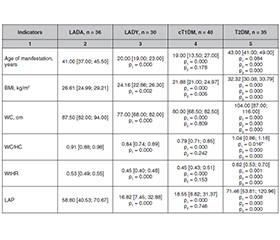
Актуальність. Точна диференціація повільно прогресуючих фенотипів автоімунного діабету, зокрема латентного автоімунного діабету молоді (LADY), та класичного цукрового діабету 1-го типу (кЦД1) і цукрового діабету 2-го типу (ЦД2) залишається основною діагностичною проблемою в клінічній ендокринології. Мета: оцінити діагностичне значення функціонального стану β-клітин підшлункової залози, профілів печінкових ферментів та сурогатних маркерів адипозопатії (продукт накопичення ліпідів — LAP, індекс вісцерального ожиріння — VAI, співвідношення окружності талії до зросту — WtHR) в осіб із LADY порівняно з тими, хто має латентний автоімунний діабет дорослих (LADA), кЦД1 та ЦД2. Матеріали та методи. Перехресне порівняльне дослідження включало 141 пацієнта, розділених на чотири групи: LADA (n = 36), LADY (n = 30), кЦД1 (n = 40) і ЦД2 (n = 35). Оцінювали С-пептид, базальний інсулін, печінкові ферменти натщесерце (аланінамінотрансфераза, аспартатамінотрансфераза, гамма-глутамілтрансфераза, лужна фосфатаза), показники адипозопатії (LAP, VAI, WtHR). Результати. Концентрації С-пептиду в групах LADY (0,62 нг/мл)
та LADA (0,60 нг/мл) були ідентичними (p = 0,995), у 6,2 раза вищими, ніж серед пацієнтів із кЦД1 (0,10 нг/мл, p < 0,001), але в 7,9 раза меншими за такі при ЦД2 (4,91 нг/мл, p < 0,001). Особи з LADY демонстрували низькі рівні вісцерального ожиріння: LAP — 16,82, VAI — 2,11, WtHR — 0,45, що вказувало на 4-разове зниження LAP і 3-разове — VAI порівняно з хворими з ЦД2 (p < 0,001). Печінкові ферменти при LADY залишалися в межах норми. Висновки. LADY характеризується збереженою залишковою секрецією бета-клітин без первинної системної адипозопатії чи ліпотоксичності. Інтеграція показників LAP та VAI разом із оцінкою С-пептиду значно поліпшує точність диференціальної діагностики на рівні первинної медичної допомоги. LAP і VAI можна розглядати як доступні в амбулаторній практиці додаткові маркери метаболічної диференціації в межах спектра повільно прогресуючих автоімунних форм діабету (LADY/LADA). Вони доповнюють серологічну верифікацію (GADA/IA-2/ZnT8) та оцінку рівня С-пептиду, особливо в ситуаціях, коли остання не забезпечує відмінностей між групами.
Background. Accurately differentiating slowly progressive autoimmune diabetes phenotypes, particularly latent autoimmune diabetes in youth (LADY), from classical type 1 (cT1DM) and type 2 diabetes (T2DM) remains a major diagnostic challenge in clinical endocrinology. The purpose of the study was to evaluate the functional state of pancreatic β-cells, liver enzyme profiles, and robust surrogate markers of adiposopathy (lipid accumulation product, LAP; visceral adiposity index, VAI; waist-to-height ratio, WHtR) in patients with LADY compared to latent autoimmune diabetes in adults (LADA), cT1DM, and T2DM. Materials and methods. A cross-sectional comparative study included 141 patients divided into four groups: LADA (n = 36), LADY (n = 30), cT1DM (n = 40), and T2DM (n = 35). Fasting C-peptide, basal insulin, liver enzymes (alanine aminotransferase, aspartate aminotransferase, gamma-glutamyl transferase, alkaline phosphatase), and adiposopathy indices (LAP, VAI, WtHR) were evaluated. Results. Fasting C-peptide levels in LADY (0.62 ng/mL) and LADA (0.60 ng/mL) were identical (p = 0.995), being 6.2-fold higher than in cT1DM (0.10 ng/mL, p < 0.001), but 7.9 times lower than in T2DM (4.91 ng/mL, p < 0.001). Patients with LADY exhibited low visceral adiposity levels (LAP 16.82, VAI 2.11, WtHR 0.45), demonstrating a 4.0-fold reduction in LAP and a 3.0-fold reduction in VAI compared to T2DM (p < 0.001). Liver enzymes in LADY remained within normal reference ranges. Conclusions. LADY is characterized by preserved residual β-cell secretion without primary systemic adiposopathy or lipotoxicity. Integrating LAP and VAI scores alongside C-peptide evaluation significantly improves the accuracy of differential diagnosis at the primary care level. LAP and VAI can be considered as additional surrogates available in outpatient practice markers of metabolic differentiation within the spectrum of slowly progressive autoimmune forms of diabetes (LADY/LADA), complementing serological verification (GADA/IA-2/ZnT8) and C-peptide assessment, especially in situations where the latter do not provide differences between groups.
латентний автоімунний діабет молоді; підлітки; молоді люди; автоімунний цукровий діабет; латентний автоімунний діабет дорослих; співвідношення окружності талії до зросту; С-пептид; адипозопатія; диференціальна діагностика
latent autoimmune diabetes in youth; adolescents; young adults; autoimmune diabetes mellitus; latent autoimmune diabetes in adults; waist-to-height ratio; C-peptide; adiposopathy; differential diagnosis
Для ознакомления с полным содержанием статьи необходимо оформить подписку на журнал.
- Buzzetti R, Tuomi T, Mauricio D, et al. Management of Latent Autoimmune Diabetes in Adults: A Consensus Statement from an International Expert Panel. Diabetes. 2020 Oct;69(10):2037-2047. doi: 10.2337/dbi20-0017.
- Pieralice S, Pozzilli P. Latent Autoimmune Diabetes in Adults: A Review on Clinical Implications and Management. Diabetes Metab J. 2018 Dec;42(6):451-464. doi: 10.4093/dmj.2018.0190.
- Leslie RD, Palmer J, Schloot NC, Lernmark A. Diabetes at the crossroads: relevance of disease classification to pathophysiology and treatment. Diabetologia. 2016 Jan;59(1):13-20. doi: 10.1007/s00125-015-3789-z.
- Thomas NJ, Jones SE, Weedon MN, Shields BM, Oram RA, Hattersley AT. Frequency and phenotype of type 1 diabetes in the first six decades of life: a cross-sectional, genetically stratified survival analysis from UK Biobank. Lancet Diabetes Endocrinol. 2018 Feb;6(2):122-129. doi: 10.1016/S2213-8587(17)30362-5.
- Cheng J, Tang X, Yan X, et al. Latent autoimmune diabetes in youth shows greater autoimmunity than latent autoimmune diabetes in adults: Evidence from a nationwide, multicenter, cross-sectional study. Pediatr Diabetes. 2022 Aug;23(5):578-587. doi: 10.1111/pedi.13348.
- Sun Q, Yang M, Jing Y, et al. Latent autoimmune diabetes in youth. Front Immunol. 2025 Nov 21;16:1691377. doi: 10.3389/fimmu.2025.1691377.
- Gerush KV, Pashkovska NV, Ukrainets OV. Errors in the diagnosis of types of diabetes mellitus: causes and prevention strategies (literature review and own research results). Miznarodnij Endokrinologicnij Zurnal. 2024;20(4):307-315. doi: 10.22141/2224-0721.20.4.2024.1410.
- Stenström G, Gottsäter A, Bakhtadze E, Berger B, Sundkvist G. Latent autoimmune diabetes in adults: definition, prevalence, beta-cell function, and treatment. Diabetes. 2005 Dec;54 Suppl 2:S68-72. doi: 10.2337/diabetes.54.suppl_2.s68.
- Buzzetti R, Zampetti S, Maddaloni E. Adult-onset autoimmune diabetes: current knowledge and implications for management. Nat Rev Endocrinol. 2017 Nov;13(11):674-686. doi: 10.1038/nrendo.2017.99.
- Wei Y, Herzog K, Ahlqvist E, et al. All-Cause Mortality and Cardiovascular and Microvascular Diseases in Latent Autoimmune Diabetes in Adults. Diabetes Care. 2023 Oct 1;46(10):1857-1865. doi: 10.2337/dc23-0739.
- Kumar A, de Leiva A. Latent autoimmune diabetes in adults (LADA) in Asian and European populations. Diabetes Metab Res Rev. 2017 Jul;33(5). doi: 10.1002/dmrr.2890.
- Hawa MI, Kolb H, Schloot N, et al.; Action LADA consortium. Adult-onset autoimmune diabetes in Europe is prevalent with a broad cli–nical phenotype: Action LADA 7. Diabetes Care. 2013 Apr;36(4):908-913. doi: 10.2337/dc12-0931.
- Apostolopoulou M, Lambadiari V, Roden M, Dimitriadis GD. Insulin Resistance in Type 1 Diabetes: Pathophysiological, Clinical, and Therapeutic Relevance. Endocr Rev. 2025 May 9;46(3):317-348. doi: 10.1210/endrev/bnae032.
- Gastaldelli A, Cusi K. From NASH to diabetes and from diabetes to NASH: Mechanisms and treatment options. JHEP Rep. 2019 Jul 19;1(4):312-328. doi: 10.1016/j.jhepr.2019.07.002.
- Thomas EL, Frost G, Taylor-Robinson SD, Bell JD. Excess body fat in obese and normal-weight subjects. Nutr Res Rev. 2012 Jun;25(1):150-161. doi: 10.1017/S0954422412000054.
- Kahn HS. The “lipid accumulation product” performs better than the body mass index for recognizing cardiovascular risk: a population-based comparison. BMC Cardiovasc Disord. 2005 Sep 8;5:26. doi: 10.1186/1471-2261-5-26.
- Amato MC, Giordano C, Galia M, et al.; AlkaMeSy Study Group. Visceral Adiposity Index: a reliable indicator of visceral fat function associated with cardiometabolic risk. Diabetes Care. 2010 Apr;33(4):920-922. doi: 10.2337/dc09-1825.
- Gibson S, Ashwell M. A simple cut-off for waist-to-height ratio (0·5) can act as an indicator for cardiometabolic risk: recent data from adults in the Health Survey for England. Br J Nutr. 2020 Mar 28;123(6):681-690. doi: 10.1017/S0007114519003301.
- Liao J, Wang L, Duan L, et al. The association between waist circumference, weight-adjusted waist index, waist-to-height ratio and waist divided by height0.5 and the prevalence of cardiovascular diseases in patients with diabetes. BMC Public Health. 2025 Aug 19;25(1):2835. doi: 10.1186/s12889-025-24068-2.
- Tsaryk I, Pashkovska N, Pankiv V. Latent autoimmune diabetes in youth: characteristics of the metabolic endotype and anthropometric markers for differential diagnosis. Child’s Health. 2026;21(4):201-206. doi: 10.22141/2224-0551.21.4.2026.1959.
- Carlsson S. Etiology and Pathogenesis of Latent Autoimmune Diabetes in Adults (LADA) Compared to Type 2 Diabetes. Front Physiol. 2019 Mar 26;10:320. doi: 10.3389/fphys.2019.00320.
- Tuomi T, Santoro N, Caprio S, Cai M, Weng J, Groop L. The many faces of diabetes: a disease with increasing heterogeneity. Lancet. 2014 Mar 22;383(9922):1084-1094. doi: 10.1016/S0140-6736(13)62219-9.
- Golomb RC, Tittel SR, Welters A, et al. Increased cardiovascular risk in people with LADA in comparison to type 1 diabetes and type 2 diabetes: Findings from the DPV registry in Germany and Austria. Diabetes Obes Metab. 2025 Feb;27(2):563-573. doi: 10.1111/dom.16048.
- Liu B, Xiang Y, Liu Z, Zhou Z. Past, present and future of latent autoimmune diabetes in adults. Diabetes Metab Res Rev. 2020 Jan;36(1):e3205. doi: 10.1002/dmrr.3205.
- Deng R, Chen W, Zhang Z, et al. Association Between Visceral Obesity Index and Diabetes: A Systematic Review and Meta-analysis. J Clin Endocrinol Metab. 2024 Sep 16;109(10):2692-2707. doi: 10.1210/clinem/dgae303.