
Журнал «Здоровье ребенка» Том 21, №7, 2026
Вернуться к номеру
Вплив затримки росту плода на неонатальні наслідки в передчасно народжених дітей
Авторы: A. Chudzik
Neonatal Unit Central Clinical Hospital, Medical University of Lodz, Łódź, Poland
Рубрики: Педиатрия/Неонатология
Разделы: Клинические исследования
Версия для печати
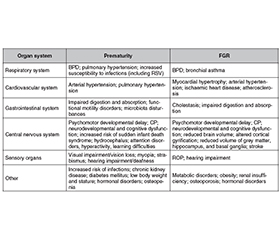
Актуальність. Поєднання затримки внутрішньоутробного розвитку плода з передчасними пологами підвищує ризик несприятливих перинатальних наслідків, однак систематизація патофізіологічних механізмів, що лежать в основі цього ефекту, та їх впровадження у клінічні рекомендації залишаються недостатніми. Метa: обґрунтувати диференційований підхід до клінічного ведення недоношених немовлят із затримкою внутрішньоутробного розвитку з урахуванням патогенетичних особливостей, що впливають на окремі системи органів. Матеріали та методи. Дослідження було проведено у формі описового огляду літератури в Медичному університеті м. Лодзь (Польща) з використанням 50 рецензованих джерел, індексованих у базах даних PubMed, Scopus, Web of Science та Google Scholar, що охоплюють період із 2003 до 2026 року. Результати. Аналіз літератури виявив, що порушення кровопостачання плаценти підтверджено в 51,2 % випадків затримки росту плода, причому частіше на ранніх стадіях (відношення шансів 1,89). Відмінності між стадіями були переважно кількісними щодо тяжкості уражень плаценти, але призводили до якісно різних наслідків для органогенезу. Поєднання передчасних пологів та затримки внутрішньоутробного розвитку плода мало синергічний ефект: ризик бронхолегеневої дисплазії середнього й тяжкого ступеня подвоювався (відношення шансів 2,5), частота некротизуючого ентероколіту зростала до 9,3 % порівняно з 4,1 %, а ризик тяжкої ретинопатії збільшувався у 4–5 разів. Висновки. Серед довгострокових наслідків було підтверджено збереження структурних змін судинної стінки в дорослому віці, а також підвищений у 8 разів ризик розвитку церебрального паралічу й епігенетичну активацію гена інсуліноподібного фактора росту 1 як механізм метаболічного програмування.
Background. The combination of foetal growth restriction with preterm birth increases the risk of adverse perinatal outcomes; however, systematisation of the pathophysiological mechanisms underlying this effect and their translation into clinical recommendations remains insufficient. The study aimed to substantiate a differentiated approach to the clinical management of preterm infants with foetal growth restriction, taking into account pathogenetic features affecting individual organ systems. Materials and methods. The study was conducted as a narrative literature review at the Medical University of Łódź (Poland), involving 50 peer-reviewed sources indexed in PubMed, Scopus, Web of Science, and Google Scholar and covering the period from 2003 to 2026. Results. Analysis of the literature indicated that placental vascular malperfusion was verified in 51.2 % of cases of foetal growth restriction, with a higher frequency in the early stages (odds ratio 1.89), and that differences between stages were predominantly quantitative in terms of the severity of placental lesions but resulted in qualitatively distinct consequences for organogenesis. The combination of prematurity and foetal growth restriction produced a synergistic effect: the risk of moderate-to-severe bronchopulmonary dysplasia doubled (odds ratio 2.5), the incidence of necrotising enterocolitis increased to 9.3 % compared with 4.1 %, and the risk of severe retinopathy increased fourfold to fivefold. Conclusions. Among long-term outcomes, persistence of structural changes in the vascular wall into adulthood was confirmed, alongside an eightfold increased risk of cerebral palsy and epigenetic activation of the insulin-like growth factor 1 gene as a mechanism of metabolic programming.
затримка внутрішньоутробного розвитку; недоношений новонароджений; плацентарна недостатність; централізація кровообігу; бронхолегенева дисплазія
foetal growth restriction; preterm newborn; placental insufficiency; centralisation of circulation; bronchopulmonary dysplasia
Для ознакомления с полным содержанием статьи необходимо оформить подписку на журнал.
- Misan N, Michalak S, Kapska K, et al. Blood-brain barrier disintegration in growth-restricted fetuses with brain sparing effect. Int J Mol Sci. 2022 Oct;23(20):12349. doi: 10.3390/ijms232012349.
- Nowaczyk J, Poniedziałek B, Rzymski P, et al. Platelets in fetal growth restriction: role of reactive oxygen species, oxygen metabolism, and aggregation. Cells. 2022 Feb;11(4):724. doi: 10.3390/cells11040724.
- Kajdy A, Feduniw S, Modzelewski J, et al. Growth abnormalities as a risk factor of adverse neonatal outcome in hypertensive pregnancies: a single-center retrospective cohort study. Children (Basel). 2021 Jun;8(6):522. doi: 10.3390/children8060522.
- Arigliani M, Stocco C, Valentini E, et al. Lung function between 8 and 15 years of age in very preterm infants with fetal growth restriction. Pediatr Res. 2021 Sep;90(3):657-663. doi: 10.1038/s41390-020-01299-0.
- Kim F, Bateman DA, Goldshtrom N, et al. Intracranial ultrasound abnormalities and mortality in preterm infants with and without fetal growth restriction stratified by fetal Doppler study results. J Perinatol. 2023 May;43(5):560-567. doi: 10.1038/s41372-023-01621-8.
- Kollia M, Iacovidou N, Iliodromiti Z, et al. Primary hemostasis in fetal growth restricted neonates studied via PFA-100 in cord blood samples. Front Pediatr. 2022 Sep;10:946932. doi: 10.3389/fped.2022.946932.
- Alda MG, Wood AG, MacDonald T, et al. Care of neonates following in-utero growth restriction: a prospective cohort study exploring neonatal morbidity. J Perinatol. 2025 Sep;45(9):1219-1225. doi: 10.1038/s41372-025-02397-9.
- Suciu LM, Giesinger RE, Mărginean C, et al. Comparative evaluation of echocardiography indices during the transition to extrauterine life between small and appropriate for gestational age infants. Front Pediatr. 2022 Jan;10:1045242. doi: 10.3389/fped.2022.1045242.
- Melamed N, Baschat A, Yinon Y, et al. FIGO (International Federation of Gynecology and Obstetrics) initiative on fetal growth: best practice advice for screening, diagnosis, and management of fetal growth restriction. Int J Gynaecol Obstet. 2021 Mar;152(Suppl 1):3-57. doi: 10.1002/ijgo.
- Gomella TL, Eyal FG, Bany-Mohamed F. Neonatology: ma–nagement, procedures, on-call problems, diseases, and medications. 8th ed. New York: McGraw Hill; 2020.
- Świetliński J, ed. Neonatologia. Warszawa: Wydawnictwo Le–karskie PZWL; 2021.
- Esnazarova A, Raiymbekova N, Klyshpayeva D, Kurbansopiev R, Kyzyrbekova A. Maternal anemia: A hidden determinant of complicated labor and adverse neonatal outcomes (A literature review). Rep Med (Central Asia). 2026 Mar;1:68-78. doi: 10.37800/RM.1.2026.680.
- Svyatova GS, Mirzakhmetova DD, Berezina GM, Murtazaliyeva AV. Genetic Factors of Idiopathic Recurrent Miscarriage in Kazakh Population. J Reprod Infertil. 2022 Jan;23(1):39-45. doi: 10.18502/jri.v23i1.8451.
- Mecacci F, Avagliano L, Lisi F, et al. Fetal growth restriction: does an integrated maternal hemodynamic-placental model fit better? Reprod Sci. 2021 Sep;28(9):2422-2435. doi: 10.1007/s43032-020-00393-2.
- Dall’Asta A, Melito C, Morganelli G, et al. Determinants of placental insufficiency in fetal growth restriction. Ultrasound Obstet Gynecol. 2023 Feb;61(2):152-157. doi: 10.1002/uog.26111.
- Redline RW, Ravishankar S, Bagby CM, et al. Four major patterns of placental injury: a stepwise guide for understanding and implementing the 2016 Amsterdam consensus. Mod Pathol. 2021 Jun;34(6):1074-1092. doi: 10.1038/s41379-021-00747-4.
- Dash P, Koppisetty BK, Jena SK, Nayak S. Combination of Mar–kers, Including hsCRP, TGFβ 1, IL-6, and T-regs, and their Predictive Va–lue as Early Warning Signs for Preeclampsia: Insights from a Tertiary Care Medical Centre in Eastern India. J Mother Child. 2026 Mar;30(1):58-66. doi: 10.34763/jmotherandchild.20263001.d-25-00031.
- Hong J, Crawford K, Daly M, et al. Utility of placental biomar–kers and fetoplacental Dopplers in predicting likely placental pathology in early and late fetal growth restriction: a prospective study. Placenta. 2024 Oct;156:20-29. doi: 10.1016/j.placenta.2024.08.016.
- Armengaud JB, Yzydorczyk C, Siddeek B, et al. Intrauterine growth restriction: clinical consequences on health and disease at adulthood. Reprod Toxicol. 2021 Jan;99:168-176. doi: 10.1016/j.reprotox.2020.10.005.
- Crispi F, Miranda J, Gratacós E. Long-term cardiovascular consequences of fetal growth restriction: biology, clinical implications, and opportunities for prevention of adult disease. Am J Obstet Gynecol. 2018 Feb;218(2 Suppl):S869-S879. doi: 10.1016/j.ajog.2017.12.012.
- Umapathy A, Clark A, Sehgal A, et al. Molecular regulators of defective placental and cardiovascular development in fetal growth restriction. Clin Sci (Lond). 2024 Jul;138(13):761-775. doi: 10.1042/CS20220428.
- Rock CR, White TA, Piscopo BR, et al. Cardiovascular and cerebrovascular implications of growth restriction: mechanisms and potential treatments. Int J Mol Sci. 2021 Jul;22(14):7555. doi: 10.3390/ijms22147555.
- Amruta N, Kandikattu HK, Intapad S. Cardiovascular dysfunction in intrauterine growth restriction. Curr Hypertens Rep. 2022 Dec;24(12):693-708. doi: 10.1007/s11906-022-01228-y.
- Van de Meent M, Nijholt KT, Joemmanbaks SCA, et al. Understanding changes in echocardiographic parameters at different ages following fetal growth restriction: a systematic review and meta-analysis. Am J Physiol Heart Circ Physiol. 2024 Jun;326(6):H1469-H1488. doi: 10.1152/ajpheart.00052.2024.
- Coutinho CM, Giorgione V, Thilaganathan B, et al. Cardiovascular adaptation in fetal growth restriction: a longitudinal study from fetuses at term to the first year of life. BJOG. 2025 Jan;132(2):189-196. doi: 10.1111/1471-0528.17956.
- Steller JG, Gumina D, Driver C, et al. Patterns of brain sparing in a fetal growth restriction cohort. J Clin Med. 2022 Aug;11(15):4480. doi: 10.3390/jcm11154480.
- Benítez-Marín MJ, Marín-Clavijo J, Blanco-Elena JA, et al. Brain sparing effect on neurodevelopment in children with intraute–rine growth restriction: a systematic review. Children (Basel). 2021 Aug;8(9):745. doi: 10.3390/children8090745.
- Ichinose M, Iriyama T, Hirota Y. Placental insufficiency and neonatal vulnerability: organ-specific mechanisms shaping early-life health. J Obstet Gynaecol Res. 2026 Feb;52(2):e70202. doi: 10.1111/jog.70202.
- Popov SV, Profatylo AO, Turner MA, Smiian OI, Vasylieva OH. Features of the progression of the inflammatory response in newborns with neonatal encephalopathy. East Ukr Med J. 2024 Mar;12(1):50-60. doi: 10.21272/eumj.2024;12(1):50-60.
- Liefke J, Heijl C, Steding-Ehrenborg K, et al. Fetal growth restriction followed by very preterm birth is associated with smaller kidneys but preserved kidney function in adolescence. Pediatr Nephrol. 2022 Jun;38(6):1855-1866. doi: 10.1007/s00467-022-05785-x.
- Guliyev NJ, Rahimova NJ. Functional state of kidneys of newborn children with hypoxia-ishemic affection of the central nervous system. Azer Med J. 2006 Feb;2:80-83.
- Grillo MA, Mariani G, Ferraris JR. Prematurity and low birth weight in neonates as a risk factor for obesity, hypertension, and chronic kidney disease in pediatric and adult age. Front Med (Lausanne). 2022 Feb;8:769734. doi: 10.3389/fmed.2021.769734.
- Adam-Raileanu A, Miron I, Lupu A, et al. Fetal growth restriction and its metabolism-related long-term outcomes — underlying mechanisms and clinical implications. Nutrients. 2025 Jan;17(3):555. doi: 10.3390/nu17030555.
- Salmeri N, Carbone IF, Cavoretto PI, et al. Epigenetics beyond fetal growth restriction: a comprehensive overview. Mol Diagn Ther. 2022 Nov;26(6):607-626. doi: 10.1007/s40291-022-00611-4.
- Harary D, Akinyemi A, Charron MJ, et al. Fetal growth and intrauterine epigenetic programming of obesity and cardiometabolic disease. Neoreviews. 2022 Jun;23(6):e363-e372. doi: 10.1542/neo.23-6-e363.
- Aguayo-Guerrero JA, León-Cabrera S, Escobedo G. Molecular mechanisms involved in fetal programming and disease origin in adulthood. J Pediatr Endocrinol Metab. 2023 May;36(7):615-627. doi: 10.1515/jpem-2022-0491.
- Lee S, Kim YN, Im D, et al. DNA methylation and gene expression patterns are widely altered in fetal growth restriction and associated with FGR development. Anim Cells Syst (Seoul). 2021 May;25(3):128-135. doi: 10.1080/19768354.2021.1925741.
- Kassenova MA, Ryskulova AGR, Baimuratova MA, Sokolova TM, Adyrbekova AK, Yesmakhanova IS. Novel Technologies in Preterm Birth Prediction: Current Advances and Ethical Challenges. J Mother Child. 2025 May;29(1):30-38. doi: 10.34763/jmotherandchild.20252901. d-24-00048.
- Sehgal A, Dassios T, Nold MF, et al. Fetal growth restriction and neonatal-pediatric lung diseases: vascular mechanistic links and therapeutic directions. Paediatr Respir Rev. 2022 Dec;44:19-30. doi: 10.1016/j.prrv.2022.09.002.
- Reiss I, Landmann E, Heckmann M, et al. Increased risk of bronchopulmonary dysplasia and increased mortality in very preterm infants being small for gestational age. Arch Gynecol Obstet. 2003 Nov;269(1):40-44. doi: 10.1007/s00404-003-0486-9.
- Groene SG, Spekman JA, Te Pas AB, et al. Respiratory distress syndrome and bronchopulmonary dysplasia after fetal growth restriction: lessons from a natural experiment in identical twins. EClinicalMedicine. 2021 Jan;32:100725. doi: 10.1016/j.eclinm.2021.100725.
- Pierro M, Villamor-Martinez E, van Westering-Kroon E, et al. Association of the dysfunctional placentation endotype of prematurity with bronchopulmonary dysplasia: a systematic review, meta-analysis and meta-regression. Thorax. 2022 Mar;77(3):268-275. doi: 10.1136/thoraxjnl-2020-216485.
- Ree IM, Smits-Wintjens VEH, Rijntjes-Jacobs EGJ, et al. Necrotizing enterocolitis in small-for-gestational-age neonates: a matched case-control study. Neonatology. 2014 Jan;105(1):74-78. doi: 10.1159/000356033.
- Sánchez-Rosado M, Reis JD, Jaleel MA, et al. Impact of size for gestational age on multivariate analysis of factors associated with necrotizing enterocolitis in preterm infants: retrospective cohort study. Am J Perinatol. 2024 Aug;41(11):1544-1553. doi: 10.1055/a-2183-5155.
- Surmeli Onay O, Velipasaoğlu M, Tutal M, et al. The effect of drip versus intermittent feeding on splanchnic oxygenation in preterm infants with intrauterine growth restriction: a prospective randomized trial. Eur J Pediatr. 2023 Mar;182(3):1317-1328. doi: 10.1007/s00431-023-04810-x.
- Zhuravlev N, Nadirkhanova D, Kuanyshbek A, Balan V, Ko–novalova K, Akramiy Z, et al. Association between red blood cell transfusion and the development of necrotizing enterocolitis in neonates: Contribution to achieving Sustainable Development Goal 3. Rep Med (Central Asia). 2026 Jul;(2):263-271. doi: 10.37800/RM.2.2026.710.
- Ding XP, Hu XW, Chen S, et al. Risk factors for necrotizing enterocolitis in small-for-gestational-age infants: a matched case-control study. Sci Rep. 2024 Aug;14:19098. doi: 10.1038/s41598-024-70351-4.
- Adilbekova I, Bozhbanbayeva N, Manzhuova L, Issenova S. Intraventricular hemorrhage in preterm neonates: clinical predictors and outcomes. Rep Med (Central Asia). 2026 Jul;(2):253-262. doi: 10.37800/RM.2.2026.724.
- Miller SL, Huppi PS, Mallard C. The consequences of fetal growth restriction on brain structure and neurodevelopmental outcome. J Physiol. 2016 Feb;594(4):807-823. doi: 10.1113/JP271402.
- Sacchi C, O’Muircheartaigh J, Batalle D, et al. Neurodeve–lopmental outcomes following intrauterine growth restriction and very preterm birth. J Pediatr. 2021 Nov;238:135-144.e10. doi: 10.1016/j.jpeds.2021.07.002.
- Cortez Ferreira M, Mafra J, Dias A, et al. Impact of early-onset fetal growth restriction on the neurodevelopmental outcome of very preterm infants at 24 months: a retrospective cohort study. BMC Pediatr. 2023 Oct;23(1):533. doi: 10.1186/s12887-023-04361-y.
- Takeshita S, Kakita H, Asai S, et al. Thrombocytopenia and insufficient thrombopoietin production in human small-for-gestational-age infants. Pediatr Res. 2023 Feb;93(3):619-624. doi: 10.1038/s41390-022-02107-7.
- Cormack BE, Jiang Y, Harding JE, et al. Neonatal refeeding syndrome and clinical outcome in extremely low-birth-weight babies: se–condary cohort analysis from the ProVIDe Trial. JPEN J Parenter Enteral Nutr. 2021 Jan;45(1):65-78. doi: 10.1002/jpen.1934.