
Журнал «Здоровье ребенка» Том 21, №7, 2026
Вернуться к номеру
Клінічні та функціональні характеристики дітей із церебральним паралічем: результати дослідження в Киргизькій Республіці
Авторы: N. Erkinbek uulu (1), A. Matkeeva (1), M. Asheraliev (1), B. Mambetalieva (2), A. Eshimbetova (3)
(1) - National Center of Maternity and Childhood Care, Bishkek, Kyrgyz Republic
(2) - International Higher School of Medicine, Bishkek, Kyrgyz Republic
(3) - I.K. Akhunbaev Kyrgyz State Medical Academy, Bishkek, Kyrgyz Republic
Рубрики: Педиатрия/Неонатология
Разделы: Клинические исследования
Версия для печати
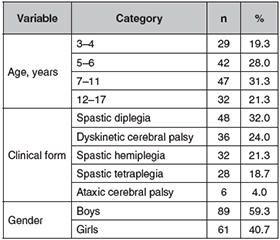
Актуальність. Церебральний параліч потребує багатовимірної оцінки функціональних обмежень. Мета: охарактеризувати клінічний і функціональний стан дітей із церебральним паралічем за чотирма системами класифікації та описово узагальнити показники фізичного функціонування відповідно до шкали PedsQL у попередньо визначених групах, що відрізнялися за великою моторикою і мануальними здібностями. Матеріали та методи. Поперечне обсерваційне дослідження охопило 150 пацієнтів (вік 3–17 років) спеціалізованого стаціонарного закладу Киргизької Республіки. Функціональний стан оцінювали за системами класифікації GMFCS (велика моторика), MACS (мануальні здібності), CFCS (комунікація) і EDACS (здатність до прийому їжі та пиття). Показники фізичного функціонування за шкалою PedsQL описово узагальнювали для груп GMFCS I–II порівняно з IV–V та MACS I–II порівняно з IV–V. Результати. Спастичні форми зустрічалися в 72 % випадків, найпоширенішою виявилася спастична диплегія (32 %). Мануальні здібності зберігалися відносно краще, ніж велика моторика, а комунікація була найбільш збереженою функціональною сферою. Між чотирма системами класифікації спостерігалися помірно сильні кореляції (ρ = 0,72–0,79; p < 0,001), хоча 29,3 % пацієнтів мали розбіжності у функціональних профілях. Середні показники фізичного функціонування за PedsQL були нижчими в групах GMFCS IV–V порівняно з I–II (46,9 ± 15,4 бала проти 81,7 ± 12,3 бала), а також MACS IV–V порівняно з I–II (51,3 ± 16,2 бала проти 76,4 ± 13,8 бала). Висновки. Чотири функціональні сфери були пов’язаними, але не взаємозамінними. Окрема оцінка великої моторики, мануальних здібностей, комунікації та здатності їсти i пити дає змогу повніше охарактеризувати функціональний стан дітей із церебральним паралічем.
Background. Cerebral palsy requires multidimensional assessment of functional limitations. This study aimed to characterise the clinical and functional status of children with cerebral palsy across four functional classification systems and to descriptively summarise PedsQL Physical Functioning scores across predefined groups differing in gross motor function and manual ability. Materials and methods. This cross-sectional observational study included 150 patients aged 3–17 years from a specialised inpatient facility in the Kyrgyz Republic. Functional status was assessed using the Gross Motor Function Classification System (GMFCS), Manual Ability Classification System (MACS), Communication Function Classification System, and Eating and Drinking Ability Classification System. PedsQL Physical Functioning scores were summarised descriptively for GMFCS I–II versus IV–V and MACS I–II versus IV–V groups. Results. Spastic forms accounted for 72 % of cases, with spastic diplegia being the most common form (32 %). Manual ability was relatively better preserved than gross motor function, while communication was the best-preserved domain. Moderately strong correlations were found between the four classification systems (ρ = 0.72–0.79; p < 0.001), although 29.3 % of patients had discrepant functional profiles. Mean PedsQL Physical Functioning scores were lower at GMFCS IV–V than I–II (46.9 ± 15.4 vs. 81.7 ± 12.3 points) and at MACS IV–V than I–II (51.3 ± 16.2 vs. 76.4 ± 13.8 points). Conclusions. The four functional domains were related but not interchangeable. Separate assessment of gross motor, manual, communication, and eating and drinking abilities provides a more complete functional profile of children with cerebral palsy.
мануальні здібності; обмеження комунікації; дискінетичний церебральний параліч; геміплегічний церебральний параліч; тетраплегічний церебральний параліч
manual ability; communication limitations; dyskinetic cerebral palsy; hemiplegic cerebral palsy; tetraplegic cerebral palsy
Для ознакомления с полным содержанием статьи необходимо оформить подписку на журнал.
- Piscitelli D, Ferrarello F, Ugolini A, Verola S, Pellicciari L. Measurement properties of the Gross Motor Function Classification System, Gross Motor Function Classification System — Expanded & Revised, Manual Ability Classification System, and Communication Function Classification System in cerebral palsy: a systematic review with meta-analysis. Dev Med Child Neurol. 2021 Nov;63(11):1251-1261. doi: 10.1111/dmcn.14910.
- Abdykarova AS, Aldashukurov YA, Turusbekova AK, Murzakarimova GP, Erkinbaeva EA. Demographic and clinical characteristics of children with cerebral palsy receiving inpatient treatment. Avicenna Bull. 2024 Nov;26(4):667-673. doi: 10.25005/2074-0581-2024-26-4-667-673.
- Ayupe KMA, Lima ALO, Gomes GCA, de Sousa DS, Camargos ACR, Chagas PSC, et al. Functional classification systems in Brazilian children with cerebral palsy: reliability and associations between functional levels. Dev Neurorehabil. 2024 Oct;27(7):243-250. doi: 10.1080/17518423.2024.2398158.
- Badgujar S, Dixit J, Kuril BM, Deshmukh LS, Khaire P, Vaidya V, Shelke M. Epidemiological predictors of quality of life and the role of early markers in children with cerebral palsy: a multi-centric cross-sectional study. Pediatr Neonatol. 2025 Jan;66(1):18-24. doi: 10.1016/j.pedneo.2024.04.003.
- Almasri NA, Alquaqzeh FA. Determinants of quality of life of children and adolescents with cerebral palsy: a systematic review. Phys Occup Ther Pediatr. 2023 Jan;43(4):367-388. doi: 10.1080/01942638.2022.2162358.
- Karim T, Muhit M, Jahan I, Galea C, Morgan C, Smithers-Sheedy H, et al. Outcome of community-based early intervention and rehabilitation for children with cerebral palsy in rural Bangladesh: a quasi-experimental study. Brain Sci. 2021 Sep;11(9):1189. doi: 10.3390/brainsci11091189.
- Shetty T, Ganesan S, Johari A, Mullerpatan R. Gross motor function profile of children with cerebral palsy in a low-resource setting: a call for reflection on the model of care. J Pediatr Rehabil Med. 2023 Mar;16(1):211-218. doi: 10.3233/PRM-220039.
- Agni PN, Muley P, Bhatt G. Association between psychological distress and quality of life among caregivers of children with cerebral palsy: a cross-sectional study. Bioinformation. 2025 Aug;21(8):2625-2630. doi: 10.6026/973206300212625.
- Wan L, Jiang L, Chen S, Yin M, He Q. Investigation on quality of life of parents of children with cerebral palsy and its influencing factors: a cross-sectional study. Medicine. 2025 Oct;104(44):e45441. doi: 10.1097/MD.0000000000045441.
- Unes S, Tuncdemir M, Ozal C, Cankaya O, Biyik KS, Deli–oglu K, et al. Relationship among four functional classification systems and parent interpredicted intelligence level in children with different clinical types of cerebral palsy. Dev Neurorehabil. 2022 Aug;25(6):410-416. doi: 10.1080/17518423.2022.2051629.
- Wong C, Westphall I, Michelsen JS. Measuring effects on pain and quality of life after abobotulinum toxin A injections in children with cerebral palsy. Toxins. 2022 Jan;14(1):43. doi: 10.3390/toxins14010043.
- Dzhamalbekova E, Dzhumabekov S, Sharshenov K. Application of botulin therapy in children with cerebral palsy. Eurasian Health J. 2024 Sep;16(4):25-29. doi: 10.54890/1694-8882-2024-4-25.
- Salih K. Pattern of cerebral palsy among Sudanese children less than 15 years of age. Cureus. 2020 Mar;12(3):e7232. doi: 10.7759/cureus.7232.
- Kibrom Y, Tekeste E, Tesfamariam S, Ogbe Z, Mohammed M. Clinical profile and associated comorbidities of cerebral palsy in children visiting Orotta National Referral Hospital, Eritrea: a cross-sectional study. BMC Pediatr. 2024 Jul;24(1):458. doi: 10.1186/s12887-024-04938-1.
- Bashe B, Assele DD, Ketema W, Shibeshi MS. Factors associated with cerebral palsy among children in Hawassa University comprehensive specialized hospital: case-control study. PLoS One. 2025 Sep;20(9):e0333406. doi: 10.1371/journal.pone.0333406.
- Awale A, Banskota B, Yadav P, Shakya G, Banskota AK. Cerebral palsy among children visiting the outpatient department of pediatric orthopaedics in a tertiary care centre. JNMA J Nepal Med Assoc. 2023 Aug;61(264):626-629. doi: 10.31729/jnma.8232.
- Patel DR, Neelakantan M, Pandher K, Merrick J. Cerebral palsy in children: a clinical overview. Transl Pediatr. 2020 Feb;9(1):S125-S135. doi: 10.21037/tp.2020.01.01.
- Rosenbaum P, Paneth N, Leviton A, Goldstein M, Bax M, Damiano D, et al. A report: the definition and classification of cerebral palsy April 2006. Dev Med Child Neurol. 2007 Jun;49(s109):8-14. doi: 10.1111/j.1469-8749.2007.tb12610.x.
- Palisano RJ, Rosenbaum P, Bartlett D, Livingston MH. Content validity of the expanded and revised Gross Motor Function Classification System. Dev Med Child Neurol. 2008 Oct;50(10):744-750. doi: 10.1111/j.1469-8749.2008.03089.x.
- Eliasson AC, Krumlinde-Sundholm L, Rösblad B, Beckung E, Arner M, Öhrvall AM, Rosenbaum P. The Manual Ability Classification System (MACS) for children with cerebral palsy: scale development and evidence of validity and reliability. Dev Med Child Neurol. 2006 Jul;48(7):549-554. doi: 10.1017/s0012162206001162.
- Hidecker MJC, Paneth N, Rosenbaum PL, Kent RD, Lillie J, Eulenberg JB, et al. Developing and validating the Communication Function Classification System for individuals with cerebral palsy. Dev Med Child Neurol. 2011 Aug;53(8):704-710. doi: 10.1111/j.1469-8749.2011.03996.x.
- Sellers D, Mandy A, Pennington L, Hankins M, Morris C. Deve–lopment and reliability of a system to classify the eating and drinking ability of people with cerebral palsy. Dev Med Child Neurol. 2014 Mar;56(3):245-251. doi: 10.1111/dmcn.12352.
- Varni JW, Seid M, Kurtin PS. PedsQL 4.0: Reliability and validity of the Pediatric Quality of Life Inventory Version 4.0 Generic Core Scales in healthy and patient populations. Med Care. 2001 Aug;39(8):800-812. doi: 10.1097/00005650-200108000-00006.
- World Medical Association. WMA Declaration of Helsinki — ethical principles for medical research involving human subjects. 2024. Available from: https://www.wma.net/policies-post/wma-declaration-of-helsinki/.
- Abate BB, Tegegne KM, Zemariam AB, Wondmagegn Alamaw A, Kassa MA, Kitaw TA, et al. Magnitude and clinical characteristics of cerebral palsy among children in Africa: a systematic review and meta-ana–lysis. PLoS Glob Public Health. 2024 Jun;4(6):e0003003. doi: 10.1371/journal.pgph.0003003.
- Kumar R, Biswas B, Kumar M, Deepak K, Ansari ME, Kundu S. Clinical spectrum and associated comorbidities of cerebral palsy among children in Eastern India. Sci Rep. 2025 Dec;15:44678. doi: 10.1038/s41598-025-28245-6.
- Wanigasinghe J, Jasotharan V, Thilaxshan T, Murugupillai R, Arambepola C. Prevalence of cerebral palsy among children aged 2 to 5 years in a rural district in Sri Lanka: a population-based study. J Pediatr Neurol. 2024 Jun;22(3):202-207. doi: 10.1055/s-0043-1770053.
- Viswanath M, Jha R, Gambhirao AD, Kurup A, Badal S, Kohli S, et al. Comorbidities in children with cerebral palsy: a single-centre cross-sectional hospital-based study from India. BMJ Open. 2023 Jul;13(7):e072365. doi: 10.1136/bmjopen-2023-072365.
- Arif F, Mannan A, Jabeen J, Shahzad H, Khalid Z, Qaiser N. Association between gross motor function and manual ability in children with spastic cerebral palsy. J Health Rehabil Res. 2023 Dec;3(2):357-362. doi: 10.61919/jhrr.v3i2.143.
- Burç E, Özal C, Kerem Günel M. The relationship among the functional levels, dyskinetic movements and participation in children with dyskinetic cerebral palsy. Neurol Asia. 2024 Jun;29(2):453-464. doi: 10.54029/2024kmn.
- Zarkada A, Dimakopoulos R, Germani T, Zavlanou A, Spinou A, Skouteli H. Cross-cultural validation in Greek and reliability of the Ea–ting and Drinking Ability Classification System in children with cerebral palsy. J Paediatr Child Health. 2025 Feb;61(2):223-229. doi: 10.1111/jpc.16739.
- Speroni A, Della Bella G, Cerchiari A, Mignolli E, Tofani M. Reliability and construct validity of the Communication Function Classification System (CFCS) in an Italian population of children with cerebral palsy. Children. 2025 Dec;13(1):12. doi: 10.3390/children13010012.
- García Ron A, González Toboso RM, Bote Gascón M, de Santos MT, Vecino R, Bodas Pinedo A. Nutritional status and prevalence of dysphagia in cerebral palsy: usefulness of the Eating and Drinking Abi–lity Classification System scale and correlation with the degree of motor impairment according to the Gross Motor Function Classification System. Neurología. 2023 Jan-Feb;38(1):35-40. doi: 10.1016/j.nrleng.2019.12.006.
- Calderone A, Militi D, Cardile D, Corallo F, Calabrò RS, Mi–liti A. Swallowing disorders in cerebral palsy: a systematic review of oropharyngeal dysphagia, nutritional impact, and health risks. Ital J Pediatr. 2025 Feb;51(1):57. doi: 10.1186/s13052-025-01903-1.
- Gong C, Liu X, Fang L, Liu A, Lian B, Qi X, et al. Prevalence of cerebral palsy comorbidities in China: a systematic review and meta-analysis. Front Neurol. 2023 Sep;14:1233700. doi: 10.3389/fneur.2023.1233700.
- Barbier V, Goeb V, Gouron R, Fritot S, Mentaverri R, Klein C. Bone health in children with severe cerebral palsy. Front Pediatr. 2023 Nov;11:1264111. doi: 10.3389/fped.2023.1264111.
- Vinje S, Terjesen T, Kibsgård T. Scoliosis in children with severe cerebral palsy: a population-based study of 206 children at GMFCS levels III–V. Eur Spine J. 2023 Nov;32(11):4030-4036. doi: 10.1007/s00586-023-07868-1.
- Harvey A, Smith N, Smith M, Ostojic K, Berryman C. Chronic pain in children and young people with cerebral palsy: a narrative review of challenges, advances, and future directions. BMC Med. 2024 Jun;22:238. doi: 10.1186/s12916-024-03458-0.
- Vinkel MN, Rackauskaite G, Finnerup NB. Classification of pain in children with cerebral palsy. Dev Med Child Neurol. 2022 Apr;64(4):447-452. doi: 10.1111/dmcn.15102.
- López-Ruiz J, Giménez M-J, Castel-Sánchez M, Rico-Mena P, Mallo-López A, Salniccia F, Martín-Casas P. Multidimensional analysis of parent-perceived quality of life in children with cerebral palsy: a cross-sectional study. Children. 2026 Jan;13(1):128. doi: 10.3390/children13010128.
- Di Lieto MC, Matteucci E, Martinelli A, Beani E, Menici V, Martini G, et al. Impact of social participation, motor, and cognitive functioning on quality of life in children with cerebral palsy. Res Dev Disabil. 2025 Jun;161:105004. doi: 10.1016/j.ridd.2025.105004.
- Albesher RA, Basoudan RM, Ghufayri A, Aldayel D, Fagihi D, Alzeer S, et al. Quality of life of children with cerebral palsy and its association with their physical activity levels: a cross-sectional study. Healthcare. 2025 Aug;13(17):2166. doi: 10.3390/healthcare13172166.
- De Pontes VA, Silva JMM, Cabral NO, Ayupe KMA, Morais RLS, Chagas PSC, et al. Participation profile and environmental context of Brazilian children with cerebral palsy: associations with functioning and environmental factors. Rev Paul Pediatr. 2025 Dec;43:e2025014. doi: 10.1590/1984-0462/2025/43/2025014.
- Nishibu H, Hosokawa Seino T, Himuro N. Psychometric evaluation and distribution of classification systems in children with cerebral palsy in Japan. J Pediatr Rehabil Med. 2023 Nov;16(1):223-233. doi: 10.3233/PRM-210098.