
Журнал «Здоровье ребенка» Том 21, №7, 2026
Вернуться к номеру
Психосоціальна реабілітація дітей із цукровим діабетом 1-го типу: вплив сімейної підтримки на якість життя та прихильність до лікування
Авторы: V. Ojovan
Nicolae Testemitanu State University of Medicine and Pharmacy, Chișinău, Republic of Moldova
Рубрики: Педиатрия/Неонатология
Разделы: Клинические исследования
Версия для печати
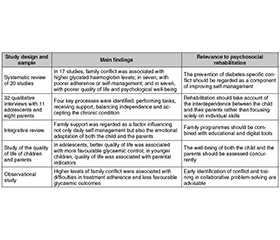
Актуальність. Цукровий діабет 1-го типу в дитячому й підлітковому віці потребує постійного медичного спостереження, а також довготривалої психологічної, поведінкової та соціальної підтримки. Це обумовлено тим, що на щоденні лікувальні заходи значною мірою впливає характер взаємодії в сім’ї. Мета: теоретично обґрунтувати важливість участі батьків у формуванні емоційного благополуччя, поведінки, пов’язаної з лікуванням, та адаптації неповнолітніх пацієнтів із порушеннями вуглеводного обміну. Матеріали та методи. Для цього в дослідженні було використано аналіз і синтез наукових даних, порівняльний метод, систематизацію, узагальнення та структурно-логічне моделювання. Вказані методи дозволили визначити основні шляхи впливу сімейної підтримки на якість життя, поведінку, пов’язану з лікуванням, і психосоціальну адаптацію дітей із цукровим діабетом 1-го типу. Результати. Встановлено, що конструктивна участь батьків охоплює емоційну доступність, узгоджений розподіл відповідальності, допомогу в самоконтролі, підтримку автономії та зменшення конфліктів. Найбільш переконливі докази стосуються негативної ролі специфічних для діабету сімейних конфліктів. Систематичний огляд 20 досліджень показав, що в 17 із них такі конфлікти були пов’язані з вищими рівнями глікованого гемоглобіну. У семи роботах виявлено їх зв’язок із нижчим самоконтролем захворювання, а ще в семи — із гіршими психологічними наслідками. Програми втручання продемонстрували позитивний вплив на впевненість батьків у своїх можливостях, самоефективність підлітків, комунікацію та окремі поведінкові показники. Разом із тим вплив на метаболічний контроль був непослідовним. Встановлено, що цифрові інструменти були ефективними лише в поєднанні з безпосередньою психологічною підтримкою. Висновки. Оптимальним підходом є модель гнучкого спільного управління захворюванням, за якої дорослі продовжують брати участь у лікувальному процесі, поступово передаючи частину відповідальності дитині згідно з її віком, зрілістю та сформованими навичками. Отримані результати можуть бути використані для розроблення програм медичної та психологічної підтримки сімей.
Background. Childhood and adolescent type 1 diabetes requires continuous medical monitoring, as well as long-term psychological, behavioural and social support. This is because daily treatment-related activities are substantially influenced by patterns of family interaction. The aim of this study was to provide a theoretical rationale for the importance of parental involvement. This involvement is in shaping emotional well-being, treatment-related behaviour and adaptation. These are among underage patients with impaired carbohydrate metabolism. Materials and methods. To this end, the study employed scientific evidence analysis and synthesis, comparative methods, systematisation, generalisation, and structural-logical modelling. These methods enabled the identification of the key ways in which family support influences the quality of life, treatment-related behaviour, and psychosocial adaptation of children with type 1 diabetes. Results. Constructive parental involvement was found to encompass emotional availability, coordinated responsibility, self-management assistance, autonomy support and conflict reduction. The most compelling evidence concerns the adverse role of diabetes-specific conflict. A systematic review of 20 studies found that 17 studies associated it with higher glycated haemoglobin levels. Seven studies found it to be associated with poorer self-management. A further seven studies found it to be associated with worse psychological outcomes. Intervention programmes were shown to have a positive effect on parental confidence, adolescent self-efficacy, communication and certain behavioural outcomes. However, their impact on metabolic control was inconsistent. It was shown that digital tools were only beneficial when combined with direct psychological support. Conclusions. The optimal approach is a model of flexible shared management. Adults remain involved in this model. They gradually transfer part of the responsibility to the child. This is in accordance with the child’s age, maturity and skills. These findings could inform the development of medical and psychological support programmes for families.
батьківський дистрес; глікемічний контроль; глікований гемоглобін; емоційна адаптація; медична та психологічна підтримка
parental distress; glycaemic control; glycated haemoglobin; emotional adaptation; medical and psychological support
Для ознакомления с полным содержанием статьи необходимо оформить подписку на журнал.
- American Diabetes Association Professional Practice Committee for Diabetes. Children and adolescents: standards of care in diabetes — 2026. Diabetes Care. 2026 Dec;49(1). doi: 10.2337/dc26-S014.
- Condrea V. Relationship between anxiety and glycated hemoglobin in adolescents with type 1 diabetes. Studies of the State University of Moldova. Series of Educational Sciences. 2024 Mar;5(175):206-211. doi: 10.59295/sum5(175)2024_30.
- Ojovan V. Biopsychosocial rehabilitation of children with type 1 diabetes mellitus. International Journal of Child Health and Nutrition. 2026 Jun;15(3):171-185. doi: 10.6000/1929-4247.2026.15.03.5.
- Kimbell B, Lawton J, Boughton CK, Hovorka R, Rankin D. Parents’ experiences of caring for a young child with type 1 diabetes: a systematic review and synthesis of qualitative evidence. BMC Pediatrics. 2021 Apr;21:160. doi: 10.1186/s12887-021-02569-4.
- Saßmann H, Kim-Dorner SJ, Berndt V, et al. Understanding daily, emotional, and physical burdens and needs of parents caring for children with type 1 diabetes. Journal of Diabetes Research. 2022 Dec;2022(1):9604115. doi: 10.1155/2022/9604115.
- Salcudean A, Lica MM. The role of systemic family psychotherapy in glycemic control for children with type 1 diabetes. Children. 2024 Jan;11(1):104. doi: 10.3390/children11010104.
- Almeida AC, Leandro ME, Pereira MG. Family functioning and quality of life in adolescents with type 1 diabetes: the role of dissimilarity in illness representations and school support. Clinical Child Psychology and Psychiatry. 2020 Apr;25(2):494-506. doi: 10.1177/1359104519895054.
- Buyuk ET, Uzsen H, Koyun M, Dönertaş R. Parental monito–ring status of the children with type 1 diabetes mellitus and their quality of life. International Journal of Diabetes in Developing Countries. 2024 Dec;44(4):687-693. doi: 10.1007/s13410-023-01304-2.
- Doutreluingne I, Hellemans H, Toelen J, Casteels K. Perspective of parents of children with type 1 diabetes on the future of their child: a qualitative study. BMJ Paediatrics Open. 2025 Jun;9(1). doi: 10.1136/bmjpo-2025-003387.
- Mohan DS, Vani HN, Madegowda RK, Palany R. Psychosocial factors and the role of family in children with type 1 diabetes mellitus. Dubai Diabetes and Endocrinology Journal. 2024 Jan;29(3–4):171-178. doi: 10.1159/000535051.
- Messina A. Immunopsychiatry: current concepts and future directions. Immunol Res. 2026 Feb;74(1):19. doi: 10.1007/s12026-026-09753-7.
- De Wit M, Gajewska KA, Goethals ER, et al. ISPAD Clinical Practice Consensus Guidelines 2022: psychological care of children, adolescents and young adults with diabetes. Pediatric Diabetes. 2022 Dec;23(8):1373-1389. doi: 10.1111/pedi.13428.
- Hickling A, Dingle GA, Barrett HL, Cobham VE. Systematic review: diabetes family conflict in young people with type 1 diabetes. Journal of Pediatric Psychology. 2021 Oct;46(9):1091-1109. doi: 10.1093/jpepsy/jsab052.
- Fox DA, Bone JN, Keidar S, Amed S. Family conflict in type 1 diabetes: who is at risk? Pediatric Diabetes. 2020 Oct;21(8):1575-1582. doi: 10.1111/pedi.13116.
- Farthing P, Bally JMG, Leurer MD, Holtslander L, Nour MA, Rennie D. Managing the unmanageable through interdependence in adolescents living with type 1 diabetes and their parents: a constructi–vist grounded theory. Journal of Pediatric Nursing. 2022 Nov;67. doi: 10.1016/j.pedn.2022.07.016.
- Totka JP, Snethen JA, Cox ED. Youth and parent health-related quality of life and association with glycemic outcomes in preadolescents and adolescents with type 1 diabetes. Journal of Pediatric Health Care. 2021 Jan;35(1):64-73. doi: 10.1016/j.pedhc.2020.07.015.
- Ispriantari A, Agustina R, Konlan KD, Lee H. Family-centered interventions for children and adolescents with type 1 diabetes mellitus: an integrative review. Child Health Nursing Research. 2023 Jan;29(1):7-23. doi: 10.4094/chnr.2023.29.1.7.
- Mitchell AE, Morawska A, Lohan A, Filus A, Batch J. Randomised controlled trial of the Healthy Living Triple P-Positive Parenting Program for families of children with type 1 diabetes. Journal of Child Health Care. 2024 Aug;28(2):235-255. doi: 10.1177/13674935221116694.
- Jafarzadeh Sheikh E. Effective strategies for chronic disease ma–nagement in resource-limited settings: the case of India. Med Sci Ukraine. 2025 Sep;21(3):123-136. doi: 10.32345/2664-4738.3.2025.13.
- Alzawahreh S, Ozturk C. Improving self-efficacy, quality of life, and glycemic control in adolescents with type 1 diabetes: randomized controlled trial for the evaluation of the family-centered empowerment model. JMIR Formative Research. 2024 Dec;8. doi: 10.2196/64463.
- Marakushyn D, Bulynina O, Isaieva I, Karmazina I, Maslova N. Impact of stress on emotional health and cognitive function. Med Sci Ukraine. 2024 Jun;20(2):136-142. doi: 10.32345/2664-4738.2.2024.18.
- Fung A, Howard D, Nichol H, et al. Coaching for parents of children with type 1 diabetes: a randomized controlled trial. Patient Education and Counseling. 2024 Jun;123:108205. doi: 10.1016/j.pec.2024.108205.
- Hughes Lansing A, Cohen LB, Glaser NS, Loomba LA. Feasibility and acceptability of a self-guided digital family skills management intervention for children newly diagnosed with type 1 diabetes: pilot randomized controlled trial. JMIR Formative Research. 2024 Oct;8. doi: 10.2196/59246.
- Bassi G, Mancinelli E, Di Riso D, Salcuni S. Parental stress, anxiety and depression symptoms associated with self-efficacy in paediatric type 1 diabetes: a literature review. International Journal of Environmental Research and Public Health. 2021 Dec;18(1):152. doi: 10.3390/ijerph18010152.
- Allen V, Mahieu A, Kasireddy E, et al. Humanistic burden of pediatric type 1 diabetes on children and informal caregivers: systematic literature reviews. Diabetology and Metabolic Syndrome. 2024 Mar;16:73. doi: 10.1186/s13098-024-01310-2.
- Azar S, Maroun Abou Jaoude N, Kędzia A, Niechciał E. Barriers to type 1 diabetes adherence in adolescents. Journal of Clinical Medicine. 2024 Sep;13(19):5669. doi: 10.3390/jcm13195669.
- Cao XL, Vu XH. Parental stress, coping, and family functioning in families of children with special needs: a critical review of psychological models. North Am J Psychol. 2026;28(2):1083-1100.
- Liu J, Li J, Li L, Zeng K. Impact of family environment on mental disorders and quality of life in children with type 1 diabetes mellitus: a cross-sectional study and intervention policy analysis. Frontiers in Pediatrics. 2025 Mar;13:1516411. doi: 10.3389/fped.2025.1516411.
- Basch M, Lupini F, Ho S, et al. Mindfulness-based group intervention for adolescents with type 1 diabetes: initial findings from a pilot and feasibility randomized controlled trial. Journal of Pediatric Psycho–logy. 2024 Oct;49(10):769-779. doi: 10.1093/jpepsy/jsae071.
- Straton E, Inverso H, Moore H, et al. Glycemic and psychosocial correlates of continuous glucose monitor use among adolescents with type 1 diabetes. Journal of Diabetes Science and Technology. 2025 Mar;19(2):436-440. doi: 10.1177/19322968231186428.
- DeBoer MD, Valdez RS, Corbett JP, et al. Effect of an automated advice algorithm (CloudConnect) on adolescent-parent diabetes-specific communication and glycemic management: a randomized trial. Diabetes Therapy. 2023 Apr;14(5):899-913. doi: 10.1007/s13300-023-01401-9.
- Hashemipour-Zavareh M, Yousofi Z, Hashemipour M. Comparison of family life quality in type 1 diabetic and healthy children from the perception of their mothers. International Journal of Preventive Medicine. 2020 Sep;11(1):154. doi: 10.4103/ijpvm.IJPVM_200_19.
- Balcázar-Hernández L, Huerta-Martínez H, Garrido Magaña E, Nishimura-Meguro E, Jiménez Márquez A, Rivera-Hernández A. Burden in primary informal caregivers of children and adolescents with type 1 diabetes: is it associated with depression, family dysfunction, and glycemic control? Frontiers in Endocrinology. 2023 Jan;13:1089160. doi: 10.3389/fendo.2022.1089160.
- Kunthamas M, Jaipaeng W, Klaisuban T, Pongsuwun K, Ruksakulpiwat S. The effect of parental involvement intervention on qua–lity of life and health outcomes among children and adolescents with chronic illness: a systematic review and meta-analysis. European Journal of Pediatrics. 2025 Nov;184:733. doi: 10.1007/s00431-025-06590-y.
- Yamaguchi M, Honda J, Fukui M. Effects of parental involvement on glycemic control in adolescents with type 1 diabetes mellitus: a scoping review. Journal of Family Nursing. 2023 Nov;29(4):382-394. doi: 10.1177/10748407231171842.