
Международный эндокринологический журнал Том 22, №7, 2026
Вернуться к номеру
Статус вітаміну D та ліпідний профіль як фактори ризику ураження печінки при латентному автоімунному діабеті дорослих і молоді
Авторы: I.O. Tsaryk, N.V. Pashkovska
Bukovinian State Medical University, Chernivtsi, Ukraine
Рубрики: Эндокринология
Разделы: Клинические исследования
Версия для печати
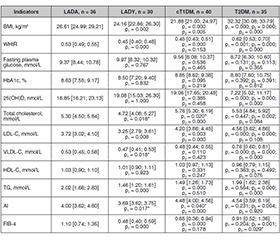
Актуальність. Латентний автоімунний діабет являє собою гетерогенний спектр автоімунного діабету, що характеризується прогресуючою дисфункцією та руйнуванням β-клітин і має варіабельні клінічні й метаболічні фенотипи, які можуть перекриватися з такими, що спостерігаються при цукровому діабеті 2-го типу (ЦД2). Цей спектр охоплює латентний автоімунний діабет у дорослих (LADA) та латентний автоімунний діабет у молоді (LADY). Метa: оцінити зв’язок між показниками ліпідного профілю, статусом вітаміну D і тяжкістю субклінічного ураження печінки (за індексом FIB-4) у пацієнтів із латентними формами автоімунного діабету порівняно з особами з класичним ЦД 1-го типу та ЦД2. Матеріали та методи. Обстежено 141 пацієнта, розділених на 4 групи: LADA (n = 36), LADY (n = 30), класичний ЦД 1-го типу (n = 40), ЦД2 (n = 35). Визначали антропометричний профіль, глікемію, рівень глікованого гемоглобіну, ліпідний профіль, печінкові ферменти, уміст 25(OH)D та розраховували індекс FIB-4. Статистичний аналіз включав тести Краскела — Уолліса і Манна — Уїтні з поправкою Бонферроні (α = 0,0083). Результати. Підтип LADY мав більш сприятливі значення індексу маси тіла, співвідношення окружності талії та зросту, тригліцеридів, ліпопротеїнів низької щільності та індексу FIB-4 порівняно з LADA (p < 0,01). Рівні 25(OH)D були однаково низькими в усіх групах автоімунного діабету (дефіцит), тоді як найнижчі значення спостерігалися при ЦД2 (p = 0,000). Дефіцит вітаміну D є фактором ризику виникнення фіброзу при всіх формах автоімунного діабету, тоді як саме різниця в тяжкості метаболічного/ліпідного компонентів (вторинна щодо віку початку захворювання й інсулінорезистентності) пояснює різницю у FIB-4 між підтипами. Висновки. Дефіцит 25(OH)D є загальним фоновим фактором для всього спектра автоімунного діабету незалежно від віку початку захворювання, а віково-залежні відмінності інсулінорезистентності обумовлюють більш сприятливий ліпідний профіль та нижчі значення FIB-4 у підгрупі LADY порівняно з LADA. Отримані результати обґрунтовують необхідність диференційованого клінічного моніторингу ліпідного спектра та неінвазивних маркерів ураження печінки в пацієнтів із латентними формами автоімунного діабету.
Background. Latent autoimmune diabetes represents a heterogeneous spectrum of autoimmune diabetes characterized by progressive β-cell dysfunction and destruction, with variable clinical and metabolic phenotypes that may overlap with those observed in type 2 diabetes mellitus (T2DM). This spectrum includes latent autoimmune diabetes in adults (LADA) and latent autoimmune diabetes in youth (LADY). The purpose of the study was to assess the relationship between lipid profile indicators, vitamin D status and severity of subclinical liver damage (according to the FIB-4 index) in patients with latent forms of autoimmune diabetes compared to those with classical type 1 diabetes and T2DM. Materials and methods. One hundred and forty-one patients were examined, divided into 4 groups: LADA (n = 36), LADY (n = 30), classical type 1 diabetes (n = 40) and T2DM (n = 35). Anthropometric profile, glycemia, HbA1c, lipid profile, liver enzymes, 25(OH)D level were determined and the FIB-4 index was calculated. Statistical analysis included Kruskal-Wallis and Mann-Whitney tests with Bonferroni correction (α = 0.0083). Results. The LADY subtype showed more favorable values of body mass index, weight-to-height ratio, triglycerides, low-density lipoprotein cholesterol and FIB-4 compared to LADA (p < 0.01). 25(OH)D levels were equally low in all autoimmune diabetes groups (deficiency), while the lowest values were observed in T2DM (p = 0.000). Vitamin D deficiency is a risk factor for fibrosis across the spectrum of autoimmune diabetes, while it is the difference in the severity of the metabolic/lipid component (secondary to age of onset and insulin resistance) that explains the difference in FIB-4 between subtypes. Conclusions. 25(OH)D deficiency is a common background factor for the entire spectrum of autoimmune diabetes regardless of the age of onset, while age-dependent differences in insulin resistance determine a more favorable lipid profile and lower FIB-4 values in the LADY subgroup compared to LADA. The results obtained justify the need for differentiated clinical monitoring of the lipid spectrum and non-invasive markers of liver damage in patients with latent forms of autoimmune diabetes.
латентний автоімунний діабет; латентний автоімунний діабет у дорослих; латентний автоімунний діабет у молоді; ураження печінки; дисліпідемія; вітамін D
latent autoimmune diabetes; latent autoimmune diabetes in adults; latent autoimmune diabetes in youth; liver damage; dyslipidemia; vitamin D
Для ознакомления с полным содержанием статьи необходимо оформить подписку на журнал.
- Buzzetti R, Tuomi T, Mauricio D, Pietropaolo M, Zhou Z, Pozzilli P, Leslie RD. Management of Latent Autoimmune Diabetes in Adults: A Consensus Statement From an International Expert Panel. Diabetes. 2020 Oct;69(10):2037-2047. doi: 10.2337/dbi20-0017.
- Cheng J, Tang X, Yan X, Huang G, Luo S, Zhou Z, Li X. Latent autoimmune diabetes in youth shows greater autoimmunity than latent autoimmune diabetes in adults: Evidence from a nationwide, multicenter, cross-sectional study. Pediatr Diabetes. 2022 Aug;23(5):578-587. doi: 10.1111/pedi.13348.
- Guerrero-Guerrero R, Mendez-Guerrero O, Carranza-Carrasco A, Tejeda F, Ardon-Lopez A, Navarro-Alvarez N. Beyond bones: Revisiting the role of vitamin D in chronic liver disease. World J Hepatol. 2025 Nov 27;17(11):112315. doi: 10.4254/wjh.v17.i11.112315.
- Zhang H, Shen Z, Lin Y, Zhang J, Zhang Y, Liu P, et al. Vitamin D receptor targets hepatocyte nuclear factor 4α and mediates protective effects of vitamin D in nonalcoholic fatty liver disease. J Biol Chem. 2020 Mar 20;295(12):3891-3905. doi: 10.1074/jbc.RA119.011487.
- Beilfuss A, Sowa JP, Sydor S, Beste M, Bechmann LP, Schlattjan M, et al. Vitamin D counteracts fibrogenic TGF-β signalling in human hepatic stellate cells both receptor-dependently and independently. Gut. 2015 May;64(5):791-9. doi: 10.1136/gutjnl-2014-307024.
- Udomsinprasert W, Jittikoon J. Vitamin D and liver fibrosis: Molecular mechanisms and clinical studies. Biomed Pharmacother. 2019 Jan;109:1351-1360. doi: 10.1016/j.biopha.2018.10.140.
- Li J, Yan N, Li X, He S. Association between serum vitamin D concentration and liver fibrosis in diabetes mellitus patients: a cross-sectional study from the NHANES database. Acta Diabetol. 2024 Nov;61(11):1393-1402. doi: 10.1007/s00592-024-02292-3.
- Chen X, Zhao Y, Zhang R, Zhao Y, Dai L. The effect of vitamin D supplementation on some metabolic parameters in patients with nonalcoholic fatty liver disease: A systematic review and meta-analysis of 8 RCTs. Medicine (Baltimore). 2023 Oct 20;102(42):e35717. doi: 10.1097/MD.0000000000035717.
- Sun Q, Yang M, Jing Y, Meng L, Zhang C, Ruan J, et al. Latent autoimmune diabetes in youth. Front Immunol. 2025;16:1691377. doi: 10.3389/fimmu.2025.1691377.
- Lundholm MD, Zhou K. Latent autoimmune diabetes in adults: Not type 1, not type 2, a little of both. Cleve Clin J Med. 2025 Dec 1;92(12):757-763. doi: 10.3949/ccjm.92a.25069.
- Tsaryk I, Pashkovska N, Pankiv V. Latent autoimmune diabetes in youth: characteristics of the metabolic endotype and anthropometric markers for differential diagnosis. Child’s Health. 2026;21(4):201-6. doi: 10.22141/2224-0551.21.4.2026.1959.
- Pludowski P, Takacs I, Boyanov M, Belaya Z, Diaconu CC, Mokhort T, et al. Clinical Practice in the Prevention, Diagnosis and Treatment of Vitamin D Deficiency: A Central and Eastern European Expert Consensus Statement. Nutrients. 2022 Apr 2;14(7):1483. doi: 10.3390/nu14071483.
- Weston CS, Boehm BO, Pozzilli P. Type 1 diabetes: A new vision of the disease based on endotypes. Diabetes Metab Res Rev. 2024 Feb;40(2):e3770. doi: 10.1002/dmrr.3770.
- Peng Y, Li X, Xiang Y, Yan X, Zhou H, Tang X, et al. GAD65 Antibody Epitopes and Genetic Background in Latent Autoimmune Diabetes in Youth (LADY). Front Immunol. 2022 Mar 9;13:836952. doi: 10.3389/fimmu.2022.836952.
- Niu X, Luo S, Li X, Xie Z, Xiang Y, Huang G, et al. Identification of a distinct phenotype of elderly latent autoimmune diabetes in adults: LADA China Study 8. Diabetes Metab Res Rev. 2019 Jan;35(1):e3068. doi: 10.1002/dmrr.3068.
- Kumar A, de Leiva A. Latent autoimmune diabetes in adults (LADA) in Asian and European populations. Diabetes Metab Res Rev. 2017 Jul;33(5). doi: 10.1002/dmrr.2890.
- Lytvyak E, Hirschfield G, Shreekumar D, Wong YJ, Montano-Loza AJ. Pathogenesis, Non-Invasive Assessments and Treatment of Hepatic Fibrosis in Autoimmune Liver Diseases. Liver Int. 2025 Aug;45(8):e70190. doi: 10.1111/liv.70190.
- Saiprasad S, Swamy N. When Type 2 Diabetes Isn’t Type 2: Latent Autoimmune Diabetes in a Lean, Highly Physically Active Adult. Cureus. 2026 Feb 4;18(2):e102964. doi: 10.7759/cureus.102964.
- Grygorieva N, Tronko M, Kovalenko V, Komisarenko S, Tatarchuk T, Dedukh N, et al. Ukrainian Consensus on Diagnosis and Management of Vitamin D Deficiency in Adults. Nutrients. 2024 Jan 16;16(2):270. doi: 10.3390/nu16020270.
- Pisal T, Gupta PR, Mestry DB, Arke AD. Latent Autoimmune Diabetes in Adults: A Case Series and Clinical Insights. Cureus. 2025 Aug 24;17(8):e90879. doi: 10.7759/cureus.90879.
- Tsaryk I, Pashkovska N, Pankiv V, Pashkovskyy V, Stankova N. Features of Anxiety and Depression Indicators in Patients With Autoimmune Diabetes Mellitus on the Background of Different Vitamin D Status. Romanian Journal of Diabetes Nutrition and Metabolic Di–seases. 2025;32(2):203-209. doi: 10.46389/rjd-2025-1873.