
Международный эндокринологический журнал Том 22, №7, 2026
Вернуться к номеру
Перспективи корекції високими дозами L-аргініну ендотеліальної дисфункції у профілактиці кардіоренальних ускладнень: у фокусі цукровий діабет
Авторы: Курята О.В., Гречаник М.М.
Дніпровський державний медичний університет, м. Дніпро, Україна
Рубрики: Эндокринология
Разделы: Клинические исследования
Версия для печати
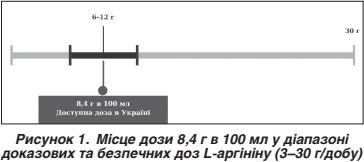
Актуальність. Сучасна концепція «кардіоренометаболічного синдрому» (КРМс) передбачає пошук єдиної терапевтичної мішені впливу, зокрема функціонального стану ендотелію. Особлива увага приділяється хворим на цукровий діабет (ЦД), які мають найбільші ризики. Мета огляду: проаналізувати літературні дані стосовно функції ендотелію при ЦД 2-го типу та ролі високих доз L-аргініну як можливої терапевтичної потреби. Матеріали та методи. Проведено пошук літератури у базах даних Medline/PubMed, Web of Science, Scopus, Cochrane Library та Google Scholar з охопленням досліджень, опублікованих до червня 2026 року. Пошук здійснювали за такими ключовими словами: «L-аргінін», «кардіоренометаболічний синдром», «цукровий діабет», «ефективність», «безпечність». Результати. Ендотеліальна дисфункція (ЕД) — загальновідомий фактор ризику розвитку серцево-судинних, цереброваскулярних захворювань, діабетичної нефропатії. Перспективним напрямком є визначення високих доз L-аргініну як єдиного ендогенного субстрату для корекції ЕД. Складні біорегуляторні механізми (дефіцит кофактора, зниження експресії NO-синтази (NOS) або надлишок ендогенних інгібіторів NOS) зумовлюють необхідність обговорення найбільш ефективних доз L-аргініну у пацієнтів з ЦД та КРМс. Результати досліджень демонструють значне поліпшення стану при ЕД, секреції та чутливості до інсуліну, толерантності до глюкози, зменшення запалення, позитивний вплив на ліпідний обмін. Висновки. ЕД є одним із ключових механізмів прогресування кардіоренальних ускладнень при ЦД. Застосування екзогенного L-аргініну має патогенетично обґрунтований терапевтичний потенціал. Клінічно доцільним є застосування високих доз у діапазоні від 6 до 12 г/добу, які забезпечують достатню доступність субстрату для синтезу NO та відповідають дозовому діапазону, ефективність якого продемонстровано в клінічних дослідженнях.
Background. The current concept of cardiorenal metabolic syndrome involves the search for a single therapeutic target of intervention, specifically the functional state of the endothelium. Special attention is given to patients with diabetes mellitus (DM), who face the highest risks. The aim of the study was to analyze the literature data regarding endothelial function in type 2 DM and the role of high doses of L-arginine as a potential therapeutic requirement. Materials and methods. A literature search was conducted in the following databases: MEDLINE/PubMed, Web of Science, Scopus, Cochrane Library, and Google Scholar, encompassing studies published up to June 2026. The search was performed using the keywords: “L-arginine”, “cardiorenal metabolic syndrome”, “diabetes mellitus”, “efficacy”, “safety”. Results. Endothelial dysfunction (ED) is a well-known risk factor for the development of cardiovascular and cerebrovascular diseases, as well as diabetic nephropathy. Evaluating high doses of L-arginine as the sole endogenous substrate for ED correction represents a promising direction. Complex bioregulatory mechanisms (cofactor deficiency, decreased expression of NO synthase (NOS), or an excess of endogenous NOS inhibitors) necessitate discussion regarding the most effective doses of L-arginine in patients with diabetes mellitus and cardiorenal metabolic syndrome. Study results demonstrate significant improvements in ED, insulin secretion and sensitivity, glucose tolerance, a reduction in inflammation, and a positive effect on lipid metabolism. Conclusions. ED is one of the key mechanisms driving the progression of cardiorenal complications in DM. The use of exogenous L-arginine possesses pathogenetically sound therapeutic potential, with high-dose therapy in the range of 6 to 12 g/day being clinically expedient — providing adequate substrate supply for the NO synthesis and matching the dosage range demonstrated as effective in clinical trials.
L-аргінін; кардіоренометаболічний синдром; цукровий діабет; коморбідність; ішемічна хвороба серця; ефективність; безпечність; огляд
L-arginine; cardiorenal metabolic syndrome; diabetes mellitus; comorbidity; coronary heart disease; efficacy; safety; review
Вступ
Матеріали та методи
/32_1.jpeg)
/33_1.jpeg)
Висновки
- Marassi M, Fadini GP. The cardio-renal-metabolic connection: a review of the evidence. Cardiovasc Diabetol. 2023;22:195. https://doi.org/10.1186/s12933-023-01937-x.
- Grigoriou K, Karakasis P, Nasoufidou A, Stachteas P, Klisic A, Karagiannidis E, et al. SGLT2 Inhibitors in the Management of Cardio-Renal-Metabolic Syndrome: A New Therapeutic Era. Medicina (Lithuania). 2025;61:1903. https://doi.org/10.3390/medicina61111903.
- Ndumele CE, Neeland IJ, Tuttle KR, Chow SL, Mathew RO, Khan SS, et al. A Synopsis of the Evidence for the Science and Clinical Management of Cardiovascular-Kidney-Metabolic (CKM) Syndrome: A Scientific Statement from the American Heart Association. Circulation. 2023;148:1636-64. https://doi.org/10.1161/CIR.0000000000001186.
- Pohlman N, Patel PN, Essien UR, Tang JJ, Joseph JJ. Novel Cardiometabolic Medications in the Cardiovascular-Kidney-Metabolic Syndrome Era. Journal of Clinical Endocrinology and Metabolism. 2025;110:2105-22. https://doi.org/10.1210/clinem/dgaf295.
- Koufakis T, Vlahakos D, Vlachopoulos C, Kallistratos E, Kotsa K, Liberopoulos EN, et al. Definition, Classification, Diagnosis, and Management of an Emerging Threat: Cardio-Renal-Metabolic Syndrome. Am J Cardiovasc Drugs. 2026 Jan;26(1):11-19. doi: 10.1007/s40256-025-00761-w. Epub 2025 Aug 26. PMID: 40858968.
- Young JB, Eknoyan G. Cardiorenal Syndrome: An Evolutionary Appraisal. Circ Heart Fail. 2024 Jun;17(6):e011510. doi: 10.1161/CIRCHEARTFAILURE.123.011510. Epub 2024 May 17. PMID: 38757274.
- Mark PB, Stafford LK, Grams ME, Aalruz H, Abd ElHafeez S, Abdelgalil AA, et al. Global, regional, and national burden of chronic kidney disease in adults, 1990–2023, and its attributable risk factors: a systematic analysis for the Global Burden of Disease Study 2023. The Lancet. 2025;406:2461-82. https://doi.org/10.1016/S0140-6736(25)01853-7.
- Sebastian SA, Padda I, Johal G. Cardiovascular-Kidney-Meta–bolic (CKM) syndrome: A state-of-the-art review. Curr Probl Cardiol. 2024;49:102344. https://doi.org/10.1016/J.CPCARDIOL.2023.102344.
- Siam NH, Snigdha NN, Tabasumma N, Parvin I. Diabetes Mellitus and Cardiovascular Disease: Exploring Epidemiology, Pathophysiology, and Treatment Strategies. Rev Cardiovasc Med. 2024;25:436. https://doi.org/10.31083/j.rcm2512436.
- Martínez-Montoro JI, Aparicio-Sánchez JJ, Pimentel B, Juárez-Campo M, Alamillo ML, Fernández-García JC. Scree–ning, prevalence, and burden of chronic kidney disease in people with type 2 diabetes managed by endocrinologists: A nationwide cross-sectio–nal study. Diabetes Res Clin Pract. 2025;226:112326. https://doi.org/10.1016/j.diabres.2025.112326.
- Zhang R, Mamza JB, Morris T, Godfrey G, Asselbergs FW, Denaxas S, et al. Lifetime risk of cardiovascular-renal disease in type 2 diabetes: a population-based study in 473,399 individuals. BMC Med. 2022;20:63. https://doi.org/10.1186/s12916-022-02234-2.
- Fontes-Carvalho R, Santos-Ferreira D, Raz I, Marx N, Ruschitzka F, Cosentino F. Protective effects of SGLT-2 inhibitors across the cardiorenal continuum: two faces of the same coin. Eur J Prev Cardiol. 2022;29:1352-60. https://doi.org/10.1093/eurjpc/zwab034.
- Eckel RH, Bornfeldt KE, Goldberg IJ. Cardiovascular disease in diabetes, beyond glucose. Cell Metab. 2021;33:1519-45. https://doi.org/10.1016/j.cmet.2021.07.001.
- Davies MJ, Aroda VR, Collins BS, Gabbay RA, Green J, Maruthur NM, et al. Management of hyperglycaemia in type 2 diabetes, 2022. A consensus report by the American Diabetes Association (ADA) and the European Association for the Study of Diabetes (EASD). Diabetologia. 2022;65:1925-66. https://doi.org/10.1007/s00125-022-05787-2.
- Chong K, Chang JKJ, Chuang LM. Recent advances in the treatment of type 2 diabetes mellitus using new drug therapies. Kaohsiung Journal of Medical Sciences. 2024;40:212-20. https://doi.org/10.1002/kjm2.12800.
- Yang DR, Wang MY, Zhang CL, Wang Y. Endothelial dysfunction in vascular complications of diabetes: a comprehensive review of mechanisms and implications. Front Endocrinol (Lausanne). 2024;15:1359255. https://doi.org/10.3389/fendo.2024.1359255.
- Singh A, Shadangi S, Gupta PKr, Rana S. Type 2 Diabetes Mellitus: A Comprehensive Review of Pathophysiology, Comorbidities, and Emerging Therapies. Compr Physiol. 2025;15:e70003. https://doi.org/https://doi.org/10.1002/cph4.70003.
- Grechanyk M, Grechanyk N, Kuryata A. Lipid metabolism, endothelial function, parameters of elastic properties and inflammation in patients with coronary heart disease combined with hepatic steatosis depending from body mass index. Atherosclerosis. 2018;275:e148. https://doi.org/10.1016/j.atherosclerosis.2018.06.438.
- Młynarska E, Bojdo K, Frankenstein H, Krawiranda K, Kustosik N, Lisińska W, et al. Endothelial Dysfunction as the Common Pathway Linking Obesity, Hypertension and Atherosclerosis. Int J Mol Sci. 2025;26:10096. https://doi.org/10.3390/ijms262010096.
- Bryan NS. Nitric oxide deficiency is a primary driver of hypertension. Biochem Pharmacol. 2022;206:115325. https://doi.org/10.1016/j.bcp.2022.115325.
- Bonafede RJ, Calvo JP, María J, Fausti V, Puebla S, Gambarte AJ, et al. Nitric oxide: A new possible biomarker in heart failure? Relationship with pulmonary hypertension secondary to left heart failure Nitric oxide: A new possible biomarker in heart failure? Palabras Clave. 2017 May-Jun;29(3):120-126. doi: 10.1016/j.arteri.2016.12.002.
- Mohammadi Z, Ravankhah M, Ahmadi M, Keshavarzian O, Azari I, Abdollahi M, et al. L-arginine impact on inflammatory and cardiac markers in patients undergoing coronary artery bypass graft: a systematic review and meta-analysis of randomized controlled trials. BMC Cardiovasc Disord. 2024;24:641. https://doi.org/10.1186/s12872-024-04318-8.
- Kim ME, Lee JS. Advances in the Regulation of Inflammatory Mediators in Nitric Oxide Synthase: Implications for Disease Modulation and Therapeutic Approaches. Int J Mol Sci. 2025;26:1204. https://doi.org/10.3390/ijms26031204.
- Szlas A, Kurek JM, Krejpcio Z. The Potential of L-Arginine in Prevention and Treatment of Disturbed Carbohydrate and Lipid Metabolism — A Review. Nutrients. 2022;14:961. https://doi.org/10.3390/nu14050961.
- Forzano I, Avvisato R, Varzideh F, Jankauskas SS, Cioppa A, Mone P, et al. L-Arginine in diabetes: clinical and preclinical evi–dence. Cardiovasc Diabetol. 2023;22:89. https://doi.org/10.1186/s12933-023-01827-2.
- Tykhomyrov AA, Nedzvetsky VS, Zabida AA, Ağca CA, Ku–ryata OV. l-Arginine treatment improves angiogenic response and reduces matrix metalloproteinase activity in chronic heart failure patients with coronary artery disease. PharmaNutrition. 2018;6:137-46. https://doi.org/10.1016/j.phanu.2018.06.005.
- Schwedhelm E, Maas R, Freese R, Jung D, Lukacs Z, Jambrecina A, et al. Pharmacokinetic and pharmacodynamic properties of oral L-citrulline and L-arginine: Impact on nitric oxide metabolism. Br J Clin Pharmacol. 2008;65:51-9. https://doi.org/10.1111/j.1365-2125.2007.02990.x.
- Scherpinski LA, König J, Maas R. Role of Transport Proteins for the Renal Handling of L-Arginine and Related Derivatives. Int J Mol Sci. 2025;26:7899. https://doi.org/10.3390/ijms26167899.
- Ren Y, Li Z, Li W, Fan X, Han F, Huang Y, et al. Arginase: Biological and Therapeutic Implications in Diabetes Mellitus and Its Complications. Oxid Med Cell Longev. 2022 Oct 26;2022:2419412. https://doi.org/10.1155/2022/2419412.
- Farahani A, Farahani A, Kashfi K, Ghasemi A. Inducib–le nitric oxide synthase (iNOS): More than an inducible enzyme? Rethinking the classification of NOS isoforms. Pharmacol Res. 2025;216:107781. https://doi.org/10.1016/j.phrs.2025.107781.
- Piatek K, Feuerstein A, Zach V, Rozados da Conceicao C, Beblo A, Belyavskiy E, et al. Nitric oxide metabolites: associations with cardiovascular biomarkers and clinical parameters in patients with HFpEF. ESC Heart Fail. 2022;9:3961-72. https://doi.org/10.1002/ehf2.14116.
- Son WH, Jeong WM, Park IY, Ha MS. Enhancing Inflammatory Factors, Nitric Oxide, and Arterial Stiffness Through Aquatic Walking for Amelioration and Disease Prevention: Targeting in Obese Elderly Women. Mediators Inflamm. 2024 Dec 23:2024:5520987. https://doi.org/10.1155/MI/5520987.
- Shen R, Zhang Y. Relationship between amino acid metabolism and inflammation in coronary heart disease (Review). Int J Mol Med. 2025;56:120. https://doi.org/10.3892/ijmm.2025.5561.
- Heuser SK, Li J, Pudewell S, LoBue A, Li Z, Cortese-–Krott MM. Biochemistry, pharmacology, and in vivo function of arginases. Pharmacol Rev. 2025;77:100015. https://doi.org/10.1124/pharmrev.124.001271.
- Kashyap SR, Lara A, Zhang R, Park YM, DeFronzo RA. Insulin Reduces Plasma Arginase Activity in Type 2 Diabetic Patients. Diabetes Care. 2008;31:134-9. https://doi.org/10.2337/dc07-1198.
- Hwang HJ, Kim N, Herman AB, Gorospe M, Lee JS. Factors and Pathways Modulating Endothelial Cell Senescence in Vascular Aging. Int J Mol Sci. 2022;23:10135. https://doi.org/10.3390/ijms231710135.
- Kurhaluk N. The Effectiveness of L-arginine in Clinical Conditions Associated with Hypoxia. Int J Mol Sci. 2023;24:8205. https://doi.org/10.3390/ijms24098205.
- Fung TS, Ryu KW, Thompson CB. Arginine: at the crossroads of nitrogen metabolism. EMBO Journal. 2025;44:1275-93. https://doi.org/10.1038/s44318-025-00379-3.
- McNeal CJ, Meininger CJ, Reddy D, Wilborn CD, Wu G. Safety and effectiveness of Arginine in adults. Journal of Nutrition. 2016;146:2587S-2593S. https://doi.org/10.3945/jn.116.234740.
- Rosenthal MD, Carrott PW, Patel J, Kiraly L, Martindale RG. Parenteral or enteral arginine supplementation safety and efficacy. Journal of Nutrition. 2016;146:2594S-2600S. https://doi.org/10.3945/jn.115.228544.
- Elsayed NA, Aleppo G, Aroda VR, Bannuru RR, Brown FM, Bruemmer D, et al. 9. Pharmacologic Approaches to Glycemic Treatment: Standards of Care in Diabetes—2023. Diabetes Care. 2023;46:S140-57. https://doi.org/10.2337/dc23-S009.
- Settergren M, Böhm F, Malmström RE, Channon KM, Pernow J. L-Arginine and tetrahydrobiopterin protects against ischemia/reperfusion-induced endothelial dysfunction in patients with type 2 diabetes mellitus and coronary artery disease. Atherosclerosis. 2009;204:73-8. https://doi.org/10.1016/J.ATHEROSCLEROSIS.2008.08.034.
- Niu F, Yu Y, Li Z, Ren Y, Li Z, Ye Q, et al. Arginase: An emerging and promising therapeutic target for cancer treatment. Biomedicine and Pharmacotherapy. 2022;149:112840. https://doi.org/10.1016/j.biopha.2022.112840.
- Piatti P, Monti LD, Valsecchi G, Magni F, Setola E, Marche–si F, et al. Long-Term Oral l-Arginine Administration Improves Periphe–ral and Hepatic Insulin Sensitivity in Type 2 Diabetic Patients. Diabetes Care. 2001;24:875-80. https://doi.org/10.2337/diacare.24.5.875.
- Lucotti P, Setola E, Monti LD, Galluccio E, Costa S, Sandoli EP, et al. Beneficial effects of a long-term oral L-arginine treatment added to a hypocaloric diet and exercise training program in obese, insulin-resistant type 2 diabetic patients. Am J Physiol Endocrinol Metab. 2006;291:906-12. https://doi.org/10.1152/ajpendo.00002.2006.
- Bogdanski P, Suliburska J, Grabanska K, Musialik K, Cieslewicz A, et al. Effect of 3-month L-arginine supplementation on insulin resistance and tumor necrosis factor activity in patients with visceral obesity. Eur Rev Med Pharmacol Sci. 2012 Jun;16(6):816-23. PMID: 22913215.
- Suliburska J, Bogdanski P, Szulinska M, Pupek-Musialik D, Jablecka A. Changes in mineral status are associated with improvements in insulin sensitivity in obese patients following l-arginine supplementation. Eur J Nutr. 2014;53:387-93. https://doi.org/10.1007/s00394-013-0533-7.
- Monti LD, Casiraghi MC, Setola E, Galluccio E, Pagani MA, Quaglia L, et al. L-Arginine enriched biscuits improve endothe–lial function and glucose metabolism: A pilot study in healthy subjects and a cross-over study in subjects with impaired glucose tolerance and metabolic syndrome. Metabolism. 2013;62:255-64. https://doi.org/10.1016/J.METABOL.2012.08.004.
- Maarsingh H, Leusink J, Bos IST, Zaagsma J, Meurs H. Arginase strongly impairs neuronal nitric oxide-mediated airway smooth muscle relaxation in allergic asthma. Respir Res. 2006;7:6. https://doi.org/10.1186/1465-9921-7-6.
- Abukhodair AW, Abukhudair W, Alqarni MS. The Effects of L-Arginine in Hypertensive Patients: A Literature Review. Cureus. 2021 Dec 17;13(12):e20485. https://doi.org/10.7759/cureus.20485.
- Cherney DZI, Scholey JW, Sochett EB. Sex differences in renal responses to hyperglycemia, L-arginine, and L-NMMA in humans with uncomplicated type 1 diabetes. Diabetes Care. 2013;36:1290-6. https://doi.org/10.2337/dc12-1305.
- de Veciana M, Major CA, Morgan MA, Asrat T, Toohey JS, et al. Postprandial versus preprandial blood glucose monitoring in women with gestational diabetes mellitus requiring insulin therapy. N Engl J Med. 1995 Nov 9;333(19):1237-41. doi: 10.1056/NEJM199511093331901. PMID: 7565999.
- Pernow J, Uriuda Y, Wang QD, Li XS, Nordlander R, Rydeén L. The protective effect of L-arginine on myocardial injury and endothelial function following ischaemia and reperfusion in the pig. Eur Heart J. 1994 Dec;15(12):1712-9. doi: 10.1093/oxfordjournals.eurheartj.a060456. PMID: 7698143.
- Carrier M, Pellerin M, Pagé PL, Searle NR, Martineau R, Caron C, et al. Can l-arginine improve myocardial protection during cardioplegic arrest? Results of a phase I pilot study. Ann Thorac Surg. 1998;66:108-12. https://doi.org/10.1016/S0003-4975(98)00321-X.
- Carrier M, Pellerin M, Perrault LP, Bouchard D, Pagé P, Searle N, et al. Cardioplegic arrest with l-arginine improves myocardial protection: results of a prospective randomized clinical trial. Ann Thorac Surg. 2002;73:837-41. https://doi.org/10.1016/S0003-4975(01)03414-2.
- Cziráki A, Lenkey Z, Sulyok E, Szokodi I, Koller A. L-Arginine-Nitric Oxide-Asymmetric Dimethylarginine Pathway and the Coronary Circulation: Translation of Basic Science Results to Clinical Practice. Front Pharmacol. 2020;11:569914. https://doi.org/10.3389/fphar.2020.569914.
- Willeit P, Freitag DF, Laukkanen JA, Chowdhury S, Gobin R, Mayr M, et al. Asymmetric dimethylarginine and cardiovascular risk: Systematic review and meta-analysis of 22 prospective studies. J Am Heart Assoc. 2015;4:e001833. https://doi.org/10.1161/JAHA.115.001833.
- Quyyumi AA. Does acute improvement of endothelial dysfunction in coronary artery disease improve myocardial ischemia? A double-blind comparison of parenteral D- and L-arginine. J Am Coll Cardiol. 1998;32:904-11. https://doi.org/10.1016/S0735-1097(98)00323-4.
- Ungvari Z, Sun D, Huang A, Kaley G, Koller A. Role of endothelial [Ca2+]i in activation of eNOS in pressurized arterioles by agonists and wall shear stress. Am J Physiol Heart Circ Physiol. 2001 Aug;281(2):H606-12. doi: 10.1152/ajpheart.2001.281.2.H606. PMID: 11454563.
- Böger RH, Bode-Böger SM, Szuba A, Tsao PS, Chan JR, Tangphao O, et al. Asymmetric dimethylarginine (ADMA): a novel risk factor for endothelial dysfunction: its role in hypercholesterolemia. Circulation. 1998 Nov 3;98(18):1842-7. doi: 10.1161/01.cir.98.18.1842. PMID: 9799202.
- Chan JR, Böger RH, Bode-Böger SM, Tangphao O, Tsao PS, Blaschke TF, Cooke JP. Asymmetric dimethylarginine increases mononuclear cell adhesiveness in hypercholesterolemic humans. Arterioscler Thromb Vasc Biol. 2000 Apr;20(4):1040-6. doi: 10.1161/01.atv.20.4.1040. PMID: 10764670.