Международный эндокринологический журнал Том 22, №7, 2026
Вернуться к номеру
Вплив фізіологічної дози селену на функціональний стан щитоподібної залози та маркери автоімунітету у пацієнтів з автоімунним тиреоїдитом
Авторы: Паньків В.І.
ДНП «Український науково-практичний центр ендокринної хірургії, трансплантації ендокринних органів і тканин МОЗ України», м. Київ, Україна
Рубрики: Эндокринология
Разделы: Клинические исследования
Версия для печати
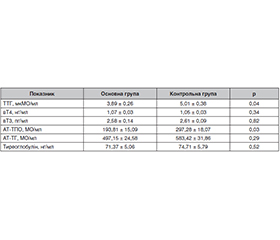
Актуальність. Автоімунний тиреоїдит (АІТ) залишається одним із найпоширеніших автоімунних захворювань щитоподібної залози та однією з основних причин розвитку первинного гіпотиреозу. Поряд із генетичною схильністю та впливом факторів довкілля дедалі більше уваги приділяється забезпеченості організму мікронутрієнтами, необхідними для нормального функціонування щитоподібної залози. Особливий інтерес становить селен — мікроелемент, який входить до складу низки селенопротеїнів, залучених до метаболізму тиреоїдних гормонів, антиоксидантного захисту та підтримання окисно-відновного балансу в тиреоцитах. Матеріали та методи. У проспективному відкритому рандомізованому дослідженні оцінювали вплив застосування 100 мкг селену на добу протягом 6 місяців у жінок з АІТ в еутиреоїдному стані та з субклінічним гіпотиреозом. Результати. На тлі застосування селену встановлено статистично значуще зниження рівня антитіл до тиреоїдної пероксидази, а серед пацієнток із субклінічним гіпотиреозом — також позитивну динаміку рівня тиреотропного гормону. Небажаних явищ протягом періоду спостереження не зареєстровано. Висновки. Отримані результати дозволяють розглядати забезпечення селеном як один із потенційних компонентів комплексного підходу до ведення окремих пацієнтів з АІТ. Водночас підкреслено необхідність персоніфікованого підходу та подальших контрольованих досліджень.
Background. Autoimmune thyroiditis (AIT) remains one of the most common autoimmune thyroid diseases and one of the leading causes of primary hypothyroidism. In addition to genetic predisposition and influence of environmental factors, increasing attention is being paid to the body’s supply with micronutrients essential for normal thyroid function. Of particular interest is selenium, an essential trace element that is a component of various selenoproteins involved in thyroid hormone metabolism, antioxidant defense, and the maintenance of redox balance within thyrocytes. Materials and methods. A prospective, open-label, randomized study evaluated the effect of 100 µg of selenium daily for 6 months in women with AIT who were either euthyroid or had subclinical hypothyroidism. Results. Selenium supplementation resulted in a statistically significant decrease in thyroid peroxidase antibody levels; among patients with subclinical hypothyroidism, a favorable trend of thyroid-stimulating hormone levels was also observed. No adverse events were recorded during the observation period. Conclusions. These findings suggest that selenium supplementation may be considered a potential component of a comprehensive management strategy for selected patients with AIT, while highlighting the need for an individualized approach and further controlled studies.
автоімунний тиреоїдит; щитоподібна залоза; селен; антитіла до тиреоїдної пероксидази; субклінічний гіпотиреоз; тиреотропний гормон
autoimmune thyroiditis; selenium; thyroid peroxidase antibodies; subclinical hypothyroidism; thyroid-stimulating hormone
Вступ
Матеріали та методи
Результати
/42_1.jpeg)
/42_2.jpeg)
Обговорення
Висновки
- Vargas-Uricoechea H, Castellanos-Pinedo A, Urrego-Nogue–ra K, et al. A Scoping Review on the Prevalence of Hashimoto's Thyroiditis and the Possible Associated Factors. Med Sci (Basel). 2025;13(2):43. doi: 10.3390/medsci13020043.
- Vargas-Uricoechea H, Castellanos-Pinedo A, Meza-Cabrera IA, et al. Iodine Intake from Universal Salt Iodization Programs and Hashimoto's Thyroiditis: A Systematic Review. Diseases. 2025;13(6):166. doi: 10.3390/diseases13060166.
- Klubo-Gwiezdzinska J, Wartofsky L. Hashimoto thyroiditis: an evidence-based guide to etiology, diagnosis and treatment. Pol Arch Intern Med. 2022;132(3):16222. doi: 10.20452/pamw.16222.
- Dillon CF, Weisman MH, Leung AM, et al. Autoimmune Thyroid Disease in the United States: Population Prevalence, Diagnosis Rates, and Trends. J Endocr Soc. 2025;9(10):bvaf120. doi: 10.1210/jendso/bvaf120.
- Teti C, Panciroli M, Nazzari E, et al. Iodoprophylaxis and thyroid autoimmunity: an update. Immunol Res. 2021;69(2):129-138. doi: 10.1007/s12026-021-09192-6.
- Tian X, Li N, Su R, Dai C, Zhang R. Selenium Supplementation May Decrease Thyroid Peroxidase Antibody Titer via Reducing Oxidative Stress in Euthyroid Patients with Autoimmune Thyroiditis. Int J Endocrinol. 2020;2020:9210572. doi: 10.1155/2020/9210572.
- Zhang H, Yang Y, Liu S, Yang Y, Liu Z. Clinical efficacy of selenium supplementation in patients with Hashimoto thyroi–ditis: A systematic review and meta-analysis. Medicine (Baltimore). 2025;104(35):e44043. doi: 10.1097/MD.0000000000044043.
- Wichman J, Winther KH, Bonnema SJ, Hegedüs L. Selenium Supplementation Significantly Reduces Thyroid Autoantibody Levels in Patients with Chronic Autoimmune Thyroiditis: A Systematic Review and Meta-Analysis. Thyroid. 2016;26(12):1681-1692. doi: 10.1089/thy.2016.0256.
- Wang LF, Sun RX, Li CF, Wang XH. The effects of sele–nium supplementation on antibody titres in patients with Hashimotoʼs thyroi–ditis. Endokrynol Pol. 2021;72(6):666-667. doi: 10.5603/EP.a2021.0074.
- van Zuuren EJ, Albusta AY, Fedorowicz Z, Carter B, Pijl H. Selenium Supplementation for Hashimoto's Thyroiditis: Summary of a Cochrane Systematic Review. Eur Thyroid J. 2014;3(1):25-31. doi: 10.1159/000356040.
- Erdal M, Sahin M, Hasimi A, Uckaya G, Kutlu M, Saglam K. Trace element levels in hashimoto thyroiditis patients with subclini–cal hypothyroidism. Biol Trace Elem Res. 2008;123(1-3):1-7. doi: 10.1007/s12011-008-8117-8.
- Mazokopakis EE, Papadakis JA, Papadomanolaki MG, et al. Effects of 12 months treatment with L-selenomethionine on serum anti-TPO levels in patients with Hashimotoʼs thyroiditis. Thyroid. 2007;17(7):609-612. doi: 10.1089/thy.2007.0040.
- Minnetti M, Sada V, Feola T, et al. Selenium Supplementation in Pregnant Women with Autoimmune Thyroiditis: A Practical Approach. Nutrients. 2022;14(11):2234. doi: 10.3390/nu14112234.
- Karimi F, Omrani GR. Effects of selenium and vitamin C on the serum level of antithyroid peroxidase antibody in patients with autoimmune thyroiditis. J Endocrinol Invest. 2019;42:481-487. doi: 10.1007/s40618-018-0944-7.
- Tian J, Guo F, Rao HH, et al. Autoimmune thyroiditis and comorbid autoimmune diseases: global research landscape and future directions. Front Immunol. 2026;17:1746955. doi: 10.3389/fimmu.2026.1746955.
- Kara E, Aycan Z. Serum selenium levels in children and ado–lescents with Hashimoto's thyroiditis: a cross-sectional case-control study. J Pediatr Endocrinol Metab. 2026;39(6):567-572. doi: 10.1515/jpem-2025-0677.
- Mantovani G, Isidori AM, Moretti C, et al. Selenium supplementation in the management of thyroid autoimmunity during pregnancy: results of the SERENA study, a randomized, double-blind, placebo-controlled trial. Endocrine. 2019;66(3):542-550. doi: 10.1007/s12020-019-01958-1.
- Cahoon EK, Grimm E, Mabuchi K, et al. Prevalence of Thyroid Nodules in Residents of Ukraine Exposed as Children or Adolescents to Iodine-131 from the Chornobyl Accident. Thyroid. 2024;34(7):890-898. doi: 10.1089/thy.2023.0654.
- Kryczyk-Kozioł J, Prochownik E, Dobrowolska-Iwa–nek J, et al. Iodine and Selenium Status in Relation to Thyroid and Immune Functions. Nutrients. 2025;17(12):1952. doi: 10.3390/nu17121952.
- Potorac A, Munteanu O, Baros A, Stoica EE, Cirstoiu MM. Autoimmune thyroiditis in pregnancy: epidemiology, clini–cal impact, and contemporary management challenges. J Med Life. 2026;19(6):426-432. doi: 10.25122/jml-2026-0019.
- Hu Y, Feng W, Chen H, et al. Effect of selenium on thyroid autoimmunity and regulatory T cells in patients with Hashimotoʼs thyroiditis: A prospective randomized-controlled trial. Clin Transl Sci. 2021;14(4):1390-1402. doi: 10.1111/cts.12993.