
Международный эндокринологический журнал Том 22, №7, 2026
Вернуться к номеру
Вплив пробіотиків на окремі механізми регуляції та функціональний стан щитоподібної залози у хворих на гіпотиреоз із порушенням функції кишечника
Авторы: V.H. Mishchuk, H.V. Kozinchuk, R.V. Kutsyk, O.Z. Vengrovych, U.P. Shalamai, T.I. Salyzhyn
Ivano-Frankivsk National Medical University, Ivano-Frankivsk, Ukraine
Рубрики: Эндокринология
Разделы: Клинические исследования
Версия для печати
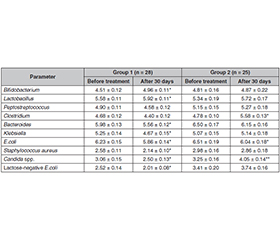
Актуальність. Порушення функції кишечника, пов’язані з гіпотиреозом, можуть зберігатися, незважаючи на терапію левотироксином. Вісь «кишечник — щитоподібна залоза», що включає зміни кишкової мікробіоти, вісцеральну гіперчутливість та нейрогуморальну регуляцію, відіграє важливу роль у формуванні гастроінтестинальних проявів. Мета: вивчити вплив 30-денного застосування пробіотиків на профіль тиреоїдних гормонів, функцію кишечника, мікробіоту, вісцеральну чутливість, рівні кортизолу й вазоактивного інтестинального пептиду (VIP) у пацієнтів із гіпотиреозом та запорами або діареєю. Матеріали та методи. Обстежено 81 хворого. Із 53 осіб із запорами 28 отримували Bifidobacterium longum 35624® і левотироксин, 25 — лише левотироксин. Із 28 осіб із діареєю 14 приймали Saccharomyces boulardii та левотироксин, а 14 — тільки левотироксин. Визначено рівні тиреотропного гормону (ТТГ), трийодтироніну (Т3), тироксину (Т4), VIP і кортизолу, а також індекс вісцеральної чутливості (VSI) та склад кишкової мікробіоти. Результати. У пацієнтів із запорами Bifidobacterium longum 35624® знижував ТТГ з 5,79 ± 0,16 мкМО/л до 4,84 ± 0,10 мкМО/л та підвищував Т3 з 1,57 ± 0,08 нмоль/л до 1,96 ± 0,06 нмоль/л (p < 0,05). Частота випорожнень зросла з 2,2 ± 0,2 до 3,9 ± 0,2 на тиждень, а 71,4 % хворих більше не потребували регулярного вживання проносних засобів. У товстій кишці вірогідно збільшилася кількість Bifidobacterium і Lactobacillus та зменшилася — Bacteroides, Klebsiella, S.aureus, Candida spp. та лактозонегативної E.coli. VSI знизився з 59,9 ± 1,6 бала до 54,1 ± 1,6 бала, рівень кортизолу — із 328,1 ± 5,9 нмоль/л до 287,3 ± 7,2 нмоль/л, VIP зріс із 46,28 ± 1,47 пг/мл до 53,32 ± 1,40 пг/мл (p < 0,05). У пацієнтів із діареєю комбінований пробіотик знижував ТТГ із 4,94 ± 0,18 мкМО/л до 4,46 ± 0,13 мкМО/л та підвищував Т4 з 1,38 ± 0,09 нг/дл до 1,73 ± 0,11 нг/дл (p < 0,05). Частота рідких випорожнень зменшилася з 3,6 ± 0,3 до 1,5 ± 0,2 на добу; здуття живота зникло в 92,9 % випадків, надмірне газоутворення — у 71,4 %. У тонкій кишці вірогідно зменшувалася кількість Bifidobacterium, Lactobacillus, Bacteroides та Enterococcus. VSI знизився з 62,9 ± 1,9 бала до 55,0 ± 1,7 бала, VIP — зі 151,3 ± 32,2 пг/мл до 87,6 ± 4,1 пг/мл, тоді як рівень кортизолу мав тенденцію до зниження без статистичної значущості. Висновки. Додавання пробіотиків до терапії левотироксином супроводжувалося позитивною динамікою тиреоїдного профілю й кишкових симптомів, змінами мікробіоти та зниженням вісцеральної гіперчутливості, а динаміка VIP залежала від типу кишкової дисфункції.
Background. Hypothyroidism-related bowel dysfunction may persist despite levothyroxine therapy. Gut-thyroid interactions involving alterations in the intestinal microbiota, visceral hypersensitivity, and neurohumoral regulation may contribute to these manifestations. This study evaluated the effects of 30-day probiotic supplementation on the thyroid hormone profile, bowel function, intestinal microbiota, visceral sensitivity, cortisol, and vasoactive intestinal peptide (VIP) levels in patients with hypothyroidism and constipation or diarrhea. Materials and methods. Eighty-one patients were studied. Of 53 patients with constipation, 28 received Bifidobacterium longum 35624® plus levothyroxine and 25 received levothyroxine alone. Of 28 patients with diarrhea, 14 received a probiotic formulation containing Saccharomyces boulardii plus levothyroxine and 14 received levothyroxine alone. Thyroid-stimulating hormone (TSH), triiodothyronine (T3), thyroxine (T4), VIP, cortisol, visceral sensitivity index (VSI), and intestinal microbiota were assessed. Results. In patients with constipation, B.longum 35624® reduced TSH from 5.79 ± 0.16 to 4.84 ± 0.10 μIU/mL and increased T3 from 1.57 ± 0.08 to 1.96 ± 0.06 nmol/L (p < 0.05). Bowel movement frequency increased from 2.2 ± 0.2 to 3.9 ± 0.2/week, and 71.4 % of patients no longer required regular laxatives. Colonic Bifidobacterium and Lactobacillus counts increased significantly, whereas Bacteroides, Klebsiella, S.aureus, Candida spp., and lactose-negative E.coli decreased. VSI decreased from 59.9 ± 1.6 to 54.1 ± 1.6, cortisol from 328.1 ± 5.9 to 287.3 ± 7.2 nmol/L, while VIP increased from 46.28 ± 1.47 to 53.32 ± 1.40 pg/mL (p < 0.05). In patients with diarrhea, the probiotic formulation reduced TSH from 4.94 ± 0.18 to 4.46 ± 0.13 μIU/mL and increased T4 from 1.38 ± 0.09 to 1.73 ± 0.11 ng/dL (p < 0.05). Loose stool frequency decreased from 3.6 ± 0.3 to 1.5 ± 0.2/day; bloating resolved in 92.9 % and excessive gas in 71.4 % of patients. Small-intestinal Bifidobacterium, Lactobacillus, Bacteroides, and Enterococcus counts decreased significantly. VSI decreased from 62.9 ± 1.9 to 55.0 ± 1.7 and VIP from 151.3 ± 32.2 to 87.6 ± 4.1 pg/mL, whereas cortisol showed a nonsignificant downward trend. Conclusions. Adding probiotics to levothyroxine therapy was associated with favorable changes in thyroid parameters and bowel symptoms, modulation of the intestinal microbiota, and reduced visceral hypersensitivity. VIP responses differed according to the predominant type of bowel dysfunction.
гіпотиреоз; кишкова мікробіота; запор; діарея; вазоактивний інтестинальний пептид; вісцеральна гіперчутливість, тиреоїдні гормони
hypothyroidism; gut microbiota; constipation; diarrhea; vasoactive intestinal peptide; visceral hypersensitivity; thyroid hormones
Для ознакомления с полным содержанием статьи необходимо оформить подписку на журнал.
- Zamwar UM, Muneshwar KN. Epidemiology, types, causes, clinical presentation, diagnosis, and treatment of hypothyroidism. Cureus. 2023;15(9). doi: 10.7759/cureus.46241.
- Kocełak P, Mossakowska M, Puzianowska-Kuźnicka M, et al. Prevalence and risk factors of untreated thyroid dysfunctions in the older Caucasian adults: results of PolSenior 2 survey. PLoS One. 2022;17(8). doi: 10.1371/journal.pone.0272045.
- Giorda CB, Carnà P, Romeo F, Costa G, Tartaglino B, Gnavi R. Prevalence, incidence and associated comorbidities of treated hypothyroidism: an update from a European population. Eur J Endocrinol. 2017;176(5):533-542. doi: 10.1530/EJE-16-0559.
- Mendes D, Alves C, Silverio N, Batel-Marques F. Preva–lence of undiagnosed hypothyroidism in Europe: a systematic review and meta-analysis. Eur Thyroid J. 2019;8(3):130-143. doi: 10.1159/000499751.
- Christian N, Rhodes MA, Adams CS, Bragg S. Thyroid and parathyroid conditions: hypothyroidism. FP Essent. 2022;514:18-23.
- Bereda G. Definition, causes, pathophysiology, and management of hypothyroidism. Mathews J Pharm Sci. 2023;7(1):14. doi: 10.30654/MJPS.10014.
- Xu GM, Hu MX, Li SY, Ran X, Zhang H, Ding XF. Thyroid disorders and gastrointestinal dysmotility: an old association. Front Physiol. 2024;15:1389113. doi: 10.3389/fphys.2024.1389113.
- Li C, Wu R, Xie D. Association between indices of thyroid hormone resistance and constipation prevalence in the US population: NHANES 2007-2010. J Clin Gastroenterol. 2025;59(9):889-900. doi: 10.1097/MCG.0000000000002107.
- Desai J, Elnaggar M, Hanfy AA, Doshi R. Toxic megacolon: background, pathophysiology, management challenges and solutions. Clin Exp Gastroenterol. 2020;13:203-210. doi: 10.2147/CEG.S200760.
- Kubiszewski K, Chapman RW, Piazza Y, Patel D, Neychev V. Hypothyroidism presenting as adynamic ileus mimicking a mechanical small bowel obstruction: a diagnostic and management dilemma. Cureus. 2023;15(12). doi: 10.7759/cureus.50799.
- Goto S, Billmire DF, Grosfeld JL. Hypothyroidism impairs colonic motility and function: an experimental study in the rat. Eur J Pediatr Surg. 1992;2(1):16-21. doi: 10.1055/s-2008-1063392.
- Zeng W, Wang Y, Zhang L. Associations of thyroid hormones with chronic diarrhea and constipation in euthyroid individuals. Front Endocrinol (Lausanne). 2024;15:1395743. doi: 10.3389/fendo.2024.1395743.
- Su X, Zhao Y, Li Y, Ma S, Wang Z. Gut dysbiosis is associated with primary hypothyroidism with interaction on gut-thyroid axis. Clin Sci (Lond). 2020;134(12):1521-1535. doi: 10.1042/CS20200475.
- Bargiel P, Szczuko M, Stachowska L, Prowans P, Czapla N, Markowska M, et al. Microbiome metabolites and thyroid dysfunction. J Clin Med. 2021;10(16):3609. doi: 10.3390/jcm10163609.
- Bronikowski K, Nagrodzka A, Starczewski Ł. The gut-thyroid axis: emerging insights into the role of intestinal microbiota in thyroid physiology and disease. J Educ Health Sport. 2026;89:69812. doi: 10.12775/JEHS.2026.89.69801.
- Parveen N, Chittawar S, Khandelwal D. Gut-thyroid axis and emerging role of probiotics in thyroid disorders. Thyroid Res Pract. 2025;21(1):4-12. doi: 10.4103/trp.trp_12_24.
- Tavassol ZH, Farsi F, Ettehad-Marvasti F, Ejtahed HS, Hasani-Ranjbar S. Gut microbiota alterations in hypothyroidism: a pilot study revealing increased abundance of specific bacterial genera. J Nutr Metab. 2026;2026:9988966. doi: 10.1155/jnme/9988966.
- Zawadzka K, Kałuzińska K, Świerz MJ, Sawiec Z, Antonowicz E, Leończyk-Spórna M, et al. Are probiotics, prebiotics, and synbiotics beneficial in primary thyroid diseases? A systematic review with meta-analysis. Ann Agric Environ Med. 2023;30(2):217-223. doi: 10.26444/aaem/162732.
- Shu Q, Kang C, Li J, Hou Z, Xiong M, Wang X, et al. Effect of probiotics or prebiotics on thyroid function: a meta-analysis of eight randomized controlled trials. PLoS One. 2024;19(1). doi: 10.1371/journal.pone.0296733.
- Jiang T, Yang X, Wu B, Tao R, Chen R, Jin L, et al. Gut microbiota in hypothyroidism: pathogenic mechanisms and opportunities for precision microbiome interventions. Front Microbiol. 2025;16:1661211. doi: 10.3389/fmicb.2025.1661211.
- Labus JS, Bolus R, Chang L, Wiklund I, Naesdal J, Ma–yer EA, et al. The Visceral Sensitivity Index: development and validation of a gastrointestinal symptom-specific anxiety scale. Aliment Pharmacol Ther. 2004;20(1):89-97. doi: 10.1111/j.1365-2036.2004.02007.x.
- Karimi M, Rabiei R, Kazemi K, Bagheri Motlagh R, Asbaghi O. Effects of probiotics and synbiotics oral supplementation on thyroid function in adults: a grade-assessed systematic review and meta-analysis. Thyroid Res. 2025;18:39. doi: 10.1186/s13044-025-00257-4.
- Ludgate ME, Masetti G, Soares P. The relationship between the gut microbiota and thyroid disorders. Nat Rev Endocrinol. 2024;20(9):511-525. doi: 10.1038/s41574-024-01003-w.
- Lucarini E, Di Pilato V, Parisio C, Micheli L, Toti A, Pacini A, et al. Visceral sensitivity modulation by faecal microbiota transplantation: the active role of gut bacteria in pain persistence. Pain. 2022;163(5):861-877. doi: 10.1097/j.pain.0000000000002438.
- Pujo J, De Palma G, Lu J, Galipeau HJ, Surette MG, Collins SM, et al. Gut microbiota modulates visceral sensitivity through calcitonin gene-related peptide (CGRP) production. Gut Microbes. 2023;15(1):2188874. doi: 10.1080/19490976.2023.2188874.
- Deng N, Xie S, Liu Q, Peng H, Fang L, Shen J, et al. The intestinal microbiota modulates the visceral sensitivity involved in IBS induced by restraint combined with tail clustering. Front Cell Infect Microbiol. 2025;15:1549617. doi: 10.3389/fcimb.2025.1549617.
- Walter KN, Corwin EJ, Ulbrecht J, Demers LM, Bennett JM, Whetzel CA, et al. Elevated thyroid stimulating hormone is associated with elevated cortisol in healthy young men and women. Thyroid Res. 2012;5(1):13. doi: 10.1186/1756-6614-5-13.
- Bains M, Laney C, Wolfe AE, Orr M, Waschek JA, Ericsson AC, et al. Vasoactive intestinal peptide deficiency is associated with altered gut microbiota communities in male and female C57BL/6 mice. Front Microbiol. 2019;10:2689. doi: 10.3389/fmicb.2019.02689.