
Международный эндокринологический журнал Том 22, №7, 2026
Вернуться к номеру
Двоцентрове когортне дослідження дистальних доброякісних обструкцій жовчовивідних шляхів, ускладнених холелітіазом, у пацієнтів із серцево-судинно-нирково-метаболічним синдромом
Авторы: O.V. Ivanko (1, 2), M.M. Stets (1), V.V. Petrynych (3), O.O. Zhukovskyi (3), O.B. Rusak (3), R.I. Sydorchuk (3)
(1) - Kyiv City Clinical Hospital 1, Kyiv, Ukraine
(2) - Bogomolets National Medical University, Kyiv, Ukraine
(3) - Bukovinian State Medical University, Chernivtsi, Ukraine
Рубрики: Эндокринология
Разделы: Клинические исследования
Версия для печати
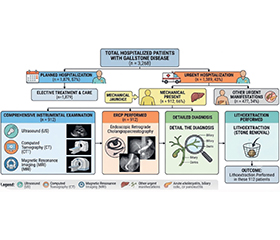
Актуальність. Ожиріння, цукровий діабет 2-го типу та дисліпідемія як ключові ознаки серцево-судинно-нирково-метаболічного (CСНM) синдрому змінюють метаболізм холестерину в печінці, підвищуючи насичення жовчі холестерином і спричиняючи утворення жовчних конкрементів, що призводить до обструкцій жовчовивідної системи. Мета: аналіз можливих методологій запобігання пошкодженню біліарного дерева при доброякісній обструкції для поліпшення якості життя в післяопераційному періоді в осіб із CСНM-синдромом. Матеріали та методи. Двоцентрове дослідження охоплює 3268 пацієнтів із CСНM-синдромом та холелітіазом, з яких 912 (28 %) мали ускладнений перебіг холелітіазу. CСНM-синдром діагностували з використанням мультидисциплінарного комплексу клінічно-лабораторних показників. Холедохолітіаз верифікували за допомогою ультразвукового дослідження, магнітно-резонансної холангіопанкреатографії або інтраопераційної холангіографії. Дослідження проведено відповідно до принципів GCP та Європейської конвенції з прав людини і біомедицини. Результати. Середній відносний вміст жирової маси в когорті був високим (30,41 ± 1,09 %), основними коморбідностями були ішемічна хвороба серця, артеріальна гіпертензія, цукровий діабет 2-го типу та периферична ангіопатія, що вказує на метаболічні й судинні зв’язки з утворенням жовчних конкрементів. Холедохолітіаз виявлено у 64,9 % пацієнтів. Ускладнення після транспапілярних втручань включали гострий панкреатит (12,8 %), кровотечу (1,4 %) та перфорацію (0,6 %). Відстрочене лапароскопічне хірургічне втручання виконано у 64,9 % випадків; частота конверсії становила 8,4 % внаслідок деструктивних змін. Метаболічні маркери суттєво варіювали, особливо фракції білірубіну. Висновки. Ожиріння й метаболічний синдром є важливими передумовами та значущими коморбідностями в осіб із холелітіазом, що призводять до механічної жовтяниці, яка становить більшість випадків. Невідкладне хірургічне лікування залишається стандартним підходом — поєднання літотрипсії з холедохоскопією дозволяє запобігти пошкодженню гепатобіліарної системи і скоротити перебування в стаціонарі при доброякісній обструкції жовчовивідних шляхів. Адекватна та своєчасна діагностика CСНM-синдрому й інших метаболічних станів може суттєво знизити ризик несприятливих результатів лікування і поліпшити подальше спостереження за пацієнтами.
Background. Obesity, type 2 diabetes mellitus, and dyslipidemia as the hallmarks of cardiovascular-kidney-metabolic (CKM) syndrome alter hepatic cholesterol metabolism increasing cholesterol saturation in the bile and causing gallstone formation leading to biliary system obstructions. The purpose of the study is to analyse possible methodologies to prevent damage to the biliary tree in benign obstruction to improve the quality of life in the postoperative period in patients with CKM syndrome. Materials and methods. The two-centre study involved 3268 patients with CKM syndrome and cholelithiasis, including complicated cholelithiasis (912 patients, or 28 %). CKM syndrome was diagnosed via a multidisciplinary battery of baseline metrics. Choledocholithiasis was diagnosed using ultrasound, magnetic resonance cholangiopancreatography or intraoperative cholangiography. The study was conducted in accordance with the principles of the Good Clinical Practice, the Council of Europe Convention on Human Rights and Biomedicine. Results. Mean relative fat mass in the cohort was high (30.41 ± 1.09 %), with common comorbidities including ischemic heart disease, hypertension, type 2 diabetes, and peripheral vascular disease, indicating metabolic and vascular links to gallstone formation. Choledocholithiasis was detected in 64.9 % of patients. Post-transpapillary intervention complications included acute pancreatitis (12.8 %), bleeding (1.4 %), and perforation (0.6 %). Delayed laparoscopic surgery was performed in 64.9 %, with an 8.4 % conversion rate due to destructive changes. Metabolic markers varied significantly, especially bilirubin fractions. Conclusions. Obesity and metabolic syndrome are the important predisposing factor and valuable comorbidity in patients with cholelithiasis leading to mechanical jaundice, which accounts for majority of cases. Surgical treatment in an urgent manner remains constant — the combination of lithotripsy accompanied by choledochoscopy makes it possible to prevent damage to the hepatobiliary system and reduce length of stay with benign obstruction of the biliary tract. Proper and timely diagnosis of CKM syndrome and other metabolic conditions may significantly alleviate risk of unsuccessful treatment results and improve patients’ follow-up.
серцево-судинно-нирково-метаболічний синдром; ожиріння; фактори ризику; дистальні жовчовивідні шляхи; обструкція; холелітіаз; транспапілярні втручання; літотрипсія; біліарна хірургія
cardiovascular-kidney-metabolic syndrome; obesity; risk factors; distal biliary system; obstruction; cholelithiasis; transpapillary interventions; lithotripsy; biliary surgery
Для ознакомления с полным содержанием статьи необходимо оформить подписку на журнал.
- Ndumele CE, Rodriguez F, et al. 2026 AHA/ACC/ADA/ASN Guideline for the Prevention, Detection, Evaluation, and Management of Cardiovascular-Kidney-Metabolic Syndrome: A Report of the American College of Cardiology/American Heart Association Joint Committee on Clinical Practice Guidelines. Circulation. 2026. doi: 10.1161/CIR.0000000000001453.
- Koval SM, Yushko KO, Snihurska IO, Starchenko TG, Pankiv VI, Lytvynova OM, Mysnychenko OV. Relations of angiotensin-(1-7) with hemodynamic and cardiac structural and functional parameters in patients with hypertension and type 2 diabetes. Arterial Hypertension. 2019;23(3):183-189. doi: 10.5603/AH.a2019.0012.
- Semianiv M, Sydorchuk L, Fedonyuk L, Nebesna Z, Kamyshnyi O, Sydorchuk A, et al. Metabolic and hormonal prognostic markers of essential arterial hypertension considering the genes polymorphism AGTR1 (rs5186) and VDR (rs2228570). Rom J Diabetes Nutr Metab Dis. 2021;28(3):284-91. Available from: https://www.rjdnmd.org/index.php/RJDNMD/article/view/1049.
- Vyklyuk Y, Semianiv I, Nevinskyi D, Todoriko L, Boyko N. Applying geospatial multi-agent system to model various aspects of tuberculosis transmission. New Microbes New Infect. 2024;59:101417. doi: 10.1016/j.nmni.2024.101417.
- Didushko OM, Herych PR, Cherniavska IV, Yatsyshyn RI, Pankiv VI. Influence of the complex treatment of hypothyroidism on the leptin level in patients with primary hypothyroidism. World of Medicine and Biology. 2018;3(65):59-63. doi: 10.26724/2079-8334-2018-3-65-59-63.
- Lesnic E, Todoriko L, Semianiv I, Ghinda S. The Role of Cell Mediated Immunity Deficiency in the Clinical Evolution of Patients with Tuberculosis Associated with HIV Infection. Tuberc Lung Dis HIV Infect (Ukr). 2023;4:16-23. doi: 10.30978/TB-2023-4-16.
- Knoph CS, Lucocq J, Kamarajah SK, Olesen SS, Jones M, Samanta J, et al. Global trends in opioid use for pain management in acute pancreatitis: a multicentre prospective observational study. United European Gastroenterol J. 2024;12(8):1114-27. doi: 10.1002/ueg2.12641.
- De Simone B, Abu-Zidan FM, Chouillard E, et al. The ChoCO-W prospective observational global study: Does COVID-19 increase gangrenous cholecystitis? World J Emerg Surg. 2022;17:61. doi: 10.1186/s13017-022-00466-4.
- Cobianchi L, Dal Mas F, Agnoletti V, et al. Time for a paradigm shift in shared decision-making in trauma and emergency surgery? Results from an international survey. World J Emerg Surg. 2023;18:14. doi: 10.1186/s13017-022-00464-6.
- Vedamurthy A, Krishnamoorthi R, Irani S, Kozarek R. Endoscopic Management of Benign Pancreaticobiliary Disorders. J Clin Med. 2025;14(2):494. doi: 10.3390/jcm14020494.
- De Simone B, Ansaloni L, Sartelli M, Kluger Y, Abu-Zidan FM, Biffl WL, et al. The Operative management in Bariatric Acute abdomen (OBA) Survey: long-term complications of bariatric surgery and the emergency surgeon’s point of view. World J Emerg Surg. 2020;15:2. doi: 10.1186/s13017-019-0281-y.
- Sydorchuk A, Sydorchuk L, Gutnitska A, Vasyuk V, Tkachuk O, Dzhuryak V, et al. The role of NOS3 (rs2070744) and GNB3 (rs5443) genes’ polymorphisms in endothelial dysfunction pathway and carotid intima-media thickness in hypertensive patients. Gen Physiol Biophys. 2023;42:179-90. doi: 10.4149/gpb_2022060.
- Parra-Landazury NM, Cordova-Gallardo J, Méndez-Sánchez N. Obesity and Gallstones. Visc Med. 2021;37(5):394-402. doi: 10.1159/000515545.
- De Simone B, Abu-Zidan FM, Saeidi S, et al. Knowledge, attitudes and practices of using Indocyanine Green (ICG) fluorescence in emergency surgery: an international web-based survey in the ARtificial Intelligence in Emergency and trauma Surgery (ARIES) — WSES pro–ject. Updates Surg. 2024;76:1969-81. doi: 10.1007/s13304-024-01853-z.
- Cobianchi L, Dal Mas F, Massaro M, et al. Diversity and ethics in trauma and acute care surgery teams: results from an international survey. World J Emerg Surg. 2022;17:44. doi: 10.1186/s13017-022-00446-8.
- Stryzhak OV, Sydorchuk RI. Gastric pathomorphology features in morbid obesity in the context of sleeve-gastrectomy. Khark Surg Sch. 2026;2:20-26. doi: 10.37699/2308-7005.2.2026.04.
- Ashat M, Berei J, El-Abiad R, Khashab MA. Benign Bi–liary Strictures: A Comprehensive Review. Turk J Gastroenterol. 2024;35(7):513-22. doi: 10.5152/tjg.2024.24044.
- Sydorchuk AR, Sydorchuk LP, Gutnitska AF, Dzhuryak VS, Kryvetska II, Sydorchuk RI, et al. Endothelium function biomar–kers and carotid intima-media thickness changes in relation to NOS3 (rs2070744) and GNB3 (rs5443) genes polymorphism in the essential arterial hypertension. Endocr Regul. 2022;56(2):104-14. doi: 10.2478/enr-2022-0012.
- De Simone B, Abu-Zidan FM, Kasongo L. et al. COVID-19 infection is a significant risk factor for death in patients presenting with acute cholecystitis: a secondary analysis of the ChoCO-W cohort study. World J Emerg Surg. 2025;20(16). doi: 10.1186/s13017-025-00591-w.
- Sydorchuk L, Lytvyn B, Sydorchuk A, et al. Alpha-adducin 1 (rs4961) gene and its expression associated with sodium sensitivity in hypertensive patients: a cohort study in the western Ukrainian population. Endocr Regul. 2024;58(1):195-205. doi: 10.2478/enr-2024-0023.
- Tartaglia D, Cremonini C, Annunziata E, et al. Acute diverti–culitis in immunocompromised patients: evidence from an international multicenter observational registry (Web-based International Register of Emergency Surgery and Trauma, Wires-T). Tech Coloproctol. 2023. doi: 10.1007/s10151-023-02758-6.
- Zhang HF, Tao JL, Liang CC, et al. Risk stratification for gallstones based on 14 obesity and lipid-related indices: a longitudinal cohort study of 44,030 Chinese adults. Lipids Health Dis. 2026;25(1):103. doi: 10.1186/s12944-026-02915-4.
- Sartelli M, Mossialos E, Coccolini F. et al. Global health at crossroads: uniting together to overcome challenges, restore trust and advance priorities for a sustainable future. World J Emerg Surg. 2025;20(84). doi: 10.1186/s13017-025-00656-w.
- Shamim Seth U, Iqbal F, Akhtar MB, Naveed M, Akhtar R, Uddin M, Shaheen A. A Cross-Sectional Analysis of Body Mass Index with Cholesterol Gallstones in Patients with Cholelithiasis in Tertiary Healthcare Settings. Cureus. 2025 Nov 6;17(11):e96214. doi: 10.7759/cureus.96214.
- Desouky M, Altawil L, Al Hayek M, Elhadi M. The efficacy and safety of magnetic compression anastomosis in the management of biliary obstruction: a systematic review and meta-analysis. Surg Endosc. 2026;40(3):1866-75. doi: 10.1007/s00464-026-12584-0.
- De Simone B, Agnoletti V, Abu-Zidan FM, et al. The Opera–ting Room management for emergency Surgical Activity (ORSA) study: a WSES international survey. Updates Surg. 2024;76(2):687-698. doi: 10.1007/s13304-023-01668-4.
- Qatomah A. Endoscopic balloon dissection to remove a percutaneously placed biliary stent with tissue ingrowth: a novel approach. IGIE. 2025;4(3):249-51. doi: 10.1016/j.igie.2025.03.003.