
Международный эндокринологический журнал Том 22, №7, 2026
Вернуться к номеру
Комплексна корекція метаболічних порушень у хворих на мієлодиспластичний синдром
Авторы: Стародуб Г.С., Горяінова Н.В.
ДУ «Національний науковий центр радіаційної медицини, гематології та онкології НАМН України», м. Київ, Україна
Рубрики: Эндокринология
Разделы: Клинические исследования
Версия для печати
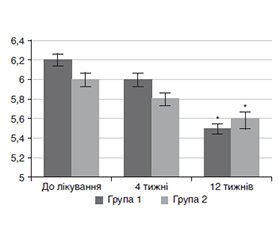
Актуальність. Коморбідні стани у хворих на гемобластози, зокрема метаболічний синдром (МС), заслуговують на відповідну увагу клініцистів, адже метаболічні порушення — це підтверджена передумова хронічного запалення, яке значуще впливає на клінічний перебіг мієлодиспластичного синдрому (МДС) та гострого мієлоїдного лейкозу (ГМЛ). Мета: вивчити ефективність комплексної корекції метаболічних порушень у хворих на МДС. Матеріали та методи. Для вивчення ефективності комплексної корекції показників вуглеводного та ліпідного обміну пацієнтів розділили на дві групи. У групу 1 (n = 33) були включені хворі, в яких раніше був діагностований МС та переддіабет і у яких рекомендації щодо зміни способу життя не дали очікуваного результату; таким пацієнтам був призначений розувастатин в дозі 5 мг 1 раз на добу під час їжі та метформін 500 мг 1 раз на добу. У групу 2 (n = 33) увійшли пацієнти, яким вперше була призначена відповідна до рекомендацій дієта та фізична активність без фармакотерапевтичного втручання. Результати. Дослідження показало, що адекватно спланований менеджмент МС на певному етапі є ефективним і має прогнозовані результати, які свідчать про тенденцію до нормалізації показників ліпідного та вуглеводного обміну у пацієнтів: ліпопротеїнів високої та низької щільності, тригліцеридів, загального холестерину, глюкози та глікованого гемоглобіну. Це важливо насамперед через те, що МС є доведеною передумовою хронічного системного запального стану, який є по суті основним фактором впливу на клінічний перебіг МДС. У динаміці спостереження у групі 1 ми також відмітили чітку тенденцію зниження активності прозапального цитокіну IL-6: якщо до початку лікування середній показник фіксувався на рівні 13,3 ± 1,8 пг/мл, то вже через місяць на рівні 10,9 ± 1,6 пг/мл, а через 3 місяці — 5,9 ± 0,9 пг/мл. У групі 2 спостерігався аналогічний сценарій — рівень IL-6 поступово знизився від 16,0 ± 0,8 пг/мл перед початком терапевтичного втручання до 11,1 ± 1,2 пг/мл у фінальній контрольній точці. Зниження маркера системного запалення наприкінці клінічного спостереження було більш значущим у групі 1, в якій пацієнти приймали метформін та розувастатин (порівняно з даними групи 2, p < 0,05). Висновки. Корекція метаболічних порушень як із застосуванням фармакотерапії, так і внаслідок корекції способу життя у хворих на МДС є ефективною, про що свідчать отримані результати біохімічних досліджень. Оцінка рівнів IL-6 у групі 1 показала, що запропонований терапевтичний сценарій за участю метформіну та розувастатину продемонстрував кращу ефективність у впливі на системний запальний процес.
Background. Comorbid conditions, particularly metabolic syndrome (MS), in patients with hemoblastoses deserve due attention from clinicians, because metabolic disorders are a confirmed prerequisite for chronic inflammation, which significantly affects the clinical course of myelodysplastic syndrome (MDS) and acute myeloid leukemia. The purpose of the study was to investigate the effectiveness of comprehensive correction of metabolic disorders in patients with MDS. Materials and methods. To study the effectiveness of comprehensive correction of carbohydrate and lipid metabolism indicators, participants were divided into 2 groups. Group 1 (n = 33) included patients who had previously been diagnosed with MS and prediabetes and in whom recommendations for lifestyle changes did not give the expected result; such patients were prescribed rosuvastatin at a dose of 5 mg once a day with food and metformin 500 mg once a day. Group 2 (n = 33) included patients who were first prescribed a diet in accordance with recommendations and physical activity without pharmacotherapeutic intervention. Results. The study showed that adequately planned management of MS at a certain stage is effective and has predictable results, indicating a tendency to normalize lipid and carbohydrate metabolism: low- and high-density lipoproteins, triglycerides, total cholesterol, glucose and glycated hemoglobin. This is important primarily because MS is a proven prerequisite for a chronic systemic inflammatory state, which is essentially the main factor influencing the clinical course of MDS. In the dynamics of observation, we also noted a clear trend of decreasing activity of the pro-inflammatory cytokine interleukin-6 in group 1: if before the start of treatment the average indicator was 13.3 ± 1.8 pg/ml, then after a month, it became 10.9 ± 1.6 pg/ml, and after 3 months — 5.9 ± 0.9 pg/ml. In group 2, a similar scenario was observed: the level of interleukin-6 gradually decreased from 16.0 ± 0.8 pg/ml before the start of therapeutic intervention to 11.1 ± 1.2 pg/ml at the final control point. A decrease in the marker of systemic inflammation at the end of clinical observation was more significant in group 1 in which patients received metformin and rosuvastatin (compared to the data of group 2, p < 0.05). Conclusions. Correction of metabolic disorders, both with the use of pharmacotherapy and as a result of lifestyle modification in patients with MDS, is effective, as evidenced by the results of biochemical studies. Assessment of interleukin-6 levels in group 1 showed that the proposed therapeutic scenario with the use of metformin and rosuvastatin demonstrated better effectiveness in influencing the systemic inflammatory process.
мієлодиспластичний синдром; дисліпідемія; метаболічний синдром; системне запалення; інтерлейкін-6
myelodysplastic syndrome; dyslipidemia; metabolic syndrome; systemic inflammation; interleukin-6
Для ознакомления с полным содержанием статьи необходимо оформить подписку на журнал.
- Kalwick M, Roth M. A Comprehensive Review of the Genetics of Dyslipidemias and Risk of Atherosclerotic Cardiovascular Disease. Nutrients. 2025 Feb 12;17(4):659. doi: 10.3390/nu17040659. PMID: 40004987; PMCID: PMC11858766.
- Anderson TS, Wilson LM, Sussman JB. Implications of the 2026 Dyslipidemia Guideline for Primary Prevention Statin Therapy. JAMA. 2026 Jul 20:e2611246. doi: 10.1001/jama.2026.11246. Epub ahead of print. PMID: 42475062; PMCID: PMC13386295.
- Wiggins BS, Barac A, Benziger CP, Blumenthal RS, Cibotti-Sun M, Moore MM, Morris PB. 2026 Dyslipidemia Guideline-at-a-Glance. J Am Coll Cardiol. 2026 May 19;87(19):2617-2623. doi: 10.1016/j.jacc.2026.02.4872. Epub 2026 Mar 18. PMID: 41848468.
- Witte J, Batram M, Lutz M, Philipp AA, Greiner W, Weingärtner O. Prevalence, incidence, and treatment of dyslipidemia in patients with high or very high cardiovascular risk in Germany. J Clin Lipidol. 2025 May-Jun;19(3):563-571. doi: 10.1016/j.jacl.2024.10.007. Epub 2024 Oct 19. PMID: 40287347.
- Soppert J, Lehrke M, Marx N, Jankowski J, Noels H. Lipoproteins and lipids in cardiovascular disease: from mechanistic insights to therapeutic targeting. Adv Drug Deliv Rev. 2020;159:4-33. doi: 10.1016/j.addr.2020.07.019. Epub 2020 Jul 27. PMID: 32730849.
- Ouimet M, Barrett TJ, Fisher EA. HDL and Reverse Cholesterol Transport. Circ Res. 2019 May 10;124(10):1505-1518. doi: 10.1161/CIRCRESAHA.119.312617. PMID: 31071007; PMCID: PMC6813799.
- Wang Z, Barinas-Mitchell E, Brooks MM, Crawford SL, Leis AM, Derby CA, et al. HDL-C criterion of the metabolic syndrome and future diabetes and atherosclerosis in midlife women: The SWAN Study. Am J Prev Cardiol. 2024 Jun 19;19:100687. doi: 10.1016/j.ajpc.2024.100687. PMID: 39070021; PMCID: PMC11279330.
- Xu L, Yang Q, Zhou J. Mechanisms of Abnormal Lipid Meta–bolism in the Pathogenesis of Disease. International Journal of Molecular Sciences. 2024;25(15):8465. https://doi.org/10.3390/ijms25158465.
- Timmis A, Townsend N, Gale CP, et al.; European Society of Cardiology. European Society of Cardiology: Cardiovascular Disease Statistics 2019. Eur Heart J. 2020 Jan 1;41(1):12-85. doi: 10.1093/eurheartj/ehz859.
- Emerging Risk Factors Collaboration; Sarwar N, Gao P, Seshasai SR, et al. Diabetes mellitus, fasting blood glucose concentration, and risk of vascular disease: a collaborative meta-analysis of 102 prospective studies. Lancet. 2010 Jun 26;375(9733):2215-22. doi: 10.1016/S0140-6736(10)60484-9.
- Olesen KKW, Madsen M, Gyldenkerne C, et al. Ten-year cardiovascular risk in diabetes patients without obstructive coronary artery disease: a retrospective Western Denmark cohort study. Cardiovasc Diabetol. 2021 Jan 21;20(1):23. doi: 10.1186/s12933-021-01212-x.
- Einarson TR, Acs A, Ludwig C, Panton UH. Prevalence of cardiovascular disease in type 2 diabetes: a systematic literature review of scientific evidence from across the world in 2007-2017. Cardiovasc Diabetol. 2018 Jun 8;17(1):83. doi: 10.1186/s12933-018-0728-6.
- Khan MAB, Hashim MJ, King JK, Govender RD, Mustafa H, Al Kaabi J. Epidemiology of Type 2 Diabetes — Global Burden of Disease and Forecasted Trends. J Epidemiol Glob Health. 2020 Mar;10(1):107-111. doi: 10.2991/jegh.k.191028.001.
- Pragati G, Paolo P. Divergence in prediabetes guidelines — A global perspective. Diabetes Res Clin Pract. 2025 May;223:112142. doi: 10.1016/j.diabres.2025.112142.
- Cosentino F, Grant PJ, et al. ESC Scientific Document Group. 2019 ESC Guidelines on diabetes, pre-diabetes, and cardiovascular diseases developed in collaboration with the EASD. Eur Heart J. 2020 Jan 7;41(2):255-323. doi: 10.1093/eurheartj/ehz486. Erratum in: Eur Heart J. 2020 Dec 1;41(45):4317. doi: 10.1093/eurheartj/ehz828.
- Magni P, Baragetti A, Poli A. Special Issue: Nutraceutical Approaches to Cardiovascular and Metabolic Diseases: Evidence and Opportunities. Nutrients. 2022 Dec 19;14(24):5399. doi: 10.3390/nu14245399. PMID: 36558557; PMCID: PMC9785404.
- Bensken WP, Pieracci FM, Ho VP. Basic Introduction to Statistics in Medicine, Part 1: Describing Data. Surg Infect (Larchmt). 2021 Aug;22(6):590-596. doi: 10.1089/sur.2020.429. PMID: 34270357; PMCID: PMC8851219.
- Salcines Rueda L, Supervía M, Sainz de Murieta E, Laxe S, Morata AB, Arroyo-Riaño O, et al.; en representación del Grupo de Trabajo de Obesidad y Sarcopenia de SERMEF. Rehabilitation in patients with obesity: Approach and role of the rehabilitation physician in mana–gement. Data from the survey by the Obesity and Sarcopenia Working Group of the Spanish Society of Rehabilitation and Physical Medicine. Rehabilitacion (Madr). 2025 Jan-Mar;59(1):100891. Spanish. doi: 10.1016/j.rh.2025.100891. Epub 2025 Feb 11. PMID: 39938418.
- Loaiza-Betancur AF, Iglesias Gonzalez LE, Chavez Guapo N, Escobar Liquitay CM, Bidonde J. Physical activity for the management of obesity in children up to the age of 9 years. Cochrane Database Syst Rev. 2026 Jul 13;7(7):CD015988. doi: 10.1002/14651858.CD015988. PMID: 42440326; PMCID: PMC13361591.
- Islam ANMS, Sultana H, Nazmul Hassan Refat M, Farhana Z, Abdulbasah Kamil A, Meshbahur Rahman M. The global burden of overweight-obesity and its association with economic status, benefi–ting from STEPs survey of WHO member states: A meta-analysis. Prev Med Rep. 2024 Sep 5;46:102882. doi: 10.1016/j.pmedr.2024.102882. PMID: 39290257; PMCID: PMC11406007.
- Pankiv V, Yuzvenko T, Kobyliak N, Pankiv I. Correction of Androgen Deficiency in Men with Type 2 Diabetes. Rev Recent Clin Trials. 2022;17(1):34-39. doi: 10.2174/1574887116666211202155304. PMID: 34856912.
- von Philipsborn P, Bahlke M, Breidenassel C, Holzapfel C, Joisten C, Plachta-Danielzik S, et al. Prevention of Obesity among Adults: Evidence- and Consensus-Based Guideline. Obes Facts. 2025;18(6):656-674. doi: 10.1159/000546415. Epub 2025 May 22. PMID: 40403714; PMCID: PMC12215444.
- Messina J, Campell S, Morris R, Eyles E, Sanders C. A narrative systematic review of factors affecting diabetes prevention in primary care settings. PLoS One. 2017;12(5). doi: 10.1371/journal.pone.0177699.e0177699.
- Tseng E, Durkin N, Clark JM, Maruthur NM, Marsteller JA, Segal JB. Clinical Care Among Individuals with Prediabetes in Primary Care: a Retrospective Cohort Study. J Gen Intern Med. 2022 Dec;37(16):4112-4119. doi: 10.1007/s11606-022-07412-9. Epub 2022 Mar 2. PMID: 35237886; PMCID: PMC8890680.
- Bray GA, Ryan DH. Evidence-based weight loss interventions: Individualized treatment options to maximize patient outcomes. Diabetes Obes Metab. 2021 Feb;23 Suppl 1:50-62. doi: 10.1111/dom.14200. Epub 2020 Nov 24. PMID: 32969147.
- Mansour MF, Husseini RA, Abdo SA, Khamis T, Mohammed HA, Alsemeh AE, et al. Mechanistic insights into the lipotropic and atheroprotective effects of rosuvastatin-loaded glycerosomes in dyslipidemic rats. Sci Rep. 2026 Jan 29;16(1):4390. doi: 10.1038/s41598-025-34918-z. PMID: 41611768; PMCID: PMC12865011.
- Misra S, Deb T, Devi S, Singh A, Goel R. Metformin modulates antioxidant and anti-inflammatory biomarkers in newly diagnosed patients with type 2 diabetes mellitus: an observational study. J Basic Clin Physiol Pharmacol. 2026 Jan 22;37(3):213-222. doi: 10.1515/jbcpp-2025-0201.